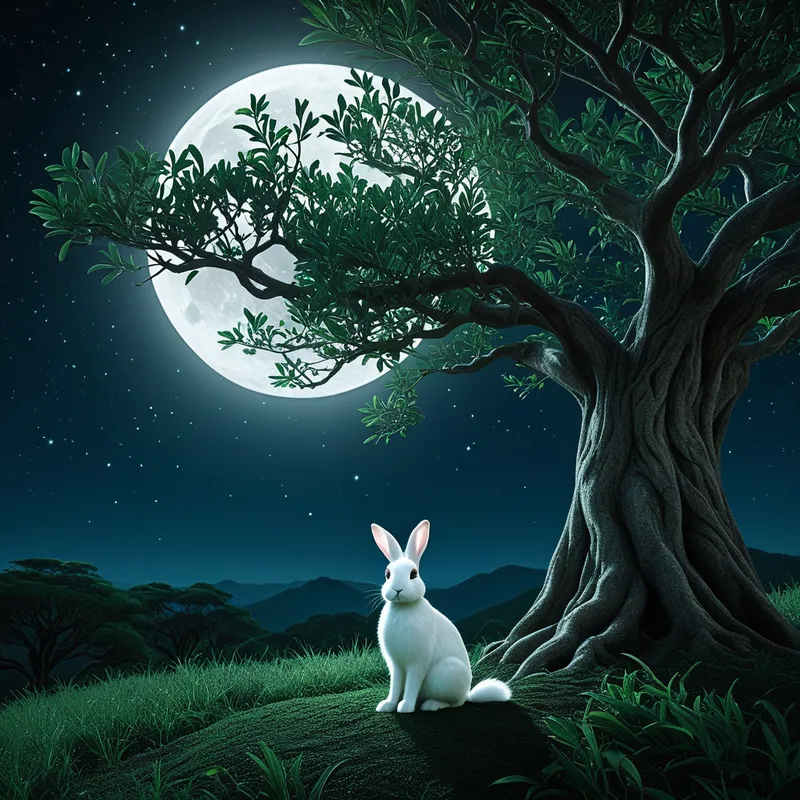
The Rabbit in the Moon Myth Meaning & Symbolism
A celestial rabbit, offered as a sacrifice by a compassionate deity, is immortalized in the moon as a symbol of ultimate selflessness and eternal virtue.
The Tale of The Rabbit in the Moon
Listen, and let your heart travel to a time when the boundaries between heaven and earth were thin as a cicada’s wing. The moon was not a cold stone, but a luminous palace, a silent witness to the dramas of the mortal realm.
On a night when the world seemed held in a single, breathless pause, three sages walked the earth. They were not men as you know them, but Xianren, cloaked in the rags of poverty to see the true heart of the world. Hunger gnawed at their bellies, a hollow echo in the vast stillness. They came upon a fox, sleek and cunning, who had just made a kill. “We are weary and starving,” the eldest immortal spoke, his voice like wind through reeds. “Can you spare a morsel for three old travelers?” The fox, its eyes sharp with possession, merely flicked its tail and vanished into the brush with its prize, leaving only the scent of blood behind.
Next, they found a monkey chattering in the high branches, its arms full of ripe, stolen fruit. “Brother Monkey,” called the second immortal, “the night is long and our journey longer. Will you not share your bounty?” The monkey grinned, shook its head, and scampered away, clutching its treasure close.
Despair began to weave its subtle threads around the travelers. Then, in a clearing washed in silver light, they saw him. A rabbit, white as the first winter snow, its eyes like dark pools of still water. He had nothing to offer but the grass he nibbled. The three immortals approached, their forms bent and pitiful. “Little brother,” they sighed in unison, their voices trembling with feigned weakness. “We are dying. Have you no food for us?”
The rabbit sat still. He looked at the empty forest, at his own frail paws, and then into the profound, aching need in the old men’s eyes. A resolve, pure and terrible, settled in his heart. He spoke, his voice a soft whisper in the vast night. “I have no food. But eat of me.”
Before the words could fade, he turned and leaped into the small fire the travelers had kindled. There was no cry of pain, only a silent offering, a body becoming light. The flames, instead of consuming, transfigured. They cooled into a radiant, gentle luminescence.
In that instant, the rags fell from the three travelers. They stood revealed in their celestial majesty, robes of cloud and starlight, faces glowing with awe and compassion. The eldest, moved beyond measure, knelt. With a gesture that gathered the essence of the rabbit’s sacrifice—the courage, the compassion, the utter selflessness—he swept his sleeve across the heavens. From the dying embers, he lifted the rabbit’s spirit, not as ash, but as a permanent, shining truth.
He placed him in the Yin He, and then, with infinite care, onto the brightest, purest disk in the night sky. “For all time,” the immortal declared, his voice now the sound of celestial spheres turning, “your act will be remembered. You will be the Yù Tù, and this will be your home.” And so, the rabbit found himself on the luminous plains of the moon, beside the eternal Guìshù, tasked with grinding the herbs of immortality in a jade mortar, his silhouette a testament forever etched in silver against the dark.
Cultural Origins & Context
The myth of the Moon Rabbit is one of the most enduring and beloved narratives in the Sinosphere. Its earliest known textual appearance is in the Chu Ci (Songs of Chu), a collection of poetry from the Warring States period (circa 3rd century BCE), where a “jade rabbit” is mentioned in the moon. The story was later expanded and popularized through Buddhist texts, which carried similar Jataka tales of animal sacrifice, and solidified in the popular imagination during the Han and Tang dynasties.
This was not merely a bedtime story. It functioned as a foundational ethical parable, transmitted by scholars, Buddhist monks, and folk storytellers alike. During the Zhōngqiū Jié, families gathering under the full moon would point out the rabbit’s shape, using the myth to teach children the values of selflessness, compassion (cíbēi), and the ultimate reward of virtue—not material gain, but eternal significance. The rabbit’s image adorned bronze mirrors, silk paintings, and porcelain, serving as a constant cultural reminder that the highest acts are those performed without expectation of return.
Symbolic Architecture
At its core, the myth is a profound map of a specific spiritual alchemy. The rabbit represents the ultimate Caregiver archetype, but in its most radical, self-annihilating form.
The fire does not destroy; it reveals. The sacrifice is not a loss, but a translation of matter into meaning.
The fox symbolizes worldly cleverness and resourcefulness that hoards its gains. The monkey represents playful intelligence and skill that serves itself. The rabbit, possessing neither cunning nor strength, embodies pure, vulnerable being. His only “resource” is his own life. His leap into the fire is the ultimate act of kenosis—an emptying of the self. The celestial beings, disguised as beggars, represent the divine or the ultimate reality testing the soul’s composition. They do not need food; they seek the substance of character.
The moon is the perfect symbolic vessel. It reflects light (it is not the source, just as virtue reflects a deeper cosmic principle), it governs cycles (of transformation, of yin), and it is the realm of the eternal, the unchanging amidst change. The rabbit’s new task—grinding the elixir of immortality—is key. He who gave his mortal life now prepares the substance of eternal life for others. His sacrifice alchemized him into the very agent of the transcendent.
The Dreamer’s Resonance
When this myth pattern arises in modern dreams, it seldom appears as a literal rabbit on the moon. More often, the dreamer encounters a profound, non-negotiable choice that feels like a kind of death. They may dream of having to give away their last possession, of offering comfort to a terrifying or decrepit figure, or of willingly entering a confining space (an oven, a small room, a pod) for a “process” they don’t understand.
Somatically, this can feel like a hollowing out in the solar plexus—a sacred emptiness. Psychologically, it marks a critical juncture in the process of individuation. The ego, having tried the tricks of the fox (manipulation) and the skills of the monkey (achievement), faces its limit. The dream is presenting the necessity of the rabbit’s path: a surrender of a cherished identity, a personal ambition, or a defensive strategy for the sake of a larger, soul-led purpose. The terror in the dream is the fire; the resolution, if the dreamer can consent, is the unexpected, cool luminescence that follows—a feeling of being seen and sanctified by a deeper layer of existence.
Alchemical Translation
The myth models the individuation process as an alchemical solve et coagula: dissolve and reconstitute. The modern individual accumulates identities—the clever professional (fox), the creative problem-solver (monkey). These are necessary, but they are not the essence of the soul. The crisis arrives when these personas fail to provide meaning or connect one to the transcendent.
The work of the soul is not accumulation, but distillation. We must become our own mortar and pestle, grinding down the hard kernels of ego to release the essential oil of being.
The “fire” is the crucible of life experience that demands we burn away what we thought we were. This could be a failure, a loss, an act of forgiveness that feels like self-betrayal, or a simple, exhausting compassion that goes utterly unrewarded. The rabbit’s choice is the moment of conscious, willing participation in this fire. It is the decision to stop protecting the small self.
The immortal’s gesture—plucking the rabbit from the flames—symbolizes the Self (the total, integrated psyche) recognizing and reclaiming this act of surrender. The translation to the moon is the coagula: the reconstitution of identity at a higher level. One is no longer just a person with traits, but a being with a purpose aligned with the eternal. The modern “moon” is not a rock in space, but a state of consciousness: reflective, calm, cyclical, and connected to the deep, rhythmic patterns of life and the unconscious. The individual becomes the Yù Tù, quietly engaged in the eternal work—not for glory, but as a natural expression of a transformed nature. They grind the herbs of their own experience into the elixir of wisdom, offering it not from a place of lack, but from the boundless abundance of a self that has willingly become a vessel for something greater.
Associated Symbols
Explore related symbols from the CaleaDream lexicon: