The Qliphoth Shadow Tree Myth Meaning & Symbolism
A myth of the inverted Tree of Life, a realm of shells and primal chaos, where the unintegrated self is mirrored and must be traversed.
The Tale of The Qliphoth Shadow Tree
Before the first word was spoken, before the vessels were formed to hold the light, there was the breaking. The Ein Sof poured forth, a river of pure radiance, into ten holy vessels—the Sephirot of the Etz Chaim. But the light was too fierce, too potent for its new forms. The vessels shattered. Holy sparks, countless and brilliant, scattered into the abyss. And what was left? The shards. The husks. The shells.
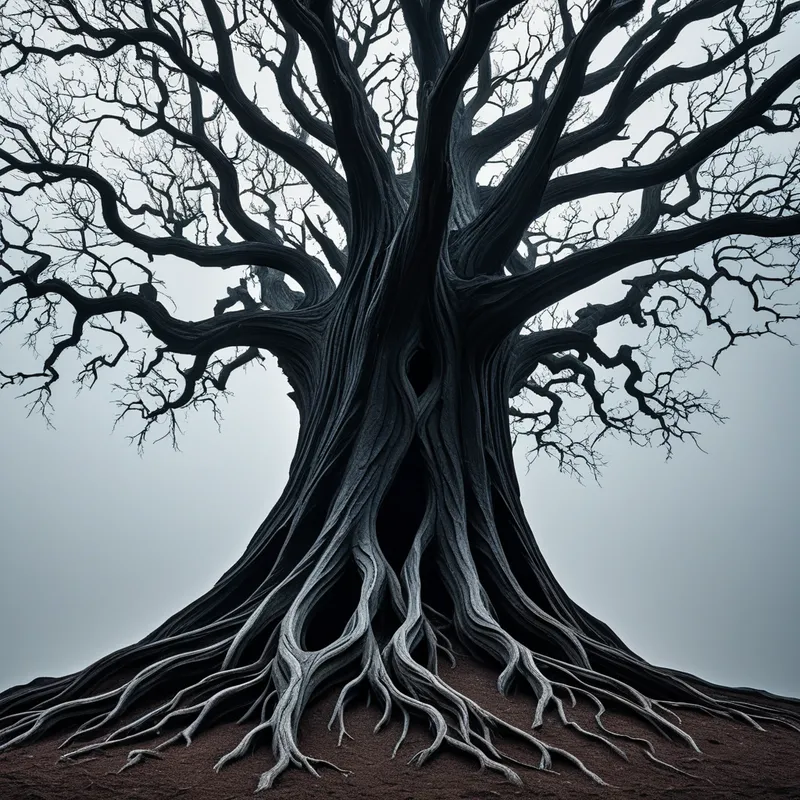
These shells did not vanish. They coalesced. They remembered the shape of the divine structure but were filled only with absence, with the echo of the light that had fled. From this memory of form and this substance of void, a tree grew. But it was a tree of roots, not branches. It grew downward, into the depths where the sparks had fallen. It grew inward, around the absence. This was the Qliphoth, the Shadow Tree.
Its ten roots are not spheres of emanation but realms of containment. Nehemoth whispers with the dry rustle of material decay. Gamaliel reflects a distorted, mocking moon. Each is a kingdom ruled by a Sitra Achra, a prince of the other side, who is not a foreign demon but the un-faced aspect of the divine force itself, turned in upon its own hollow hunger.
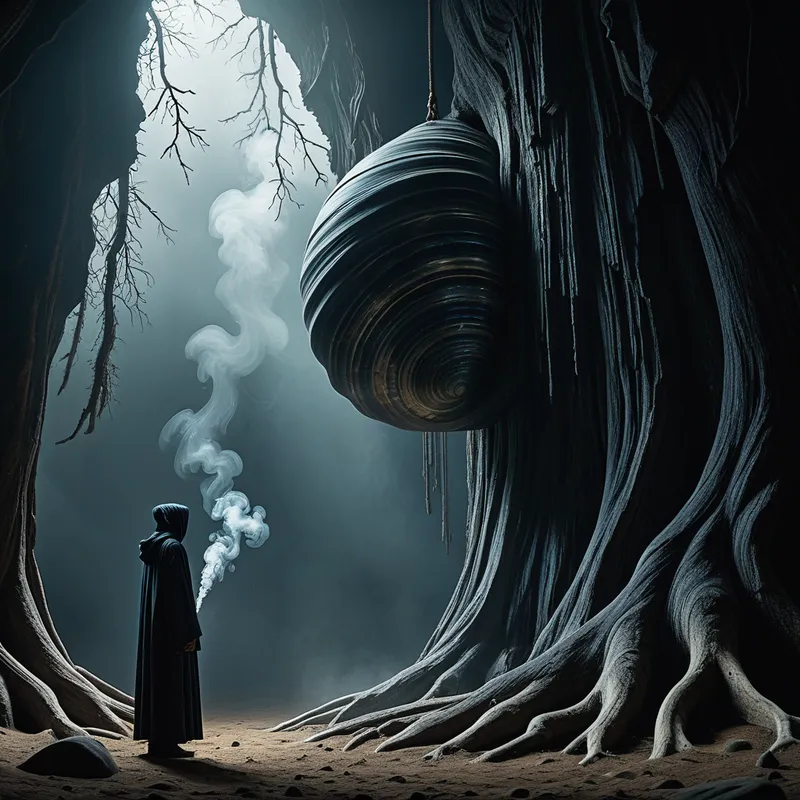
To walk here is to walk within the mirror of your own soul’s architecture. The air is thick with static, the residue of divine speech unheard. The ground is not ground, but a clinging, psychic residue. Here, the Tohu</abtitle=“The primal, formless substance from which creation is formed”>, the primal chaos, never received the ordering touch of Davar. It writhes in its raw, potential state—a storm of unmanifested forms, a scream that never found a mouth. This is the realm where every rejected thought, every repressed impulse, every exiled fragment of being finds its dominion. It is the world as it might have been, had the light failed completely, and yet it holds, buried in its darkest soil, the very sparks it was meant to destroy.
Cultural Origins & Context
The myth of the Qliphoth is not a popular folktale but a profound and guarded strand of Kabbalistic thought, emerging most distinctly in the late medieval period, particularly within the Zohar and later Lurianic Kabbalah of the 16th century. It was not a story for the uninitiated; it was a map for the mystic. Passed down through intricate commentaries and oral teachings among small circles of scholars, its function was deeply psychological and cosmological. It explained the origin of evil not as a separate creation, but as a consequence of the creative process itself—the “Breaking of the Vessels” (Shevirat HaKelim). The myth served as a warning about the dangers of spiritual ascent without proper preparation and, more importantly, as an instruction for Tikkun Olam, the repair of the world. To affect repair, one had to understand the nature of the break, to dare to look into the shadow of the divine.
Symbolic Architecture
The Qliphoth Shadow Tree is the ultimate symbol of the structured shadow. It is not formless evil, but the inverse pattern of the Etz Chaim. Where the Tree of Life represents consciousness, order, and revelation, the Shadow Tree represents the unconscious, chaos, and everything that has been repressed to create that order.
The shadow is not the absence of light, but the shape the light refuses to fill.
Each “shell” (Qlipha) corresponds to a Sephirah, but in a distorted, inverted form. Tiferet’s harmony becomes Thagirion’s raging dispute. Binah’s receptive intelligence becomes Satariel’s concealed horror. This is not mere opposition; it is the pathological potential of the divine attribute itself when severed from the balancing flow of the whole. Psychologically, each Qlipha represents a complex—a structured cluster of trauma, defense, and unrealized potential—that sits like a cyst in the psyche, mirroring but blocking the healthy function of a core archetypal energy.
The Dreamer’s Resonance
When this myth stirs in the modern unconscious, it manifests not as a literal tree but as the somatic experience of inversion and containment. One may dream of a familiar house with a hidden, decaying basement that mirrors the floor plan above. They may encounter a doppelgänger whose face is a blurred or grotesque version of their own—a Shadow Figure that knows their unspoken thoughts. The dream body may feel heavy, stuck in tar, or traversing a labyrinth where every turn leads back to the same distorted mirror.
This is the psyche signaling that a period of necessary descent has begun. The ego’s tidy structure is being confronted by the “roots” of its own formation. The process is one of disintegration—not as madness, but as the deconstruction of a persona that has become too rigid, too clean, and thus too fragile. The anxiety, the sense of confronting a “hollow” version of oneself, is the feeling of touching the Qliphothic shell. The dream is the beginning of the Journey to gather the spark within it.

Alchemical Translation
The myth of the Qliphoth models the most perilous and essential phase of individuation: the conscious engagement with the shadow. It is the Descent into one’s personal underworld, not to battle monsters as an external hero, but to reclaim sovereignty over the exiled parts of the self that have become monstrous through neglect.
Transmutation begins not by bringing light into the darkness, but by recognizing the darkness as unborn light.
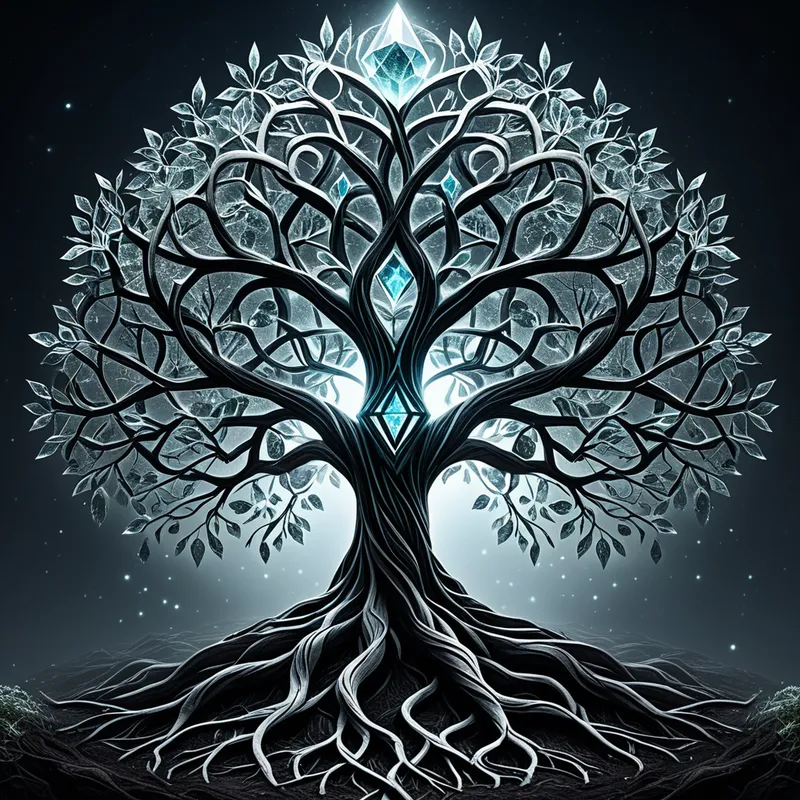
The alchemical operation is solve et coagula: to dissolve and re-coagulate. The journey through the Qliphoth is the solve. The ego’s certainties are dissolved in the acidic truth of the repressed. One must face the Grief in Satariel, the Rage in Thagirion, the Pride in Samael. This is not an act of destruction, but of sacred recovery. Each spark of divine light trapped within a shell is a lost talent, a stifled emotion, a denied instinct. To liberate it is to perform Tikkun, repair, at the microcosmic level. The re-coagulation (coagula) is the integration of these reclaimed energies back into the personality, no longer as chaotic demons, but as vital forces that now inform a more complete, more resilient, and truly individual Soul. The Shadow Tree, once traversed, becomes the hidden root system of the renewed Tree of Life, providing depth, stability, and a connection to the raw, creative Chaos of the unconscious.
Associated Symbols
Explore related symbols from the CaleaDream lexicon:
- Tree of Life — The luminous counterpart and original pattern, whose shattered vessels gave birth to the Shadow Tree, representing the goal of integrated wholeness.
- Shadow — The core substance of the Qliphoth, representing the personal and collective unconscious contents that form inverted, structured complexes.
- Mirror — The essential function of the Qliphothic realms, which reflect a distorted, truthful image of the aspects of self the conscious mind has refused to see.
- Root — The foundational structure of the Shadow Tree, representing the deep, often hidden origins of psychological complexes and the descent into the underworld of the self.
- Chaos — The primal Tohu that animates the Qliphoth, the raw, unformed potential that must be engaged and shaped during shadow work.
- Key — The insight or courage required to unlock the shells of the Qliphoth and liberate the trapped sparks of light and potential within.
- Cave — The symbolic setting for the descent into the Qliphoth, a place of inward journey, confrontation with hidden truths, and incubation.
- Door — The threshold between the ordered world of consciousness (the Sephirot) and the chaotic realm of the shadow (the Qliphoth), which one must consciously choose to pass through.
- Light — The scattered divine sparks trapped within the shells, representing lost wholeness, potential, and the ultimate goal of reclamation and integration.
- Rebirth — The outcome of successfully navigating the Qliphoth, involving the death of the old, rigid persona and the birth of a more authentic, complete self.
- Grief — A primary emotional substance found within the shells, often the buried pain that hardens into a defensive complex or pattern.
- Journey — The essential narrative arc of the myth, framing the engagement with the shadow not as a single battle but as an arduous, transformative pilgrimage.