The Pulque Maguey Worm Myth Meaning & Symbolism
A lowly worm sacrifices itself to become the sacred maguey plant, birthing the divine pulque and revealing the hidden spirit within matter.
The Tale of The Pulque Maguey Worm
Listen. Before the Fifth Sun found its rhythm, when the earth was a canvas of dust and promise, there existed a creature of profound humility. It was not a jaguar, whose coat mirrored the starry night. It was not an eagle, who conversed with the sun. It was a worm. A simple, earth-bound maguey worm, dwelling in the dry soil, knowing only the taste of roots and the darkness beneath the stone.
Its world was one of lack. The rains were sparse gifts. The sun was a relentless lord. The worm felt a thirst, a yearning not just of the body, but of the spirit—a longing for a sweetness it could not name, for a belonging it had never known. It spent its days in a silent pilgrimage through the grit, a prayer written in the slow trail of its passage.
One night, as the great cloak of Citlalicue was pinned with cold, sharp stars, the worm witnessed a celestial sorrow. A single, radiant tear fell from the heavens. It was not water, but liquid starlight, and it carried the essence of Mayahuel, the beautiful goddess who was the very spirit of the green, succulent life the earth so desperately needed. Her tear struck the parched ground where the worm rested, and in that moment, the creature understood its destiny. It was not an accident of creation; it was a vessel awaiting its sacred duty.
The voice of the cosmos, perhaps Ometeotl themself, whispered on the wind. “Little one, child of the dust. To know the nectar of the gods, you must become the cup that holds it. To end the thirst of the world, you must first become the world’s thirst.”
Without hesitation, without a thought for its own brief existence, the worm consented. It pressed its body into the spot where the divine tear had fallen. It offered itself—its form, its life, its very being—to the hungry earth. This was not a death, but a sowing. The worm’s body dissolved, not into nothingness, but into potential. Its essence merged with the goddess’s gift, sinking deep into the underworld’s memory.
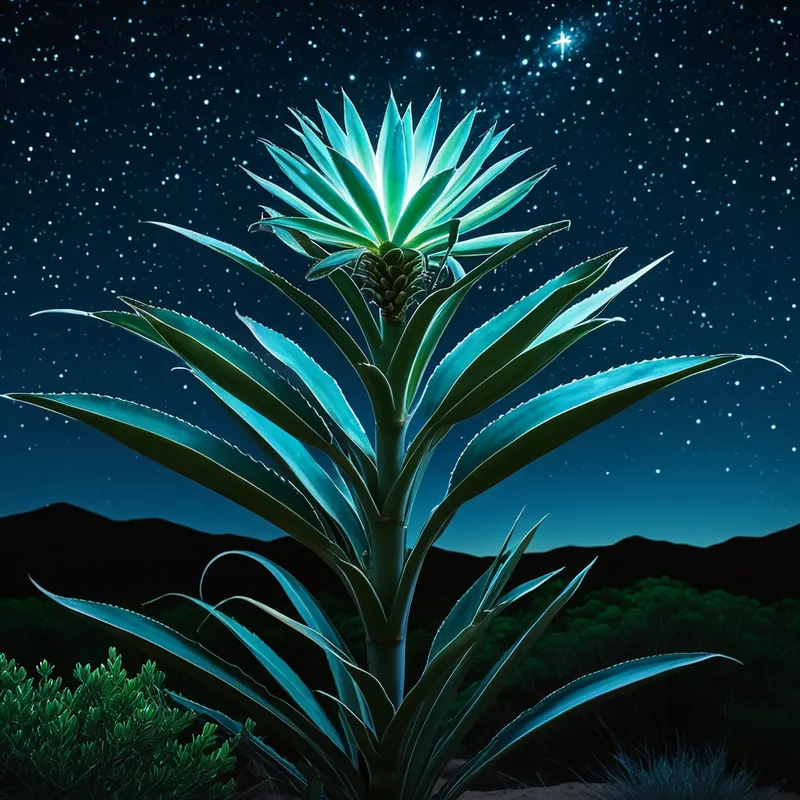
From that sacred sacrifice, a miracle pushed through the crust of the world. A fierce, blue-green spike pierced the sky—the first maguey. Its leaves were swords of collected rain and sunlight; its heart, a vast, hidden vessel. And within that heart, where the worm’s spirit now resided, a new alchemy began. The longing of the lowly creature and the divine essence of the goddess fermented together in the plant’s core. They transformed the plant’s watery sap into a milky, potent, and sacred liquor: pulque, the drink of poets, the blood of ceremony, the revealed secret of the earth.
The worm, once the humblest of beings, had become the guardian of the plant’s soul and the catalyst for its greatest gift. It did not rule from a temple, but from within the living flesh of the maguey, a hidden divinity that made the divine accessible. The thirst was quenched, not by water, but by revelation.
Cultural Origins & Context
This myth originates from the rich, complex tapestry of Mexica cosmology, recorded in post-Conquest texts like the Florentine Codex compiled by Bernardino de Sahagún. It was not merely a “just-so” story for the origin of a beverage. Pulque was far more than drink; it was a ritually controlled sacrament, a medium for communion with the gods, and a vital source of nutrition. Its consumption was governed by strict social and religious codes, permitted for the elderly, nursing mothers, and during specific festivals.
The myth of the maguey worm served a crucial societal function: it sacralized the entire process of pulque production, from the lowly creature in the soil to the exalted state of ritual intoxication. It taught that divinity and transformative power are not the sole province of majestic gods on high, but are hidden within the most mundane and despised aspects of creation. The story was likely told by tlamatinime (wise ones, philosophers) and elders during ceremonies to instill respect for the maguey plant and to explain the sacred, paradoxical nature of pulque—a gift born from decay and sacrifice, a spirit (pulque) liberated from matter (the plant) by a spirit (the worm).
Symbolic Architecture
At its core, this myth is a masterclass in the alchemy of value. The worm represents the ultimate psychic shadow—that which is considered lowly, insignificant, even repulsive. It is the part of the self, or of society, deemed unworthy. The maguey plant symbolizes the manifest world, the body, the vessel of life that stands between heaven and earth. Mayahuel’s tear is the animating spark of divine consciousness or creative potential.
The most profound transformations begin not with a grand act of will, but with a humble act of surrender to a calling greater than the self.
The worm’s sacrifice is not a negation, but the ultimate act of self-realization. By giving up its limited identity as “just a worm,” it gains a cosmic one as the essential catalyst. It becomes the axis mundi of the plant, the hidden center around which the sacred process revolves. The resulting pulque symbolizes the intoxicating, unifying spirit that is released when the “lowest” part of nature is united with a “higher” purpose—the ecstasy of poetry, the vision of the seer, the nourishment of the community, all born from acknowledged decay.

The Dreamer's Resonance
When this myth stirs in the modern unconscious, it often manifests in dreams of humble, wriggling creatures—worms, grubs, caterpillars—in places of importance: in one’s bed, one’s food, or at the center of a cherished object. The initial feeling is one of disgust or intrusion. This is the psyche’s first reaction to its own neglected, “worm-like” aspects: a buried talent deemed impractical, a childhood vulnerability, a raw hunger or need judged as shameful.
The somatic process is one of deep, earthy tension in the gut, a feeling of being “stuck in the mud” of one’s own perceived inadequacies. The dream is presenting the maguey worm archetype, inviting the dreamer to do what the culture’s myth did: to stop trying to exterminate this “pest,” and instead, to see it as the necessary, sacred ingredient. The psychological process is the beginning of sacrificial containment—holding the discomfort of this lowly self-image long enough for it to reveal its purpose. The dreamworm is not a problem to be solved, but a latent potential waiting for its divine tear, its moment of meaningful connection.

Alchemical Translation
For the individual on the path of individuation, the myth of the Pulque Maguey Worm is a map for psychic transmutation. The first stage is Recognizing the Worm: confronting the part of oneself that feels worthless, parasitic, or bound to the “dirt” of one’s history or base instincts. This is the prima materia—the despised starting material of the alchemist.
The second stage is The Celestial Tear: the arrival of an insight, a moment of grace, or a profound emotional wound (like Mayahuel’s sorrow) that connects this “worm” to a larger, spiritual pattern. It is the realization that this shameful thing is actually connected to a deep, creative need or a sacred duty.
Individuation brews in the vessel where our deepest shame ferments with our highest calling.
The third and crucial stage is The Sacrificial Sowing: the conscious, willing decision to “plant” that wounded, lowly self-concept into the heart of one’s life (the maguey). This is not wallowing, but an active containment—allowing that part to decompose its old identity and become fertilizer for new growth. The final stage is The Fermentation of Pulque: a period of patient, internal processing where the conscious ego (the plant’s structure) holds the transforming shadow (the worm). The result is not the eradication of the worm, but its transmutation into a vital, spirited essence—one’s unique creative intoxicant, one’s authentic voice, or one’s capacity for sacred joy, liberated from within the very thing one once despised. The worm becomes the guardian of the soul’s most potent gift.
Associated Symbols
Explore related symbols from the CaleaDream lexicon: