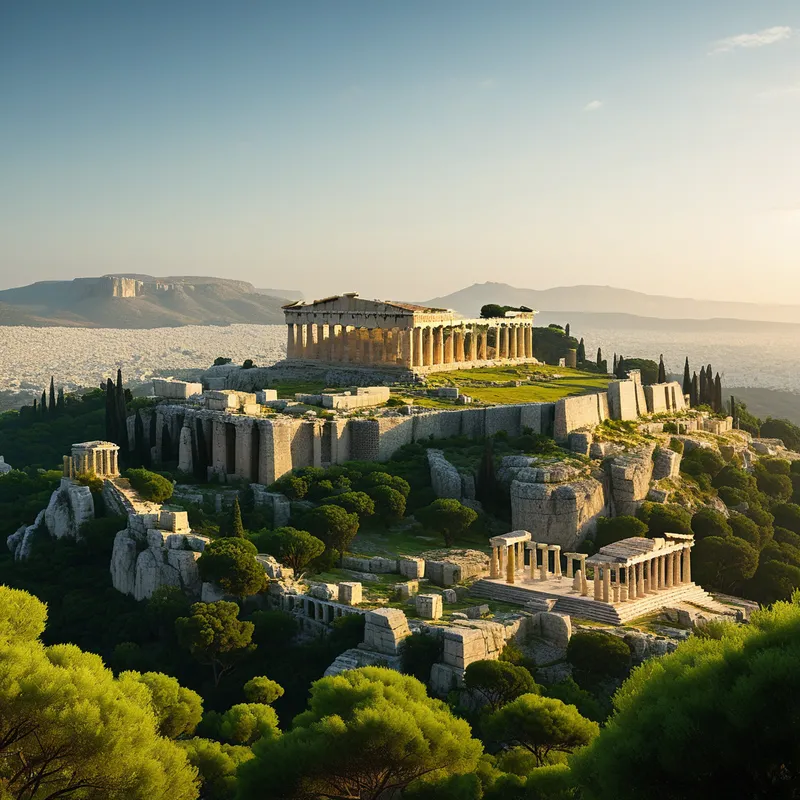
The Polis Myth Meaning & Symbolism
The mythic tale of how gods and heroes carved a sacred, ordered space from the primal wilderness, establishing the spiritual blueprint for human community.
The Tale of The Polis
Listen, and hear the tale not of a single hero, but of a living soul born from stone and spirit. It begins not with a founding, but with a longing. In the age when [the world](/myths/the-world “Myth from Tarot culture.”/) was young and raw, humanity huddled in [the shadow](/myths/the-shadow “Myth from Jungian culture.”/) of the wild. The forests were deep and whispered with the voices of [nymphs](/myths/nymphs “Myth from Greek culture.”/) and satyrs; the mountains were the thrones of capricious gods; [the sea](/myths/the-sea “Myth from Greek culture.”/) was a vast, hungry mystery. People lived in scattered clusters, their lives ruled by the whims of earth and sky, their hearts aching for a center, a [Hestia](/myths/hestia “Myth from Global/Universal culture.”/), a hearth that would not be extinguished by the next storm.
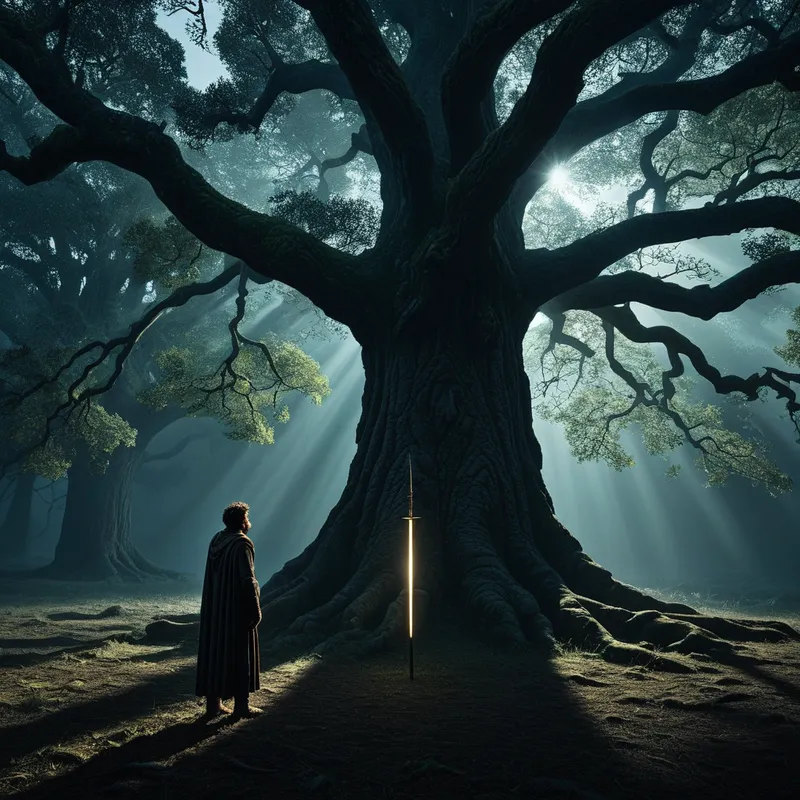
Then came the call, carried on [the wind](/myths/the-wind “Myth from Various culture.”/) from the lips of Apollo himself, or found in the rustling leaves of [the sacred oak](/myths/the-sacred-oak “Myth from Celtic culture.”/) at Dodona. A voice spoke to a chosen one—a weary king, a visionary exile, a son of Athena. The command was clear yet terrifying: “Go to the place where the eagle drops the [tortoise](/myths/tortoise “Myth from Greek culture.”/) upon the rock. Go to where the white sow lies beneath the oak, encircled by her thirty young. There, you must build the [omphalos](/myths/omphalos “Myth from Greek culture.”/), the navel of the world.”
The hero’s journey was not across monstrous seas, but into the heart of the agrios—the untamed. He pushed through thorns that clutched like fingers, crossed rivers that murmured forgotten names, until he found the sign. Perhaps it was a spring, bursting forth where his spear struck the barren earth, a gift from Earth-Shaker himself, who contested with Athena for the city’s patronage. The air here tasted different—charged, expectant. This was the [temenos](/myths/temenos “Myth from Greek culture.”/), the cut-off place, the sacred precinct.
Here, the real labor began. Not with sword, but with plough. Yoking a bull and a cow, the founder traced the pomerium, the sacred boundary. The bronze ploughshare bit into the fertile soil, carving a furrow of pure intention. Where the plough was lifted, a gate would be; the soil turned inward became the inviolable wall. This was magic of the highest order: the transformation of undifferentiated earth into hieros (sacred) and profanos (profane), of wilderness into oikos (home). The first stones of the agora were laid, not for a palace, but for a space of shared speech. The altar to Hestia was raised, and her eternal flame was kindled, a tiny, defiant sun around which the entire cosmos of the city would orbit.
And then, the people came. Not as a conquering horde, but as a gathering. From the hills and the hidden valleys, they were drawn to the flame, to the ordered space. They built their homes within [the sacred circle](/myths/the-sacred-circle “Myth from Various culture.”/). The smell of baking bread mingled with the scent of incense from the new temples. The random noises of the wild were slowly replaced by the deliberate sounds of human life: the smith’s hammer, [the potter](/myths/the-potter “Myth from Abrahamic culture.”/)’s wheel, the debate of citizens in the open air. The Polis was born—not a pile of stones, but a living prayer in marble and flesh, a fragment of kosmos wrested from the primal chaos.
Cultural Origins & Context
The myth of the Polis is not contained in a single epic like the Iliad. It is the foundational story embedded in the ritual practices, civic ceremonies, and local histories of every independent Greek city-state. It was told and retold during the Panegyris, the great festivals that united the community. The aition (origin story) of a city’s founding was its spiritual charter, recited to remind citizens of their sacred contract with the gods and with each other.
These stories served a vital societal function: they provided divine sanction for human law and social order. The founder, or oikist, was often elevated to hero-cult status, a semi-divine intermediary between the people and the Olympians. The myth justified the city’s territory, its patron deities, and its unique customs (nomoi). To be a citizen was not merely to reside within walls; it was to participate in a ongoing mythological act—the perpetual maintenance of that sacred order against the ever-present threat of dissolution, both from without (invasion) and within (stasis, or civil strife).
Symbolic Architecture
At its core, the myth of the Polis is a grand [metaphor](/symbols/metaphor “Symbol: A figure of speech where one thing represents another, often revealing hidden connections and deeper truths through symbolic comparison.”/) for the [birth](/symbols/birth “Symbol: Birth symbolizes new beginnings, transformation, and the potential for growth and development.”/) of [consciousness](/symbols/consciousness “Symbol: Consciousness represents the state of awareness and perception, encompassing thoughts, feelings, and experiences.”/) itself within the [human](/symbols/human “Symbol: The symbol of a human represents individuality, complexity of emotions, and social relationships.”/) [psyche](/myths/psyche “Myth from Greek culture.”/).
The Polis is the psyche in its civilized form: the arduous project of creating an inner temenos—a sacred, ordered space of self-awareness—from the boundless, undifferentiated wilderness of the unconscious.
The primal [wilderness](/symbols/wilderness “Symbol: Wilderness often symbolizes the untamed aspects of the self and the unconscious mind, representing a space for personal exploration and discovery.”/) represents the totality of the psyche in its raw, instinctual state—powerful, creative, but also terrifying and lawless. The founding [hero](/symbols/hero “Symbol: A hero embodies strength, courage, and the ability to overcome significant challenges.”/) is the emerging ego-consciousness, tasked with the impossible yet necessary work of establishing a center. The plough that carves the [boundary](/symbols/boundary “Symbol: A conceptual or physical limit defining separation, protection, or identity between entities, spaces, or states of being.”/) is the function of discrimination, of making choices, of saying “this is me, and that is not-me.” The agora symbolizes the internal forum where different thoughts, values, and complexes (the inner citizens) can meet, debate, and find a working [harmony](/symbols/harmony “Symbol: A state of balance, agreement, and pleasing combination of elements, often associated with musical consonance and visual or social unity.”/). [The eternal flame](/myths/the-eternal-flame “Myth from Universal culture.”/) of Hestia is the central, unwavering point of [identity](/symbols/identity “Symbol: Identity represents the sense of self, encompassing personal beliefs, cultural background, and social roles.”/) and psychic warmth, [the Self](/myths/the-self “Myth from Jungian culture.”/) around which the entire [personality](/symbols/personality “Symbol: Personality in dreams often symbolizes the traits and characteristics of the dreamer, reflecting how they perceive themselves and how they believe they are perceived by others.”/) constellates.
The conflict between gods like Athena and [Poseidon](/myths/poseidon “Myth from Greek culture.”/) for patronage mirrors the psyche’s struggle to integrate different ruling principles: strategic wisdom versus raw emotional power, civilized craft versus chthonic force. The completed Polis represents the individuated personality—not a monolithic, rigid [structure](/symbols/structure “Symbol: Structure in dreams often symbolizes stability, organization, and the framework of one’s life, reflecting how one perceives their environment and personal life.”/), but a dynamic, living [system](/symbols/system “Symbol: A system represents structure, organization, and interrelated components functioning together, often reflecting personal or social order.”/) where order and vitality, law and inspiration, exist in a sacred [tension](/symbols/tension “Symbol: A state of mental or emotional strain, often manifesting physically as tightness, pressure, or unease, signaling unresolved conflict or anticipation.”/).
The Dreamer’s Resonance
When this myth stirs in the modern dreamer, it often manifests in dreams of building, organizing, or discovering sacred spaces. You may dream of finding a hidden room in your house, of meticulously constructing a model city, of cleaning and ordering a chaotic attic or garden. These are not mere dreams of tidiness. They are somatic signals of a profound psychological process: [the ego](/myths/the-ego “Myth from Jungian culture.”/)’s attempt to establish or re-establish a functional, sacred structure within.
Conversely, dreams of the Polis under threat—walls crumbling, streets flooding with dark [water](/myths/water “Myth from Chinese culture.”/), the sacred flame guttering—speak to a crisis of inner order. This is the stasis within, a civil war among competing values, drives, or life roles. The dream-ego may feel like a lone defender on the battlements, overwhelmed by a rising tide of chaos from the unconscious (the returning wilderness). Such dreams call not for fortification, but for re-consecration—a return to the foundational rites, the core values (the omphalos) that once gave the inner world its meaning and cohesion.

Alchemical Translation
The alchemical journey mirrored in the Polis myth is the opus of Individuation—the civitas dei or “Philosopher’s Stone” of the soul, which is not a [thing](/myths/thing “Myth from Norse culture.”/), but a well-ordered and vibrant psychic community.
The [prima materia](/myths/prima-materia “Myth from Alchemical culture.”/) is the raw, chaotic stuff of one’s inherited nature and unlived life. The [nigredo](/myths/nigredo “Myth from Alchemical culture.”/), or blackening, is the hero’s journey into the untamed wilderness of the psyche, a descent into confusion, depression, or crisis where all previous structures seem meaningless. The moment of finding the sacred site—the spring, the omen—is the albedo, the first glimpse of the Self, the organizing principle around which a new life can be built.
The act of ploughing the boundary is the rubedo, the red work of conscious commitment. It is the painful, deliberate act of setting limits, making sacrifices, and defining what one truly stands for, thereby giving distinct form to the soul.
Building the temples is the process of giving due honor to the various archetypal forces within—the inner Athena (wisdom), the inner Apollo (purpose), the inner Dionysus (ecstasy)—not by letting any one rule tyrannically, but by giving each a proper place in the inner agora. The final stage is not a static completion, but the circulatio, the ongoing maintenance. The citizen’s daily life in the Polis represents the conscious engagement with one’s own complexity: tending the inner flame, participating in the internal debates, repairing the walls after life’ inevitable sieges, and forever negotiating the sacred boundary between the cultivated self and the wild, creative mystery from which it sprang and upon which it eternally depends. To become a Polis is to become, at last, both a sovereign and a servant to the totality of who you are.
Associated Symbols
Explore related symbols from the CaleaDream lexicon: