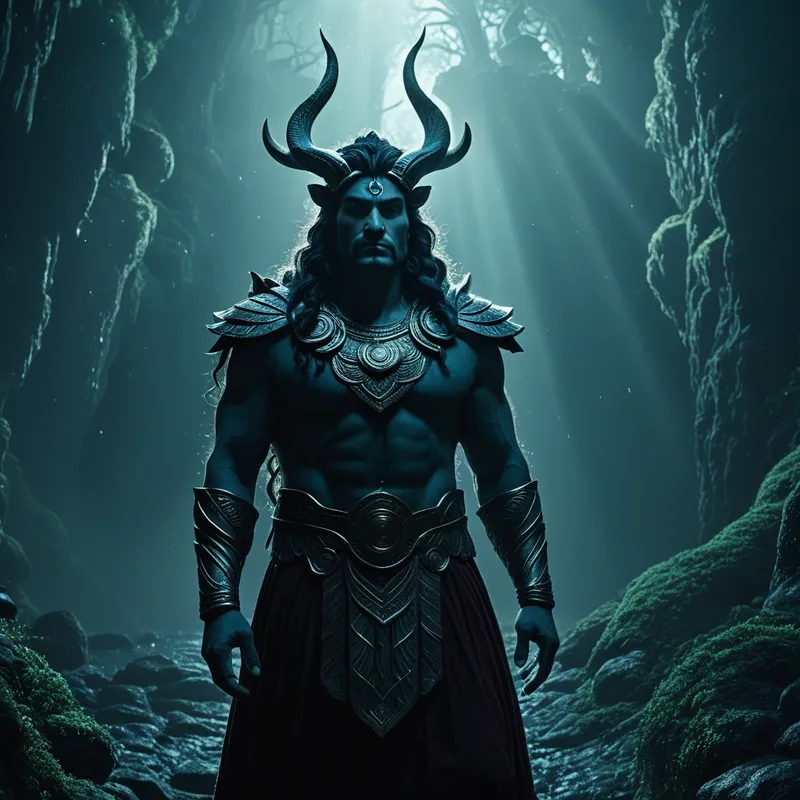
The Polar Bear Creator
An Inuit myth where a powerful polar bear shapes the Arctic world, embodying creation, strength, and the deep connection between humans and nature.
The Tale of The Polar Bear Creator
In the time before time, when [the world](/myths/the-world “Myth from Tarot culture.”/) was a formless expanse of ice and shadow, there existed only the great silence and the eternal cold. From within this primordial stillness, a consciousness stirred. It was not a thought, nor a voice, but a profound presence—a massive, luminous white bear, whose breath was [the wind](/myths/the-wind “Myth from Various culture.”/) and whose body was the living ice. This was the Polar Bear Creator, Sila’s first child, [the architect](/myths/the-architect “Myth from Various culture.”/) of the tangible world.
The Bear did not speak, for words had not yet been invented. Instead, it moved. With each deliberate, powerful paw-step, the featureless ice groaned and cracked, giving birth to pressure ridges and fjords. Where it lay down to rest, its great weight carved out deep basins that would later fill with the salt tears of [the earth](/myths/the-earth “Myth from Hindu culture.”/), becoming the first seas. Its claws, scratching at the eternal frost, dug the riverbeds and valleys. The rhythm of its heartbeat became the slow, grinding pulse of the glaciers.
But a world of only ice and rock was a lonely dominion. One day, the Polar Bear Creator gazed into a meltwater pool, a circle of dark [water](/myths/water “Myth from Chinese culture.”/) in the white expanse. Seeing its own reflection, it was stirred by a new desire: not to shape, but to share. It breathed upon the water, and from its warm breath and the dark mirror, the first humans emerged—small, fragile, but with eyes that held the same spark of awareness as the Bear’s own. They were of the land, born from its image and its breath.
The Bear then turned its attention to the empty sky and the barren land. From the white of its own pelt, it shook loose the first snow goose and the snowy owl. From the dark skin of its nose and lips, it called forth the [raven](/myths/raven “Myth from Haida culture.”/) and the seal. It planted its claws in the earth, and where they touched, the tough lichen and the hardy bearberry bush took root. The world was populated.
Yet, the Creator’s final and most profound act was one of transformative sacrifice. It saw that its children, the humans, were afraid of the long, dark winter, of the hunger and the cold. The Bear walked to the center of the land it had made, laid down upon the ice, and willed its own immense spirit to change. Its vast body dissolved not into [death](/myths/death “Myth from Tarot culture.”/), but into a diffusion of essence. Its bones became the mountain ranges, the enduring skeleton of the world. Its pelt became the [aurora](/myths/aurora “Myth from Roman culture.”/) borealis, dancing with silent, protective light across the winter sky. Its fierce spirit fragmented into the spirits of every polar bear that would ever walk the ice—no longer a single creator, but a thousand guardians, a living law woven into the fabric of life.
The first humans understood. The Bear was not gone. It was in the bear they hunted for survival, in the ice that tested them, in the aurora that guided them. The Creator had become the relationship itself—the sacred, perilous, and necessary bond between human and animal, between community and the ruthless, beautiful world.
Cultural Origins & Context
This myth, in its various regional tellings across the Inuit world, is not a story of distant, celestial creation. It is a terrestrial genesis, born from the direct, sensory experience of the Arctic. The Inuit, or Inuit, have lived for millennia in a landscape where the line between land, sea, and sky is blurred by ice and light, and where the polar bear (nanuq) is the apex embodiment of power, intelligence, and survival. The myth arises from this profound observation: the bear is not just in the environment; it is the environment in a concentrated, animate form.
The concept of Sila, the great weather-spirit and life-force of [the sky](/myths/the-sky “Myth from Persian culture.”/) and air, is often the ultimate backdrop. The Polar Bear Creator is frequently seen as Sila’s agent or first manifestation, the being that translates intangible cosmic force into tangible, earthly form. This grounds creation in the immediate, knowable world. The myth functions as an ecological and ethical charter. It explains the origin of topography and species, but more importantly, it establishes the foundational [covenant](/myths/covenant “Myth from Christian culture.”/): humans are kin to the bear, born from its essence, and thus exist in a relationship of profound respect, reciprocity, and identity. To hunt the bear is not mere predation; it is a ritual engagement with the creator-spirit, demanding honor, skill, and gratitude.
Symbolic Architecture
The [architecture](/symbols/architecture “Symbol: Architecture in dreams often signifies structure, stability, and the framing of personal identity or life’s journey.”/) of this myth is built from the physical and psychological materials of the Arctic itself. The Polar Bear [Creator](/symbols/creator “Symbol: A figure representing ultimate origin, divine power, or profound authorship. Often embodies the source of existence, innovation, or personal destiny.”/) is the ultimate [Creator](/symbols/creator “Symbol: A figure representing ultimate origin, divine power, or profound authorship. Often embodies the source of existence, innovation, or personal destiny.”/) [archetype](/symbols/archetype “Symbol: A universal, primordial pattern or prototype in the collective unconscious that shapes human experience, behavior, and creative expression.”/), but one devoid of patriarchal [detachment](/symbols/detachment “Symbol: A psychological or emotional separation from oneself, others, or reality, often indicating a need for self-protection, perspective, or spiritual growth.”/). Its creation is an act of embodiment and, ultimately, of [dissolution](/symbols/dissolution “Symbol: The process of breaking down, dispersing, or losing form, often representing transformation, release, or the end of a state of being.”/) into its creation.
The Bear’s transformation from a singular entity into the plural spirit of all bears and the landscape itself represents a cosmology where the sacred is immanent, not transcendent. The Creator does not rule from afar; it becomes the law of life, death, and interdependence.
Ice is not merely a setting; it is the raw [material](/symbols/material “Symbol: Material signifies the tangible aspects of life, often representing physical resources, desires, and the physical world’s influence on our existence.”/) of [consciousness](/symbols/consciousness “Symbol: Consciousness represents the state of awareness and perception, encompassing thoughts, feelings, and experiences.”/)—formless, potential, and hard. The act of shaping it with claw and [weight](/symbols/weight “Symbol: Weight symbolizes burdens, responsibilities, and emotional loads one carries in life.”/) symbolizes the struggle to bring form and meaning into existence. The [water](/symbols/water “Symbol: Water symbolizes the subconscious mind, emotions, and the flow of life, representing both cleansing and creation.”/) pool, as a mirror, is a critical threshold. It represents the [moment](/symbols/moment “Symbol: The symbol of a ‘moment’ embodies the significance of transient experiences that encapsulate emotional depth or pivotal transformations in life.”/) of self-[awareness](/symbols/awareness “Symbol: Conscious perception of self, surroundings, or internal states. Often signifies awakening, insight, or heightened sensitivity.”/), where the Creator sees itself and, in that act of [reflection](/symbols/reflection “Symbol: Reflection signifies self-examination, awareness, and the search for truth within oneself.”/), conceives of an “Other,” leading to the [birth](/symbols/birth “Symbol: Birth symbolizes new beginnings, transformation, and the potential for growth and development.”/) of humanity. This makes humanity literally born from self-reflection, destined to forever see themselves in the natural world and vice versa.
The final sacrifice is the core of the myth’s psychological [depth](/symbols/depth “Symbol: Represents profound layers of consciousness, hidden truths, or the unknown aspects of existence, often symbolizing introspection and existential exploration.”/). It moves the sacred from a [static](/symbols/static “Symbol: Static represents interference, disruption, and the breakdown of clear communication or signal, often evoking feelings of frustration and disconnection.”/) figure to a dynamic process. The Creator’s [identity](/symbols/identity “Symbol: Identity represents the sense of self, encompassing personal beliefs, cultural background, and social roles.”/) is not preserved but is willingly shattered into a million fragments of sacred [presence](/symbols/presence “Symbol: Presence in dreams often signifies awareness or acknowledgment of something significant in one’s life.”/). This establishes a world where every encounter with [nature](/symbols/nature “Symbol: Nature symbolizes growth, connectivity, and the primal forces of existence.”/) is potentially an encounter with the divine.
The Dreamer’s Resonance
For the modern dreamer or [psyche](/myths/psyche “Myth from Greek culture.”/), the Polar Bear Creator myth speaks to the genesis of one’s own internal world. The “formless ice” can be felt as the cold, silent, undifferentiated state of depression, trauma, or a life not yet lived with purpose. The stirring Polar Bear is the emergence of the primal Self—the powerful, instinctual force that begins to move, to carve out the ridges and valleys of our personality, our talents, and our struggles.
The gaze into the meltwater mirror is the moment of psychological awakening. It is when we first truly see ourselves, perhaps in therapy, in a moment of crisis, or through art, and from that reflection, we begin to differentiate our conscious identity (the human) from our vast, unconscious power (the Bear). The myth tells us that our conscious self is born from a dialogue with our own immense, often fearsome, inner nature.
Most critically, the myth guides us toward a necessary inner sacrifice. We may start life identifying with a singular, powerful “creator” complex—our intellect, our ambition, our trauma. Health and wholeness come when that rigid identity dissolves, distributing its energy throughout the entire psyche. The rage becomes disciplined strength; the grief becomes compassionate depth; the isolated genius becomes connected creativity. We are no longer ruled by one monolithic inner figure, but are in relationship with a whole ecosystem of inner forces, each bearing a spark of the original creative fire.
Alchemical Translation
The alchemical process here is not of turning lead to gold, but of turning unity into sacred multiplicity, and cold potential into animated, interdependent life. The [prima materia](/myths/prima-materia “Myth from Alchemical culture.”/) is the undifferentiated ice—pure potential in a state of frozen stasis.
The Bear is the alchemist and the agent of transformation simultaneously. Its movement is the application of the opus contra naturam—the work against nature—as it imposes form on the formless. Yet its final dissolution is the ultimate solve et coagula: it dissolves its own unified form to coagulate as the living spirit of the entire world.
The stages are clear: [Nigredo](/myths/nigredo “Myth from Alchemical culture.”/) is the primordial darkness and cold. [Albedo](/myths/albedo “Myth from Alchemical culture.”/) is the emergence of the white bear and the creation of the white, reflective landscape. The gaze into the dark water pool introduces the citrinitas, the yellowing or dawn of consciousness and relationship. The final sacrifice and transformation into the aurora (dancing light) and the spirit-in-all-things is the achievement of the [rubedo](/myths/rubedo “Myth from Alchemical culture.”/), the red stage of completion and spiritualization of matter.
In psychological alchemy, this is the journey of individuation. One must first confront and shape the cold, chaotic mass of the unconscious (the ice). One then encounters [the Self](/myths/the-self “Myth from Jungian culture.”/) (the Bear) in its awesome, solitary power. The crucial turn is the sacrificial act: [the ego](/myths/the-ego “Myth from Jungian culture.”/)’s inflation as “creator” must die, allowing the energy of the Self to animate all aspects of the personality. The individual becomes less a centralized ruler of their inner world and more a steward of a vibrant, interconnected psychic ecology, where every thought, feeling, and impulse is respected as part of a sacred whole.
Associated Symbols
Explore related symbols from the CaleaDream lexicon:
- Bear — The primal embodiment of instinctual power, solitary introspection, and a fierce, protective force that hibernates to transform.
- Ice — The frozen potential of the unconscious mind, representing stillness, preservation, clarity, and the hard, unyielding material of reality before it is shaped.
- Mirror — [The threshold](/myths/the-threshold “Myth from Folklore culture.”/) of self-awareness, revealing the true self and creating the duality necessary for consciousness and relationship to emerge.
- Transformation Cocoon — The state of dissolution and latent potential where an old form breaks down to be rewoven into a new, more complex and integrated existence.
- Sacrifice — The voluntary surrender of a singular, powerful identity or possession to generate life, meaning, and spiritual connection for a wider whole.
- Dream — The inner landscape where formless thoughts and feelings take shape, guiding the dreamer toward self-knowledge and integration, much like the Bear shaping the ice.
- Nature — The ultimate, immanent manifestation of the divine, a system of interdependent forces where every part contains the spirit of the whole.
- Guardian Bear — The protective, watchful aspect of the primal Self that patrols the boundaries of the psyche and ensures the integrity of one’s inner world.
- Cyclic Nature — The eternal rhythm of creation, dissolution, and rebirth embodied in the seasons, the hunt, and the transformation of the Creator into an ongoing process.
- Spirit — The invisible, animating force that inhabits all things, connecting the material world to its sacred source and purpose.