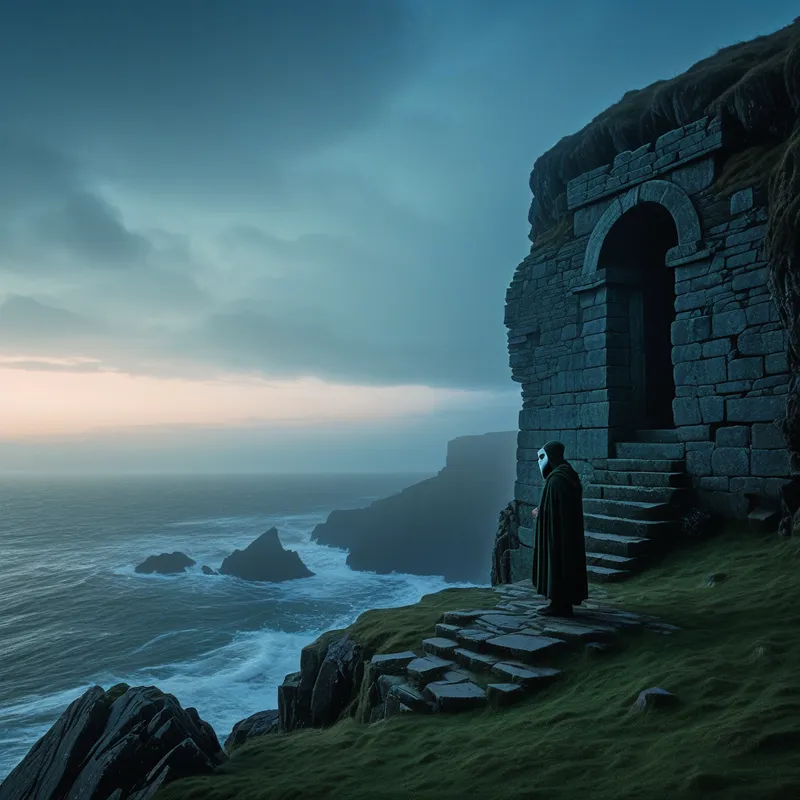
The Poet's Bothán Myth Meaning & Symbolism
A poet, driven mad by a stolen song, journeys to a liminal hut to reclaim his voice from the gods, facing the terror of his own creative source.
The Tale of The Poet’s Bothán
Listen. [The wind](/myths/the-wind “Myth from Various culture.”/) does not just blow across the grey-green hills; it carries a lament. It is the memory of a song lost, a melody stolen from the throat of [the world](/myths/the-world “Myth from Tarot culture.”/). In a time when [the veil](/myths/the-veil “Myth from Various culture.”/) was thin as morning mist, there lived a poet named Fili. His name was Céolchruthaitheoir, and his verses could calm storms, make stones weep, and cause kings to lay down their swords.
But one evening, as he chanted a new poem beside a sacred Tobar, a shadow fell across the [water](/myths/water “Myth from Chinese culture.”/)—not his own. From the deepening twilight emerged Ériu herself, but in her aspect as the Morrígan of inspiration. She did not speak. She simply opened her mouth, and the last, most beautiful line of Céolchruthaitheoir’s unfinished poem—the line that held its soul—was drawn from his lips like a silver thread. She swallowed it, turned, and vanished into the [Sídhe](/myths/sdhe “Myth from Celtic / Irish culture.”/) mounds.
A silence fell upon the poet, a silence so profound it was a living [thing](/myths/thing “Myth from Norse culture.”/) inside his chest. He was mute. Not just of voice, but of mind. The wellspring of his Aisling was dust. He became a hollow man, wandering the borders of the known world, a ghost to his own people.
In his despair, an old Druí, who remembered the older ways, found him. “The song is not destroyed,” the Druí whispered, his voice like dry leaves. “It has been taken to the Bothán an Fhile. It is a hut that stands where the world ends and the [Tír na nÓg](/myths/tr-na-ng “Myth from Celtic culture.”/) begins. To enter is to face the source of your gift, which is also the source of your madness. You may reclaim your song, or you may become a permanent part of the silence within.”
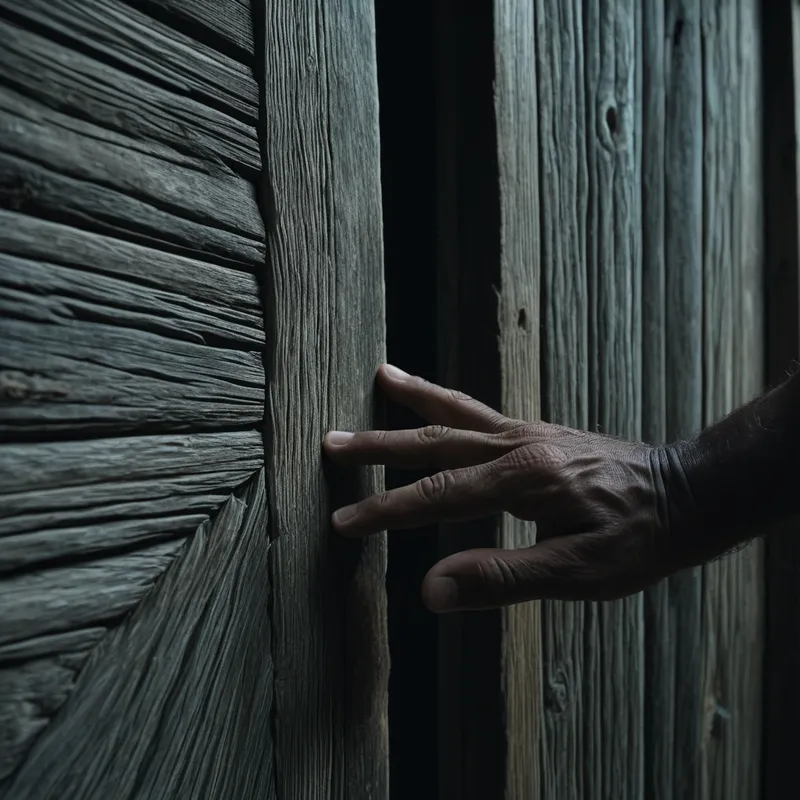
With nothing but his hollow heart, Céolchruthaitheoir journeyed to the edge of the western sea, to a cliff where the salt spray tasted of tears and time. There it stood: a simple, round hut of woven hazel and stone, with a roof of living sod and a door of ancient, unadorned oak. No path led to it. It simply was. The air around it hummed, a sound below hearing.
He pushed the door. It opened not onto a room, but onto a vast, starless interior sky. In the center, on a stool of blackthorn, sat his stolen line of poetry, now a shimmering, restless orb of light. And around it, forms moved—shadows of all the poems he had ever made, and all the poems he had failed to make. They whispered, they accused, they pleaded. The orb was the heart of this chaos. To take it, he understood, was to take responsibility for the entire storm of creation and destruction that lived inside him. He had to willingly step into the madness to master it. With a cry that was his first sound in a year, he plunged his hands into the light. It did not burn; it remembered. It flowed back into him, not as a single line, but as the terrifying, glorious torrent of the Imbas Forosnai. He fell to the floor of the hut—which was now just a floor of hard-packed earth—and when he awoke at dawn, he was on the cliff. The bothán was gone. And the wind carried a new song.
Cultural Origins & Context
The motif of the Bothán an Fhile is not a single, standardized myth from a specific text, but a powerful archetypal fragment woven through the later Bardic traditions and Fiannaíocht lore. It emerges from a culture where poetry (dan) was not entertainment but a sacred technology, a force that could shape reality, curse enemies, and uphold the truth (fír). The poet (fili) underwent decades of rigorous training, but his ultimate authority came from the Aisling, a potentially dangerous gift from the Sí.
This myth likely functioned as an initiatory parable within the bardic schools. It was told not to the public, but to apprentices grappling with the “drought” or the “frenzy” of inspiration. It served as a map for a psychological crisis. The bothán itself is a quintessential liminal space—more permanent than a tent, less solid than a house, often associated with hermits, madmen, and visionaries on the edges of society and geography. It represents the structured container necessary to approach the formless chaos of the unconscious, the cruthaitheach (creative) source. The story validates the ordeal of the artist, framing the loss of voice not as a failure, but as the necessary prelude to a deeper, more terrifying encounter with the muse.
Symbolic Architecture
At its core, the myth diagrams the [relationship](/symbols/relationship “Symbol: A representation of connections we have with others in our lives, often reflecting our emotional state.”/) between the conscious ego (the poet), the transcendent [source](/symbols/source “Symbol: The origin point of something, often representing beginnings, nourishment, or the fundamental cause behind phenomena.”/) of creativity (the [goddess](/symbols/goddess “Symbol: The goddess symbolizes feminine power, divinity, and the nurturing aspects of life, embodying creation and wisdom.”/)/Tír na nÓg), and the mediating container (the bothán).
The stolen song-line represents the numinous core of a creative work—its essential spark, which feels bestowed from beyond [the self](/myths/the-self “Myth from Jungian culture.”/). Its theft is the experience of creative blockage, depression, or the sense that one’s [authentic voice](/symbols/authentic-voice “Symbol: The ‘Authentic Voice’ symbolizes the true expression of self, encompassing personal beliefs, emotions, and individuality.”/) has been alienated. The poet’s muteness is the [paralysis](/symbols/paralysis “Symbol: A state of being unable to move or act, often representing feelings of powerlessness, fear, or being trapped in waking life.”/) of [the ego](/myths/the-ego “Myth from Jungian culture.”/) when cut off from the nourishing waters of the unconscious.
The Bothán is not where the gift is kept. It is where the self meets the condition of being worthy of the gift.
The Bothán itself is the crucial [symbol](/symbols/symbol “Symbol: A symbol can represent an idea, concept, or belief, serving as a powerful tool for communication and understanding.”/). It is the [temenos](/myths/temenos “Myth from Greek culture.”/), the sacred precinct. It is the [ritual](/symbols/ritual “Symbol: Rituals signify structured, meaningful actions carried out regularly, reflecting cultural beliefs and emotional needs.”/) [structure](/symbols/structure “Symbol: Structure in dreams often symbolizes stability, organization, and the framework of one’s life, reflecting how one perceives their environment and personal life.”/), the artistic form (the sonnet, the [canvas](/symbols/canvas “Symbol: A blank surface representing potential, creativity, and the foundation for expression or identity.”/), the [ritual](/symbols/ritual “Symbol: Rituals signify structured, meaningful actions carried out regularly, reflecting cultural beliefs and emotional needs.”/)), the therapeutic container, even the disciplined mind itself. It provides the boundaries that make encountering the infinite possible without being annihilated. The [moment](/symbols/moment “Symbol: The symbol of a ‘moment’ embodies the significance of transient experiences that encapsulate emotional depth or pivotal transformations in life.”/) the [interior](/symbols/interior “Symbol: The interior symbolizes one’s inner self, thoughts, and emotions, often reflecting personal growth, vulnerabilities, and secrets.”/) becomes a starless sky reveals that the true “hut” is within the poet’s own [psyche](/myths/psyche “Myth from Greek culture.”/). The chaotic shadows of made and unmade poems are the contents of the personal and [collective unconscious](/symbols/collective-unconscious “Symbol: The Collective Unconscious refers to the part of the unconscious mind shared among beings of the same species, embodying universal experiences and archetypes.”/), the repressed [material](/symbols/material “Symbol: Material signifies the tangible aspects of life, often representing physical resources, desires, and the physical world’s influence on our existence.”/) and latent potentials. Reclaiming the orb is an act of re-[integration](/symbols/integration “Symbol: The process of unifying disparate parts of the self or experience into a cohesive whole, often representing psychological wholeness or resolution of internal conflict.”/), not simple retrieval. The poet [doesn](/symbols/doesn “Symbol: The word ‘doesn’ typically points to a lack or feeling of uncertainty regarding action or inactivity in one’s life.”/)‘t just get his old song back; he is flooded with the raw power of Imbas, meaning he has aligned his conscious will with the creative dynamism of the Self.
The Dreamer’s Resonance
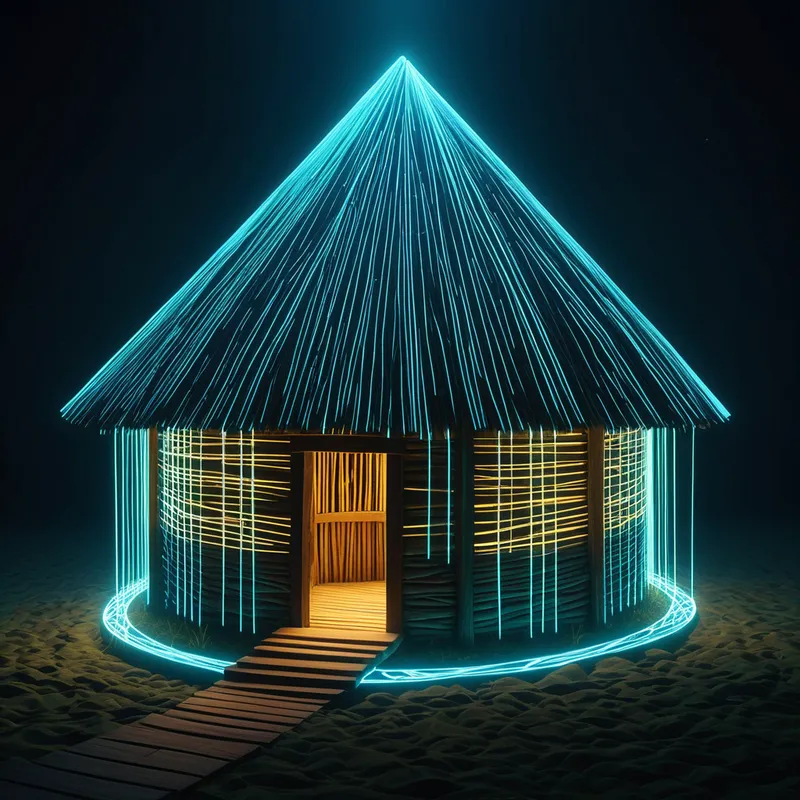
When this myth stirs in modern dreams, it seldom appears as a literal Celtic hut. It manifests as a profound dream of a liminal room: a forgotten closet in one’s childhood home that now contains something terrifying and vital; a shed at the bottom of a garden with a locked door; a small, isolated cabin in a dream-forest that the dreamer both fears and is compelled to enter.
The somatic experience is one of dread mixed with magnetic pull. There is a tightening in the chest, a literal feeling of being “speechless” or powerless. This dream pattern signals that the dreamer is at [the threshold](/myths/the-threshold “Myth from Folklore culture.”/) of a major psychological process—what James Hillman might call a “poetics of the soul.” They are being called to confront a lost or stolen part of their own creative spirit, their authentic voice, or a deep truth they have been unable to articulate. The “theft” often correlates with a life event, trauma, or long-held adaptation that silenced a core aspect of the self. The dream bothán is the psyche’s own staging ground for the recovery mission. To enter the dream-hut is to consent to the inner work. To flee from it is to remain in the “wandering hollow” state of depression or creative sterility.
Alchemical Translation
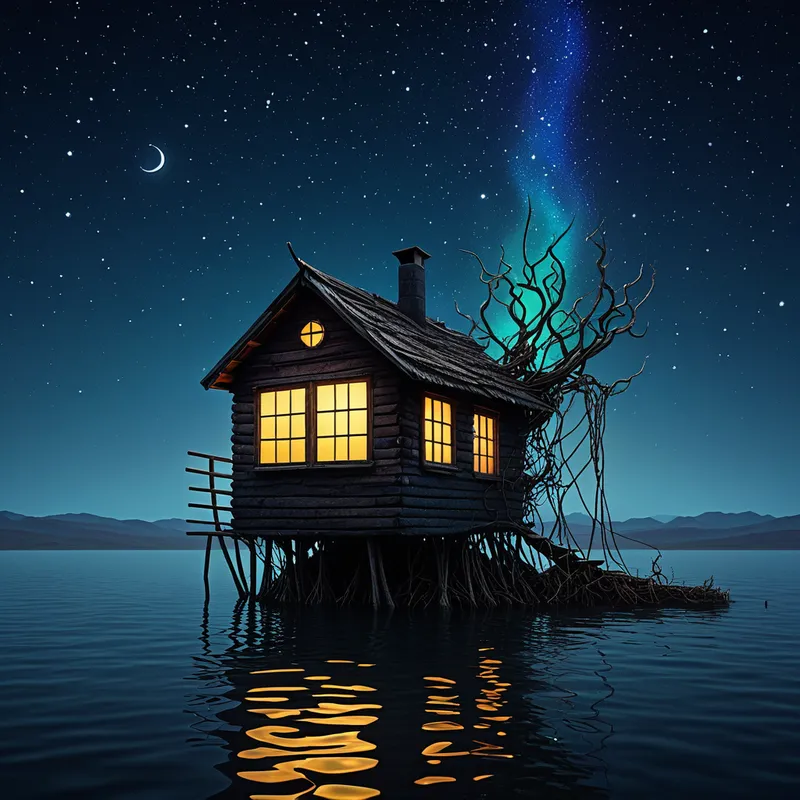
In the alchemy of individuation, the myth of the Poet’s Bothán models the Coniunctio with the creative spirit, a stage beyond the initial encounter with [the shadow](/myths/the-shadow “Myth from Jungian culture.”/) or anima/animus.
The poet’s initial state is the [Nigredo](/myths/nigredo “Myth from Alchemical culture.”/), [the dark night of the soul](/myths/the-dark-night-of-the-soul “Myth from Christian Mysticism culture.”/) where all meaning and vitality (the song) is lost. The journey to the cliff’s edge is the conscious commitment to the process, the Albedo. The bothán is the Vas, [the hermetic vessel](/myths/the-hermetic-vessel “Myth from Alchemy culture.”/) where the transformation occurs.
The ordeal is not to steal back from the gods, but to discover that the god-voice was always one’s own deepest voice, waiting to be claimed with adult courage.
Entering the bothán and facing the chaotic interior represents the [Rubedo](/myths/rubedo “Myth from Alchemical culture.”/), the fiery confrontation with the totality of the psyche. The shimmering orb is the [Lapis Philosophorum](/myths/lapis-philosophorum “Myth from Alchemical culture.”/) in its nascent state—the integrated Self. By plunging his hands into it, the poet performs the ultimate alchemical act: he incorporates the transcendent into the personal. [The flood](/myths/the-flood “Myth from Biblical culture.”/) of Imbas is the resultant Multiplicatio. The creative function is no longer a sporadic gift from the unconscious but a sustained, flowing relationship with it. The poet returns not just with a song, but as a vessel for the song. For the modern individual, this translates to the movement from being a victim of one’s complexes and blocks to becoming a conscious co-creator of one’s life narrative, having faced the source of one’s power and accepted its terrifying, glorious responsibility. The bothán, therefore, is [the crucible](/myths/the-crucible “Myth from Alchemical culture.”/) of authentic voice.
Associated Symbols
Explore related symbols from the CaleaDream lexicon: