The Poem of the Righteous Sufferer Ludlul Myth Meaning & Symbolism
A Babylonian nobleman, pious and prosperous, is cast into inexplicable suffering by the gods, only to be restored after a profound crisis of faith and identity.
The Tale of The Poem of the Righteous Sufferer Ludlul
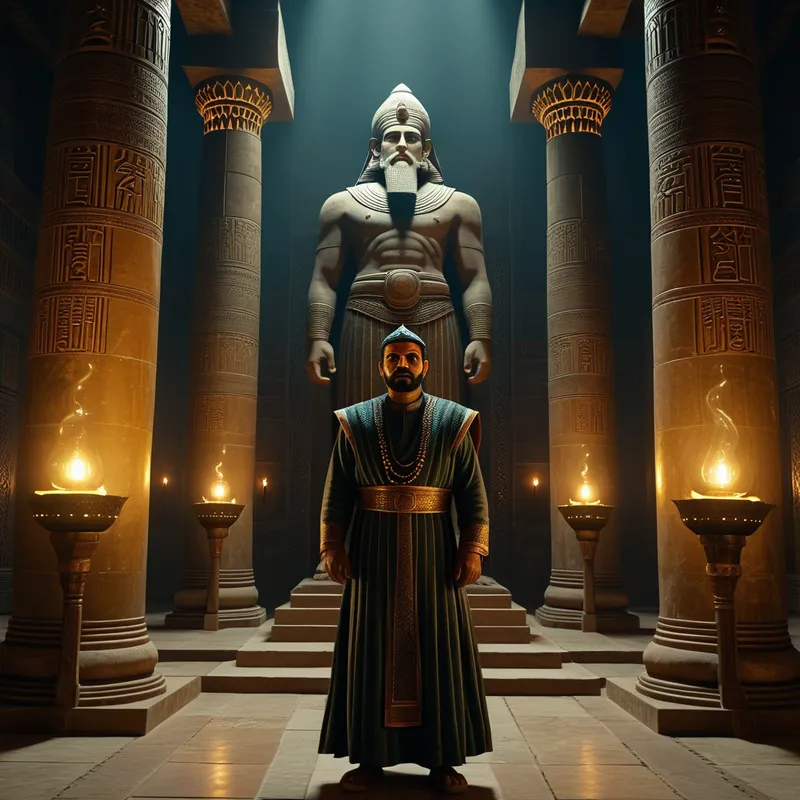
Hear now the lament of a man who walked in the light and was cast into the deepest dark. I will sing of Shubshi-meshre-Shakkan, a lord among men, a prince of Babylon. His table groaned with abundance, his counsel was sought by kings, and his voice rose in praise to the gods each dawn and dusk. He was a man who knew the rites, who poured libations of fine oil, who offered the fattest lambs to Marduk, and who honored the šēdu and lamassu who walked at his shoulder.
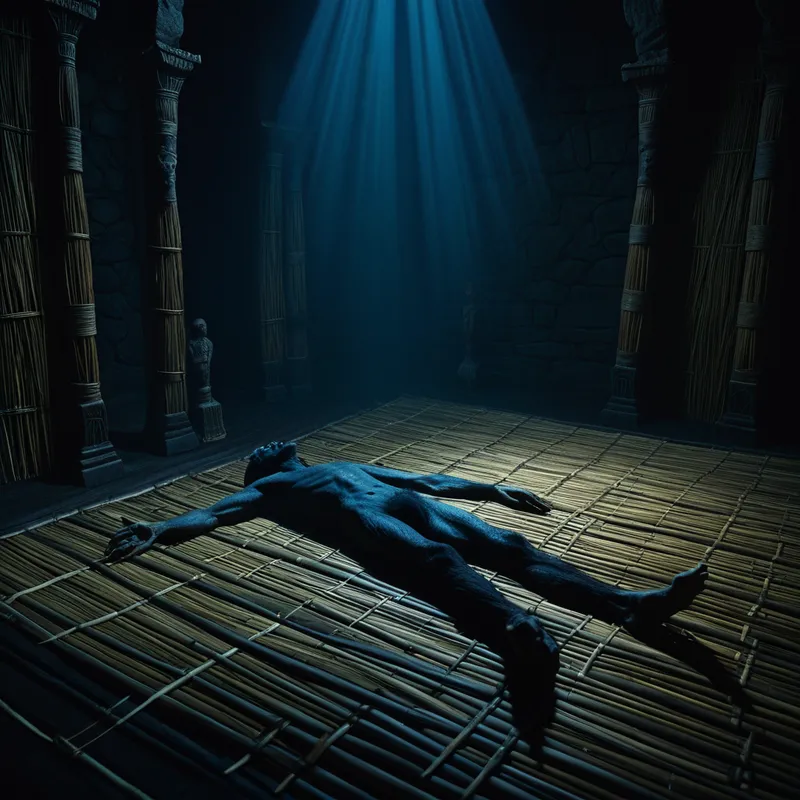
But the wind from the north changed. Without warning, without transgression, the cord was cut. His protective spirits vanished like mist in the midday sun. Where there was favor, a curse settled. His friends became spies, whispering in shadowed corners. His brothers plotted, their eyes gleaming with malice. His body, once strong, became a prison of affliction. A searing pain settled in his skull, his ears filled with a deafening roar. His eyes clouded, seeing only phantoms. A burning fever consumed his flesh; his skin erupted in pustules that wept and stank. He was cast from his bed to a mat on the floor, a feast for flies.
He cried out to his god, but the heavens were brass. He sought a sign in the entrails of sheep, but the diviner saw only confusion. The priests could not name his sin. The exorcists could not drive out the nameless demon that clung to him. He was expelled from the temple, deemed unclean, an offense to the divine presence. “My god has forsaken me,” he wailed into the silence. “My goddess has abandoned me.” The very order of the cosmos, the mes, seemed to unravel around him. He was a ghost among the living, a righteous man drowning in a sea of unjust suffering.
Then, in the depth of his despair, as he hovered at the threshold of the Erṣetu, a change stirred. Not in his body, but in the unseen fabric of things. He began to dream. Visions came, not of comfort, but of strange and portentous signs. And in the waking world, a messenger arrived—a šā’ilu, a dream interpreter. This man did not speak of sins, but listened to the suffering. He spoke of a god whose ways are inscrutable, whose anger is a mystery, but whose mercy is profound.
And then, the dawn. The weight lifted. The pain receded like a tide. His eyes cleared, and he saw the sun—Shamash—not as a tormentor, but as a healer. Marduk, the king of the gods, whose heart had seemed like stone, turned. The mighty god reached down and shattered the demonic bonds. The sores healed. The fever broke. His family returned, his friends sought forgiveness, his honor was restored tenfold. He was led back into the temple, not as an outcast, but as a living testament. He stood before the statue of Marduk, and his first restored act was to pour out a libation of gratitude, his song of lament transformed into a hymn of bewildered, glorious praise.
Cultural Origins & Context
Ludlul bēl nēmeqi, meaning “I will praise the Lord of Wisdom,” is a masterpiece of Mesopotamian literature from the Kassite period. Composed in Akkadian on a series of clay tablets, it belongs to a genre of “righteous sufferer” literature, a profound theological exploration that grappled with the problem of theodicy—why do the righteous suffer?—centuries before the Book of Job.
This was not folk tale, but high literature, studied and copied by scribes in the edubbas (scribal schools). It functioned as both a theological treatise and a psychological balm for an elite, literate class whose world was built on a precarious covenant with the gods. In the Babylonian worldview, prosperity and health were direct evidence of divine favor. Sudden catastrophe, therefore, was not mere misfortune; it was a cosmic crisis, a terrifying indication that one’s relationship with the divine had ruptured, often for reasons utterly unknown. The poem provided a narrative container for this unbearable anxiety. It affirmed that even the most devout could be tested, that the gods’ justice was ultimately beyond human comprehension, and that restoration, though never guaranteed, was possible. It was a map for the spiritual desert.
Symbolic Architecture
At its core, Ludlul is not about [punishment](/symbols/punishment “Symbol: A dream symbol representing consequences for actions, often tied to guilt, societal rules, or internal moral conflicts.”/) for sin, but about the terrifying withdrawal of meaning. The [protagonist](/symbols/protagonist “Symbol: The central character or hero in a narrative, representing the dreamer’s ego, agency, or the part of the self navigating life’s challenges.”/)’s social [identity](/symbols/identity “Symbol: Identity represents the sense of self, encompassing personal beliefs, cultural background, and social roles.”/), physical integrity, and religious certainty are all systematically dismantled.
The most profound suffering is not pain itself, but the annihilation of the story you told about why the pain should not be.
The afflictions are symbolic: lost [vision](/symbols/vision “Symbol: Vision reflects perception, insight, and clarity — often signifying the ability to foresee or understand deeper truths.”/) (the failure of understanding), [deafness](/symbols/deafness “Symbol: A dream symbol representing inability to hear, often signifying emotional disconnection, avoidance of truth, or spiritual blockage.”/) ([isolation](/symbols/isolation “Symbol: A state of physical or emotional separation from others, often representing a need for introspection or signaling distress.”/) from divine or [human](/symbols/human “Symbol: The symbol of a human represents individuality, complexity of emotions, and social relationships.”/) communication), [skin](/symbols/skin “Symbol: Skin symbolizes the boundary between the self and the world, representing identity, protection, and vulnerability.”/) [disease](/symbols/disease “Symbol: Disease represents turmoil, issues of control, or unresolved personal conflicts manifesting as physical or emotional suffering.”/) (the [breakdown](/symbols/breakdown “Symbol: A sudden failure or collapse of a system, structure, or mental state, often signaling a need for fundamental change or repair.”/) of the [boundary](/symbols/boundary “Symbol: A conceptual or physical limit defining separation, protection, or identity between entities, spaces, or states of being.”/) between self and world, becoming repulsive to the [community](/symbols/community “Symbol: Community in dreams symbolizes connection, support, and the need for belonging.”/)). The [abandonment](/symbols/abandonment “Symbol: A dream symbol representing feelings of being left behind, isolated, or emotionally deserted, often tied to primal fears of separation and loss of support.”/) by his personal god and [goddess](/symbols/goddess “Symbol: The goddess symbolizes feminine power, divinity, and the nurturing aspects of life, embodying creation and wisdom.”/) represents the collapse of the internalized parental [archetype](/symbols/archetype “Symbol: A universal, primordial pattern or prototype in the collective unconscious that shapes human experience, behavior, and creative expression.”/)—the sense of a protective, guiding [presence](/symbols/presence “Symbol: Presence in dreams often signifies awareness or acknowledgment of something significant in one’s life.”/) in the [universe](/symbols/universe “Symbol: The universe symbolizes vastness, interconnectedness, and the mysteries of existence beyond the individual self.”/). He is orphaned by the [cosmos](/symbols/cosmos “Symbol: The entire universe as an ordered, harmonious system, often representing the totality of existence, spiritual connection, and the unknown.”/) itself.
The turning point is the [arrival](/symbols/arrival “Symbol: The act of reaching a destination, marking the end of a journey and the beginning of a new phase or state.”/) of the dream interpreter. This figure symbolizes the [emergence](/symbols/emergence “Symbol: A process of coming into being, rising from obscurity, or breaking through a barrier, often representing birth, transformation, or revelation.”/) of a new psychic function: not the ego pleading its [case](/symbols/case “Symbol: A case often signifies containment, protection of personal matters, and the need for organization in one’s life.”/), but a [capacity](/symbols/capacity “Symbol: A measure of one’s potential, limits, or ability to contain, process, or achieve something, often reflecting self-assessment or external demands.”/) for receptive interpretation. It is the beginning of listening to the symptoms, the dreams, the [chaos](/symbols/chaos “Symbol: In Arts & Music, chaos represents raw creative potential, uncontrolled expression, and the breakdown of order to forge new artistic forms.”/), not as meaningless punishment, but as a cryptic communication from the [depths](/symbols/depths “Symbol: Represents the subconscious, hidden emotions, or foundational aspects of the self, often linked to primal fears or profound truths.”/). The restoration that follows is not a return to the old state, but a [rebirth](/symbols/rebirth “Symbol: A profound transformation where old aspects of self or life die, making way for new beginnings, growth, and renewal.”/) into a more complex [relationship](/symbols/relationship “Symbol: A representation of connections we have with others in our lives, often reflecting our emotional state.”/) with the divine—one that includes the experience of abandonment and [mystery](/symbols/mystery “Symbol: An enigmatic, unresolved element that invites curiosity and exploration, often representing the unknown or hidden aspects of existence.”/).
The Dreamer’s Resonance
When this mythic pattern stirs in the modern psyche, it manifests in dreams of profound existential dislocation. One may dream of being in their own home, but every door opens to a void. Familiar faces of family or partners become cold, alien, and hostile. The dreamer might find themselves covered in a strange, unhealing rash or unable to speak, their voice stolen. These are somatic expressions of the “dark night of the soul,” where the foundational narratives of one’s life—career, relationships, self-image—crumble without apparent cause.
The psychological process is the brutal, involuntary stripping of the persona and the conscious ego’s structures. It is the ego’s confrontation with the Shadow and the terrifying autonomy of the psyche, which can withdraw its energy (the “protective spirits”) and plunge the individual into a state of psychic poverty. The dreamer is undergoing a crisis of meaning, where old gods (values, goals, beliefs) have died, and new ones have not yet appeared.

Alchemical Translation
The alchemical journey in Ludlul is a perfect model of nigredo—the blackening, the putrefaction—followed by a mysterious albedo—the whitening, the cleansing. The righteous sufferer is the prima materia, the base metal of a naive consciousness that believes in a simple equation: piety = prosperity. His suffering is the necessary dissolution in the sealed vessel of isolation.
The crucible of unjust suffering forces a consciousness to choose: to identify forever as a victim of a broken universe, or to seek a meaning that transcends cause and effect.
His lamentations are the heat of the opus. He does not initially understand the process; he only feels its agony. The key operation is not an action he takes, but a stance he eventually adopts: the willingness to report his dreams, to have his chaos interpreted. This is the coniunctio between the shattered ego and a new, symbolic intelligence. The restoration by Marduk symbolizes the emergence of a new ruling principle from the unconscious—a Self that is more complex and resilient because it has integrated the reality of divine caprice and human fragility. The individual is no longer a child of the gods, but an adult who has faced their absence and lived to offer a libation of gratitude for the incomprehensible whole.
Associated Symbols
Explore related symbols from the CaleaDream lexicon:
- Wound — The physical and social afflictions of the sufferer represent the rupture in the individual’s covenant with reality, the point where meaning leaks out and suffering floods in.
- Abandonment — The core trauma of the myth, as the personal protective deities vanish, symbolizing the psyche’s terrifying experience of being orphaned by its own guiding principles.
- Dream — The pivotal mechanism for change; when conscious understanding fails, the dream becomes the vessel for cryptic messages from the deeper Self, offering a thread through the labyrinth.
- God — Represents the ultimate, inscrutable authority of the psyche (the Self), whose judgments are beyond ego comprehension and whose mercy is not earned but mysteriously granted.
- Healing — Not merely the cessation of pain, but the restoration that follows dissolution, creating a stronger, more conscious structure that includes the memory of brokenness.
- Justice — The central questioned concept; the myth challenges simplistic notions of cosmic justice, proposing a deeper, more paradoxical order that operates on a level beyond human morality.
- Shadow — The collective of demonic forces, former friends, and bodily decay that assails the sufferer, representing everything the conscious identity has rejected or ignored, now demanding integration.
- Temple — The symbol of sacred order and community; expulsion from it is the depth of isolation, and return to it marks the reintegration of the transformed individual into a meaningful world.
- Right — The protagonist’s unwavering, yet shattered, belief in his own righteousness forms the central paradox, forcing a confrontation with a universe that does not operate on a system of just deserts.