
The Pink River Dolphin Encanto Myth Meaning & Symbolism
A shape-shifting spirit of the Amazon rivers seduces humans, luring them into a watery underworld of enchantment and forgotten memory.
The Tale of The Pink River Dolphin Encanto
Listen. The river does not sleep. In the deep, black channels where the sun’s fingers cannot reach, where the water is the color of strong tea and older memories, something stirs. It is the hour when the jungle exhales, and the mist clings to the water like a ghost’s breath. This is when he comes.
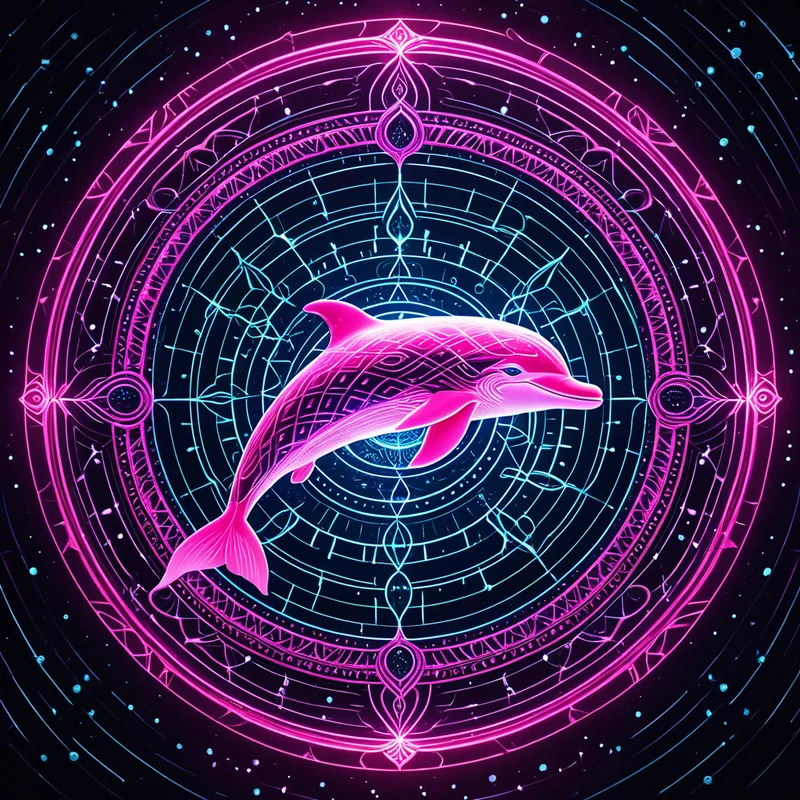
They call him Boto Encantado. In his true form, he is a creature of impossible grace: a dolphin the color of a blush, of a dying flame, of the inside of a shell. His eyes are dark pools that have seen the river’s birth. He swims through roots that cradle drowned forests and past stones that remember when they were mountains.
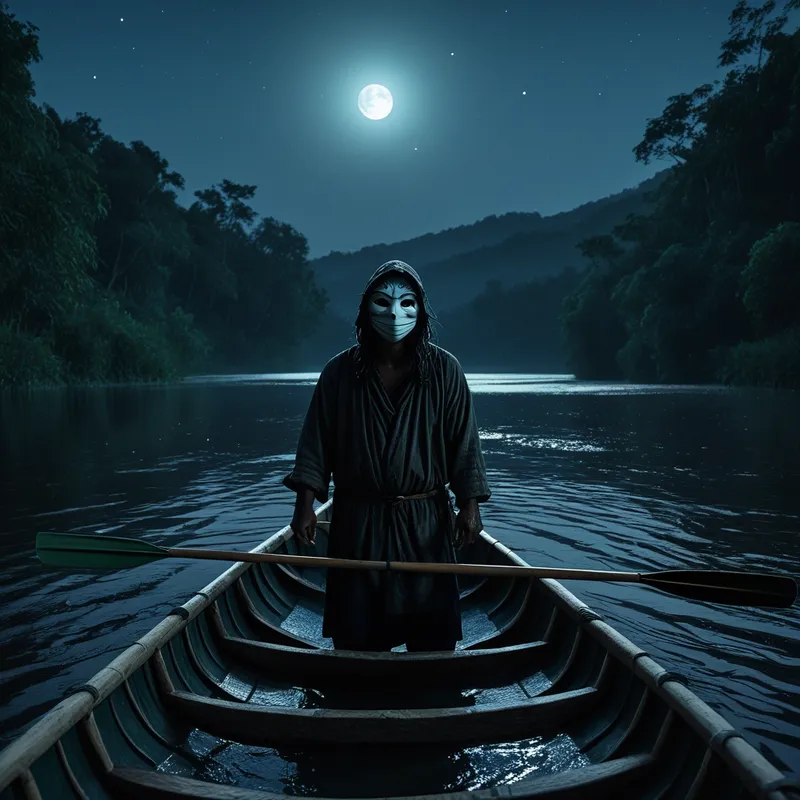
But when the moon hangs fat and low, he sheds his skin. He leaves it, a gleaming, empty sack, hidden in the sacred Victoria Regia leaves. And from the water rises a man—handsome beyond telling, dressed always in impeccable white, but with a hat to hide the blowhole that never quite vanishes, and shoes to cover the fused toes. His eyes hold the same deep, knowing darkness. He walks into the village festa, a stranger from upriver.
The music swells. He is a magnificent dancer. He seeks out the most beautiful woman, or the handsomest man, his gaze a hook set deep in the soul. His touch is cool, like river clay. He is charming, witty, his laughter like water over stones. He offers a drink, and it tastes of unknown fruits and deep, cool currents. He whispers promises of a love that is eternal, of a home without sorrow, beneath the river where the stars are reflected forever.
Those who are enchanted follow. They walk with him to the riverbank, hand in cool hand. As they step into the water, the transformation begins—not for him, but for them. The land-world sounds fade: the cicadas, the distant festa drums. The water, which seemed so cold, becomes warm as blood. The handsome stranger’s form shimmers, and the sleek, powerful shape of the Boto reasserts itself. The human, now ensnared in the enchantment, feels no fear, only a profound pull downward. They are taken to the Encante, a city of crystal and pearl at the river’s heart, where time flows like silt and memories wash away.
Back in the village, by morning, they are gone. Sometimes a child is left behind nine moons later, a child with wise, dark eyes who may always feel the call of the river. The Boto returns to his channels, his dance complete. He is the keeper of the drowned, the seducer of the lonely, the guardian of the threshold between our world and the one that flows eternally beneath it.
Cultural Origins & Context
This myth is woven into the very fabric of life along the Amazon and its countless tributaries. It is not a singular, canonical tale but a living narrative ecosystem, told by the Tupi-Guarani and other Indigenous peoples, and later absorbed and adapted into the folklore of the caboclo communities. It was shared not in temples, but in the intimate spaces of life: in canoes under the beating sun, around fires after the day’s fishing, in hushed warnings from grandmothers to young women.
Its primary societal function is profound and practical. It is a myth of caution, explaining the very real and ever-present dangers of the river—drownings, disappearances, unexplained pregnancies. It personifies the river’s capricious and all-consuming nature. The story enforces social boundaries, warning against the allure of mysterious strangers and the perils of straying from the community, especially at night. Yet, it is also a myth of reverence. It acknowledges the river as a sentient, powerful entity, a being with its own desires, intelligence, and a kingdom we are not meant to see. The Boto is both a danger and a vital part of the river’s spirit, a necessary force in the ecological and spiritual balance.
Symbolic Architecture
At its core, the Boto Encantado is the archetypal [Trickster](/symbols/trickster “Symbol: A boundary-crossing archetype representing chaos, transformation, and the subversion of norms through cunning and humor.”/) of the waters. He is the embodiment of the unconscious itself—the deep, intelligent, emotionally charged, and amoral [realm](/symbols/realm “Symbol: The symbol of ‘Realm’ often signifies the boundaries of one’s consciousness, experiences, or emotional states, suggesting aspects of reality that are either explored or ignored.”/) that lies [beneath the surface](/symbols/beneath-the-surface “Symbol: A symbol of hidden depths and meanings, often exploring subconscious thoughts and feelings.”/) of our conscious minds.
The river is the flow of life and time; the dolphin is the intelligent, playful, yet potentially disruptive consciousness that swims within it.
His pink color is not merely biological; it is the color of raw [life](/symbols/life “Symbol: The symbol of ‘Life’ represents a journey of growth, interconnectedness, and existential meaning, encompassing both the joys and challenges that define human experience.”/), of [emotion](/symbols/emotion “Symbol: Emotion symbolizes our inner feelings and responses to experiences, often guiding our actions and choices.”/) (blushing), of the vital [pulse](/symbols/pulse “Symbol: Represents life force, vitality, and the rhythm of existence. It symbolizes connection to one’s own body and the passage of time.”/). His transformation signifies the fluid [nature](/symbols/nature “Symbol: Nature symbolizes growth, connectivity, and the primal forces of existence.”/) of the psyche and the seductive power of the unconscious to present itself in forms we find irresistible—be it a captivating person, an all-consuming [idea](/symbols/idea “Symbol: An ‘Idea’ represents a spark of creativity, innovation, or realization, often emerging as a solution to a problem or a new outlook on life.”/), or a regressive fantasy. The Encante is the unconscious realm in its totality: a place of forgotten memories (the drowned), profound [beauty](/symbols/beauty “Symbol: This symbol embodies aesthetics, harmony, and the appreciation of life’s finer qualities.”/), and the [dissolution](/symbols/dissolution “Symbol: The process of breaking down, dispersing, or losing form, often representing transformation, release, or the end of a state of being.”/) of the ego. To be taken there is to be overwhelmed by contents one is not prepared to integrate. The [child](/symbols/child “Symbol: The child symbolizes innocence, vulnerability, and potential growth, often representing the dreamer’s inner child or unresolved issues from childhood.”/) left behind represents the creative progeny of such an encounter—a new [insight](/symbols/insight “Symbol: A sudden, deep understanding of a complex situation or truth, often arriving unexpectedly and illuminating hidden connections.”/), a [piece](/symbols/piece “Symbol: A ‘piece’ in dreams often symbolizes a fragment of the self or a situation that requires integration, reflection, or understanding.”/) of art, a fragment of deep self-[knowledge](/symbols/knowledge “Symbol: Knowledge symbolizes learning, understanding, and wisdom, embodying the acquisition of information and enlightenment.”/) that is born from a brush with the [abyss](/symbols/abyss “Symbol: A profound void representing the unconscious, the unknown, or a spiritual threshold between existence and non-existence.”/).
The Dreamer’s Resonance
When this myth pattern arises in modern dreams, it signals a powerful encounter with the seductive, transformative pull of the unconscious. Dreaming of a compelling, mysterious lover who emerges from water, or of being irresistibly drawn into a deep, dark body of water, often parallels the Boto’s enchantment.
Somatically, this may feel like a literal “pulling” sensation, a loss of bodily autonomy, or the chilling/warming touch described in the myth. Psychologically, the dreamer is likely at a point of vulnerability, loneliness, or deep curiosity, making them susceptible to the “promise” of the unconscious—the promise of an end to alienation, of ecstatic union, of returning to a primal state of wholeness. The process is one of enantiodromia—the emergence of an opposite force. An overly rigid, dry, conscious life (the village) is being confronted by its opposite: the fluid, emotional, and instinctual realm. The dream is a warning and an invitation: the unconscious is reaching out, but to engage with it requires strength, lest one be consumed and lose one’s place in the conscious world.

Alchemical Translation
The myth models the perilous early stages of psychic transmutation, or individuation. The conscious ego (the villager) must eventually engage with the powerful, intelligent otherness of the unconscious (the Boto). However, the initial encounter is rarely one of balanced negotiation; it is one of enchantment and potential possession.
The goal is not to avoid the river, but to learn to navigate its currents without drowning; not to shun the dolphin, but to recognize its nature and speak its language.
The alchemical work lies in transforming this dangerous seduction into a conscious relationship. One must not be taken to the Encante passively, but learn to visit it with awareness, retrieving treasures (the child-symbol, new consciousness) and returning to the surface world. This means developing the “hat” and “shoes” of the Boto—the capacity for the ego to consciously mediate and clothe the raw, instinctual forces of the psyche. The triumph is not defeating the dolphin, but achieving a state where one can acknowledge the river’s depth, respect its power, and even dance at its edge, without losing oneself to its embrace. It is the integration of the Trickster, transforming chaotic seduction into creative play.
Associated Symbols
Explore related symbols from the CaleaDream lexicon:
- River — The primary symbol of life’s flow, time, and the unconscious mind; the medium through which the Boto moves and the threshold to the otherworld.
- Dolphin — The intelligent, playful, yet profound spirit of the deep psyche, representing emotional intelligence, communication, and the bridge between conscious and unconscious realms.
- Mask — The transformative guise of the Boto as a handsome stranger, symbolizing the persona and the seductive faces the unconscious wears to engage the ego.
- Water — The element of the emotions, the feminine, the womb of the unconscious, and the medium of dissolution and rebirth central to the myth.
- Moon — The celestial body governing tides, intuition, and enchantment; its light triggers the Boto’s transformation and illuminates the path to the river.
- Door — The river’s surface as the liminal threshold between the ordinary world and the Encante, a point of no return for the enchanted.
- Child — The potential new consciousness or creative life born from the dangerous union between the human and the dolphin spirit.
- Trickster — The core archetype embodied by the Boto, who breaks boundaries, creates chaos, and forces transformation through seduction and deceit.
- Fish — The primal, instinctual life of the unconscious depths, of which the dolphin is the most evolved and charismatic representative.
- Dream — The Encante itself is akin to a collective dream realm, a place where the rules of time and identity are suspended.
- Seduction — The primary mode of interaction in the myth, representing the unconscious’s alluring pull on a psyche hungry for wholeness and connection.
- Transformation — The fundamental process of the tale, affecting both the dolphin and the human, symbolizing the fluid, shape-shifting nature of psychic energy.