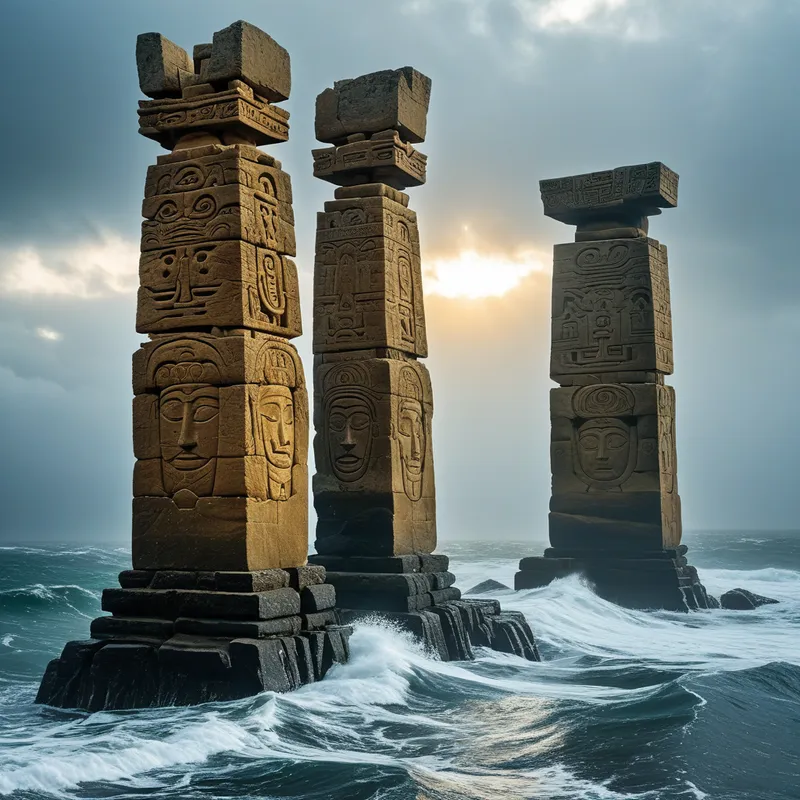
The Pillars of Hercules Myth Meaning & Symbolism
Hercules, as penance, performs a labor to reach the world's western edge, erecting pillars that mark the ultimate boundary between order and chaos.
The Tale of The Pillars of Hercules
Hear now the tale of the edge of the world, where the wine-dark sea of Pontus meets the yawning throat of oblivion. It is a story born of rage, of madness, and of a penance that would etch a man’s name into the very bones of the earth.
It began in shadow. Heracles, whom the Romans would call Hercules, was a son of Zeus, but the goddess Hera’s jealousy was a poison in his blood. In a fit of madness she sent, he saw not his beloved wife and children, but monstrous shapes. When the crimson fog lifted, he stood amidst a horror of his own making. The silence that followed was heavier than any mountain. To purify this unspeakable crime, the Delphic Oracle decreed a sentence: ten labors, services to his cousin, the petty king Eurystheus.
The tenth labor was a whisper of impossibility. “Bring me the cattle of Geryon,” Eurystheus commanded, a cruel smile on his lips. Geryon, a giant with three bodies, dwelt on the island of Erytheia, at the very western rim of the world, beyond where the sun plunged each night into the underworld. To reach it was to journey beyond the maps of men.
Heracles took his club, his lion-skin, and his sorrow, and walked west, always west. He crossed lands that tasted of myth and deserts that burned with forgotten names. Finally, he stood at the end of all things. Before him lay the vast, unknowable Oceanus, and barring his path to Erytheia, two great mountains stood joined, Calpe and Abyla. They were not mere rock; they were the final wall, the last teeth of the earth clamping shut against the outer chaos.
Here, the hero paused. No ship could sail around, no path led over. The very cosmos seemed to say, “Thus far, and no further.” But a labor undone was a soul forever stained. Drawing upon the divine strength in his veins, the son of Zeus planted his feet upon the bedrock of the world. He set his shoulders against the flank of Calpe, his hands against the face of Abyla. The earth groaned in protest. Stone screamed as it sheared. With a roar that echoed in the halls of Hades itself, he pushed. Muscles, sinew, and will became a single force of separation. The mountains shuddered, cracked, and slowly, irrevocably, moved apart.
The waters of Oceanus, held back for eons, rushed in with a thunderous roar, carving a new strait between the continents. Where once was a solid wall, now was a gateway. Heracles, breathing the salt spray of the newly freed sea, took stones from the mountains and raised two mighty pillars to mark the passage he had forced. They stood as eternal sentinels. He had reached Geryon, faced the monster, and taken the cattle, but that is another tale. The true labor was the passage. The true monument was not the cattle delivered, but the boundary crossed and forever marked: The Pillars of Hercules.

Cultural Origins & Context
The myth of the Pillars is not a single story from one poet, but a collective geographical mythos that crystallized around the known limits of the Hellenic world. For the early Greek sailors and traders, the Strait of Gibraltar was the ultimate peras, the limit beyond which lay the realm of monsters, perpetual fog, and the unknown—often called the Ocean River. The tangible, visible promontories of Gibraltar and Ceuta became naturally mythologized as the divine markers set by their greatest culture hero.
The tale was woven into the epic cycle of Heracles, most notably in accounts by ancient historians like Herodotus and poets referencing the hero’s journey to the Hesperides or Erytheia. It served a crucial societal function: it transformed a terrifying geographical reality into a narrative of human (or semi-divine) triumph. The boundary was not just a random edge; it was created by a hero, thus bringing it within the fold of the Greek cultural imagination. The warning inscription later attributed to the Pillars—Non Plus Ultra (“Nothing Further Beyond”)—encapsulates this dual function: it is both a warning of danger and a proud declaration of the known world’s extent, defined by heroic endeavor.
Symbolic Architecture
At its core, the myth is a master symbol of the limen, the threshold. The Pillars are the ultimate representation of a binary: known/unknown, order/chaos, civilization/wilderness, conscious/unconscious. Heracles’s act of separating them is not merely a feat of strength, but an act of cosmic differentiation.
To create a passage is to first acknowledge the wall. The hero’s task is not to deny the boundary, but to formalize it, making the unconscious conscious by erecting a marker between them.
Psychologically, Heracles at the Pillars represents the ego facing the ultimate boundary of the self. The crime that precipitated the labors—the murder of his family in madness—is the eruption of the unconscious (the “Hera-sent” fury) into the conscious realm. The labors are a protracted process of atonement and integration. The tenth labor, requiring him to journey to the world’s edge and create a gateway, symbolizes the final, most profound stage of this process: consciously engaging with the very architecture of his own psyche. He does not destroy the boundary (the mountains); he reconfigures it, creating a navigable strait and marking it with pillars. This is the establishment of a conscious relationship with the vast, unknown “Oceanus” of the personal and collective unconscious.
The Dreamer’s Resonance
When this myth stirs in the modern dreamer, it often manifests as an encounter with a formidable, dual barrier. One might dream of two towering gates, a narrow canyon entrance, a pair of immense doors, or even two silent figures blocking a path. The somatic feeling is one of arrested movement, profound hesitation, or immense pressure. There is a palpable sense of “thus far.”
This dream pattern signals a psychological process at a critical juncture. The dreamer is likely confronting a self-imposed or externally recognized limit in their life—a career ceiling, the edge of a relationship’s possibility, the boundary of a long-held identity, or the fear of embarking on a radically new phase. The dream presents the limit not as abstract but as architectural, solid, and ancient. The anxiety (or awe) felt is the ego’s recognition that to proceed requires a Herculean effort of will and a fundamental rearrangement of one’s inner landscape. The dream asks: What mountains within you need to be pushed apart to allow the next journey to begin?
Alchemical Translation
The alchemical journey, akin to Jung’s process of individuation, is one of successive separations (separatio) and unions (coniunctio). The myth of the Pillars is a perfect map for the separatio phase at its most grand scale. The undifferentiated mass of the joined mountains represents the massa confusa of the psyche, where opposites are fused in conflict (known/unknown, possible/impossible).
The labor of consciousness is the heroic act of distinction—pushing apart the fused opposites to create a vas, a sacred vessel or passage, in which transformation can occur.
Heracles’s act is the application of focused, disciplined will (the ego) upon the primal matter of the self (the unconscious). The resulting strait is the newly opened channel between conscious intention and unconscious potential. The erected pillars are the enduring symbols of this achievement—they do not close the passage but sanctify it, reminding the individual of the threshold they have integrated. For the modern soul, the “alchemical translation” is this: our greatest penance and our greatest labor is to face the edge of our own known world. Our madnesses and errors (the “crimes”) demand we journey to that edge. There, we must use our will not to flee or destroy the boundary, but to consciously, painstakingly create a gateway through it, forever marking the point where the old self ended and the voyage into the vast, unknown self began.
Associated Symbols
Explore related symbols from the CaleaDream lexicon: