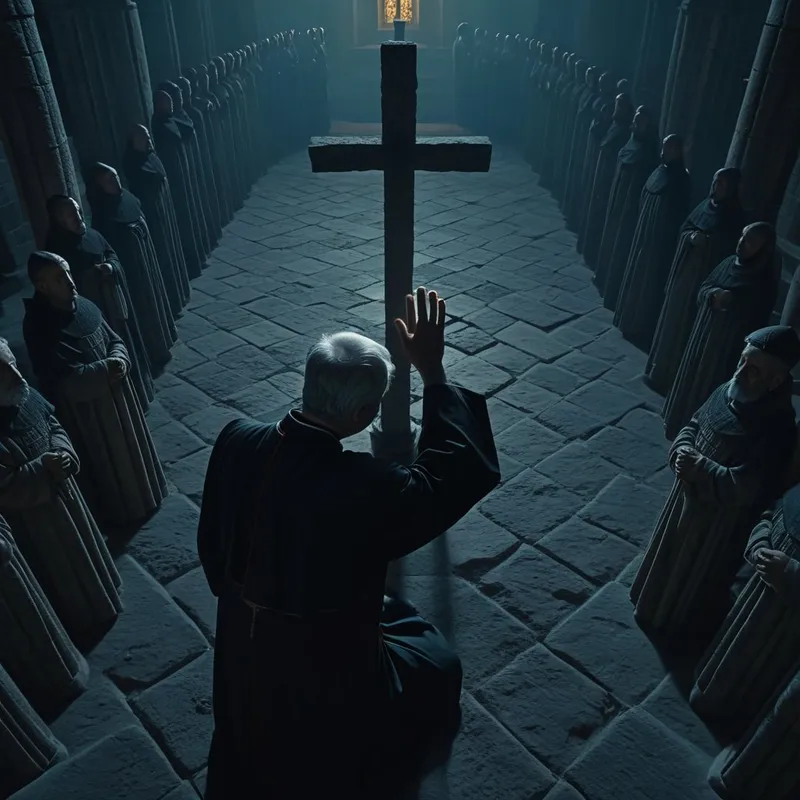
The Alchemy of Penance: When the Soul Demands Its Reckoning
The Somatic Echo
It begins not as a thought, but as a weight. A specific gravity in the chest, a density behind the sternum that pulls you toward the earth. It is the feeling of a ledger left unbalanced, a transaction suspended in the red. The breath becomes shallow, as if the air itself is rationed, a currency you are no longer worthy to spend in full. There is a cold, metallic taste at the back of the tongue—the flavor of old coins, of vows left to tarnish. This is the body’s memory of a fracture, a schism between an action and its consequence, between a version of the self that acted and the version that now must bear witness. It is not panic; it is a profound, cellular acknowledgment of a debt. The mind will later scramble to name it—guilt, shame, regret—but first, it is simply a somatic fact: something within the architecture of your being is out of true, and the entire structure groans in the wind.
The Dreamer's Log
I am kneeling on a floor of cold, polished stone. Before me is a simple wooden bowl, filled to the brim with dark water. My task is to carry it across an immense hall without spilling a single drop. I know, with dream-certainty, that the water is the sum of every harsh word I’ve ever spoken, now given liquid form. My focus is absolute, a prayer of muscle and will, but the surface trembles with the echo of my own heartbeat.
Here, the psyche presents its equation: the weight of intangible harm given a tangible, precious form. The act of carrying it is the penance—not an erasure, but a conscious, embodied transportation of consequence.

The False Lead
Penance is not punishment. This is the critical misstep. Punishment is external, a sentence passed down. It seeks to cripple, to diminish, to settle a score. Penance, in its deepest archetypal form, is an internal, sovereign act. It is not the lash of a whip you flee, but the stone you choose to carry. To mistake one for the other is to confuse a prison with a pilgrimage. A dream of mere punishment is a nightmare of helplessness. A dream of penance, however stark, contains a hidden engine of agency. The difference lies in the direction of the energy: punishment flows inward to crush, while penance is cultivated within to compost the past into a soil for future growth. It is not about bad luck or cosmic retribution; it is about a soul-imposed curriculum for integrity.
Psychological Architecture
The architecture of penance is built in the shadowlands of the Self, where the Internal Family System holds its most solemn councils. Here, a Protector part, perhaps one that acted with ruthlessness or cowardice in a past season of your life, stands accused by an Exile carrying the pain of that action—either pain you caused another or a betrayal of your own values. The psyche’s default state might be a civil war: the Protector justifying, the Exile weeping, the Self fragmented.
Penance emerges when the conscious you, the observing Self, steps onto this battlefield not as a judge, but as a mediator who accepts responsibility. This is the core of the Shadow work. You are not integrating the shadow by becoming the cruel Protector or the helpless Exile. You are integrating by acknowledging that both exist within your history, and that you—the sovereign of your present—hold the obligation to mend the rift between them. It is the process of Individuation in one of its most demanding phases: the refusal to disown any part of your story. You must host the trial where you are simultaneously the accused, the witness, and the only one capable of passing a sentence that leads not to death, but to transformation. The sentence is always the same: You must bear the weight of knowing what you have done, and from that weight, forge a new ethic of being.
Mythic Resonance
We see this eternal process in the myth of the Fisher King, guardian of the Grail. His wound—a grievous injury to the thigh, the seat of generative power—will not heal. His kingdom becomes a barren Wasteland, a direct reflection of his inner state. The healing question, when finally asked, is not “How are you wounded?” but “Whom does the Grail serve?” The penance here is the long, stagnant vigil. His suffering is the necessary condition that prepares him for the question. His kingdom suffers because he suffers, trapped in a cycle of sterile introspection. The penance is the wasteland itself, and the healing comes only when his focus shifts from his own pain to the sacred object of service. His penance is the prerequisite for his redemption.
Similarly, in the Greek psyche, the Erinyes (Furies) were not mere monsters of vengeance. They were the sacred enforcers of misama—ritual pollution caused by blood-guilt, especially against kin. They hounded the guilty not for petty justice, but to restore a cosmic order that had been ruptured. Their relentless pursuit was the engine of penance, forcing the guilty one toward an oracle, toward a prescribed ritual cleansing. The penance was the path out of the pollution, the only way to silence the Furies and transform them into the Eumenides, the “Kindly Ones.” The terror was the furnace.
Symbolic Nodes
- Carrying a Heavy, Fragile Load: A bowl of liquid, a stone, a child, a fragile artifact.
- Repetitive, Futile Tasks: Scrubbing a stain that won’t fade, counting grains of sand, rebuilding a collapsing wall.
- Barren or Waiting Landscapes: Empty deserts, frozen tundras, dormant fields—the internal Wasteland.
- Kneeling, Bowing, or Being Prostrate: The body in a posture of submission to a self-created law.
- Offering or Sacrificing a Valued Possession: Giving away a jewel, burning a book, releasing a beloved animal.
- Being Watched by Impassive Judges: Stone figures, portraits with moving eyes, a silent council.
Archetypal Resonance
The Ruler Archetype is the sovereign energy at the heart of true penance. Not the Shadow Ruler—the Tyrant who demands punishment from others—but the mature Ruler who understands that ultimate sovereignty begins with absolute responsibility for one’s own domain. The somatic echo—the weight in the chest—is the Ruler’s crown grown heavy, felt not as privilege but as duty. This archetype knows that to rule a life with integrity, one must first audit the kingdom’s ledgers, acknowledge every debt, and administer the difficult justice required to restore order and legitimacy. The alchemical potential lies in the Ruler’s capacity to pass a sentence that is simultaneously rigorous and restorative, transforming chaos (the guilt, the fracture) into a new, more resilient order (self-respect, wholeness). The penitent, in this light, is not a beggar at the gate, but a monarch cleaning their own throne room.
The Alchemical Process
The alchemy of penance is the transformation of leaden guilt into golden responsibility. The prima materia is the raw, toxic shame—the sense of being fundamentally flawed for an action. The heat and pressure are applied by the conscious, unwavering act of sitting with the debt. This is the nigredo, the blackening. You do not numb it, you do not rationalize it, you do not spin it into a lesson too quickly. You let its full weight press upon you.
In this crucible of sustained awareness, a separation occurs. The pure metal of your genuine fault—the specific breach of your own ethics—is separated from the slag of neurotic, identity-shattering shame. This is the albedo, the whitening. You see the act clearly, for what it was. Then, through the relentless focus of your attention and the willingness to make amends (even if only symbolically), the yellowing (citrinitas) begins: the understanding that this fault-line is now part of your structure, a vulnerability that can become a source of compassion, a compass-point for future action. The final rubedo, the reddening, is not the disappearance of the memory, but its integration. The weight remains, but its nature has changed. It is no longer a chain that drags; it is the ballast that steadies your ship. You have become sovereign over your own past.

The Integration Protocol
Question 1: If the feeling in the dream were a tangible object you must carry for one year, what would its exact weight, temperature, and texture be? Describe it without using metaphors of poison or filth.
Question 2: What exiled part of yourself did you betray in the original situation that now calls for penance? Was it your innocence, your courage, your compassion?
Question 3: Imagine the being or principle you feel you wronged. If true reconciliation were impossible, what single act of integrity—performed in absolute secrecy—would honor the sanctity you feel was violated?
Action 1 (The Silent Audit): In complete silence, with a pen and paper, write two columns. In the first, list the specific action or failure (e.g., "I broke a promise to X," "I remained silent when I should have spoken"). In the second, next to each, write not an apology, but the exact principle that was fractured (e.g., "Fidelity," "Courage"). Burn the first column. Keep the second.
Action 2 (The Vessel of Return): Find a small stone. Hold it and imbue it with the somatic echo of the debt. Then, take it to a moving body of water—a river, the sea, even a steady rain gutter. As you return it to the flow, state aloud: "I return the weight to the process. I keep the lesson."
Action 3 (Unstructured Writing from the Fracture): Set a timer for 10 minutes. Write from the perspective of the fracture itself—the space between who you were then and who you are now. Let it speak. Does it groan? Does it gleam? Is it cold? What does it see from its vantage point? Do not guide it toward resolution. Let it describe its own geography.
Final Validation
To dream of penance is to be entrusted with a severe and sacred grace. It means your psyche refuses the cheap salvation of forgetfulness. It insists you are worthy of a heavier, more authentic freedom—one earned through the courageous ownership of your entire story. The path is arduous, for it is walked alone, bearing a load no one else can see. But at its end lies a sovereignty that cannot be granted, only forged: the unshakable knowledge that you have met the darkest ledger of your soul, and having paid its price from your own substance, you now walk debt-free in the kingdom of your own life.