The Pierian Spring Myth Meaning & Symbolism
A sacred spring in Pieria, home to the Muses, whose waters grant divine inspiration and poetic madness to those who drink from its source.
The Tale of The Pierian Spring
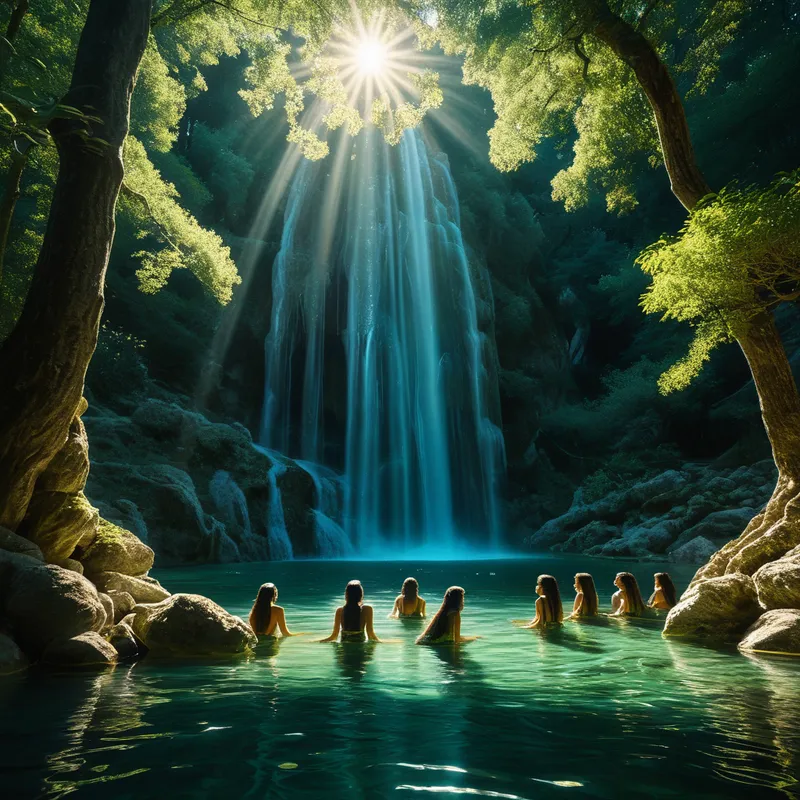
Listen. Before the first word was spoken, before the first song was sung, there was a sound. It was the sound of water, not falling, but welling up from the heart of the world. It flowed from a cleft in the sacred earth of Pieria, a land of wildflowers and whispering pines that cradled the lower slopes of mighty Olympus. This was no ordinary spring. Its waters were not silver, nor clear, but seemed to hold the light of a captured dawn, shimmering with a potential that was almost audible—a hum just below hearing.
This was the Pierian Spring, and it was the first home of the Muses. They were born not of flesh, but of memory and meaning, daughters of Mnemosyne, she who remembers all. The spring was their cradle and their mirror. Here, Calliope first traced the shape of a hero’s fate in the moist earth. Here, Erato heard the first echo of a heartbeat in the water’s drip. Euterpe found the rhythm in the bubbling flow, and Clio saw the past and future reflected on its shimmering surface. The spring was their shared breath, the source from which all art, all science, all true knowing, sprang.
But a source calls to the thirsty. From the plains and cities below came the seekers: the poets with dry throats and empty scrolls, the philosophers whose logic had led them to a cliff of silence, the musicians whose instruments had forgotten their song. The journey was perilous, a climbing into the realm of the gods. To find the spring was to leave the mundane world behind.
The ritual was simple, yet terrifying. One had to kneel on the mossy stones, silence the clamor of one’s own mind, and drink. Not a sip, but a deep draught. And the water… it was cold, colder than winter, and it burned like wine. It did not quench a physical thirst, but ignited a spiritual one. For some, it was a gentle unlocking, a door swinging open to a sunlit garden of verse. For others, it was a flood, a divine madness (theia mania) that tore through the soul, scouring away the ordinary self. The poet might emerge speaking in tongues of fire, the historian might see the tapestry of time in a single glance, the astronomer might hear the music of the spheres. But to drink was to be changed. To taste the water of the Pierian Spring was to remember, for a moment, what it was to be a god—and to carry the searing, beautiful burden of that memory back into the world of men.
Cultural Origins & Context
The Pierian Spring is not the subject of a single, grand epic narrative like the tales of Odysseus or Heracles. Its power is woven into the fabric of Greek thought through allusion and invocation, primarily in the works of poets who were, themselves, claiming its inspiration. The most famous reference comes from the poet Hesiod, who opens his Theogony by calling upon the Muses who “dance on soft feet about the deep-blue spring and the altar of the mighty Zeus.” He locates them specifically on Mount Helicon, but the tradition of their Pierian origin is older and more foundational.
This myth functioned as the foundational metaphor for the creative and intellectual process in Hellenic culture. It answered the profound question: where does a great idea, a beautiful melody, or a timeless truth come from? The Greeks attributed it not solely to personal genius, but to divine infusion. The spring symbolized the external, sacred source of this infusion. It was a cultural acknowledgment that inspiration (inspirare – to breathe into) comes from beyond the individual ego. Rhapsodes, playwrights, and philosophers would begin their works with a prayer to the Muses, a ritualistic “drinking from the spring” to legitimize their voice and align themselves with a tradition of divinely-sanctioned knowledge. It placed the artist and thinker in a lineage, connecting them to a primordial, sacred source.
Symbolic Architecture
At its core, the Pierian Spring is the archetypal symbol of the Source. It represents the wellspring of the unconscious, the collective font of image, pattern, and primordial knowledge from which all conscious creativity and cognition must draw.
The Spring is not knowledge itself, but the living water that makes the seeds of knowledge grow. To drink is to initiate a marriage between the structured mind and the chaotic, fertile depths.
The water symbolizes potentia—pure, undifferentiated potential. It is cold, representing the often shocking, alien quality of true inspiration, which does not come from our warmed-over thoughts. Its burn is the friction of integration, the difficult process of bringing a numinous idea into the realm of form and language. The location—on a mountain, near the gods—signifies that accessing this source requires an ascent, an effort to transcend the mundane concerns of the lowlands. The Muses, as guardians, represent the differentiated forms this raw potential can take: epic poetry, history, astronomy, comedy. They are the personified channels of the one, great Source.
Psychologically, the spring is the Self, the central, organizing principle of the psyche from which the ego-consciousness must periodically drink to remain vital and authentic. The “dry throat” of the seeker is the feeling of aridity, burnout, and meaninglessness that comes from living solely in the conscious, directed mind, cut off from the nourishing waters of the unconscious.
The Dreamer's Resonance
When this mythic pattern stirs in the modern dreamscape, it often manifests in times of creative block, intellectual stagnation, or a profound sense of spiritual dehydration. The dreamer may find themselves in a barren landscape, desperately searching for water. They might discover a hidden, glowing pool in an unexpected place—a basement, a closet, the center of a maze. The act of drinking is frequently fraught: the water may be elusive, the dreamer may be forbidden from drinking, or the water itself may transform—becoming thick like honey, burning like acid, or speaking in whispers.
Somatically, this dream process correlates with the psyche’s attempt to re-hydrate a parched aspect of the Self. The thirst is real. The conflict in the dream—the fear of drinking, the pollution of the spring, the presence of intimidating guardians—mirrors the dreamer’s own resistance. This resistance is often the ego’s fear of being overwhelmed, of losing control, of the madness (mania) that true inspiration can bring. To integrate a powerful new content from the unconscious can be destabilizing. The dream is the psyche’s ritual journey to the mountain, presenting the spring and testing the dreamer’s readiness to receive its gifts, to undergo the necessary transformation.
Alchemical Translation
The myth of the Pierian Spring is a perfect map for the alchemical process of individuation, specifically the stage of inspiratio—the divine inhalation. The modern individual’s “lowland” is the persona-driven life of adaptation, routine, and consensus reality. It is a necessary place, but one that can become a spiritual desert.
The journey to the Spring is the courageous withdrawal of projection and the turning inward. The climb is the hard, conscious work of self-examination, of confronting personal history and shadow material that blocks the path to the source.
The “drinking” is the critical, non-rational act of receptivity. It is allowing oneself to be penetrated by an insight, an image, or an emotion that does not originate from the ego’s agenda. This is the coniunctio, the sacred marriage of the conscious mind (the seeker) with the unconscious (the spring). The burning, cold water is the solve et coagula—it dissolves the old, rigid structures of thought and feeling, and begins the process of re-coagulating them around a new, more authentic center.
The triumph is not in becoming a famous poet, but in achieving the internal state of the one who has drunk. It is to carry a living connection to the source within. The transformed individual does not just have ideas; they are inspired. Their work and life flow from an inner Pierian Spring, a connectedness to the deep, creative ground of being. They understand that to create, to know, and to live authentically, one must regularly make the pilgrimage away from the noise of the world, kneel in humility at the source, and dare to drink the terrifying, glorious water of the soul.
Associated Symbols
Explore related symbols from the CaleaDream lexicon: