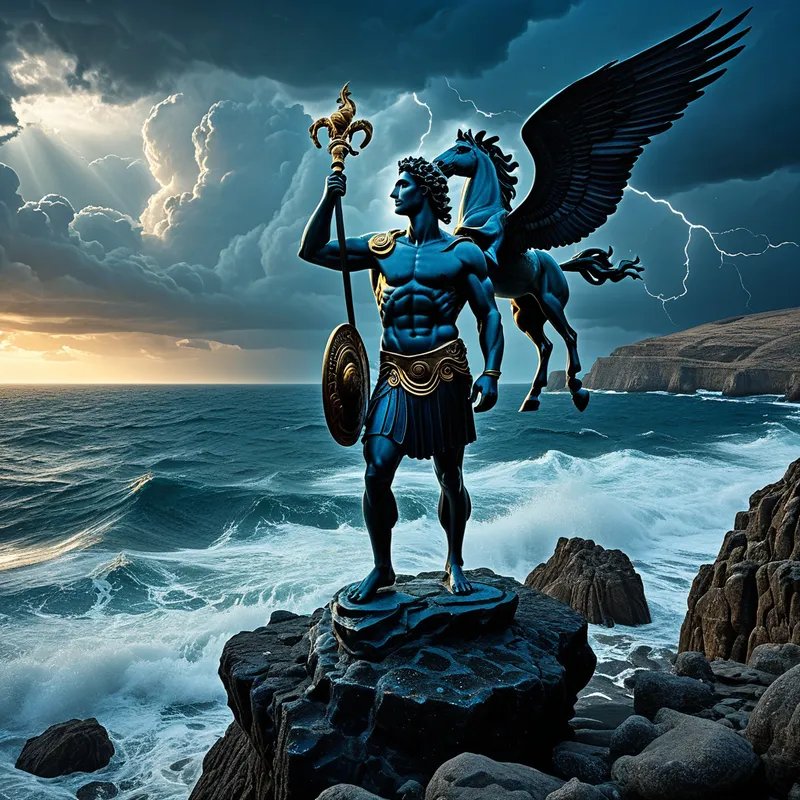
The Perseids Myth Meaning & Symbolism
The heroic lineage of Perseus, born of divine gold and mortal terror, whose descendants' trials and triumphs were immortalized as a celestial shower.
The Tale of The Perseids
Hear now a story written not on parchment, but in the very fabric of the night sky. It begins not with a hero, but with a prison. In the city of Argos, a king trembled. An oracle had spoken a cruel truth to King Acrisius: his own daughter’s son would one day be his death. Fear, cold and sharp, seized his heart. To defy fate, he built a chamber of bronze, sunk deep within [the earth](/myths/the-earth “Myth from Hindu culture.”/), and sealed his daughter, the radiant Danaë, inside. No mortal man could reach her. But fate has a key that fear cannot forge.
It came as a shower of gold. Zeus, he who commands the thunder, desired Danaë. He transformed his essence into a cascade of molten sunlight, piercing the bronze roof, falling upon her in the darkness. From this impossible union, a son was born: [Perseus](/myths/perseus “Myth from Greek culture.”/).
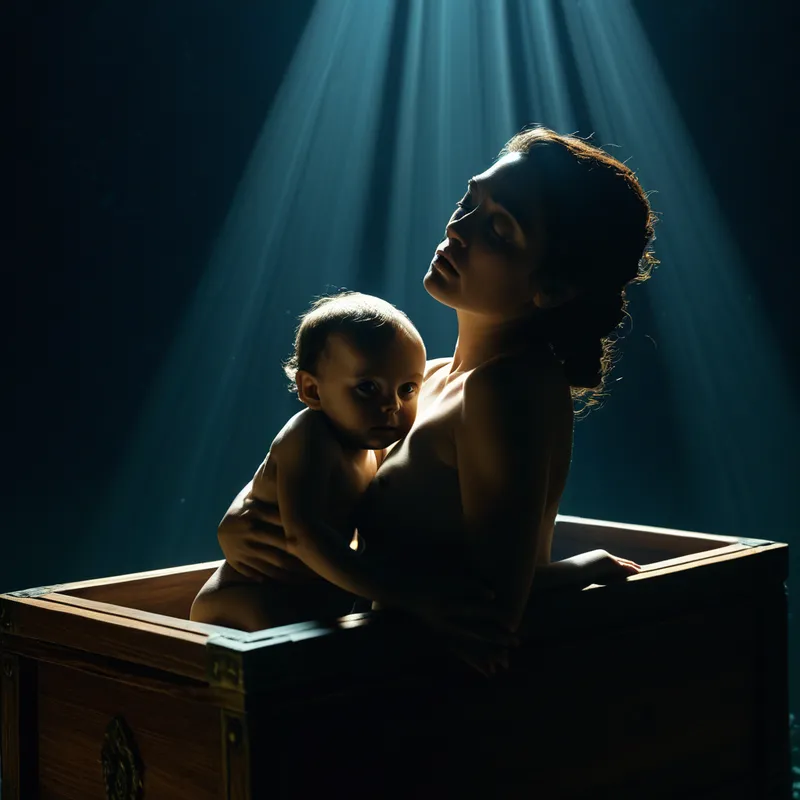
When Acrisius heard the infant’s cry echo from the earth, his dread turned to fury. He would not spill blood directly—a curse upon kin-slayers—so he cast mother and child into [the sea](/myths/the-sea “Myth from Greek culture.”/), locked in a wooden chest. For days and nights, they were tossed by [Poseidon](/myths/poseidon “Myth from Greek culture.”/)’s whims, Danaë’s prayers their only sail. Yet the gods who weave destiny are not always cruel. The chest washed ashore on the island of Seriphos, found by the fisherman Dictys, a brother to the island’s king.
Years passed. Perseus grew strong and bold under the sun and salt air. But the king, Polydectes, desired Danaë and saw her son as an obstacle. At a feast, he demanded a gift: the head of the Gorgon [Medusa](/myths/medusa “Myth from Greek culture.”/), a task meant to be a death sentence. The young hero, bound by honor, accepted.
He did not go unarmed. The gods, architects of his fate, provided tools for the impossible. From the Graeae, he stole the secret of the Gorgons’ lair. Athena gave him a shield of polished bronze, a mirror to avoid the petrifying gaze. [Hermes](/myths/hermes “Myth from Global/Universal culture.”/) granted an adamantine sickle, sharp enough to sever the monstrous neck. From the [Hesperides](/myths/hesperides “Myth from Greek culture.”/) came a cap of darkness to hide him, winged sandals to carry him, and a magical sack to hold his prize.
In the stony, silent land at [the world](/myths/the-world “Myth from Tarot culture.”/)’s edge, Perseus found the sleeping Gorgons. Using the shield’s reflection as his guide, he moved like a shadow. One swift, terrible stroke, and Medusa’s head was his. From her bleeding neck sprang the winged horse [Pegasus](/myths/pegasus “Myth from Global/Universal culture.”/) and the giant Chrysaor. With his gifts, Perseus fled the wrath of Medusa’s sisters.
His return journey was a path of redemption. He rescued the princess Andromeda from a sea monster, turning the beast to stone with [the Gorgon](/myths/the-gorgon “Myth from Various culture.”/)’s head. He returned to Seriphos and used the same dread power to petrify the tyrant Polydectes, freeing his mother. Finally, in a twist of fate he sought to avoid, he traveled to compete in athletic games. His discus, thrown with heroic strength, veered into the crowd and struck an old man dead—his grandfather, Acrisius. The oracle’s word was fulfilled, not by malice, but by the inexorable turn of destiny’s wheel.
Perseus and Andromeda ruled wisely, founding a great line: the Perseids. Their children and grandchildren became kings and heroes, their stories woven into the bedrock of Greece. And when their mortal lives ended, Demeter herself, some say, placed them among the stars. Perseus, Andromeda, her mother Cassiopeia, and even the sea monster Cetus were set in the heavens. And every year, when the earth passes through the dust of the comet Swift-Tuttle, [the sky](/myths/the-sky “Myth from Persian culture.”/) weeps tears of light—the Perseid meteor shower—a celestial memorial to a lineage born of gold, forged in terror, and crowned in stars.
Cultural Origins & Context
The myth of Perseus and his descendants, the Perseids, is not a single, frozen tale but a living river of oral tradition that flowed through the Greek world for centuries before being captured by poets like Hesiod in his Theogony and later dramatized by playwrights such as Sophocles and Euripides. It functioned as a foundational charter myth, explaining the divine right and heroic origins of several ruling dynasties, most notably in the powerful city-states of Mycenae and Thebes. To claim descent from Perseus was to claim a lineage touched directly by Zeus, legitimizing power through a connection to the cosmic order.
The story was told in communal settings—at festivals, in symposia, and by traveling bards—serving multiple societal functions. It reinforced the cultural ideal of the arete of the hero: cunning intelligence ([metis](/myths/metis “Myth from Greek culture.”/)) paired with physical prowess. It also grappled with profound, universal anxieties: the fear of prophetic doom, the vulnerability of women and children, and the inescapable nature of fate (moira). The meteoric “Perseids” themselves, observed for millennia, provided a breathtaking, annual celestial phenomenon that ancient cultures naturally wove into their existing mythic tapestry, seeing the “falling stars” as the luminous traces of the hero’s storied family.
Symbolic Architecture
At its core, the Perseid myth is a profound map of the [psyche](/myths/psyche “Myth from Greek culture.”/)’s confrontation with the impossible [task](/symbols/task “Symbol: A task represents responsibilities, duties, or challenges one faces.”/), the “[dragon](/symbols/dragon “Symbol: Dragons are potent symbols of power, wisdom, and transformation, often embodying the duality of creation and destruction.”/)” that must be slain for [consciousness](/symbols/consciousness “Symbol: Consciousness represents the state of awareness and perception, encompassing thoughts, feelings, and experiences.”/) to evolve. Perseus represents the nascent ego, born from a transcendent union (the [shower](/symbols/shower “Symbol: In dreams, a shower often symbolizes purification, renewal, and the release of emotional burdens.”/) of gold) but immediately cast into the chaotic, unconscious sea (the [chest](/symbols/chest “Symbol: The chest symbolizes the core of one’s being, encompassing emotions, identity, and the protective barriers we create around ourselves.”/) adrift). His [quest](/symbols/quest “Symbol: A quest symbolizes a journey or search for purpose, fulfillment, or knowledge, often representing life’s challenges and adventures.”/) is not one of brute force, but of guided intelligence and the [acceptance](/symbols/acceptance “Symbol: The experience of being welcomed, approved, or integrated into a group or situation, often involving validation of one’s identity or actions.”/) of divine aid—the gifts from the gods symbolize the latent psychic resources ([insight](/symbols/insight “Symbol: A sudden, deep understanding of a complex situation or truth, often arriving unexpectedly and illuminating hidden connections.”/), swiftness, protection) that become available when one aligns with a [purpose](/symbols/purpose “Symbol: Purpose signifies direction, meaning, and intention in life, often reflecting personal ambitions and core values.”/) greater than oneself.
The Gorgon Medusa is not merely a monster; she is the petrifying face of the unintegrated trauma, the monstrous aspect of the Great Mother that turns consciousness to rigid, defensive stone upon direct confrontation.
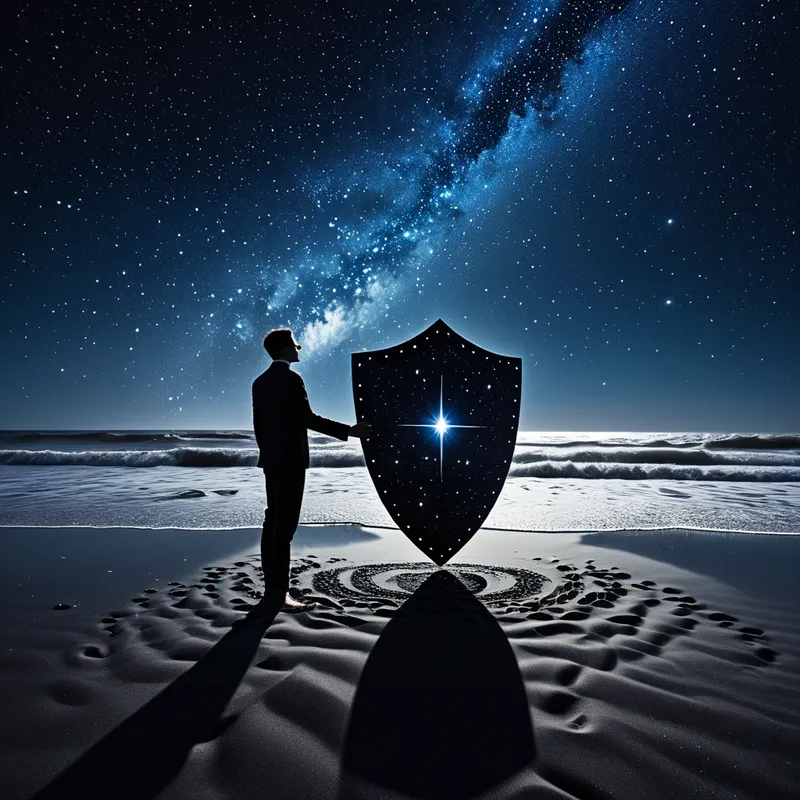
Perseus’s [strategy](/symbols/strategy “Symbol: A plan of action designed to achieve a long-term or overall aim, often involving competition, resource management, and foresight.”/) is the key: he does not look at her directly, but views her [reflection](/symbols/reflection “Symbol: Reflection signifies self-examination, awareness, and the search for truth within oneself.”/) in the [shield](/symbols/shield “Symbol: A symbol of protection, defense, and boundaries, representing personal security, resilience, and the need to guard against external threats or emotional harm.”/) given by Athena. This is the archetypal act of indirect approach, of integrating the [shadow](/symbols/shadow “Symbol: The ‘shadow’ embodies the unconscious, repressed aspects of the self and often represents fears or hidden emotions.”/) through symbolic understanding rather than primal combat. To slay her is to overcome the paralyzing power of the archaic, terrifying feminine—a necessary step for the patriarchal heroic consciousness of the myth’s era. From her [death](/symbols/death “Symbol: Symbolizes transformation, endings, and new beginnings; often associated with fear of the unknown.”/) springs [Pegasus](/symbols/pegasus “Symbol: A winged divine horse from Greek mythology, symbolizing inspiration, poetic genius, and spiritual ascension beyond earthly limitations.”/), the [symbol](/symbols/symbol “Symbol: A symbol can represent an idea, concept, or belief, serving as a powerful tool for communication and understanding.”/) of poetic inspiration and the [soul](/symbols/soul “Symbol: The soul represents the essence of a person, encompassing their spirit, identity, and connection to the universe.”/)’s [ascent](/symbols/ascent “Symbol: Symbolizes upward movement, progress, spiritual elevation, or striving toward higher goals, often representing personal growth or transcendence.”/), suggesting that confronting our deepest horrors can release creative and spiritual [energy](/symbols/energy “Symbol: Energy symbolizes vitality, motivation, and the drive that fuels actions and ambitions.”/).
The Dreamer’s Resonance
When the pattern of the Perseids stirs in the modern dreamer, it often signals a profound somatic and psychological initiation. To dream of being locked in a bronze chamber may speak to a feeling of being trapped by familial expectations or self-imposed limitations, a prison of one’s own history. The shower of gold in a dream is rarely literal; it may manifest as a sudden, illuminating insight, a moment of grace, or an infusion of creative energy that penetrates a seemingly hopeless situation.
Dreams of being given impossible, magical tools—a mirror, winged shoes, a cloak—suggest the unconscious is providing the precise “instruments” needed for a coming psychological ordeal. The climax, encountering a Medusa-figure, is the dream ego facing its own capacity for terror. The somatic response is crucial: a feeling of rigidity, of being frozen. This is the body remembering the myth, experiencing the petrification before the dream-self finds the reflective shield—the capacity for self-observation and perspective that allows one to engage the terror without being destroyed by it. Such dreams mark a transition from victimhood (Danaë in the chest) to agency (Perseus on his quest).
Alchemical Translation
The alchemical journey of the Perseid myth is a perfect model for the process of psychic transmutation, or individuation. The initial state is [nigredo](/myths/nigredo “Myth from Alchemical culture.”/), the blackening: Danaë in the darkness of the bronze tomb, [the ego](/myths/the-ego “Myth from Jungian culture.”/) confined and oppressed by a tyrannical, fear-based complex (Acrisius). The coniunctio, or [sacred marriage](/myths/sacred-marriage “Myth from Alchemy culture.”/), is the shower of gold—the impregnation of consciousness by [the Self](/myths/the-self “Myth from Jungian culture.”/) (Zeus), a divine influx that feels both violating and miraculous, birthing a new potential ([the child](/myths/the-child “Myth from Alchemy culture.”/)-hero).
The quest for Medusa’s head is the arduous albedo, the whitening, where [the adept](/myths/the-adept “Myth from Alchemical culture.”/) learns to work with subtle, reflective tools. The polished shield represents the vas or vessel of the work, where the raw, terrifying material of the unconscious (Medusa) is viewed not directly, but in reflection, allowing for a differentiated, conscious relationship.
The severing of the head is the separatio—the crucial, conscious differentiation of the ego from the overpowering, archetypal force. It is not annihilation, but a sacred act of distinction.
Finally, the liberation of Andromeda, the petrification of the tyrant, and the ascension to the stars signify the [rubedo](/myths/rubedo “Myth from Alchemical culture.”/), the reddening or culmination. The redeemed feminine (anima) is integrated, the internal tyrant is neutralized (fixed in stone, its power ended), and the totality of the psyche—hero, bride, monster, and ancestor—is recognized as a coherent, celestial pattern. The annual Perseid shower becomes a symbol of this completed cycle: the luminous, recurring reminder that our deepest trials, when faced with reflected wisdom, can scatter light across the dark vault of our being.
Associated Symbols
Explore related symbols from the CaleaDream lexicon: