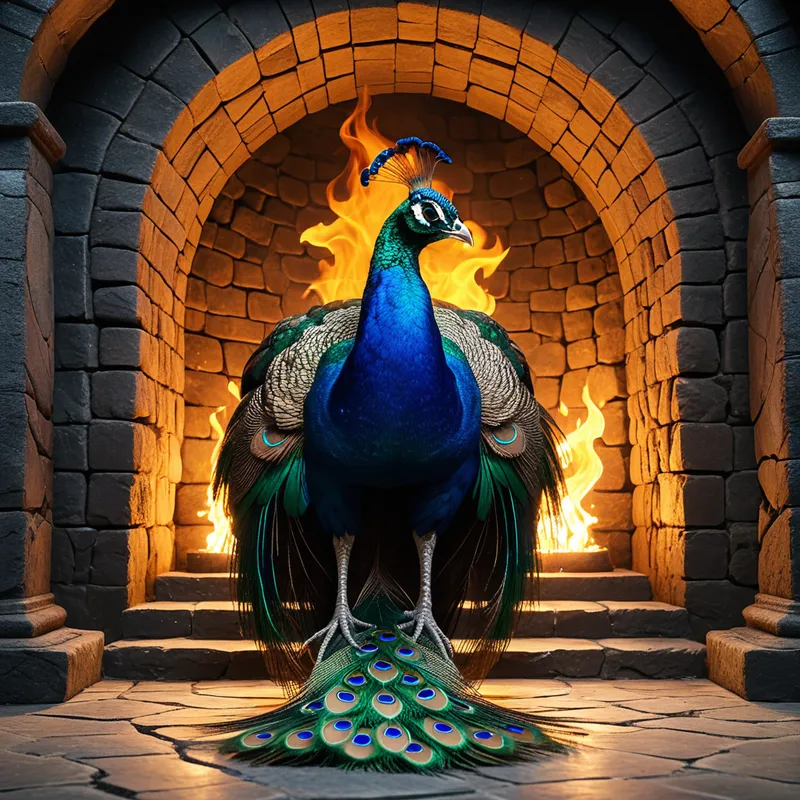
The Peacock's Tail Myth Meaning & Symbolism
An alchemical parable where the soul's blackest despair, the Nigredo, transforms into a radiant, all-seeing vision of wholeness: the Peacock's Tail.
The Tale of The Peacock's Tail
In the beginning, there was the Work. Not the work of hands, but the Work of the soul, a labor conducted in the silent, stone-cold chambers beneath the waking world. Here, the Artifex toiled, a figure of shadow and resolve. Their task was not to make gold from lead, but to make light from darkness.
They gathered the Prima Materia—the raw stuff of their own being, all their hopes, shames, forgotten memories, and unspoken fears. This they placed within the sacred vessel, the Vas Hermeticum. With a breath that was both prayer and curse, they sealed it. Then came the fire.
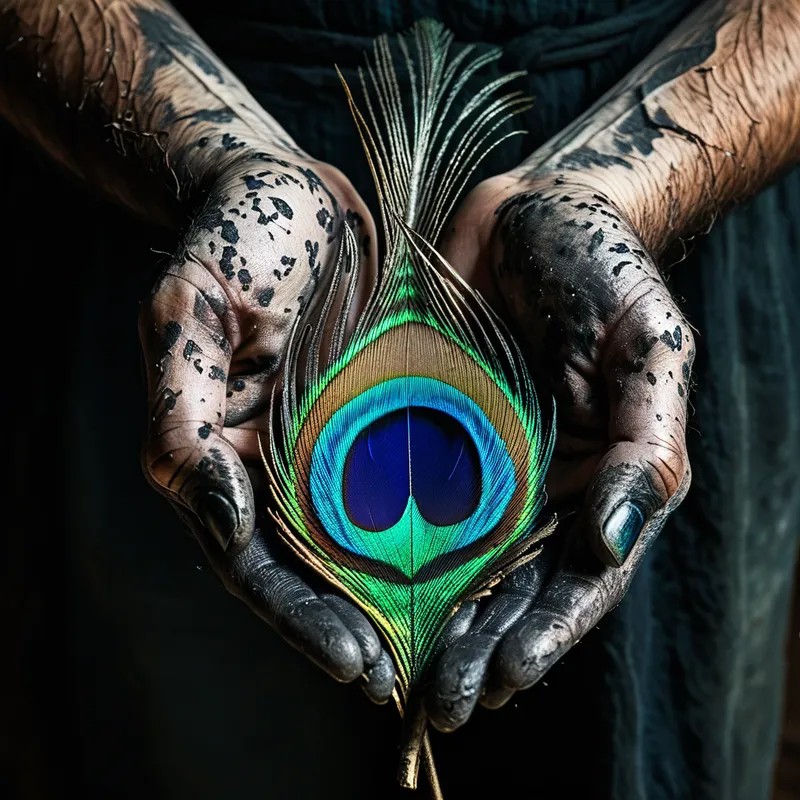
Not a gentle flame, but the Igneus Naturalis, the fire that does not consume but dissolves. For days that bled into nights, the Artifex watched. The beautiful, chaotic Prima Materia within did not glow. It blackened. It putrefied. A stench of despair rose from the vessel—the stink of failure, of a soul rotting in its own confinement. This was the Nigredo, the long, starless night of the spirit. The Artifex wept ashes, believing the Work was lost, that only a cinder of a soul remained.
But in that absolute blackness, at the nadir of hope, a sigh stirred within the vessel. Not a sound, but a shimmer. A single, impossible color, like oil on water, bloomed in the soot. Then another. And another. Emerald, sapphire, amethyst, and gold swirled from the core of the blackness, rising like vapors of pure light.
The Artifex, trembling, leaned closer. The colors did not dissipate. They coalesced, weaving themselves into a pattern more intricate than any tapestry. From the heart of the ruined matter, a vision unfolded: a great, circular fan of iridescent feathers, each one tipped with a brilliant, knowing eye. It was a tail of impossible splendor, born from absolute ruin. The eyes did not judge; they saw. They saw the blackness that birthed them, the fire that forged them, and the Artifex who witnessed them. In their collective gaze was the whole story—the putrefaction and the glory, the lead and the gold, the death and the life, all held in a single, breathtaking vision of wholeness. This was the Cauda Pavonis, the Peacock's Tail. The long night was over. The Work had begun.
Cultural Origins & Context
The myth of the Peacock's Tail is not a narrative passed down by bards, but a visual and experiential parable encoded within the cryptic texts of European alchemy, spanning from the Hellenistic period through the Renaissance. It was recorded in illuminated manuscripts like the Splendor Solis and described in the writings of adepts such as Hermes Trismegistus (in the Emerald Tablet) and later practitioners. Its primary "storytellers" were the alchemists themselves, who saw their laboratory processes (Opus) as a direct mirror of the soul's journey (Opus Spirituale).
The myth functioned as a map and a solace. For the solitary practitioner facing the terrifying dissolution of the Nigredo—a stage often equated with profound depression or a "dark night of the soul"—the promise of the Cauda Pavonis was a lifeline. It was a sign that the process was lawful and necessary, that putrefaction was not an end but the fertile ground for a more complex, integrated beauty. It served to validate the internal, non-linear process of transformation, assuring the seeker that the emergence of dazzling, often contradictory insights (the many colors and eyes) was a milestone on the path to the ultimate goal: the Rubedo, or reddening, symbolizing completion and embodied spirit.
Symbolic Architecture
The Peacock's Tail is the psyche's own masterpiece, born from its deepest negation. Its symbolism is a multi-layered revelation of the transformation process.
The Nigredo (The Blackening) is not merely suffering; it is the necessary de-structuring of the old, conscious personality. It is the death of naive certainty, the dissolution of the ego's comfortable lies. All that was solid must become chaotic and dark before it can be reconstituted.
The most radiant vision is always seeded in the soil of what we hoped to forget.
The Iridescent Colors represent the dawn of psychic multiplicity. After the monolithic blackness of despair, the soul begins to perceive its own complex nature—not as a flaw, but as a spectrum. Jealousy (green), intuition (violet), wisdom (blue), and vitality (gold) all arise, not as separate enemies, but as facets of a whole.
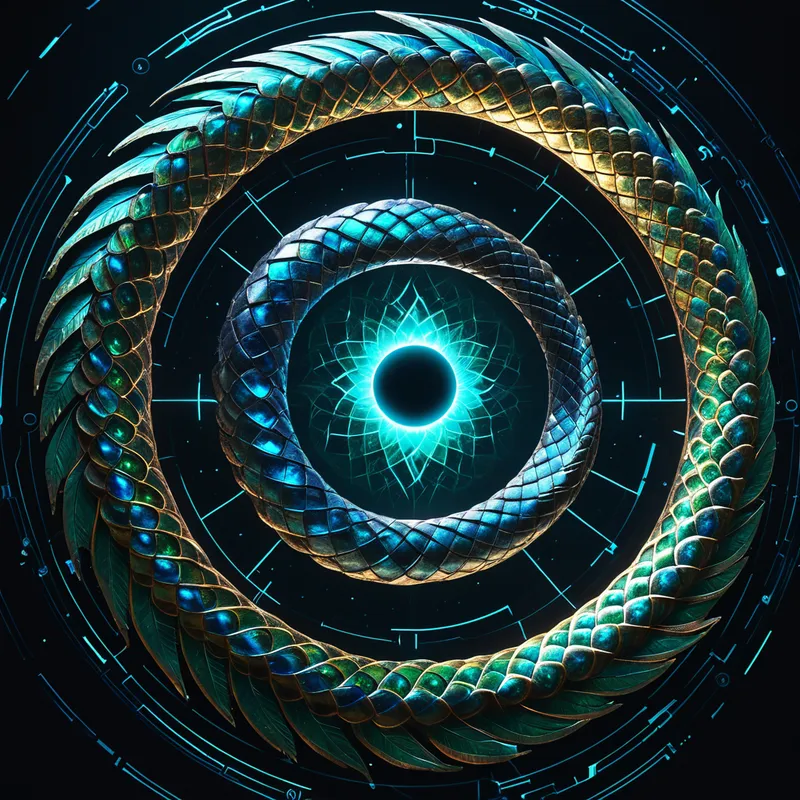
The Eyes on the Feathers are the core of the symbol. They represent consciousness turned back upon itself—the act of witnessing. Each eye is an insight, a moment of self-recognition. They signify that the transformed matter (the soul) is now aware. It sees its own process. This is the birth of objective self-knowledge, where one can look upon one's own history, pain, and beauty without identification or shame.
The Peacock Itself, often only implied by its tail, is the emerging Self. It is the creature that can bear this magnificent, all-seeing burden. The tail is not an ornament; it is an organ of perception, a display of hard-won wholeness.
The Dreamer's Resonance
When the pattern of the Peacock's Tail stirs in the modern dreamscape, it signals a profound somatic and psychological pivot. The dreamer is likely emerging from, or in the thick of, a Nigredo phase—a period of depression, burnout, loss, or existential confusion where everything feels "black" and lifeless.
To dream of iridescent oil slicks on pavement, the sudden, dazzling play of light through a prism, or most directly, of a peacock or its feathers, is the unconscious announcing: the dissolution is working. The psyche is beginning to differentiate the contents of the black mass. Somaticly, this can feel like a sudden, inexplicable surge of energy after prolonged fatigue, or a sense of lightness and expanded breath. Psychologically, it manifests as fleeting but crystal-clear insights—sudden understanding of an old wound, compassion for a former enemy (often a part of oneself), or the spontaneous arising of creative ideas from the "void."
The "eyes" in the dream may appear as actual eyes in patterns, as mirrors, or as a feeling of being benevolently watched by the dream itself. This is the nascent Self beginning to observe the ego's drama from a place of wholeness, initiating the healing loop of consciousness.

Alchemical Translation
For the modern individual seeking individuation, the myth of the Peacock's Tail models the critical transition from analysis to synthesis. Our personal Nigredo is the often involuntary descent into the shadow—confronting repressed emotions, outdated identities, and inherited traumas. We stew in this darkness, analyzing each piece of pain.
The Peacock's Tail marks the moment we stop merely analyzing the darkness and begin to see what it is made of. The disparate insights (the colors) from therapy, journaling, or life crises begin to connect. We see how our anger is tied to our passion (red), how our sadness holds deep empathy (blue), how our anxiety is linked to a fierce desire to protect (gold). These are no longer isolated problems to be solved, but vital threads of a emerging tapestry.
The goal is not to eliminate the blackness, but to learn the art by which it weaves itself into vision.
The "eyes" symbolize the establishment of an inner witness. We move from being our pain to having our pain, and observing it with the compassionate, multifaceted gaze of the Tail. This is psychic transmutation: the leaden weight of suffering is not discarded; its very substance is rearranged at an atomic level into a new structure that is conscious, complex, and breathtakingly beautiful. The individual does not become "perfect," but whole. They gain the Peacock's Tail—the ability to hold all their contradictions, history, and potential in a single, integrated field of awareness, and to display this hard-won totality as their authentic presence in the world. The Work continues, but now under a new, all-seeing light.
Associated Symbols
Explore related symbols from the CaleaDream lexicon: