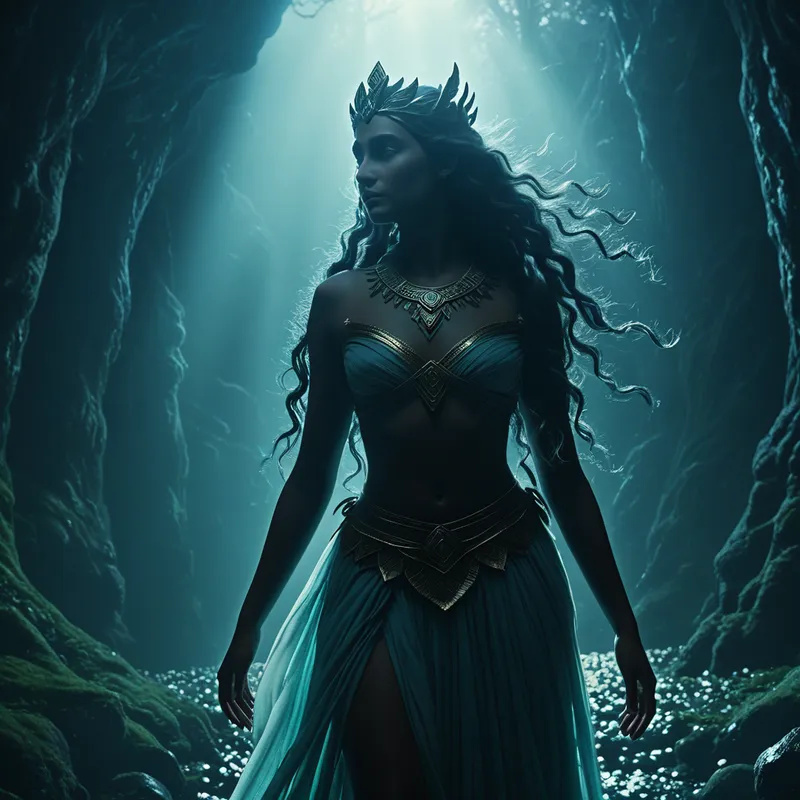
The Passage of the Reed Sea
A foundational Hebrew myth where divine power parts the waters, enabling escape from oppression and marking a transformative journey toward freedom and identity.
The Tale of The Passage of the Reed Sea
The air over the marshlands of the Reed Sea was thick with terror and the dust of a fleeing nation. Behind the Hebrews, a horizon darkened not with storm clouds, but with the polished bronze and relentless purpose of [Pharaoh](/myths/pharaoh “Myth from Egyptian culture.”/)’s chariots. The thunder of hooves and wheels was the drumbeat of a recaptured fate. Before them, the waters stretched, impassable, a liquid wall sealing their doom. They were trapped between the empire of human order and the [chaos](/myths/chaos “Myth from Greek culture.”/) of the deep, a people caught in the birth-canal of their own destiny, screaming that [death](/myths/death “Myth from Tarot culture.”/) in [the desert](/myths/the-desert “Myth from Biblical culture.”/) would have been preferable.
At their head stood [Moses](/myths/moses “Myth from Biblical culture.”/), a man stretched between two worlds, his staff not a weapon but a sign. He raised his arms, not in defiance of the army, but in appeal to the unseen. A wind awoke—not a gentle breeze, but the very breath of God, a [ruach](/myths/ruach “Myth from Hebrew culture.”/) Elohim that tore across the face of the waters all that night. It was a wind of separation, of divine distinction. It did not calm [the sea](/myths/the-sea “Myth from Greek culture.”/); it sculpted it. The waters were driven back, heaped up like walls of trembling glass, and the hidden mud of the seabed was laid bare, a dark, miry path through the heart of the impossible.
The command was given. A nation, a ragged assembly of former slaves, stepped onto the ocean floor. They walked not on dry, firm earth, but through a corridor of suspended catastrophe, the walls of [water](/myths/water “Myth from Chinese culture.”/) held back by an invisible will. The reeds, now exposed, stood like silent witnesses along the path, their roots clutching the revealed secrets of the deep. Above, the [pillar of cloud](/myths/pillar-of-cloud “Myth from Biblical culture.”/) that had guided them shifted, moving to their rear. It became a veil of darkness to the Egyptians, a blinding confusion, while ahead, for the Hebrews, it became a pillar of fire, illuminating the path through the night of their fear.
Then came the pursuit. Pharaoh’s heart, hardened once more, saw not a miracle but an opportunity. His chariots, the supreme technology of oppression, plunged into the gorge. But the path of liberation is not a road for the machinery of empire. The wheels clogged with the thick clay; panic replaced order. In the watch before dawn, from the pillar of fire and cloud, the gaze of God looked down upon the Egyptian host and threw them into a panic. The moment of passage was complete.
Moses stretched his hand over the sea again. As morning broke, the suspended walls collapsed. [The wind](/myths/the-wind “Myth from Various culture.”/) ceased; the waters returned to their place with a roar that was both tomb and womb. They covered the chariots, the horsemen, the entire army of Pharaoh. Not one remained. On the far shore, the Hebrews saw the great hand of their deliverance. They saw the bodies of their taskmasters washed up like driftwood. And in that moment, a people born in the brick-yards of Egypt died, and a people chosen for [covenant](/myths/covenant “Myth from Christian culture.”/) was born from the waters. [Miriam](/myths/miriam “Myth from Biblical culture.”/), the prophetess, took a timbrel in her hand, and all the women followed her with dancing and song: “Sing to the Lord, for he has triumphed gloriously; the horse and his rider he has thrown into the sea.” The song was not yet one of law, but of raw, ecstatic liberation—the first free breath of a new soul.
Cultural Origins & Context
The story is anchored in the Book of [Exodus](/myths/exodus “Myth from Biblical culture.”/), the foundational epic of Israelite identity. Its historical kernel is elusive, a subject of endless scholarship, but its psychological and theological truth is absolute for the tradition. The term Yam Suph is crucial; it is not the vast, deep “Red Sea” of later tradition, but the “Sea of Reeds,” evoking the marshy, lacustrine regions of the eastern [Nile Delta](/myths/nile-delta “Myth from Egyptian culture.”/). This grounds the miracle not in a cosmic ocean but in a liminal, muddy, biologically rich borderland—a place of transition between the ordered world of Egypt and the trackless wilderness of Sinai.
The narrative serves as the definitive rupture. Egypt represents more than a geopolitical enemy; it is the archetype of the oppressive system, the “house of bondage” where identity is subsumed under [the Pharaoh](/myths/the-pharaoh “Myth from Egyptian culture.”/)’s totalizing order. The Passage is the violent, necessary severance from that order. It is the moment the abstract promise made to the ancestors becomes a tangible, collective experience. The event is immediately liturgized in the “Song of the Sea” (Exodus 15), one of the oldest texts in the Hebrew Bible, suggesting its central role in shaping communal memory. This was not merely an escape; it was the constitutive event that defined the Hebrews as a people liberated by and for Yahweh, setting the stage for the covenant at Sinai. The myth answers the perennial question of origins: “We are who we are because God brought us out with a mighty hand and an outstretched arm.”
Symbolic Architecture
The [architecture](/symbols/architecture “Symbol: Architecture in dreams often signifies structure, stability, and the framing of personal identity or life’s journey.”/) of the myth is a masterpiece of liminal [symbolism](/symbols/symbolism “Symbol: The use of symbols to represent ideas or qualities, often conveying deeper meanings beyond literal interpretation. In dreams, it’s the language of the unconscious.”/). It occurs in a literal threshold [space](/symbols/space “Symbol: Dreaming of ‘Space’ often symbolizes the vastness of potential, personal freedom, or feelings of isolation and exploration in one’s life.”/)—between land and [water](/symbols/water “Symbol: Water symbolizes the subconscious mind, emotions, and the flow of life, representing both cleansing and creation.”/), [night](/symbols/night “Symbol: Night often symbolizes the unconscious, mystery, and the unknown, representing the realm of dreams and intuition.”/) and day, slavery and freedom, [chaos](/symbols/chaos “Symbol: In Arts & Music, chaos represents raw creative potential, uncontrolled expression, and the breakdown of order to forge new artistic forms.”/) and order. The [path](/symbols/path “Symbol: The ‘path’ symbolizes a journey, choices, and the direction one’s life is taking, often representing individual growth and exploration.”/) itself is the ultimate [limen](/myths/limen “Myth from Roman culture.”/).
The parted waters are not merely a barrier removed but a revelation of the substructure of reality. They show that what appears as an insurmountable, monolithic obstacle (the sea, fate, oppression) contains, by divine command, a hidden pathway. The impossible is redefined as a corridor of grace.
The wind (ruach) is the active, shaping [presence](/symbols/presence “Symbol: Presence in dreams often signifies awareness or acknowledgment of something significant in one’s life.”/) of the divine, echoing the [ruach Elohim](/myths/ruach-elohim “Myth from Abrahamic culture.”/) that hovered over the primordial waters in Genesis. Here, it does not create, but re-creates a people. The pillar of cloud and fire is the visible sign of the invisible guide, embodying the [paradox](/symbols/paradox “Symbol: A contradictory yet true concept that challenges logic and perception, often representing unresolved tensions or profound truths.”/) of a God who is both a concealing [mystery](/symbols/mystery “Symbol: An enigmatic, unresolved element that invites curiosity and exploration, often representing the unknown or hidden aspects of existence.”/) (cloud) and an illuminating presence (fire).
The Egyptians’ destruction is not framed as mere military defeat but as the drowning of an old paradigm. The chariot, symbol of Pharaoh’s crushing, centralized power, becomes hopelessly mired in the very muck of the new path. The tools of oppression cannot traverse the road of liberation.
The [journey](/symbols/journey “Symbol: A journey in dreams typically signifies adventure, growth, or a significant life transition.”/) through the sea is a collective [baptism](/symbols/baptism “Symbol: A ritual of spiritual cleansing, initiation, and rebirth, symbolizing profound transformation and commitment to a new path.”/)—a [death](/symbols/death “Symbol: Symbolizes transformation, endings, and new beginnings; often associated with fear of the unknown.”/) to the old [identity](/symbols/identity “Symbol: Identity represents the sense of self, encompassing personal beliefs, cultural background, and social roles.”/) of slave and a [birth](/symbols/birth “Symbol: Birth symbolizes new beginnings, transformation, and the potential for growth and development.”/) to the new identity of a free people covenanted to God. The Hebrews pass through the waters, and the waters close over their past.
The Dreamer’s Resonance
For the individual [psyche](/myths/psyche “Myth from Greek culture.”/), the Reed Sea is the image of the critical juncture, the “point of no return” in any profound transformation. It resonates with the feeling of being utterly trapped between an unsustainable past (the advancing chariots of old habits, toxic situations, or internalized oppression) and a seemingly impossible future (the daunting, unknown sea of change). The anxiety is palpable: to go back is slavery, to go forward seems like annihilation.
The myth speaks to the moment when faith—not as certainty, but as a desperate, forward-leaning action—is required. It is the decision to step onto the muddy, uncertain path that appears only when one commits to moving toward the barrier. The “walls of water” represent the immense psychological pressures that flank any major life transition: the fear of regression on one side and the fear of the unknown on the other. The dreamer is called to walk the narrow path between these towering anxieties, sustained by a force that feels both deeply personal and utterly transcendent. The destruction of the “Egyptians” symbolizes the necessary death of the internalized pharaohs—the voices of limitation, shame, and fear that pursue us even in our escape. They must be drowned, not negotiated with.
Alchemical Translation
In the alchemy of the soul, the Passage is the [solutio](/myths/solutio “Myth from Alchemical culture.”/) and [coagulatio](/myths/coagulatio “Myth from Alchemical culture.”/)—the dissolution of the old, rigid form and the coagulation of the new. The waters, [the prima materia](/myths/the-prima-materia “Myth from Alchemical culture.”/) of the unconscious and the emotional body, are first divided (analysis, discernment) to reveal the hidden via regia, the royal road through the heart of the problem.
The miracle is not that the sea disappears, but that a way is made through it. The alchemical work is not about avoiding the depths of feeling or the chaos of transformation, but about finding the sacred path that leads directly through its center. The mud of the seabed is the nigredo, the black, fertile chaos from which new consciousness is born.
The wind is the activating spirit, the [pneuma](/myths/pneuma “Myth from Greek culture.”/) that initiates the operation. The people are the raw material, the massa confusa, being led from the leaden state of bondage ([Saturn](/myths/saturn “Myth from Alchemical culture.”/)/Egypt) toward the golden dawn of a promised self (Sol/Sinai). The entire event is a divine opus performed upon the collective body, with Moses as the mediating vessel or [alembic](/myths/alembic “Myth from Alchemical culture.”/). The song and dance on the far shore are the first manifestation of the new substance—the [rubedo](/myths/rubedo “Myth from Alchemical culture.”/) or reddening, the joyous, embodied expression of liberated life.
Associated Symbols
Explore related symbols from the CaleaDream lexicon:
- Passage — The core archetype of transformative transition, a journey through a constricted, dangerous space that leads from one state of being to another.
- Water — The primordial substance of chaos, emotion, and the unconscious, which can both drown and cleanse, block and birth.
- Reed — A symbol of flexibility and resilience, rooted in the mud but rising upward; the humble, natural material that names the sea of passage.
- Faith — The active, forward-moving trust that steps onto the invisible path, the substance of things hoped for and the evidence of things not seen.
- Liberation — The state of release from constricting bondage, achieved not by gradual reform but by a decisive, often terrifying, rupture.
- Chariot — The symbol of ordered, worldly power and [the ego](/myths/the-ego “Myth from Jungian culture.”/)’s controlling structures, which become obsolete and founder in the terrain of true transformation.
- Wind — The invisible, shaping spirit of divine intervention, the breath of life that actively creates new possibilities from chaos.
- Path — [The way](/myths/the-way “Myth from Taoist culture.”/) that appears only in the act of commitment, leading through the heart of an obstacle, often revealed rather than built.
- Mud — The fertile, chaotic ground of potential that is exposed when the waters of habit part, the base matter from which new life is formed.
- Song — The spontaneous, ecstatic expression of a liberated spirit, the first creative act of a people freed from the dirge of oppression.
- Door — [The threshold](/myths/the-threshold “Myth from Folklore culture.”/) between realms, the decisive opening that appears in the wall of impossibility, requiring a choice to step through.
- Death — The necessary end of an old identity, system, or way of life, which is swallowed up so that a new existence can emerge.