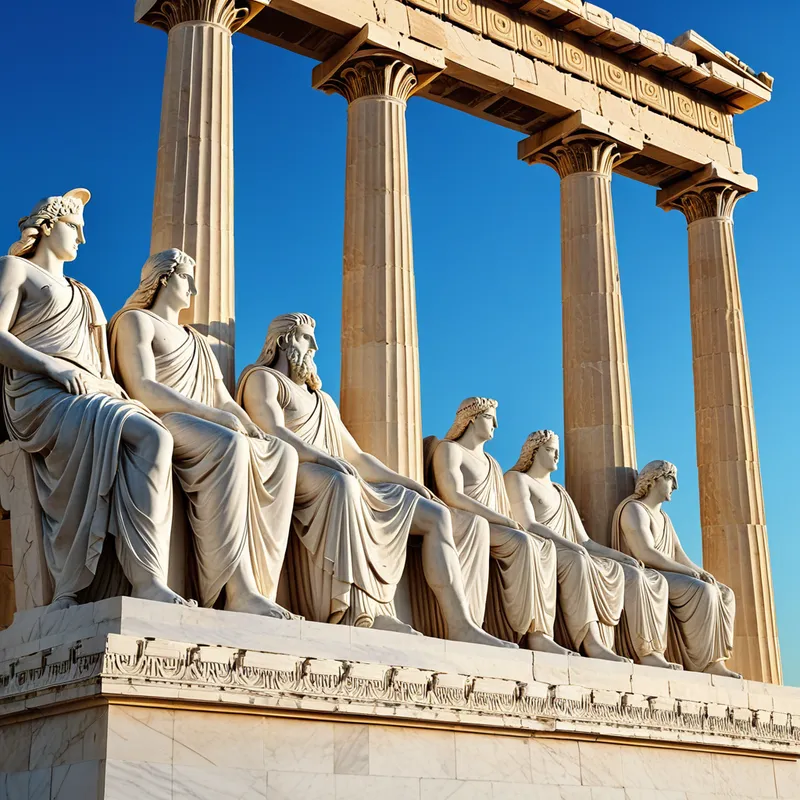
The Parthenon Pediment Sculptures Myth Meaning & Symbolism
The birth of Athena from the mind of Zeus, witnessed by the gods, a myth of wisdom's violent emergence and the establishment of cosmic order.
The Tale of The Parthenon Pediment Sculptures
Hush now, and listen. The tale is not told in words, but in stone, frozen in the golden light that first touches the Acropolis. On the temple’s eastern face, the dawn of the world is being born anew.
In the center, a throne of power. Upon it sits the Zeus, not as a distant ruler, but as a vessel of unbearable tension. His great form is coiled, his divine brow a landscape of concentration. For within him, a prophecy stirs—a child greater than its father. His first wife, Metis, the very essence of cunning thought, was with child. Swallowing her whole, Zeus believed he had contained the threat. But wisdom cannot be digested; it must be born.
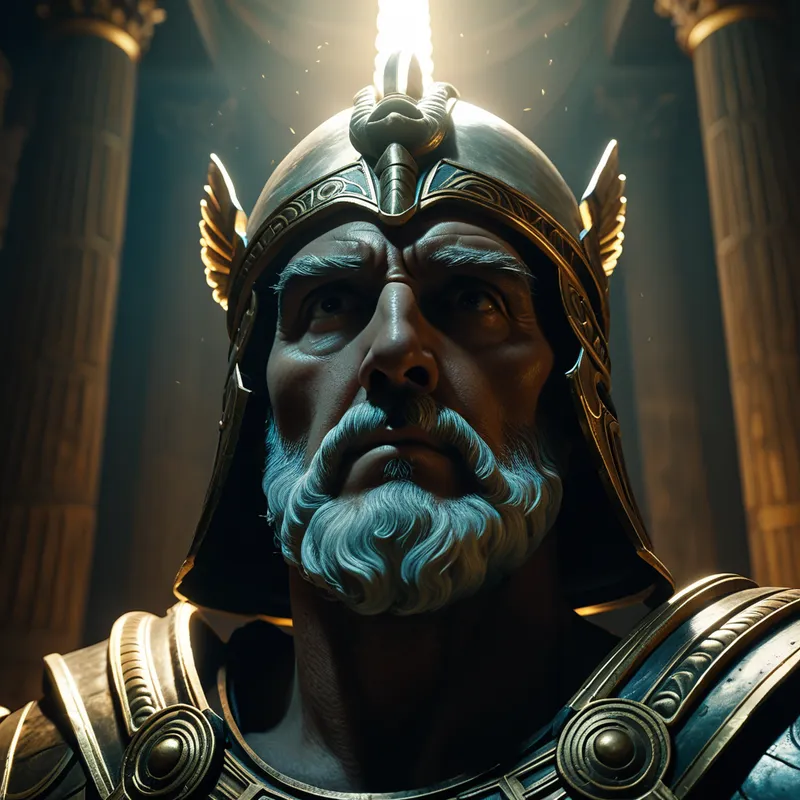
And so, from the crown of the father, from the seat of thought itself, comes the splitting. Not a bloody birth, but a cleaving of light from darkness. From the fissure in the divine skull emerges a figure, fully formed and terrible in her majesty. Athena springs forth, not a babe, but a warrior maiden. Her aegis is upon her chest, her spear is in her hand, her helmet crowns her head. Her eyes are open, seeing all, knowing all from the first moment. The act is one of violent intellect, a thunderclap of consciousness that shakes the very pillars of Olympus.
To the left and the right, the divine court holds its breath. Here is Hestia, draped in quiet modesty, a still point in the cosmic shock. There, the mighty Poseidon, his trident resting, his gaze a turbulent sea of rivalry and awe. The youthful Artemis turns, her hound beside her, forever captured in motion towards the miracle. Aphrodite reclines against her mother Demeter, their forms a symphony of mortal-like wonder at the immortal event. Each god, each goddess, is a facet of the cosmos witnessing its own reordering.
This is the moment the world changed. The old order of raw, titanic power gives way to a new sovereignty: the reign of wisdom, strategy, and civilized arts. The birth-pangs of Zeus are the birth-pangs of a new age. As Athena stands triumphant, the message is etched in marble for all time: true power emanates from the mind, and true order is born from the marriage of intellect and divine will.
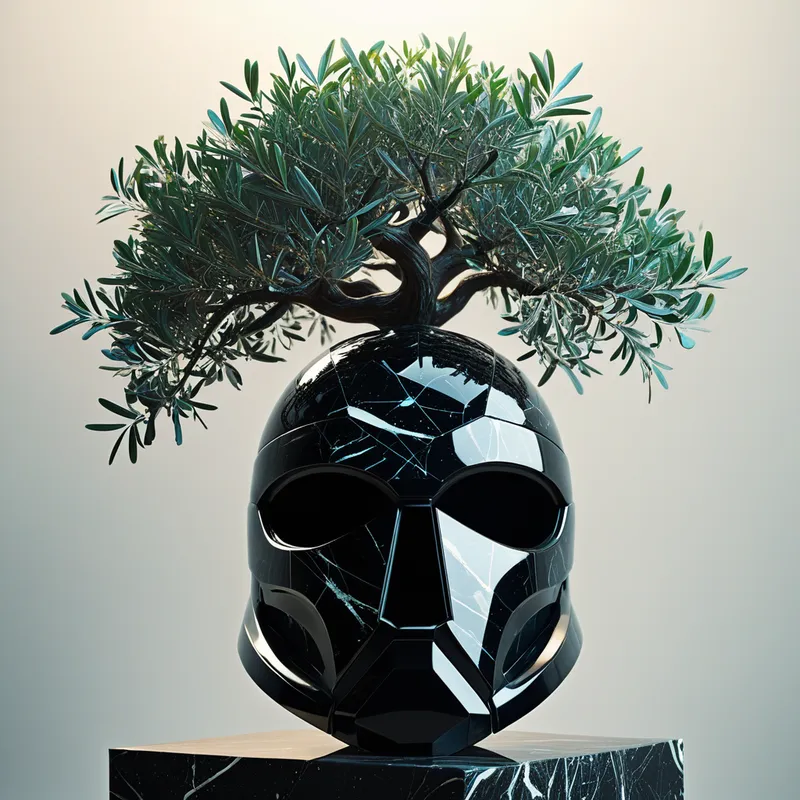
Turn now to the western pediment, where the sun sets. Here, the story concludes. The scene is the contest for the patronage of Athens. Athena and Poseidon stand opposed, each offering a gift to the people. Poseidon strikes the rock with his trident, and a saltwater spring erupts—a symbol of naval power, but also of barrenness. Athena, in response, plants her spear into the earth. From it grows the first olive tree—a gift of wood, oil, food, and peace. The people choose the olive. The city has its name, its soul, its destiny. The contest is resolved; harmony is restored under the clear, knowing eyes of the goddess who was born from thought. The circle is closed, from violent emergence to peaceful, fruitful settlement.
Cultural Origins & Context
This myth, immortalized in the pediments of the Parthenon (447-432 BCE), was not merely a decorative frieze. It was the foundational narrative of Athenian identity, carved in the most sacred and public space of the polis. The sculptures, designed under the supervision of the master sculptor Pheidias, served as a permanent, monumental sermon.
The myth of Athena’s birth from Zeus affirmed Athens’ special relationship with its patron goddess, positioning the city as the direct inheritor of the newest and greatest Olympian decree. The west pediment’s contest localized this cosmic event, showing Athena’s tangible gift to her chosen people. This was state theology in stone, intended for every citizen and visitor to see. It communicated that Athenian power, law, and culture (arete) were not arbitrary but divinely ordained, sprung from the very head of the king of gods. The myth was passed down not only through oral poetry like the Homeric Hymns but through this overwhelming architectural experience, making belief visceral and unavoidable.
Symbolic Architecture
The myth’s core is an alchemical drama of consciousness. Zeus, the principle of sovereign authority and raw cosmic power, integrates Metis, the principle of practical wisdom and cunning. The result is not a dilution, but a crisis that forces a new, higher synthesis.
The birth of Athena is the moment the unconscious potential of wisdom becomes conscious, manifest reality. It is the painful, necessary fracturing of a unified ego to allow a superior faculty to emerge.
Athena herself is the ultimate symbol of this synthesis. She is not purely intellectual; she is a warrior, born armed. Her wisdom is strategic, applied, and protective. The olive tree of the west pediment completes the symbol: from the violent emergence (spear) comes lasting peace and civilization (olive). This represents the journey from the chaos of potential to the order of realized creation. The assembled gods witnessing the event symbolize the various aspects of the psyche—emotion, instinct, desire—coming into alignment under this new, ruling principle of conscious wisdom.
The Dreamer’s Resonance
When this myth stirs in the modern dreamer, it often manifests as dreams of immense pressure in the head, of cracking or opening skulls, or of sudden, fully-formed ideas or identities emerging in a flash. One might dream of giving birth to an object, like a book, a tool, or a weapon, rather than a child. These are somatic echoes of a psychic birth.
The dreamer is undergoing what psychologists call a “separation from the parental complex.” The old, internalized authority (the Zeus-father within) is being challenged by a nascent, autonomous intelligence. The “headache” of Zeus is the ego’s resistance to this process. To dream of witnessing such an event, like the Olympian gods, suggests the dreamer’s other psychic components are observing a central, transformative shift in the psyche’s ruling principle. It is a dream of individuation in its most dramatic, intellectual form.
Alchemical Translation
The alchemical journey modeled here is the individuation process centered on the development of the animus or the logos principle. For the modern individual, the myth maps the terrifying but essential process of birthing one’s own authentic wisdom and authority.
First, we must “swallow” our Metis—absorb our latent skills, insights, and cunning intelligence, often through study and experience. Then comes the crisis: containment becomes impossible. The integrated knowledge swells and demands expression, threatening to split our old sense of self (the Zeus-ego) apart. The alchemical translation is the willingness to endure this psychic rupture.
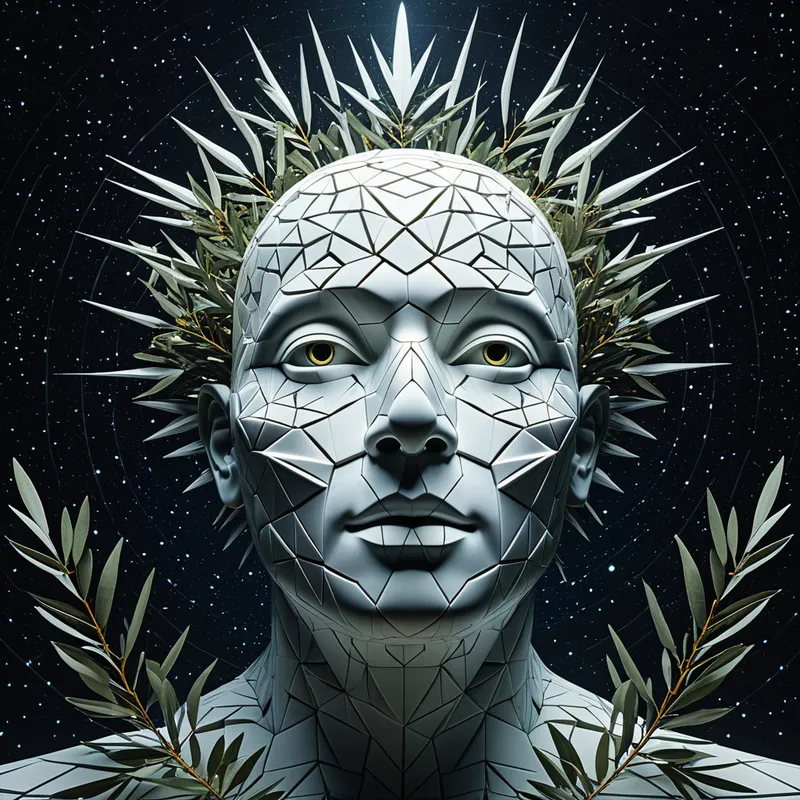
The hammer that splits the skull of Zeus is the shock of insight that dismantles old paradigms. The goal is not to avoid the fracture, but to midwife the armored wisdom that emerges from it.
The born Athena is the Self in its aspect as guiding intelligence. She represents a wisdom that is not passive but active, capable of defending its territory (the psyche) and cultivating its resources (the olive tree of inner peace and creativity). The triumph is not over external monsters, but over the inner tyranny of unexamined, archaic authority. We become citizens of our own Athens, ruled not by the chaotic trident of raw emotion or impulse (Poseidon), but by the strategic, life-giving wisdom that was born from our own deepest struggle for consciousness.
Associated Symbols
Explore related symbols from the CaleaDream lexicon: