The Owl and the Raven Myth Meaning & Symbolism
A creation myth where Raven, the trickster, steals light for a dark world, while Owl becomes the solemn guardian of the night's wisdom.
The Tale of The Owl and the Raven
In the time before time, the world was a place of unending shadow. Not the comforting dark of a sleeping Inuit camp, but a deep, heavy gloom that pressed upon the soul. The people moved like ghosts, their hands fumbling, their hearts cold with a longing they could not name. They knew only the feeble glow of the Moon and the distant, cold pinpricks of the stars. The great Sun was a prisoner, locked away by a powerful being who hoarded all light for himself in a lodge of ice and whalebone.
Into this perpetual twilight flew Raven. He was not yet the glossy black bird we know. In the beginning, he was white as the snow, a creature of curiosity and cunning. He heard the people’s sighs on the wind, felt their silent despair. His spirit, ever restless, could not abide this stolen Light. He flew to the great lodge, his mind whirring with schemes.
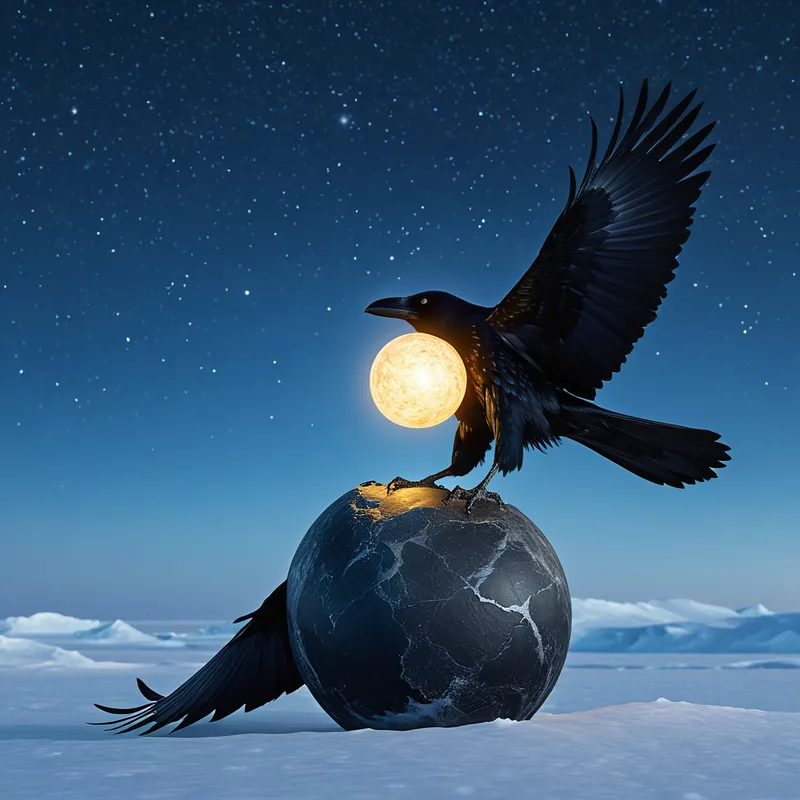
Transforming himself into a pine needle, he drifted into the water cup of the light-keeper’s daughter. She drank, and Raven was reborn within her as a child—a strange, dark-eyed boy who grew with impossible speed. He cried and fussed until the grandfather, doting on this peculiar child, brought out the treasures of the house to soothe him: bags of stars, the bag of the moon, and finally, the most precious of all, a series of nested boxes containing the shining, radiant spheres of the sun. Raven played with them, rolling the luminous orbs across the floor, until the moment of his design arrived. In a flash, he resumed his bird form, seized the brightest sphere in his beak, and burst through the smoke hole of the lodge into the vast sky.
The world erupted. Light, fierce and glorious, poured forth for the first time, painting the ice in gold and blue, revealing the contours of the Earth and the sparkle of the sea. The people cried out in joy and wonder. But Raven, in his frantic, triumphant flight, was pursued. The guardian of the light, in his wrath, hurled a Stone of darkness at the thief. It struck Raven’s feathers, and the soot from the lodge’s smoke hole, stirred by the chaos, settled upon him forever, staining his pristine white plumage into the deepest black.
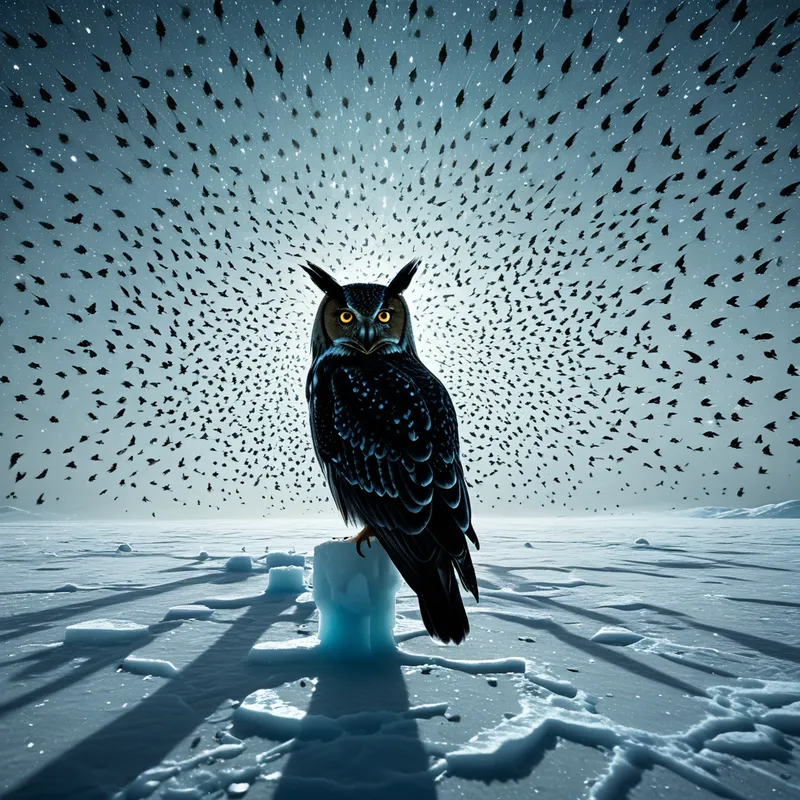
And where did the last fragments of the old darkness flee? They gathered in the silent places, the deep crevices of glaciers and the quiet under the winter stars. There, the Owl received them. While Raven brought the day, Owl became the sovereign of what remained. She took the solemn duty of the night, her wide eyes seeing truly in the realm Raven had abandoned. She became the watcher in the twilight, a reminder that not all things need, or should, be brought into the glaring light.
Cultural Origins & Context
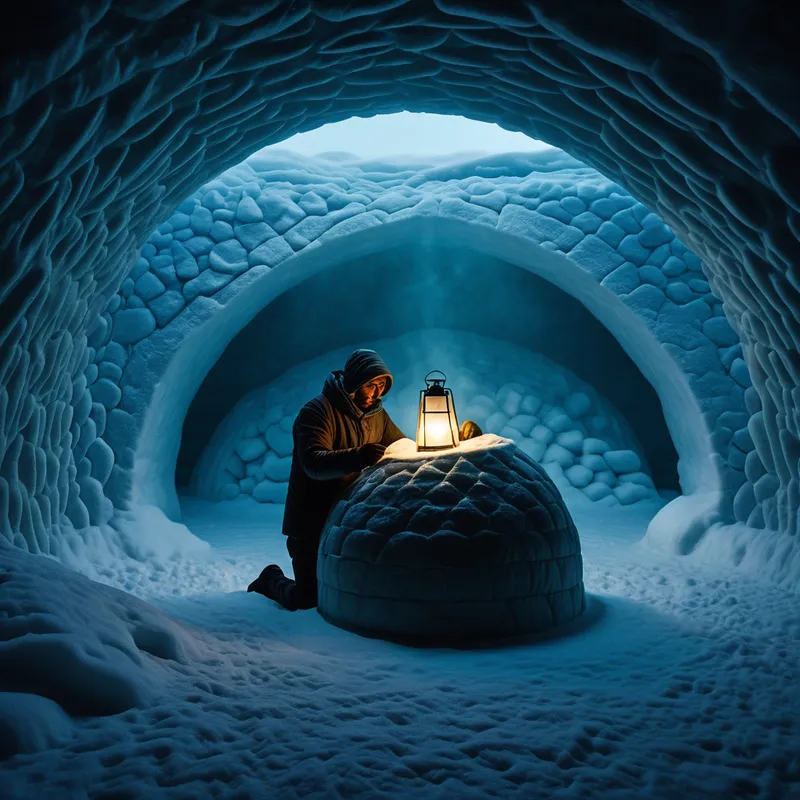
This myth belongs to the rich oral traditions of the Inuit nations, a story told across the vast expanse of the North. It was not written but breathed into existence, shared in the warm confines of the igloo or sod house during the long winter nights. Elders, the keepers of Inuit Qaujimajatuqangit, would narrate it to wide-eyed children, using the rhythm of their voice and the crackle of the seal-oil lamp to paint the scene. Its function was multifaceted: it was a creation myth, explaining the origin of daylight and the colors of the raven and the owl. It was also a moral and psychological map, illustrating the necessary balance between bold action and quiet wisdom, between the transformative force and the stabilizing presence. The story validated the environment itself—the extreme contrast between the midnight sun and the polar night was mirrored in the duality of its avian protagonists.
Symbolic Architecture
At its [heart](/symbols/heart “Symbol: The heart symbolizes love, emotion, and the core of one’s existence, representing deep connections with others and self.”/), this is a myth of primordial Transformation initiated by the archetypal [Trickster](/symbols/trickster “Symbol: A boundary-crossing archetype representing chaos, transformation, and the subversion of norms through cunning and humor.”/). [Raven](/symbols/raven “Symbol: The raven is often seen as a messenger of the divine and a symbol of transformation, wisdom, and the mysteries of life and death.”/) does not petition or wage war; he uses guile, patience, and a willingness to be swallowed by the unknown (the [daughter](/symbols/daughter “Symbol: In dreams, a daughter symbolizes innocence, potential, and the nurturing aspects of oneself or one’s relationships.”/)’s [womb](/symbols/womb “Symbol: A symbol of origin, potential, and profound transformation, representing the beginning of life’s journey and the unconscious source of creation.”/)) to achieve his goal. His transformation from white to black is the indelible [mark](/symbols/mark “Symbol: A ‘mark’ often symbolizes identity, achievement, or a defining characteristic in dreams.”/) of his Sacrifice—he carries the soot of the old world on his feathers as a testament to the deed.
The gift of consciousness is often stolen, not given, and the thief bears the stains of the struggle forever.
Owl represents the [integration](/symbols/integration “Symbol: The process of unifying disparate parts of the self or experience into a cohesive whole, often representing psychological wholeness or resolution of internal conflict.”/) of what is left behind. She is not the [antagonist](/symbols/antagonist “Symbol: A character or force that opposes the protagonist, creating conflict and driving narrative tension in artistic works.”/) but the complementary force. If Raven is the Fire of [dawn](/symbols/dawn “Symbol: The first light of day, symbolizing new beginnings, hope, and the transition from darkness to illumination.”/), Owl is the deep, reflective [Water](/symbols/water “Symbol: Water symbolizes the subconscious mind, emotions, and the flow of life, representing both cleansing and creation.”/) of the [moonlit night](/symbols/moonlit-night “Symbol: A moonlit night symbolizes mystery, intuition, and the unconscious mind’s exploration.”/). She signifies the wisdom that comes from embracing the [shadow](/symbols/shadow “Symbol: The ‘shadow’ embodies the unconscious, repressed aspects of the self and often represents fears or hidden emotions.”/), the parts of the self and the world that remain mysterious, unseen, and potent. Her [Vision](/symbols/vision “Symbol: Vision reflects perception, insight, and clarity — often signifying the ability to foresee or understand deeper truths.”/) is of a different order than Raven’s acquisitive [sight](/symbols/sight “Symbol: Sight symbolizes perception, awareness, and insight, representing both physical and inner vision.”/).
The Dreamer’s Resonance
When this myth stirs in the modern Dream, it often signals a profound inner conflict between two necessary but opposing psychic forces. To dream of a raven stealing light may reflect a deep, instinctual push to bring something hidden within the psyche—a talent, a memory, a trauma—into the light of awareness, no matter the cost to one’s current “color” or identity. It is the call of the Explorer and the Rebel.
Conversely, dreaming of the owl’s silent gaze often accompanies a somatic sense of being watched or known at a level deeper than thought. This can feel unsettling, a confrontation with the Shadow. It is the psyche’s insistence that not every uncovered truth must be acted upon immediately; some must be held, contemplated, and understood in the quiet dark before they can be integrated. The dreamer may be in a phase of necessary incubation, where the Wound itself becomes a source of insight.
Alchemical Translation
The myth models the alchemical process of individuation—the journey toward psychic wholeness. The initial state is one of unconscious darkness (“the world in shadow”). The Raven’s Call within us is the trickster spirit that grows restless with this limitation. It engineers a daring, often messy, theft of illumination. This is the nigredo, the blackening; Raven is stained, and the old order is destroyed. We acquire light (consciousness) but are marked by the process.
The psyche’s dawn is always an act of creative theft from the tyrant of the familiar.
Yet, the work is not complete with possession alone. The albedo, or whitening, is represented by Owl. She is the conscious assimilation of what the light reveals and, crucially, what it does not. She is the capacity to sit with the remaining darkness—the grief, the mystery, the unanswerable questions—without rushing to fill it with false light. The final stage is not a victory of day over night, but the establishment of a sacred balance. The integrated self can act with Raven’s transformative cunning and rest in Owl’s deep, accepting wisdom, understanding that both the flight and the vigil are essential to a complete Soul.
Associated Symbols
Explore related symbols from the CaleaDream lexicon:
- Raven — The archetypal trickster and bringer of light, whose transformative act changes the world and stains him forever, symbolizing the cost of consciousness.
- Light — The stolen illumination Raven brings, representing consciousness, awareness, and the dawn of psychic clarity from a state of primordial shadow.
- Shadow — The primordial darkness and the personal unconscious, embodied by Owl’s domain and the stain on Raven, representing all that is hidden and integrated.
- Trickster — The archetype perfectly embodied by Raven, who uses cunning and transformation to break stagnant order and initiate necessary change.
- Sacrifice — Raven’s loss of his original white plumage, representing the inevitable personal cost paid in the process of gaining enlightenment or creating change.
- Moon — The celestial body associated with Owl, reflecting the passive, receptive, and intuitive wisdom that complements the sun’s active light.
- Vision — The profound sight possessed by Owl, representing the ability to see truth in darkness and understand what is not immediately illuminated.
- Transformation — The core process of the myth, seen in Raven’s color change and the world’s shift from dark to light, mirroring inner psychic alchemy.
- Journey — Raven’s flight from the lodge into the sky, symbolizing the perilous but necessary psychic voyage from unconsciousness to awareness.
- Earth — The world transformed by the light, representing the grounded reality and the people who benefit from the stolen gift of consciousness.