The Otherworld Hostel Myth Meaning & Symbolism
A king enters a mysterious hostel in the Otherworld, where he must navigate impossible tasks to claim his destiny and restore cosmic order.
The Tale of The Otherworld Hostel
Listen, and let the fire’s crackle become the whisper of [the sidhe](/myths/the-sidhe “Myth from Celtic culture.”/). There was a king, Cormac mac Airt, whose reign was a golden branch upon the tree of Tara. But [the world](/myths/the-world “Myth from Tarot culture.”/) of men is but one leaf. One grey dawn, a mist that was not mist rolled across the plain, and from it stepped a warrior. His cloak was the colour of a [raven](/myths/raven “Myth from Haida culture.”/)’s wing, and in his hand he bore a branch of silver from which hung nine apples of red gold. When shaken, they made a music so sweet that wounds would heal and sorrows flee.
“This branch is for you, King of Tara,” said [the stranger](/myths/the-stranger “Myth from Biblical culture.”/), his voice like wind through stones. “But its price is three wishes.” Cormac, ensnared by the beauty, agreed. And so the stranger named his price: Cormac’s wife, his son, and his daughter. One by one, in the years that followed, a magical fog would descend, and his beloved would vanish. Grief hollowed the king like a winter oak.
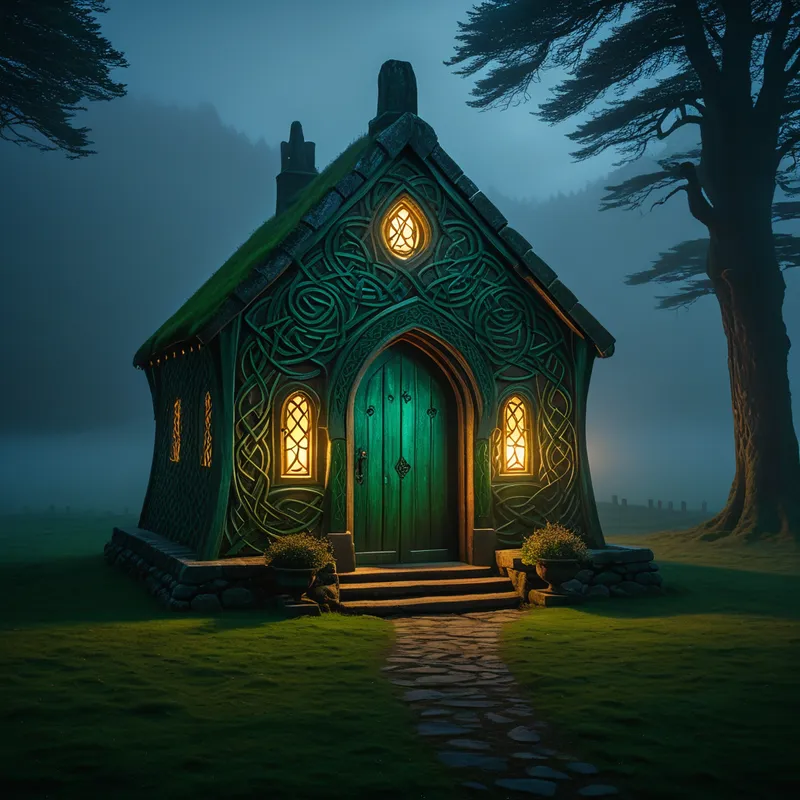
When his daughter disappeared, Cormac seized his spear and strode alone into the thickening mist, following a path only despair could see. The world of solid earth fell away. He walked until he came upon a plain of wonder, where the light had no single source. And there stood a hostel. It was a house of kings, yet unlike any on earth—its walls seemed of silver and its roof thatch of white bird feathers. A fragrance of cooking meat and mead, of applewood and peat, poured from its open door.
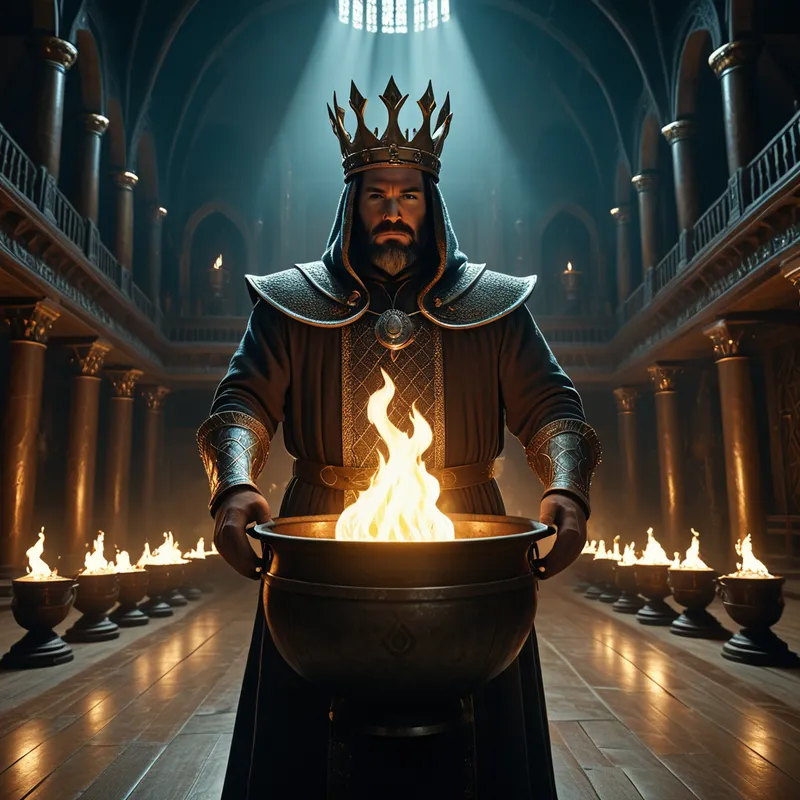
Inside, a company awaited. A beautiful, fierce woman tended a fire. A grey-haired warrior sharpened a spear. And on a throne sat a man of majestic, terrible presence—the Dagda himself, lord of the Tuatha Dé Danann. “Welcome, Cormac,” [the Dagda](/myths/the-dagda “Myth from Celtic culture.”/) said, his voice warming the very stones. “You have passed the first test: the journey of longing.”
But hospitality in [the Otherworld](/myths/the-otherworld “Myth from Celtic culture.”/) is a trial. Before the feast could begin, a log was needed for the fire. Cormac watched as four giants dragged in a great tree. “Split it,” commanded the Dagda. Four men tried and failed. “You try, King of Tara.” Cormac took the axe. With a blow that echoed his heart’s resolve, he cleft the log in two. From its centre writhed a sheep and a ram. “Now,” said the Dagda, a glint in his eye, “separate them.”
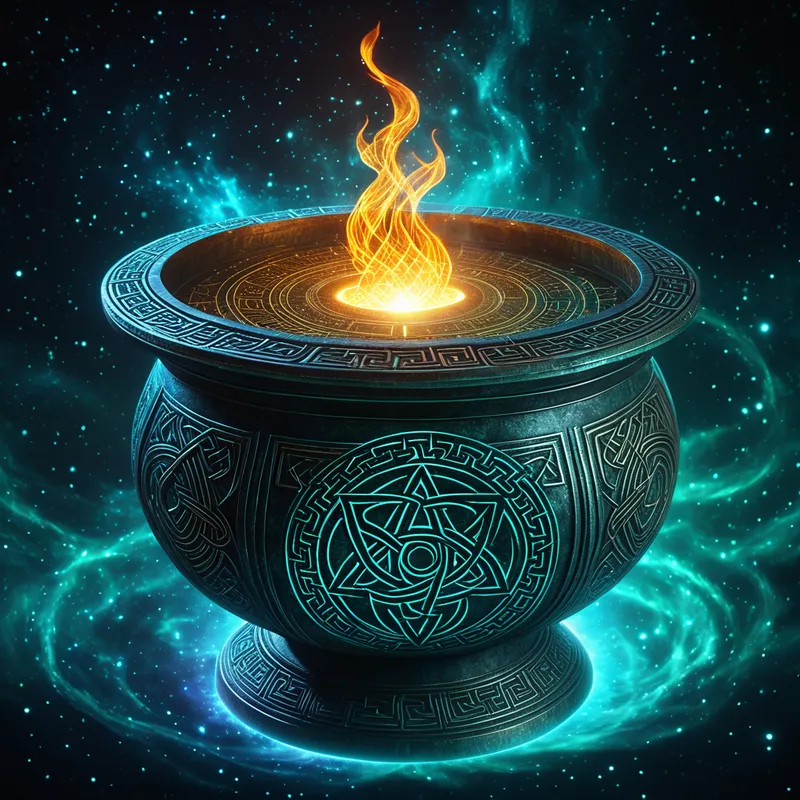
The hall held its breath. Cormac grasped the woolly beasts, and with a strength born of all his lost loves, he tore them apart. As he did, the sheep became a bundle of wool, the ram a measure of grain. “The final task,” said the woman, gesturing to a cauldron. “Tell us the truth of this vessel.” Cormac looked into its depths, where scenes of falsehood boiled. “It is a cauldron of truth,” he declared. “No lie can be uttered near it, and it will not cook food for a man of deceit.”
A silence, deep and approving, filled the hostel. Then the Dagda smiled. “You have split the impossible, separated sustenance from its source, and named truth in [the vessel](/myths/the-vessel “Myth from Alchemical culture.”/) of mystery. You have earned more than your family’s return.” And from behind a curtain stepped Cormac’s wife, son, and daughter, whole and smiling. The warrior who had taken them was none other than [Manannán mac Lir](/myths/manannn-mac-lir “Myth from Celtic culture.”/), who had orchestrated this entire initiation. As a gift for his integrity, Manannán gave Cormac [the silver branch](/myths/the-silver-branch “Myth from Celtic culture.”/), and the Dagda bestowed upon him a cup of gold that would shatter if three lies were spoken before it. Then, [the mist](/myths/the-mist “Myth from Celtic culture.”/) returned Cormac to Tara, his household restored, and in his hand, the tangible grace of the [Otherworld](/myths/otherworld “Myth from Celtic culture.”/)—a branch that sang, and a cup that held kingship itself to account.
Cultural Origins & Context
This tale, Serglige Con Culainn (“The Wasting Sickness of Cú Chulainn”) and found in parts of the Lebor Gabála Érenn, is not mere entertainment. It is a sovereignty myth, a narrative template performed by filí (poets) and seanchaithe (storytellers) to articulate the sacred contract between a king and the land. The king’s prosperity—and by extension, the tribe’s—was directly tied to his fír flathemon, his “ruler’s truth,” a combination of [justice](/myths/justice “Myth from Tarot culture.”/), integrity, and personal righteousness.
The Otherworld Hostel, or Bruidhen, is a quintessential liminal zone. It is not a paradise of rest, but a testing ground where the cosmic order is maintained. The story was likely told at gatherings, reinforcing the idea that true leadership requires a perilous journey beyond the comfort of the known, into the realm of archetypal powers (the Tuatha Dé Danann), where one’s essential character is forged in the fire of impossible demands. It transmits a core Celtic value: that generosity and hospitality (fēich) are paramount, but they are reciprocal and demanding, creating bonds of obligation that tie the human world to the divine.
Symbolic Architecture
The Hostel is the [psyche](/myths/psyche “Myth from Greek culture.”/) itself—a structured, yet mysterious, [interior](/symbols/interior “Symbol: The interior symbolizes one’s inner self, thoughts, and emotions, often reflecting personal growth, vulnerabilities, and secrets.”/) [space](/symbols/space “Symbol: Dreaming of ‘Space’ often symbolizes the vastness of potential, personal freedom, or feelings of isolation and exploration in one’s life.”/) where the conscious ego (Cormac) encounters the autonomous powers of the unconscious (the Gods). The [loss](/symbols/loss “Symbol: Loss often symbolizes change, grief, and transformation in dreams, representing the emotional or psychological detachment from something or someone significant.”/) of [family](/symbols/family “Symbol: The symbol of ‘family’ represents foundational relationships and emotional connections that shape an individual’s identity and personal development.”/) is the initial, devastating [dissolution](/symbols/dissolution “Symbol: The process of breaking down, dispersing, or losing form, often representing transformation, release, or the end of a state of being.”/) of [the ego](/myths/the-ego “Myth from Jungian culture.”/)’s attachments, the necessary price for admission to a deeper [reality](/symbols/reality “Symbol: Reality signifies the state of existence and perception, often reflecting one’s understanding of truth and life experiences.”/).
The cauldron that will not cook a falsehood is the heart of the matter: the unconscious demands utter psychic integrity, and will withhold its nourishing energy from a fragmented or deceitful self.
The [silver branch](/myths/silver-branch “Myth from Celtic culture.”/) with its healing apples is the call of [the Self](/myths/the-self “Myth from Jungian culture.”/)—the transcendent, unifying center of the psyche—whose [beauty](/symbols/beauty “Symbol: This symbol embodies aesthetics, harmony, and the appreciation of life’s finer qualities.”/) lures us away from comfortable identification with [persona](/symbols/persona “Symbol: The social mask or outward identity one presents to the world, often concealing the true self.”/) and [status](/symbols/status “Symbol: Represents one’s social position, rank, or standing within a group, often tied to achievement, power, or recognition.”/). The tasks are not tests of brute [strength](/symbols/strength “Symbol: ‘Strength’ symbolizes resilience, courage, and the ability to overcome challenges.”/), but of symbolic competence: splitting the log (differentiating opposites), separating the [sheep](/symbols/sheep “Symbol: Sheep often symbolize innocence, vulnerability, and the idea of conforming to societal norms.”/) and ram (discerning the creative potential within primal unity), and naming the [cauldron](/symbols/cauldron “Symbol: A large metal pot for cooking or brewing, symbolizing transformation, nourishment, and hidden potential.”/) (articulating [the principle](/symbols/the-principle “Symbol: A fundamental truth, law, or doctrine that serves as a foundation for a system of belief, behavior, or reasoning, often representing moral or ethical standards.”/) of inner [truth](/symbols/truth “Symbol: Truth represents authenticity, honesty, and the quest for knowledge beyond mere appearances.”/)). Success means the ego does not conquer the unconscious, but proves itself a worthy [vessel](/symbols/vessel “Symbol: A container or structure that holds, transports, or protects something essential, representing the self, emotions, or life journey.”/) for its contents, resulting in the restoration of the “family”—the now-integrated parts of the [personality](/symbols/personality “Symbol: Personality in dreams often symbolizes the traits and characteristics of the dreamer, reflecting how they perceive themselves and how they believe they are perceived by others.”/)—and the gift of self-regulating wisdom (the [truth](/symbols/truth “Symbol: Truth represents authenticity, honesty, and the quest for knowledge beyond mere appearances.”/)-telling cup).
The Dreamer’s Resonance
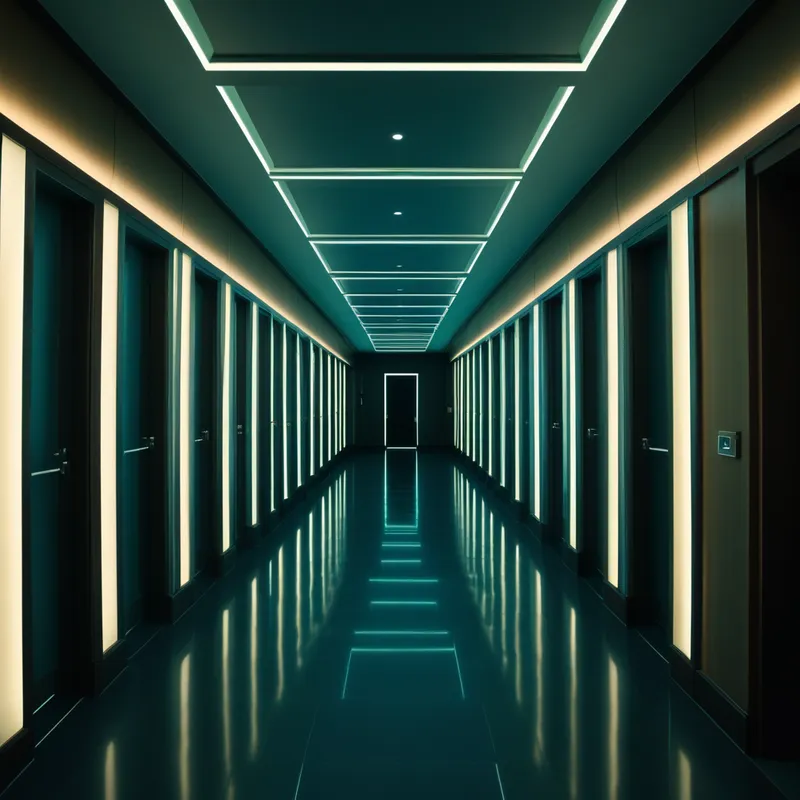
When this myth stirs in modern dreams, it often manifests as dreams of mysterious hotels, endless corridors, or being tested in a strange, institutional building. The somatic feeling is one of anxious awe, a pressure in the chest, a sense of being scrutinized. Psychologically, this indicates a profound initiation underway. The dreamer is in a liminal phase between life stages, identities, or levels of consciousness.
The “impossible task” in the dream—be it solving an unsolvable riddle, finding a lost room, or facing a panel of silent judges—mirrors Cormac at the log. It represents a core complex or neurotic pattern that feels monolithic and indivisible. The dream is the psyche’s theatre, staging this confrontation. Success in the dream task, or even the courageous attempt, signals the ego’s growing capacity to engage with, rather than flee from, the demands of the deep Self. The eventual appearance of a guide, a gift, or a reunited “family” of dream figures marks the resolution of this psychic ordeal and the promise of renewed inner cohesion.
Alchemical Translation
The alchemical process mirrored here is the [nigredo](/myths/nigredo “Myth from Alchemical culture.”/) and albedo—the initial descent into darkness (the loss of all Cormac holds dear) followed by the washing in the waters of meaning (the trials in the Hostel). Cormac’s journey is a blueprint for individuation.
First, the mortificatio: the conscious world is stripped away. This is the painful, often involuntary, dissolution of old structures. Then, in the Hostel (the vas or alchemical vessel), the work begins. The ego is not dissolved entirely, but put to service. Splitting the log is the [separatio](/myths/separatio “Myth from Alchemical culture.”/), the crucial ability to discern the opposites warring within the psyche. Separating the sheep from the ram is the coniunctio in potential—seeing that from the primal unity ([the tree of life](/myths/the-tree-of-life “Myth from Kabbalistic culture.”/)) comes both the softness of nurturance (wool) and the active principle of fertility (grain).
The ultimate prize is not the gold or the singing branch, but the cauldron of truth itself—the integrated psyche where deception is impossible, and where the nourishment of the Self is freely available.
For the modern individual, this myth advises that our greatest crises are invitations to cross the misty threshold. Our “Hostel” may be therapy, a creative ordeal, a period of depression, or a spiritual quest. The “impossible tasks” are the inner work we believe we cannot do: facing a shadow, enduring a grief, speaking a soul-truth. By engaging with them directly, with the full force of our being, we do not win back our old life, but a life reconstituted on a truer, more sovereign foundation. We return to our personal Tara bearing not just what we lost, but the magical tools—the branch of inspiration and the cup of integrity—that make us true rulers of our own inner realm.
Associated Symbols
Explore related symbols from the CaleaDream lexicon: