The Origin of Fire Aboriginal Myth Meaning & Symbolism
A myth where a cunning hero steals fire from its jealous guardians, bringing the sacred element to humanity and altering the world forever.
The Tale of The Origin of Fire Aboriginal
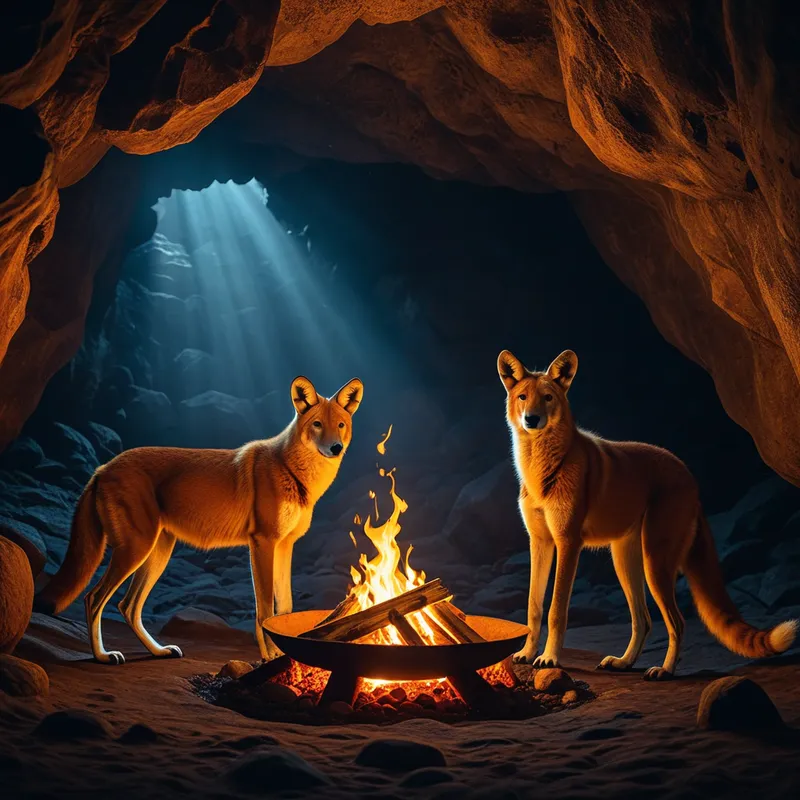
In the Dreaming, the world was a place of cold shadows. People shivered in the long nights, eating their food raw, their spirits dimmed by the absence of warmth and light. Fire existed, but it was a secret, a jealous treasure hoarded far away. It was kept by two fierce Dingos, ancestral beings of sharp tooth and sharper instinct, who guarded the flame in a hidden, rocky place. They knew its power and coveted it, letting no spark escape their watchful eyes.
Into this cold world came a hero, not of brute strength, but of supreme cunning. His name is remembered in many ways across the songlines, but his nature is constant: he was the Trickster. He saw his people’s suffering and heard the whispers of the land itself, longing for the crackle and dance of flame. A plan, delicate and dangerous, kindled within him.
He journeyed far, following the scent of smoke on the wind, until he found the guardians’ lair. There, the two Dingos lay curled around their prize, a small, perfect fire burning in a scooped-out hearth. Their ribs rose and fell in sleep, but their ears twitched at every sound. The Trickster knew he could not fight them. Instead, he became like the wind—unseen, patient. He watched their patterns, the deep rhythm of their slumber.
When the moment was ripe, he moved. Not with a grab, but with a gentle, precise theft. Using a long, dry stick, he coaxed a single, glowing coal from the edge of the fire. The heat seared his hands, but he did not flinch. As the coal touched the prepared tinder in his other hand, a wisp of smoke, then a tiny tongue of flame, was born. The scent of burning awoke the guardians. With a roar that split the silence, the Dingos sprang up, eyes blazing with fury.
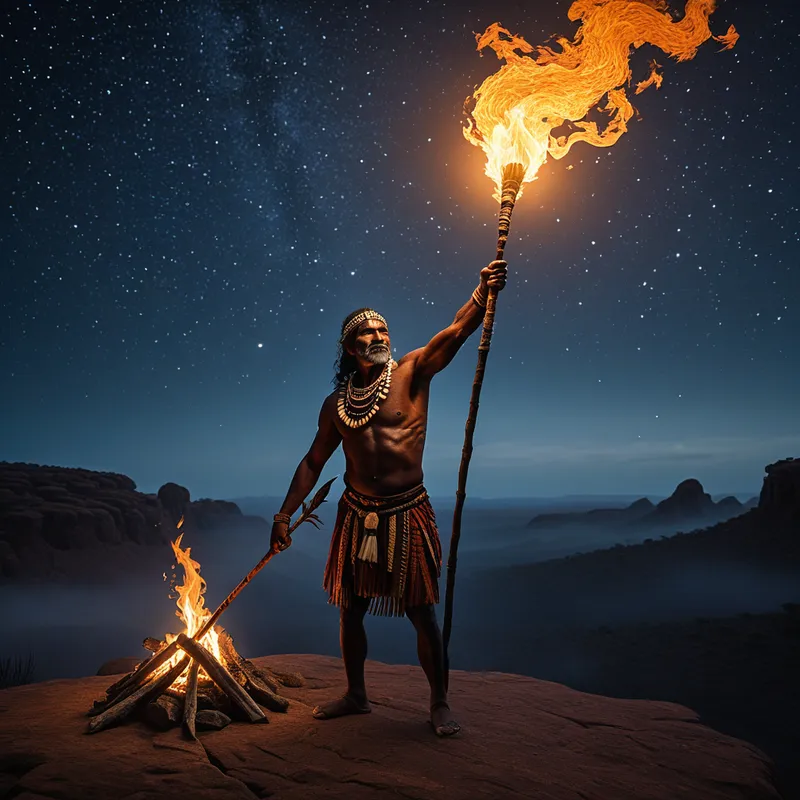
What followed was not a chase, but a transformation. The Trickster ran, the fledgling fire clutched to his chest. He was not running to escape, but to distribute. As he fled, he touched his firebrand to the trees he passed. The gum tree caught flame and has held the secret of fire in its wood ever since, ready to be coaxed out. The grass tree offered its resinous heart as a torch. He gave the fire to the land itself, scattering its essence so it could never again be held by one.
Finally, exhausted and triumphant, he brought the last flame to his people. They gathered around, feeling its warmth for the first time—a warmth that entered not just their skin, but their stories, their ceremonies, their very souls. The world was changed. The jealous guardians were left with only ashes, while humanity, and the land itself, now held the sacred spark.
Cultural Origins & Context
This myth is not a mere story but a vital chapter in the living map of the Dreaming. It belongs to the complex tapestry of Aboriginal Australian cosmology, where ancestral beings shaped the world and its laws. Passed down orally for millennia through song, dance, and ceremonial narrative, it was (and is) a foundational teaching. Elders and knowledge keepers would recount it to illustrate profound truths about the nature of resources, ingenuity, and cosmic order.
Its societal function was multifaceted. Practically, it encoded essential survival knowledge—how to identify fire-bearing trees like the gum tree and the grass tree. Spiritually, it explained the sacred responsibility that comes with powerful knowledge: fire is a gift that requires respect, for it can cook food and warm the tribe, but it can also ravage the country if misused. The myth establishes that vital resources belong to the community and the land, not to hoarding individuals, reinforcing a core ethic of sharing and ecological balance.
Symbolic Architecture
At its [heart](/symbols/heart “Symbol: The heart symbolizes love, emotion, and the core of one’s existence, representing deep connections with others and self.”/), this myth is an [allegory](/symbols/allegory “Symbol: A narrative device where characters, events, or settings represent abstract ideas or moral qualities, conveying deeper meanings through symbolic storytelling.”/) for the acquisition of [consciousness](/symbols/consciousness “Symbol: Consciousness represents the state of awareness and perception, encompassing thoughts, feelings, and experiences.”/) itself. Fire represents transformative [knowledge](/symbols/knowledge “Symbol: Knowledge symbolizes learning, understanding, and wisdom, embodying the acquisition of information and enlightenment.”/), technology, culture, and the sacred spark of [spirit](/symbols/spirit “Symbol: Spirit symbolizes the essence of life, vitality, and the spiritual journey of the individual.”/) that lifts humanity from a state of primitive survival.
The theft of fire is the primordial act of consciousness differentiating itself from the unconscious, instinctual state.
The hoarding Dingos symbolize the protective, conservative forces of the psyche and the world. They are the instinctual guardians of potent [energy](/symbols/energy “Symbol: Energy symbolizes vitality, motivation, and the drive that fuels actions and ambitions.”/), fearful of its release because they intuit the irreversible change it will bring. The [Trickster](/symbols/trickster “Symbol: A boundary-crossing archetype representing chaos, transformation, and the subversion of norms through cunning and humor.”/) [hero](/symbols/hero “Symbol: A hero embodies strength, courage, and the ability to overcome significant challenges.”/) embodies the necessary disruptive intelligence—the cunning of the ego or the emerging conscious mind that must sometimes defy the old orders to bring about growth. His act is one of sacred rebellion. The burning of the trees represents the internalization and dissemination of this knowledge; once awakened, consciousness cannot be contained—it transforms everything it touches, becoming a latent potential within the very fabric of the world (and the psyche).
The Dreamer’s Resonance
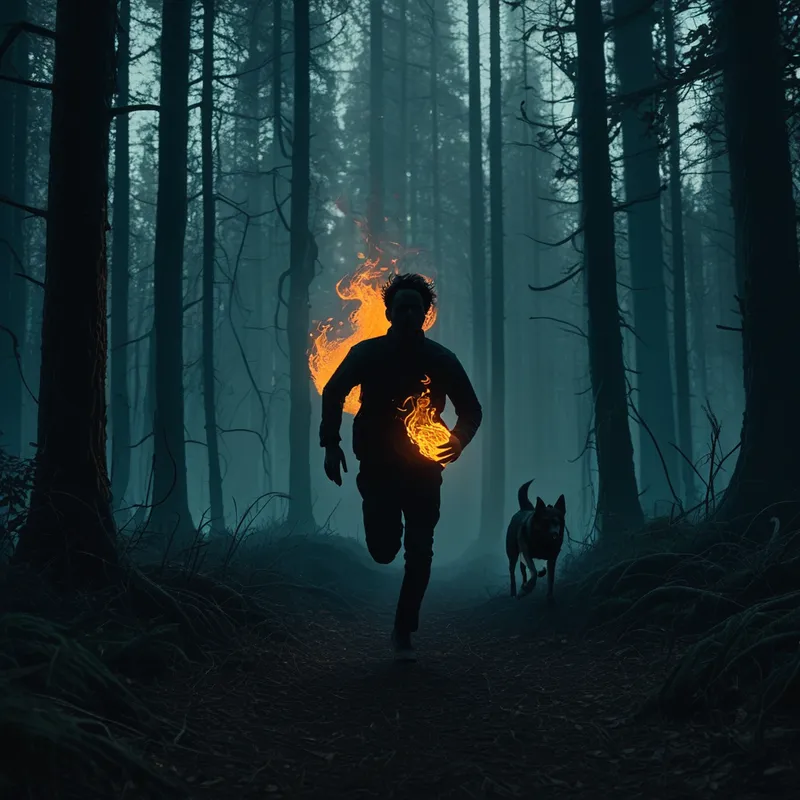
When this mythic pattern stirs in the modern dreamer, it often signals a critical phase of psychological “fire-stealing.” One may dream of being pursued after taking something precious, of hiding a glowing secret, or of trying to ignite a damp torch in the dark.
Somatically, this can correlate with a feeling of burning excitement mixed with anxiety—a racing heart, restless energy. Psychologically, the dreamer is navigating the theft of their own potential from internal or external “guardians.” These guardians can be internalized voices of authority, familial expectations, or outmoded aspects of the self that resist change. The chase in the dream mirrors the inner conflict: the exhilaration of claiming one’s power (the fire) clashes with the guilt, fear, or shame (the pursuing Dingos) instilled by the old order. The dream is the psyche’s theater for rehearsing this risky but vital act of self-possession.
Alchemical Translation
In the alchemical vessel of individuation, this myth models the process of separatio and coniunctio—the separation of a precious element from the primal mass and its integration into a new, more complex whole.
The initial cold, shadowy world represents a psychic state of unconscious identification, where one’s inner fire—passion, creativity, true will—is dormant, projected onto external authorities or locked away by fear. The Trickster’s journey is the ego’s courageous foray into the unconscious to reclaim this projected energy. The “theft” is the necessary, often uncomfortable, act of withdrawing projections and taking responsibility for one’s own power.
The moment of seizing the coal is the moment of insight, where a latent complex becomes conscious, burning the hand that holds it but illuminating the path forward.
The ensuing chase and distribution symbolize the integration phase. The new consciousness cannot be kept secret; it must be applied, transforming one’s relationship to the inner world (the symbolic landscape of trees) and the outer world (the community). The old guardians—rigid patterns, defensive complexes—are not destroyed but left behind, their role in hoarding the energy now obsolete. The individual, now a carrier of the sacred spark, learns to tend it with respect, using its light for warmth and vision, aware of its power to both create and destroy.
Associated Symbols
Explore related symbols from the CaleaDream lexicon:
- Fire — The central symbol of transformative knowledge, sacred spirit, and cultural awakening; the element stolen from instinctual guardians for the benefit of all.
- Trickster — The archetypal embodiment of cunning intelligence and necessary rule-breaking, representing the psyche’s capacity to outwit rigid structures to procure vital growth.
- Journey — The essential path from a state of lack (coldness) to one of empowerment, involving risk, strategy, and a confrontation with guardians of the status quo.
- Sacrifice — The hero’s endurance of searing pain and pursuit, representing the personal cost always paid for a leap in consciousness or the claiming of one’s power.
- Tree — Specifically the fire-holding trees, symbolizing the internalization of knowledge; once awakened, potential becomes a latent, enduring part of the psychic structure.
- Shadow — The pursuing guardians (Dingos) represent the shadow aspects of authority, jealousy, and the instinctual self that resist the release of transformative energy.
- Dream — The entire narrative occurs within the Dreaming, framing it as a foundational, archetypal pattern etched into the collective unconscious of a people and humanity.
- Origin — This is a myth of primordial beginnings, explaining the origin of a fundamental human condition: living with the transformative, dangerous gift of consciousness.
- Cave — The hidden, guarded location of the original fire, representing the deep, unconscious recesses of the psyche where primal energy and potential are stored.
- Fear — The emotional landscape of the guardians and the initial state of humanity; the theft of fire is an act that moves the community from a state dominated by fear to one of empowered warmth.