The Oracle's Chamber Myth Meaning & Symbolism
A seeker descends into a sacred cavern to confront the terrifying, divine voice of the Oracle, emerging forever changed by the truth they dared to hear.
The Tale of The Oracle's Chamber
Beneath the twin peaks of Parnassus, where eagles circle the high, clear air, the earth herself breathes. A scent of stone, of bay laurel, and of something older than memory hangs in the stillness. This is the Temenos of Delphi, but its heart lies not in the sunlit colonnades. Its heart is a wound in the world, a crack in the mountain's flank leading down into a chamber of eternal twilight.
They come from across the wine-dark sea: kings with armies at their backs, colonists seeking a sign for a new city, poets hollowed out by divine madness. They bring rich gifts—tripods of bronze, statues of ivory and gold—and lay them at the threshold. But these treasures are but whispers before the roar that awaits. For a day and a night, they purify themselves in the cold waters of the Castalian Spring, washing away the dust of the road and the pride of their stations. They become supplicants, empty vessels hoping to be filled with a word from the god.
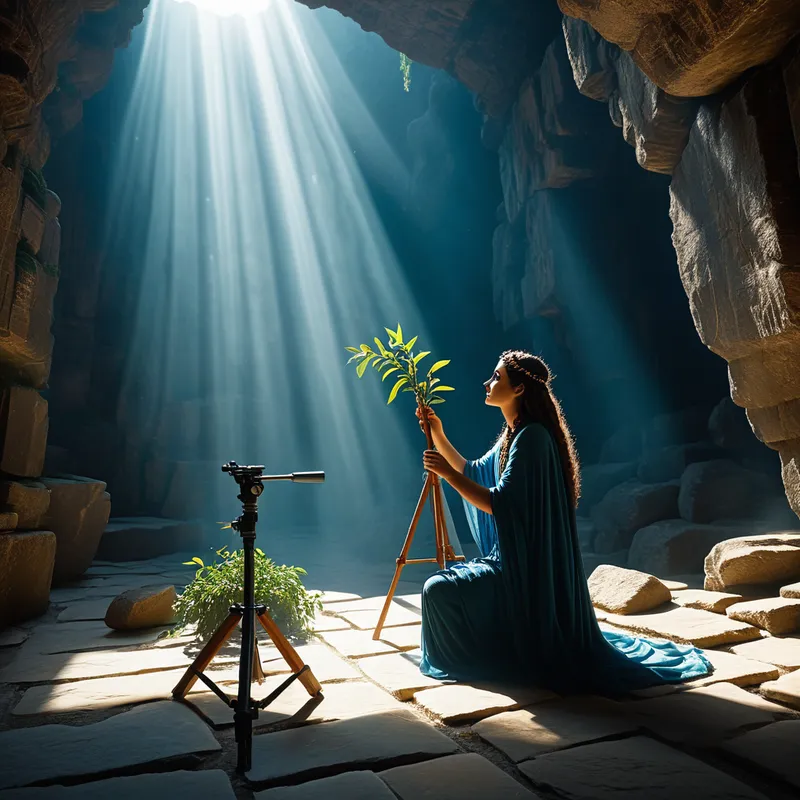
On the seventh day of each month, when the god Apollo is present, the chosen one descends. She is the Pythia, an ordinary woman of the region. She bathes, she fasts. She chews the bitter leaves of the laurel, the tree sacred to the Far-Shooter. Led by silent priests, she passes into the innermost sanctum, the adyton.
Here, the air is thick and warm, smelling of damp rock and a strange, sweet vapor that coils from a deep fissure in the floor. She seats herself upon a tall, three-legged stool—the tripod—placed directly over the chasm. The vapors rise, enveloping her. Her eyes, once clear, grow clouded and distant. Her body trembles, then stiffens. A sound begins, not from her lips but from the very stone: a low groan that builds into a rush of incomprehensible syllables, a torrent of raw sound. The god has entered the chamber.
The seeker is brought before her. The question, carefully formulated and written, is presented. The chaotic sounds that pour forth—gasps, cries, fragmented words—are captured by the attending priests. In the echoing stillness that follows the divine storm, they translate the cacophony into a hexameter verse, a riddle wrapped in the ambiguity of the gods. The answer is never a simple yes or no. It is a mirror held up to fate, showing the seeker the contours of their own destiny, the hidden consequences of their desires. To hear it is to be forever unmoored from simple certainty. The seeker emerges from the chamber's gloom into the blinding sun, clutching a truth that is also a burden, forever marked by the voice from the deep.

Cultural Origins & Context
The Oracle of Delphi was not merely a story; it was the geopolitical and spiritual nerve center of the ancient Greek world for centuries. Its origins are shrouded in myth, said to be first guarded by the earth goddess Gaia, then by her daughter Python, whom Apollo slew to claim the site. This mythic succession from chthonic (earth) power to Olympian (celestial) order reflects a profound cultural shift.
Historically, the oracle functioned from at least the 8th century BCE. Its authority was unparalleled. City-states consulted it before founding colonies, going to war, or establishing laws. Its pronouncements, famously ambiguous, required interpretation, creating a vital role for priests and fostering a culture of deep deliberation. The oracle’s power derived from its perceived neutrality and its direct link to the divine will of Apollo. It served as a container for the collective anxieties and ambitions of the Hellenic world, a place where human uncertainty could be projected into a sacred space and returned, transformed into a poetic directive that demanded wisdom to unravel.
Symbolic Architecture
The Oracle's Chamber is a master symbol of the encounter between the conscious ego and the autonomous, often terrifying, voice of the deeper Self. Every element is psychically charged.
The descent into the adyton is a journey into the unconscious. The seeker leaves the sunlit world of rational order (Apollo's domain) to enter the dark, moist, vaporous realm of the earth (Gaia's domain). This is the necessary movement inward, away from persona and societal role.
The chasm and its vapors represent the raw, unformed substance of the psyche—the primal energy and archetypal patterns that precede and generate conscious thought. The Pythia, seated on the tripod over the fissure, becomes the mediating vessel, the point of connection. The tripod itself, a symbol of stability, suggests the need for a structured, ritualized container to safely channel this overwhelming power.
The oracle does not speak the language of the marketplace; it speaks the poetry of the soul, where every answer is a question turned back upon the questioner.
The fragmented, ecstatic speech of the Pythia is the voice of the unconscious in its pure, unedited form—powerful, symbolic, but not yet integrated. The priests' translation into verse symbolizes the essential work of consciousness: to take the raw material from the deep and give it a form that can be related to, interpreted, and lived. The resulting riddle is the truth of the psyche, which is never linear or literal but always symbolic, demanding engagement and personal responsibility to decipher.

The Dreamer's Resonance
When the pattern of the Oracle's Chamber arises in modern dreams, it signals a powerful initiation into a deeper layer of self-knowledge. The dreamer may find themselves in a basement, a cave, a sealed room, or any confined, subterranean space where a presence—often unseen—communicates.
The somatic experience is key. One may feel the ground tremble, smell an odd scent (sulfur, ozone, damp earth), or feel a pressure in the air. The "voice" may not be auditory; it could be a knowing, a sudden image, or a wave of emotion that feels alien yet profoundly personal. This is the psyche's equivalent of the Pythic vapors, activating a state between sleep and waking, reason and madness.
Psychologically, this dream marks a moment when the unconscious is forcefully presenting content to the conscious mind. The "oracle" is the voice of the Self, the central archetype of wholeness. Its message often feels disruptive because it challenges the dreamer's current identity, plans, or self-understanding. The anxiety in the dream mirrors the seeker's terror before the Pythia. The process underway is one of numinous invasion—a sacred, terrifying breaking-in of a truth too large for the ego to comfortably hold. The dreamer is being asked to "sit on the tripod": to find a stable, observing center within themselves from which to receive and ultimately translate this disruptive energy.
Alchemical Translation
The myth models the complete alchemical cycle of psychic transmutation, or individuation. The prima materia—the base, confused state of the seeker with their urgent, ego-driven question—is brought to the sacred vessel (the chamber).
The descent (negredo) is the darkening, the dissolution of certainty. The ego's plans are rendered meaningless before the chthonic power. The ecstatic possession of the Pythia represents the coniunctio, the fiery, chaotic union of opposites: conscious and unconscious, masculine and feminine (Apollo and the Earth), order and chaos. This is a state of psychic fermentation, often experienced in life as a crisis, a breakdown, or a period of intense creative or emotional turmoil.
The tripod is the ego's final, essential duty: not to command, but to provide a steadfast seat for the transpersonal Self to speak.
The translation by the priests is the albedo, the whitening. The chaotic experience is lifted into the light of consciousness, given form and language. The raw revelation becomes a reflective riddle. This is the work of analysis, journaling, art, or dialogue—making the unconscious content conscious and relatable.
Finally, the return with the riddle is the rubedo, the reddening. The transformed material is integrated back into life. The seeker does not receive a command but a symbolic directive that they must actively interpret and enact. The truth is not handed over; it is co-created through the living of it. The individual is no longer who they were; they have been reconstituted around a deeper, more paradoxical center of gravity, having dared to consult the oracle within.
Associated Symbols
Explore related symbols from the CaleaDream lexicon: