The Opus Magnum Myth Meaning & Symbolism
The alchemist's quest to transmute base matter into the Philosopher's Stone, a sacred process of death, purification, and rebirth that mirrors the soul's journey to perfection.
The Tale of The Opus Magnum
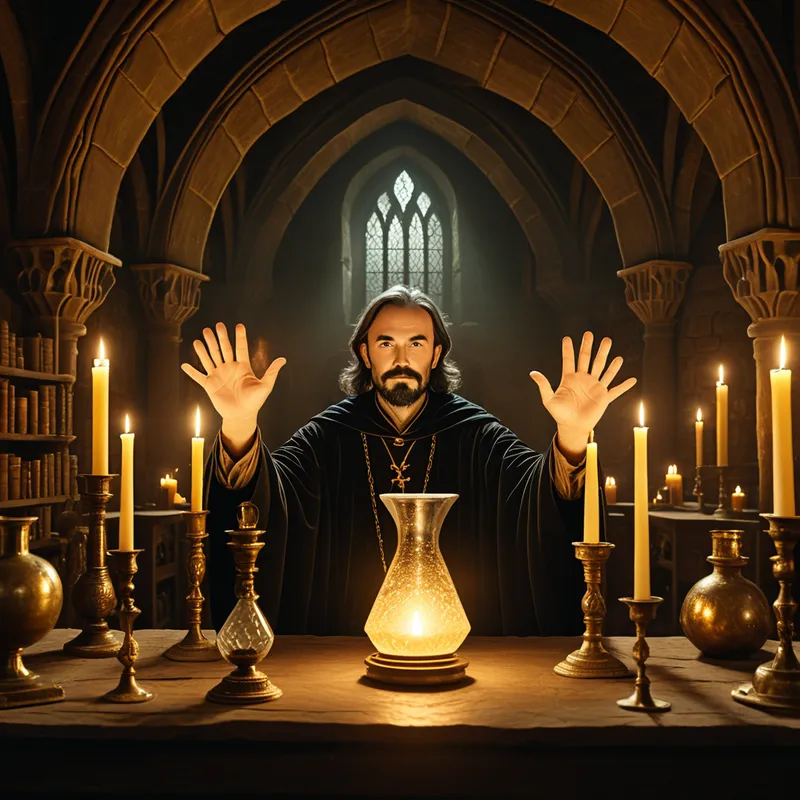
Listen, and I will tell you of the Great Work. It does not begin in a palace or on a battlefield, but in a place of quiet despair: the Athanor. Here, in the perpetual twilight of his laboratory, the Alchemist stands before the Hermetic Vessel. Within it lies the Prima Materia—a mass of black, heavy, and foul-smelling earth. It is the very dregs of the world, the Nigredo. He seals the vessel, and the fire is lit.
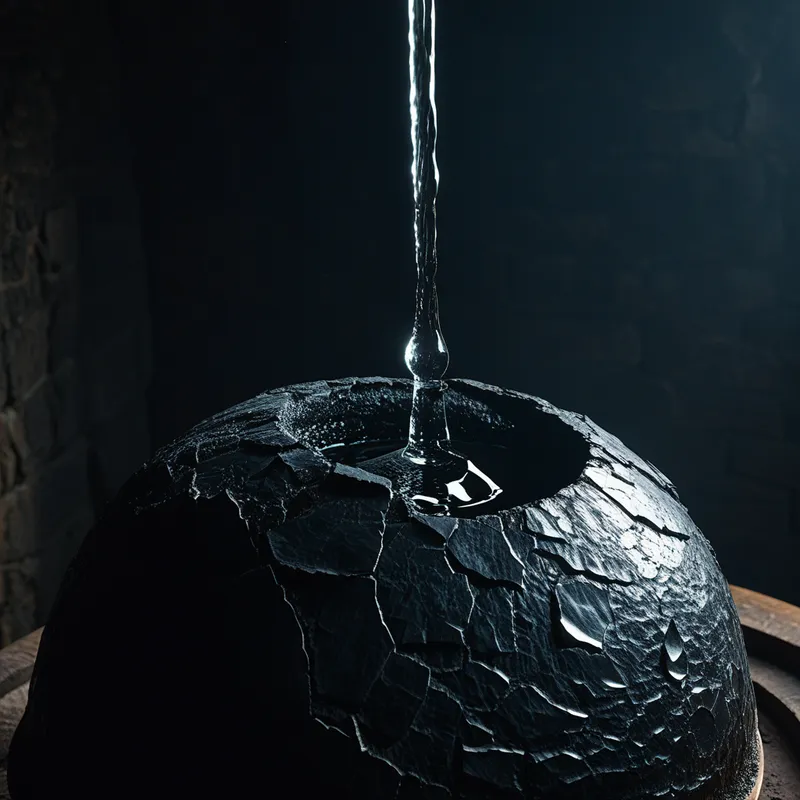
For days that bleed into months, the Alchemist tends the flame. The substance within does not glow; it rots. It sweats a bitter dew and cracks with a sound like breaking bones. A profound melancholy descends upon the operator. This is the death. The old king, the unrefined soul, must die in his own corruption. The Alchemist’s faith is his only guide.
Then, in the depth of the blackness, a miracle. A whitening, the Albedo. Like the first light of dawn after a long night, a silvery sheen appears. The matter softens, becomes fluid and mercurial. It is the washing in the Aqua Vitae, the emergence of the feminine Anima from the tomb of the masculine body. A white rose blooms in the ashes.
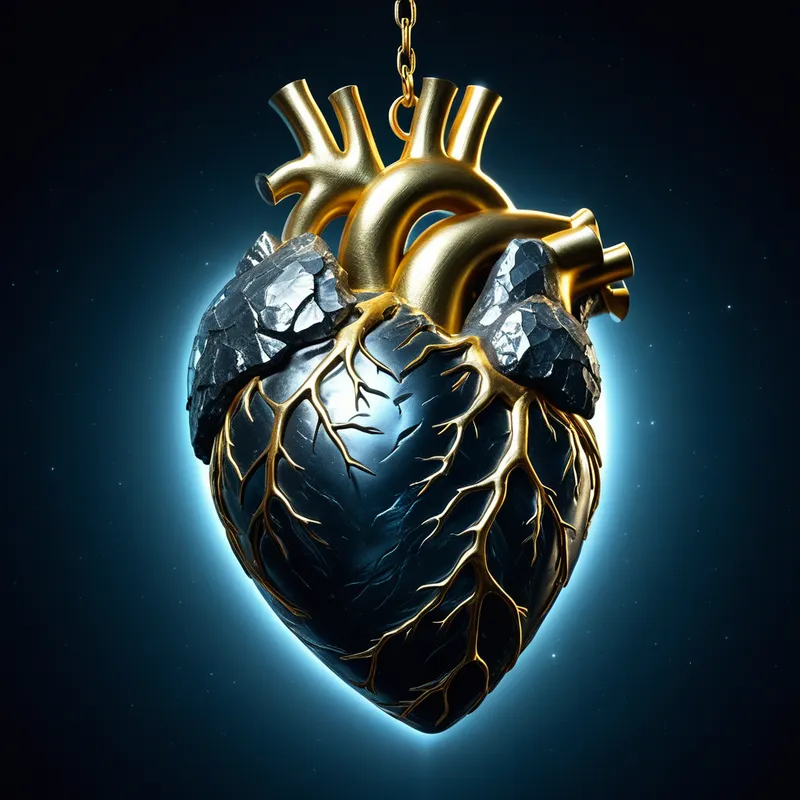
But the fire must increase. The whitened queen now meets the red king. The heat intensifies, and the substance blushes. This is the Rubedo. A fierce, glorious crimson floods the vessel. Colors dance—citrine, peacock’s tail—until they resolve into a stable, radiant gold. From the heart of the fire, a new substance is born. It is heavy yet luminous, solid yet alive. It is the Philosopher’s Stone, the Elixir Vitae. The Alchemist opens the vessel. A light fills the room, not of the sun or moon, but of a star born within the earth. The Work is complete. The base has become noble; the lead has dreamed itself into gold.
Cultural Origins & Context
The myth of the Opus Magnum is not a single story with named heroes, but a procedural epic encoded in the cryptic texts of European Hermeticism and laboratory alchemy, flourishing between the 12th and 17th centuries. It was passed down through a chain of initiates—figures like Hermes Trismegistus, Paracelsus, and the anonymous authors of the Rosarium Philosophorum. Its primary medium was the allegorical treatise, filled with symbolic illustrations of dragons, kings, queens, and lions, designed to conceal its true meaning from the unworthy (the profane) while revealing it to the dedicated seeker (the adept).
Its societal function was dual. Exoterically, it was a pseudo-science seeking material wealth and physical immortality, funded by princes and popes. Esoterically, and far more importantly, it was a map of the soul’s ascent. In an age where orthodox religion often presented a fixed path, alchemy offered a deeply personal, experiential mysticism. The laboratory was a sacred theater where the macrocosm of the universe and the microcosm of the human psyche were seen as mirrors. To perform the Work was to engage in the most sacred act of all: participating in the ongoing perfection of Creation itself.
Symbolic Architecture
The myth is a grand symbolic equation where every laboratory operation corresponds to an inner, psychological event. The Prima Materia is the raw, unconscious content of the psyche—our complexes, inherited patterns, and shadow material. It is not evil, but potential in its most chaotic and “base” form.
The furnace is the crucible of conscious attention, and the fire is the relentless heat of self-observation and unavoidable suffering.
The stages—Nigredo, Albedo, Rubedo—are not linear but spiraling phases of death and rebirth. The Nigredo is the confrontation with the shadow, the depression and disintegration that comes when our conscious persona proves inadequate. The Albedo symbolizes the cleansing of this darkness, the emergence of a reconciling consciousness (the anima or animus) that can wash the psyche. The Rubedo represents the final, passionate union of opposites—conscious and unconscious, spirit and matter—resulting in the birth of the Self.
The ultimate symbol, the Philosopher’s Stone, is the achieved state of psychic wholeness or individuation. It is not a state of flawless perfection, but of complete authenticity. It is the “gold” of a personality that has integrated its leaden flaws and transmuted them into the substance of its own unique being.
The Dreamer’s Resonance
When the Opus Magnum stirs in the modern dreamer, it often manifests not as a literal alchemist, but through its core sensations and symbolic phases. One may dream of being trapped in a decaying, blackened room (Nigredo), of washing in a powerfully cleansing but cold silver river (Albedo), or of witnessing the heart of a dark machine suddenly ignite with a warm, red, life-giving light (Rubedo).
Somatically, the process feels like a profound purification. It is the psyche’s innate drive to metabolize trauma, grief, or stagnation. The “putrefaction” stage may correlate with dreams of illness or rotting food, signaling a necessary breakdown of an old attitude. The sensation of a “weight” turning to “light” is common. This is the body’s unconscious intelligence participating in the symbolic transformation, often occurring during periods of major life transition, therapy, or creative incubation, where the old self must die for a new one to be born.
Alchemical Translation
For the modern individual, the Opus Magnum provides a non-dogmatic model for psychic transmutation. It teaches that transformation is not an act of willpower alone, but a natural process that requires containment, heat, and time. The first step is to identify one’s Prima Materia—what is that “lead” in your life? It may be a recurring resentment, a pattern of failed relationships, or a stifled creativity. This material must be placed in the Vas Hermeticum of committed self-work—perhaps through journaling, art, or dialogue—and sealed from the distracting winds of external opinion.
The fire is applied not to destroy the base material, but to force it to reveal its hidden, essential nature.
The Nigredo is the dark night of the soul that follows when we truly face this material. It is the depression, anger, or confusion that feels like an end. The alchemical counsel is to stay with the process, to tend the fire even when nothing seems to be happening. The Albedo arrives as a moment of insight, forgiveness, or cathartic release—the “white stone” of new understanding. Finally, the Rubedo is the embodied integration, where the insight becomes a lived reality, coloring one’s actions with newfound purpose and connection.
The goal is not to become someone else, but to become utterly oneself—to create the inner Lapis Philosophorum. This “stone” is then the touchstone of one’s existence. It does not make life perfect, but it transmutes every experience, even suffering, into the gold of meaning. In this, the modern individual becomes the Alchemist, the laboratory, and the Stone—completing the Great Work of becoming whole.
Associated Symbols
Explore related symbols from the CaleaDream lexicon: