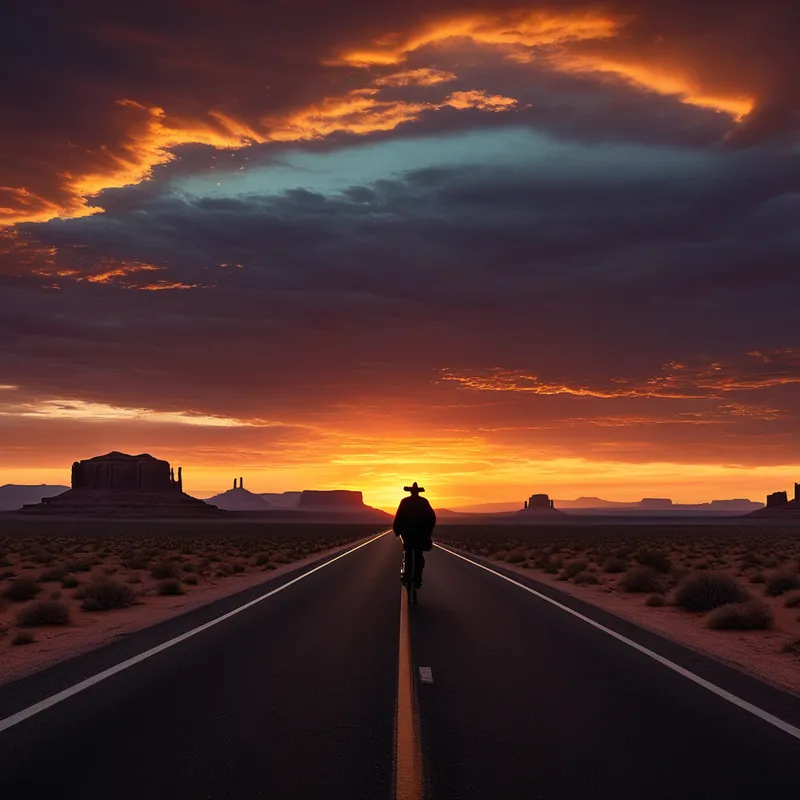
The Open Road Myth Meaning & Symbolism
A mythic call to leave the known for the horizon, where the journey itself becomes the destination and the traveler is forged by the road.
The Tale of The Open Road
Listen. Before the first concrete was poured, before the first white line was painted, the Road was already there. It was a whisper in the tall prairie grass, a sigh in [the wind](/myths/the-wind “Myth from Various culture.”/) through the mountain pass, a promise written in the dust of a thousand wagon ruts. It called not with a voice, but with a vacancy—a hollow space on the map where a soul could write its own name.
The figure who answers is never a king or a god, but the Traveler. He—or she—stands at the edge of a town whose name is Already-Known. The air there is thick with the scent of cut grass and settled decisions. The windows of the houses are eyes, watching. The Traveler feels the Road before they see it, a pull in the breastbone like a [lodestone](/myths/lodestone “Myth from Greek culture.”/) finding true north. It begins with a turning of a key, the crunch of gravel under tire, the click of a suitcase latch. It begins with leaving.
The Road is not one path but ten thousand. It is the Oregon Trail, etched with the ghosts of bonnets and oxen. It is Route 66, a faded ribbon of asphalt singing a song of neon and chrome. It is a dirt track leading to a mountain, a thin black line bisecting the salt flat. Its surface is a scripture of cracks and tar snakes, reading of heat and cold and relentless passage.
The conflict is not with a dragon, but with [the self](/myths/the-self “Myth from Jungian culture.”/) that wishes to turn back. The Ghost of the Porch Light rides in the passenger seat, whispering of warm beds and predictable tomorrows. The Road fights back with its own allies: the Desert Wind that scours the mind clean; the Standing Rock that offers perspective in millennia; the Stranger at the Diner Counter who shares a story that becomes part of your map.
The rising action is measured in miles and sunsets. A flat tire under a bowl of impossible stars. A diner coffee that tastes of every road that ever was. The moment the radio signal fades into static, and the only music is the hum of the engine and the rhythm of your own blood. The landscape becomes a mirror—the relentless openness of the plains reflecting a need for inner space, the convoluted switchbacks of the mountains mirroring a tangled [psyche](/myths/psyche “Myth from Greek culture.”/) being slowly straightened.
The climax is never a battle at [the world](/myths/the-world “Myth from Tarot culture.”/)’s end. It is a quiet moment at a Crossroads at Dawn. The signposts point to places with names, but the Traveler looks down the road that is not on the sign. It is just a grey line vanishing into [the mist](/myths/the-mist “Myth from Celtic culture.”/). Here, the Ghost of the Porch Light speaks its final, tempting argument. And here, the Traveler does not choose a destination. They choose the Road itself. They choose the going.
The resolution is not an arrival. It is a dissolution. The boundary between the Traveler and the traveled blurs. The dust of the road is in their skin; the song of the tires is in their pulse. They understand the secret: the Horizon is not a place you reach. It is the engine of your going. The journey is the destination, wearing the clothes of motion. And as the car crests one more hill, revealing yet another vast, beautiful, unknown valley, the myth completes its cycle—not with an ending, but with a long, open vowel of possibility, sung into the wind.

Cultural Origins & Context
The myth of The Open Road is a folk narrative woven in the 19th and 20th centuries, not from a single storyteller’s lips but from the collective breath of a nation on the move. Its earliest bards were pioneers writing in the ledgers of wagon trains, their tales of hardship and hope becoming the bedrock. It was carried in the work songs of railroad gangs stitching the continent together with steel, and in the blues hollers of sharecroppers dreaming of a “better way up north.”
The myth found its modern voice with the mass production of the automobile and the federal paving of highways like the <abbr title=“The “Mother Road,” a central artery of American travel”>Lincoln Highway and Route 66. It was amplified by Jack Kerouac’s fevered prose, by the restless anthems of Woody Guthrie and later Bruce Springsteen, and by the cinematic vistas of John Ford’s westerns. It was told at family dinner tables recounting the great post-war road trip, and in the lonely, exalted CB radio chatter of long-haul truckers.
Its societal function was dual. For a young, expanding nation, it was a myth of Manifest Destiny turned inward—a doctrine of personal expansion and reinvention. It served as a pressure valve for social unrest and personal stagnation, offering a script for leaving behind failure, convention, or a troubled past. Simultaneously, it created a shared national identity rooted not in a static place, but in the idea of movement itself, binding a disparate people through the common ritual of the journey.
Symbolic Architecture
At its core, the Open Road is the archetypal [symbol](/symbols/symbol “Symbol: A symbol can represent an idea, concept, or belief, serving as a powerful tool for communication and understanding.”/) of the Individuation [journey](/symbols/journey “Symbol: A journey in dreams typically signifies adventure, growth, or a significant life transition.”/). The car, [wagon](/symbols/wagon “Symbol: A wagon in dreams often symbolizes the journey of life, progress towards goals, and the burdens we carry along the way.”/), or boots are the [vessel](/symbols/vessel “Symbol: A container or structure that holds, transports, or protects something essential, representing the self, emotions, or life journey.”/) of the conscious ego—the fragile, directed self moving through the vastness of the unconscious, represented by the [landscape](/symbols/landscape “Symbol: Landscapes in dreams are powerful symbols representing the dreamer’s emotional state, personal journey, and the broader context of life situations.”/).
The Road is the line the ego draws across the face of the unknown, creating the illusion of direction in order to dare the voyage.
The Town Left Behind symbolizes the [Persona](/symbols/persona “Symbol: The social mask or outward identity one presents to the world, often concealing the true self.”/)—the comfortable, confining mask. The act of leaving is the necessary [rupture](/symbols/rupture “Symbol: A sudden break or tear in continuity, often representing abrupt change, separation, or the shattering of established patterns.”/), the [rejection](/symbols/rejection “Symbol: The experience of being refused, excluded, or dismissed by others, often representing fears of inadequacy or social belonging.”/) of collective values in service of a deeper, more personal [truth](/symbols/truth “Symbol: Truth represents authenticity, honesty, and the quest for knowledge beyond mere appearances.”/). The Landscape itself is the Self in all its terrifying and beautiful complexity—the deserts of [aridity](/symbols/aridity “Symbol: Aridity symbolizes emotional or spiritual barrenness, a lack of nourishment, and a state of profound dryness or emptiness.”/), the mountains of [obstacle](/symbols/obstacle “Symbol: Obstacles in dreams often represent challenges or hindrances in waking life that intercept personal progress and growth. They can symbolize fears, doubts, or external pressures.”/), the rivers of [emotion](/symbols/emotion “Symbol: Emotion symbolizes our inner feelings and responses to experiences, often guiding our actions and choices.”/), the forests of [mystery](/symbols/mystery “Symbol: An enigmatic, unresolved element that invites curiosity and exploration, often representing the unknown or hidden aspects of existence.”/).
The Strangers Met are aspects of the [Shadow](/symbols/shadow “Symbol: The ‘shadow’ embodies the unconscious, repressed aspects of the self and often represents fears or hidden emotions.”/) and the [Animus](/symbols/animus “Symbol: In Jungian psychology, the masculine inner personality in a woman’s unconscious, representing logic, action, and spiritual guidance.”/)/[Anima](/symbols/anima “Symbol: The feminine archetype within the male unconscious, representing soul, creativity, and connection to the inner world.”/), encountered in projected form. The helpful mechanic might be the neglected skill of self-reliance; the cryptic [waitress](/symbols/waitress “Symbol: The waitress symbolizes service, nurturing, and the exchange of energy, often relating to how we perceive care and support in relationships.”/) might be an intuitive wisdom. The Ghost of the [Porch](/symbols/porch “Symbol: A porch often signifies a transitional space in dreams, representing the area between the inside self and the outside world.”/) Light is the regressive pull of the Great [Mother](/symbols/mother “Symbol: The symbol of ‘Mother’ represents nurturing, protection, and the foundational aspect of one’s emotional being, often associated with comfort and unconditional love.”/), promising [security](/symbols/security “Symbol: Security denotes safety, stability, and protection in one’s personal and emotional life.”/) at the cost of [consciousness](/symbols/consciousness “Symbol: Consciousness represents the state of awareness and perception, encompassing thoughts, feelings, and experiences.”/).
Ultimately, the myth’s central [alchemy](/symbols/alchemy “Symbol: A transformative process of purification and creation, often symbolizing personal or spiritual evolution through difficult stages.”/) is the transformation of [space](/symbols/space “Symbol: Dreaming of ‘Space’ often symbolizes the vastness of potential, personal freedom, or feelings of isolation and exploration in one’s life.”/) into time. The physical [distance](/symbols/distance “Symbol: Distance in dreams often symbolizes emotional separation, unattainable goals, or the need for personal space and reflection.”/) traveled becomes psychological [depth](/symbols/depth “Symbol: Represents profound layers of consciousness, hidden truths, or the unknown aspects of existence, often symbolizing introspection and existential exploration.”/) achieved. The [horizon](/symbols/horizon “Symbol: The horizon can symbolize the boundary between the known and the unknown, representing future possibilities and the journey ahead.”/) is the teleological goal of the Self—always receding, always calling, ensuring the process of becoming never ceases.
The Dreamer’s Resonance
When the Open Road appears in modern dreams, it signals a profound somatic and psychological process: the psyche is mapping a new trajectory. The dreamer is at a pre-conscious threshold, feeling the “pull” of unlived life or unresolved inner conflict.
Somatically, these dreams may be accompanied upon waking by a feeling of restless legs, a tightness in the chest (the feeling of being “stuck” breaking loose), or an odd kinesthetic memory of motion. Psychologically, the condition is one of liminality—the painful, fertile state of being betwixt and between identities.
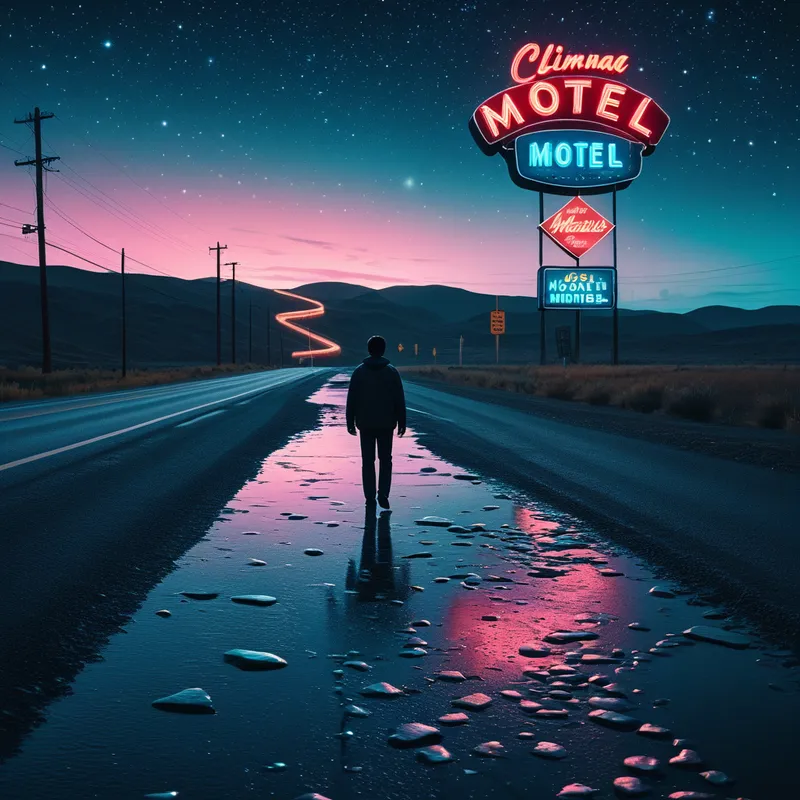
A dream of a blocked road, a broken-down car, or a missed exit speaks to perceived obstacles in this inner journey—often self-imposed limitations or fears. A dream of flying down an empty highway under a starry sky reflects a moment of alignment and effortless movement with the unconscious, a taste of psychic freedom. The dream is the psyche’s way of rehearsing the voyage, testing the vehicle ([the ego](/myths/the-ego “Myth from Jungian culture.”/)’s strength), and surveying the interior landscape that must be crossed.
Alchemical Translation
The myth of The Open Road provides a masterful model for psychic transmutation. It reframes the daunting, abstract process of individuation into a concrete, actionable narrative: You must leave. You must choose a direction. You must keep moving.
The first alchemical stage, [Nigredo](/myths/nigredo “Myth from Alchemical culture.”/), is the leaving itself—the voluntary dissolution of the old identity. This is [the dark night of the soul](/myths/the-dark-night-of-the-soul “Myth from Christian Mysticism culture.”/) on the empty plains, the confrontation with [the void](/myths/the-void “Myth from Buddhist culture.”/) one sought to escape. The Albedo occurs in the encounters and reflections along [the way](/myths/the-way “Myth from Taoist culture.”/)—the insights gained from the landscape and the strangers, the purifying solitude that burns away non-essentials.
The gasoline that fuels this transmutation is not ambition, but longing—the sacred discontent that refuses the soul’s domestication.
The Citrinitas is glimpsed at [the crossroads](/myths/the-crossroads “Myth from Celtic culture.”/) at dawn, the moment of conscious choice for the unknown path, where personal will aligns with the beckoning of the Self. Finally, the [Rubedo](/myths/rubedo “Myth from Alchemical culture.”/) is not a static state of “arrival,” but the permanent internalization of the road. The seeker understands they are not on a journey; they are the journey. The boundary between traveler and road dissolves. The ego becomes a capable, humble vehicle for the vastness of the Self, and [the horizon](/myths/the-horizon “Myth from Various culture.”/) is no longer “out there” but is the very circumference of one’s ever-expanding awareness. The myth teaches that the gold is not at the end of the road; the gold is the wear on the wheel, the dust on the jacket, the light in the eyes of one who has chosen, and continues to choose, to go.
Associated Symbols
Explore related symbols from the CaleaDream lexicon: