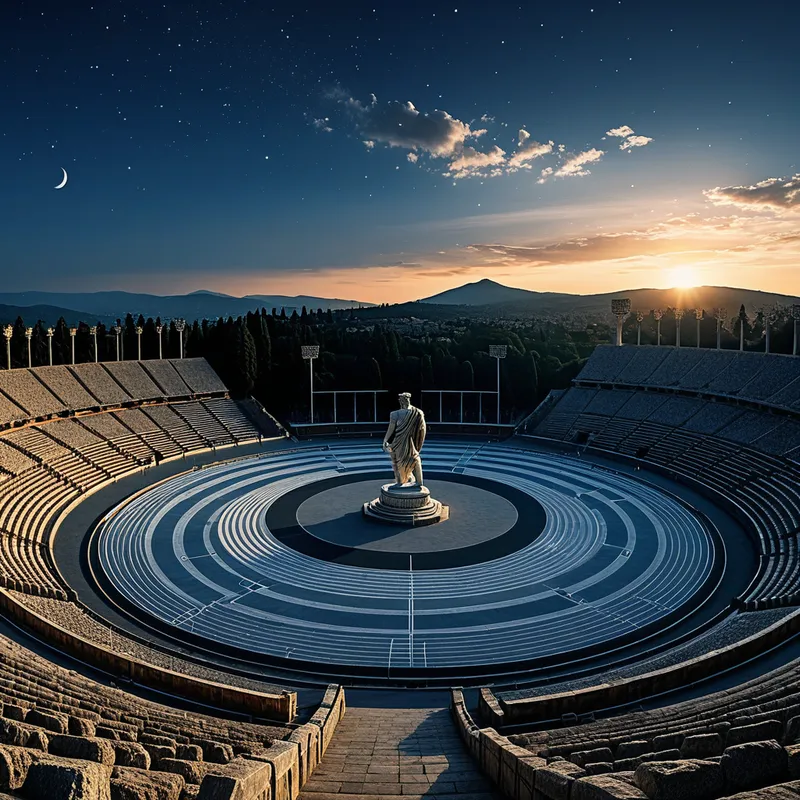
The Olympic Games Myth Meaning & Symbolism
A sacred truce forged by Heracles to honor Zeus, where mortal athletes competed for divine favor, transforming conflict into a ritual of human excellence.
The Tale of The Olympic Games
Hear now, and listen well, to the tale not of a single hero, but of a sacred space born from strife and sanctified by sweat. In the age when gods walked [the earth](/myths/the-earth “Myth from Hindu culture.”/) in disguise and heroes carved their names into the very bones of [the world](/myths/the-world “Myth from Tarot culture.”/), a shadow lay upon the land of Elis. King Oenomaus, his heart poisoned by a prophecy that foretold his death by the hand of his daughter’s husband, challenged all suitors of Hippodamia to a chariot race. The price of loss was a spear through the back. The ground of Olympia was soaked with the blood of young princes.
Then came [Pelops](/myths/pelops “Myth from Greek culture.”/), not with brute force alone, but with a cunning whisper. He won the race, and the princess, but the victory was tarnished, the land cursed by treachery. The cycle of vengeance spiraled. It was into this wounded place that the son of Zeus, [Heracles](/myths/heracles “Myth from Greek culture.”/), strode. He came not as a conqueror, but as a cleanser. With his own hands, he measured the Altis, [the sacred grove](/myths/the-sacred-grove “Myth from Celtic culture.”/). He cleared the wild olive tree for the victor’s crown. He raised altars to his father, Zeus, and to [Hestia](/myths/hestia “Myth from Global/Universal culture.”/), where a perpetual flame would whisper of eternity.
But his greatest act was not of construction, but of proclamation. Heracles declared a sacred truce—the Ekecheiria. From the moment the heralds set out from Elis, all war in Hellas was to cease. Spears were to be buried, shields hung upon walls. For the duration of the Games, and the journey to and from them, the land was to be a sanctuary. Conflict was not destroyed; it was transformed. The rage of armies was channeled into the strain of sprinters on the stadion. The clash of shields became the thud of wrestlers on the sand of the skamma. The drive for glory was redirected from the battlefield to the stadium, under the gaze of the chryselephantine Zeus.
For five days every four years, the air in the Alpheios valley grew thick with the smell of roasting meat from a hundred altars, the dust kicked up by chariots, the sharp tang of sweat and sacred oil. Men competed naked, as they were born, their bodies the only offering. The victor knew no material prize, only a wreath of wild olive, a ribbon of wool, and the right to have his name, his father’s name, and his city sung by poets for all time. In that moment of crowning, a mortal touched the divine. He became a living bridge between the world of men and the realm of Zeus Olympios. The myth was not a single story, but a ritual reborn, a drama of human limits performed before the gods.
Cultural Origins & Context
The mythic origins of the Games served as the divine charter for a profoundly human institution. Historically emerging in the 8th century BCE, the Olympics were anchored in the prehistoric funeral games for heroes like Patroclus. By attributing their foundation to Heracles, the Greeks sacralized the event, lifting it from mere athletics to a panegyris. The stories were kept alive not in one sacred text, but in the collective practice of the Hellenes, recited by poets at the Games themselves and woven into the fabric of local histories.
The societal function was multifaceted. The Ekecheiria was a pragmatic diplomatic miracle, allowing safe passage and communication across fiercely independent and often warring city-states. The Games were a supreme expression of arete—excellence of body, spirit, and skill. They reinforced a pan-Hellenic identity; to compete, one had to be Greek. It was a ritual of order, a temporary imposition of Dike upon the chaotic, violent impulses of Eris. The athlete became a microcosm of [the polis](/myths/the-polis “Myth from Greek culture.”/), his victory a divine favor bestowed upon his entire city.
Symbolic Architecture
At its core, the Olympic myth is a grand [alchemy](/symbols/alchemy “Symbol: A transformative process of purification and creation, often symbolizing personal or spiritual evolution through difficult stages.”/) of conflict. It takes the raw, destructive [energy](/symbols/energy “Symbol: Energy symbolizes vitality, motivation, and the drive that fuels actions and ambitions.”/) of war and rivalry and transmutes it into a contained, ritualized, and beautiful display of [human](/symbols/human “Symbol: The symbol of a human represents individuality, complexity of emotions, and social relationships.”/) potential.
The stadium is a vas where the lead of brute conflict is turned into the gold of sacred competition.
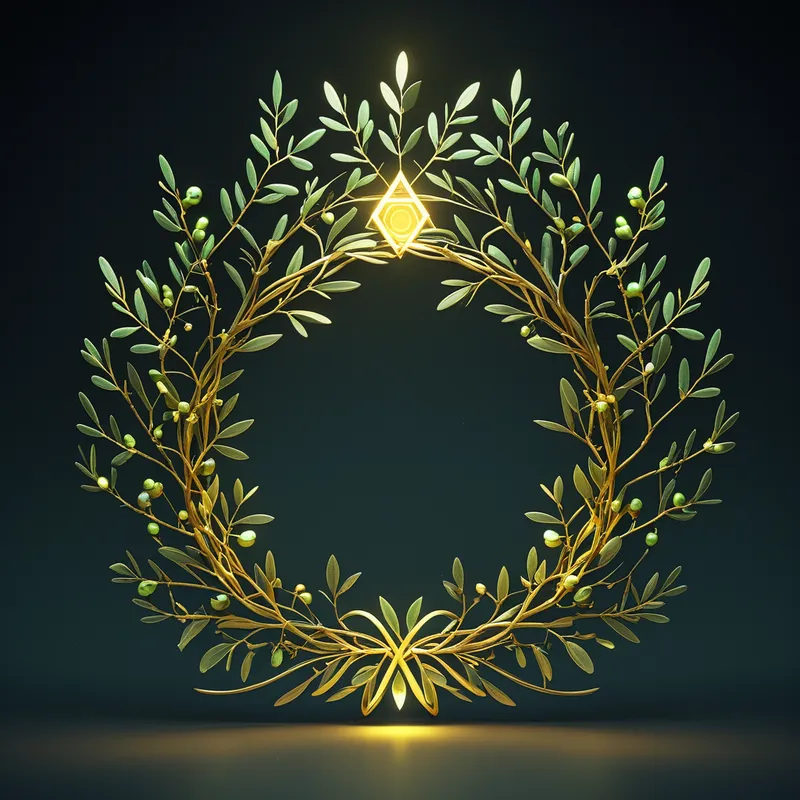
The Altis symbolizes the [temenos](/myths/temenos “Myth from Greek culture.”/), the sacred [enclosure](/symbols/enclosure “Symbol: A bounded space representing psychological containment, social boundaries, or existential limitations. It can symbolize both safety and restriction.”/) of the [psyche](/myths/psyche “Myth from Greek culture.”/) where the inner battles can be confronted safely, under conscious observation (the gaze of Zeus). The nakedness of the athletes represents radical authenticity—the stripping away of social [armor](/symbols/armor “Symbol: Armor represents psychological protection, emotional defense, and the persona presented to the world. It symbolizes both safety and the barriers that separate us from vulnerability.”/), [wealth](/symbols/wealth “Symbol: Wealth in dreams often represents abundance, security, or inner resources, but can also symbolize burdens, anxieties, or moral/spiritual values.”/), and [status](/symbols/status “Symbol: Represents one’s social position, rank, or standing within a group, often tied to achievement, power, or recognition.”/) to reveal the pure, unadorned self in its striving. The olive [wreath](/symbols/wreath “Symbol: A wreath commonly symbolizes completion, cyclical nature, and the binding of different life phases, often associated with celebration or remembrance.”/) is the ultimate [symbol](/symbols/symbol “Symbol: A symbol can represent an idea, concept, or belief, serving as a powerful tool for communication and understanding.”/) of this transformation: it is not a [crown](/symbols/crown “Symbol: A crown symbolizes authority, power, and achievement, often representing an individual’s aspirations, leadership, or societal role.”/) of [metal](/symbols/metal “Symbol: Metal in dreams often signifies strength, transformation, and the qualities of resilience or coldness.”/), heavy with earthly power, but a living, perishable circle of [peace](/symbols/peace “Symbol: Peace represents a state of tranquility and harmony, both internally and externally, often reflecting a desire for resolution and serenity in one’s life.”/) (Eirene) and wisdom (Athena), its value purely spiritual and honorific.
Psychologically, the myth represents [the ego](/myths/the-ego “Myth from Jungian culture.”/)’s struggle to master and redirect the chaotic, aggressive drives of the [shadow](/symbols/shadow “Symbol: The ‘shadow’ embodies the unconscious, repressed aspects of the self and often represents fears or hidden emotions.”/). Heracles, the archetypal [hero](/symbols/hero “Symbol: A hero embodies strength, courage, and the ability to overcome significant challenges.”/) who masters monstrous labors, models the conscious [effort](/symbols/effort “Symbol: Effort signifies the physical, mental, and emotional energy invested toward achieving goals and personal growth.”/) to build a [structure](/symbols/structure “Symbol: Structure in dreams often symbolizes stability, organization, and the framework of one’s life, reflecting how one perceives their environment and personal life.”/) (the Games, the Truce) that can contain and give form to these powerful energies, rather than being destroyed by them.
The Dreamer’s Resonance
When this myth stirs in the modern dreamer, it often surfaces during periods of intense internal or external competition, rivalry, or a feeling that one’s energies are being wasted in fruitless conflict. To dream of an ancient stadium may signal that the psyche is seeking a temenos—a sacred, bounded space within which to confront a challenge.
Somatic sensations might include the feeling of running but being stuck in place (the endless preparation of the athlete), the strain of lifting an impossible weight ([the labors of Heracles](/myths/the-labors-of-heracles “Myth from Global/Universal culture.”/)), or the profound silence and focus before a starting signal. The dream may present opponents who are, upon closer look, mirrors of [the self](/myths/the-self “Myth from Jungian culture.”/)—shadow aspects competing for dominance. The crowning with an olive wreath in a dream is a powerful symbol of the Self (in the Jungian sense) conferring validation, not for destroying an enemy, but for successfully integrating a conflict into a higher order of being. The absence of the wreath, or failing to finish the race, points to the dreamer’s fear that their struggles are not yet transformative, but remain chaotic and unredeemed.
Alchemical Translation
The individuation journey modeled by the Olympic myth is one of sacralization of struggle. The modern individual is perpetually engaged in contests: for recognition, security, love, purpose. The raw material of the [prima materia](/myths/prima-materia “Myth from Alchemical culture.”/) is this daily strife, the friction of life, the “wars” of career and relationship.
The first labor is to declare your own Ekecheiria—to consciously cease the unconscious, automatic hostilities within and around you.
This is the creation of the inner Altis. One must measure out a sacred space in time or practice—through meditation, therapy, art, or ritual—where the driving forces of ambition, anger, and envy can be invited in not as enemies, but as contestants. In this vessel, we can “compete naked,” examining our motives without the armor of [persona](/myths/persona “Myth from Greek culture.”/). The goal is not to annihilate [the shadow](/myths/the-shadow “Myth from Jungian culture.”/)-drive, but to give it a form and a rule-set—the discipline of a craft, the ethics of a relationship, the commitment to a health practice.
The victor’s wreath is the symbol of successful transmutation. It represents the moment when the energy that was once expended in draining conflict becomes a sustained source of inner honor and peace. The individual is no longer simply fighting against something; they are striving for an excellence that aligns with their deepest values (the gaze of the inner Zeus, the archetype of order and consciousness). The prize is not external reward, but the profound, quiet knowledge of having turned base conflict into a performance of one’s own humanity, achieving a fleeting, perfect harmony between body, will, and spirit—a moment of wholeness that echoes the divine.
Associated Symbols
Explore related symbols from the CaleaDream lexicon: