The Odu of Ifa Myth Meaning & Symbolism
The story of how the sacred patterns of destiny, the Odu, were brought from the heavens to earth to guide humanity through the wisdom of Ifa.
The Tale of The Odu of Ifa
In the time before time, when the sky was a breath away from the earth, the world was a place of raw potential and profound silence. Humanity wandered, blessed with life but deaf to the whispers of their own destiny. They lived in the brilliant, terrifying now, with no map for the morrow, no mirror for the soul. The great [Olodumare](/myths/olodumare “Myth from Yoruba culture.”/) looked upon this and saw not chaos, but a yearning. A question hung in the air, thicker than the mist over the primordial waters.
It was [Orunmila](/myths/orunmila “Myth from Yoruba culture.”/), the witness to destiny, who felt this question in his very essence. He ascended the cosmic Iroko, its branches piercing the veil between the visible and the invisible realms. At the summit, in the realm of pure consciousness, he beheld them: the Sixteen Great Mothers, the primordial Odu. They were not books, not words, but living, breathing patterns of energy—cosmic blueprints containing all that was, is, and could ever be. Each was a universe of stories, a symphony of possibilities for joy, sorrow, creation, and dissolution.
Eshu, the indispensable catalyst, was there. He did not steal this wisdom; he challenged it. “What good is a map in the heavens,” he quipped, his voice the sound of a path forking, “if the traveler’s feet are upon the earth?” The Odu themselves stirred, recognizing the truth. They were complete, but static. To fulfill their nature as patterns of becoming, they needed the friction of the material world, the choices of mortal hearts.
And so, with Eshu as the necessary provocateur and Orunmila as the willing vessel, a great alchemy began. The Sixteen descended, not as a gentle rain, but as a cascade of luminous code. They flowed into Orunmila, and through his profound meditation, they began to speak. They did not speak in one voice, but in dialogue, pairing and combining. From their congress, the 256 Odu of Ifa were born—a vast, dynamic system of divine grammar.
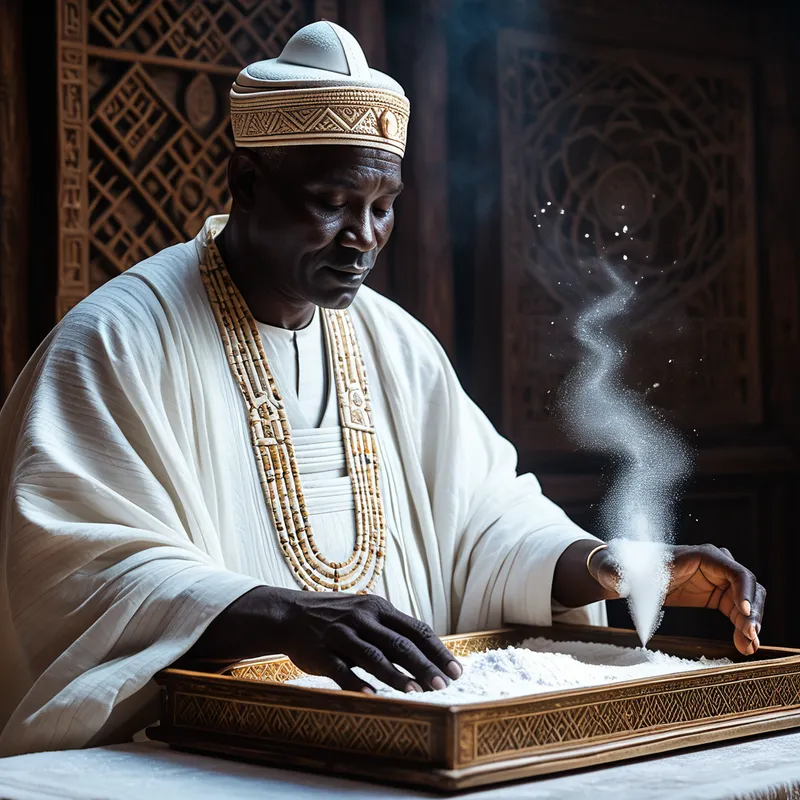
Orunmila returned to earth, his head heavy with the weight of all futures. To his first disciples, the Babalawo, he did not simply teach; he performed the sacred ritual. He cast the palm nuts, and the nuts fell into patterns. He marked the dust of the divination tray, and the lines became glyphs. Each cast was a question from the cosmos, and each glyph was an answer—a specific Odu, containing its own verses (ese), its own proverbs, sacrifices, and warnings. The silence was broken. The whispers became a language. Humanity was given not a predetermined script, but a mirror and a compass: the ability to see their place in the pattern and choose, with wisdom, how to walk their path.

Cultural Origins & Context
The myth of the Odu is the foundational narrative of the Ifa divination system, the intellectual and spiritual cornerstone of Yoruba culture and its diasporic expressions like Santería and Candomblé. It is not a mere story but a living paradigm transmitted through an unbroken oral lineage of Babalawo (fathers of secrets). These priests are not just ritual specialists; they are custodians of a vast literary corpus memorized verbatim. The myth legitimizes their authority as intermediaries who “speak” the language of the Odu.
Societally, Ifa functions as a profound technology of order. It is consulted for everything from naming ceremonies and marriages to diagnosing illness and guiding statecraft. The myth establishes that human life is not random but is part of a meaningful, intelligible cosmic order (ase). However, this order is not a fatalistic prison. The system’s complexity—256 Odu, each with hundreds of verses—models the infinite possibilities within destiny. The myth thus sanctions both tradition (the given pattern) and agency (the choice of how to align with it), creating a resilient framework for navigating life’s complexities.
Symbolic Architecture
The Odu represent the archetypal bedrock of [reality](/symbols/reality “Symbol: Reality signifies the state of existence and perception, often reflecting one’s understanding of truth and life experiences.”/) itself. They are the primordial patterns from which all specific forms and events emerge.
The Odu are not predictions, but the full spectrum of potentialities; divination is the art of discerning which note in the cosmic chord is waiting to be sung by the individual soul.
Psychologically, the Sixteen Great Mothers symbolize the fundamental, irreducible structures of the unconscious—the primary archetypes in their pure, collective state. Their descent and [multiplication](/symbols/multiplication “Symbol: Represents exponential growth, spiritual expansion, and the amplification of energy or consciousness beyond linear progression.”/) into 256 patterns mirror the process of psychic [differentiation](/symbols/differentiation “Symbol: The process of distinguishing or separating parts of the self, emotions, or identity from a whole, often marking a developmental or psychological milestone.”/), where core complexes take on personal coloration. Orunmila represents the conscious ego that willingly submits to and carries this overwhelming unconscious content, translating it into a usable [language](/symbols/language “Symbol: Language symbolizes communication, understanding, and the complexities of expressing thoughts and emotions.”/). Eshu is the critical function of disruption, the psychological “[trickster](/symbols/trickster “Symbol: A boundary-crossing archetype representing chaos, transformation, and the subversion of norms through cunning and humor.”/)” that prevents the [system](/symbols/system “Symbol: A system represents structure, organization, and interrelated components functioning together, often reflecting personal or social order.”/) from becoming dogmatic and insists it engage with the messy reality of lived experience. The [divination](/symbols/divination “Symbol: The practice of seeking knowledge of the future or unknown through supernatural means, reflecting humanity’s desire for certainty and connection with hidden forces.”/) [tray](/symbols/tray “Symbol: A tray symbolizes organization, receptivity, and the act of offering or sharing.”/) (opon Ifa) is the temenos, the sacred [space](/symbols/space “Symbol: Dreaming of ‘Space’ often symbolizes the vastness of potential, personal freedom, or feelings of isolation and exploration in one’s life.”/) where the unconscious (the patterns) and [consciousness](/symbols/consciousness “Symbol: Consciousness represents the state of awareness and perception, encompassing thoughts, feelings, and experiences.”/) (the question) meet for [dialogue](/symbols/dialogue “Symbol: Conversation or exchange between characters, representing communication, relationships, and narrative flow in games and leisure activities.”/).
The Dreamer’s Resonance
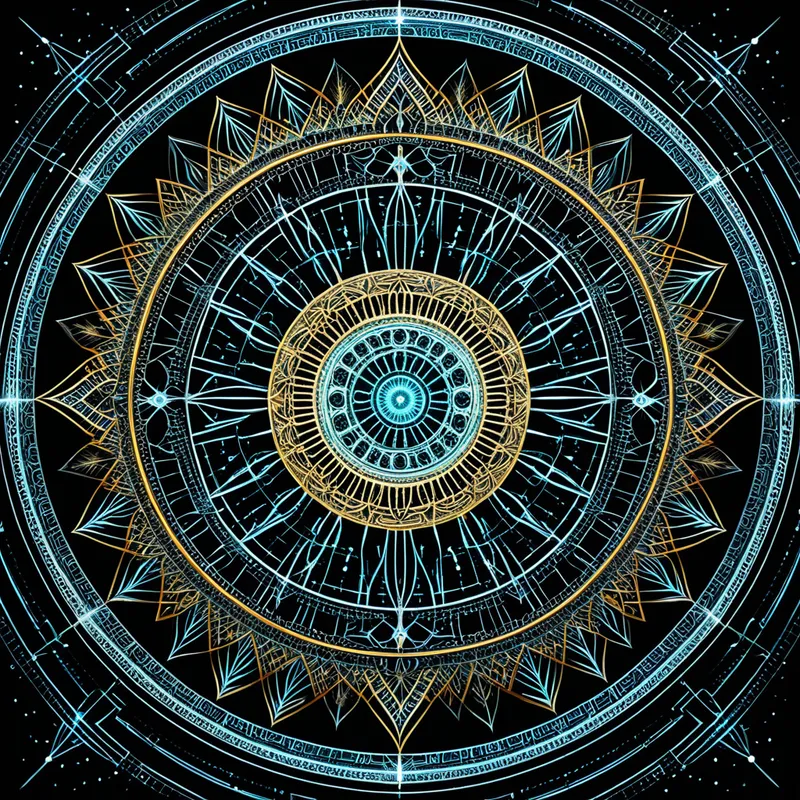
When the Odu pattern emerges in modern dreams, it seldom appears as literal Yoruba glyphs. Instead, one dreams of infinitely complex and beautiful geometric grids, mandalas that shift and reconfigure, or libraries where books rearrange their own contents. One may dream of hearing a polyphonic chant in an unknown language that nonetheless feels deeply personal, or of finding a single, unique symbol etched into a stone or their own palm.
Somatically, this can feel like a profound reorganization within the body—a sense of crystalline structures aligning in the psyche, or a download of information too vast for the waking mind. Psychologically, this dream signals a confrontation with one’s own archetypal bedrock. The dreamer is being shown the underlying “code” of a current life situation or inner conflict. It is the unconscious presenting the full map of a destiny-crossroads, indicating that the dreamer is ready to engage with their life not as a series of accidents, but as a meaningful narrative with multiple potential trajectories. It often precedes a major life decision or a deep phase of self-analysis.
Alchemical Translation
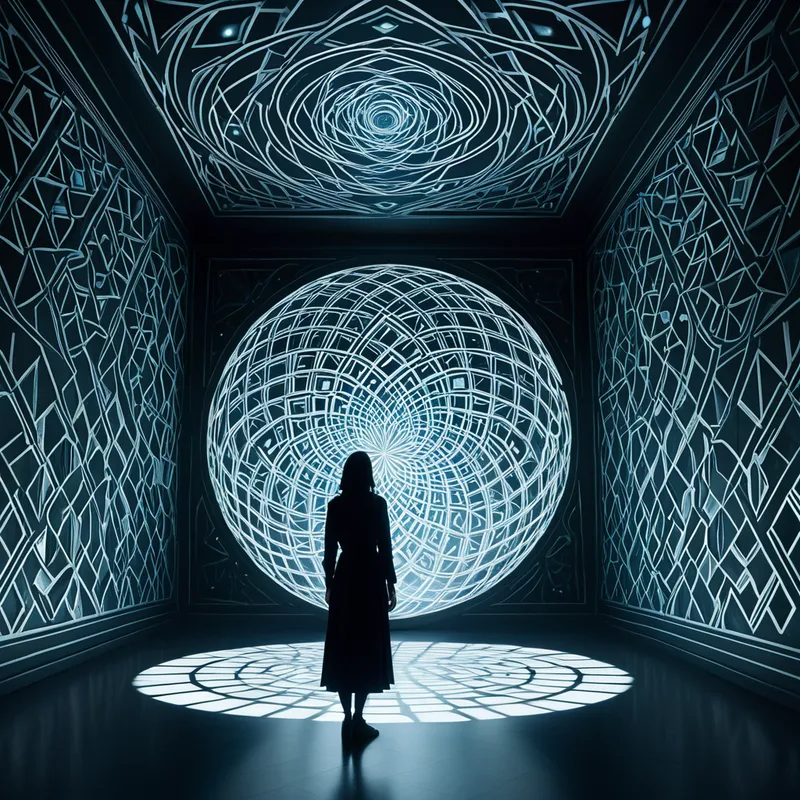
The myth of the Odu models the entire process of Jungian individuation—the journey toward psychic wholeness. The initial state of humanity represents the unconscious, undifferentiated psyche, living reactively without self-reflection. The ascent of Orunmila is the ego’s first courageous turn toward the Self, the totality of the psyche.
Individuation is the lifelong divination session: casting the nuts of our experiences onto the tray of consciousness to reveal which Odu—which archetypal pattern—is active, and then choosing the sacrifice (the conscious attitude) that aligns us with our deepest fate.
The descent of the Odu is the critical, often overwhelming, stage of inundation by the unconscious. This is the “numinous experience” that shatters old identities. The role of Eshu is crucial here; it is the disruptive, shadowy element that forces this raw material to engage with reality, preventing psychic inflation. The final stage—the casting of the nuts and reading the signs—is the transcendent function. It is the conscious ego’s disciplined work of synthesizing this archetypal material into a coherent, personal life narrative. One does not become the Odu; one learns their language. The goal is not to know the future, but to develop the wisdom (ogbon) to consciously participate in one’s own becoming, transforming blind fate (kadara) into realized destiny (ayanmo).
Associated Symbols
Explore related symbols from the CaleaDream lexicon:
- Tree — The Iroko is the axis mundi, the connecting pillar between heaven and earth through which the Odu descend, representing the spine of the cosmos and the individual’s connection to the archetypal realm.
- Pattern — The core essence of the Odu themselves; the divine geometry and order underlying apparent chaos, symbolizing the hidden structure of destiny and the psyche.
- Mirror — The divination tray and the Odu system itself function as a mirror, reflecting back to the individual the hidden patterns and potentials of their own soul and situation.
- Key — Each Odu is a key that unlocks understanding of a specific life circumstance, and the wisdom of Ifa is the keyholder that provides access to the map of one’s destiny.
- Destiny — The central theme the Odu govern; not a fixed path, but a field of potentialities that requires engagement and wise choice to be fully realized.
- Wisdom — The gift of Orunmila and the ultimate goal of consulting the Odu; the applied knowledge of how to navigate one’s pattern with integrity and purpose.
- Order — The fundamental principle the Odu introduce to the world; the cosmic and psychic law that brings meaning and structure to human experience.
- Journey — The process of divination and life itself modeled by the myth; an ongoing voyage of discovery where one consults the map (Odu) at each crossroads.
- Star — The Odu in their celestial origin are like constellations, fixed points of light that provide navigation through the dark night of the soul and the unknown future.
- Trickster — Eshu’s essential role, ensuring the system remains dynamic, challenging dogma, and forcing the divine patterns to engage with earthly complexity and change.