The Oak King Myth Meaning & Symbolism
A myth of two kings, one of oak and one of holly, locked in an eternal duel for the sovereignty of the year, embodying the cycle of life, death, and rebirth.
The Tale of The Oak King
Listen. The wheel of the year turns, and its axle is the great duel. In the deep green heart of the world, where the roots of the Hawthorn drink from the same waters as the stars, two kings are born of the land itself.
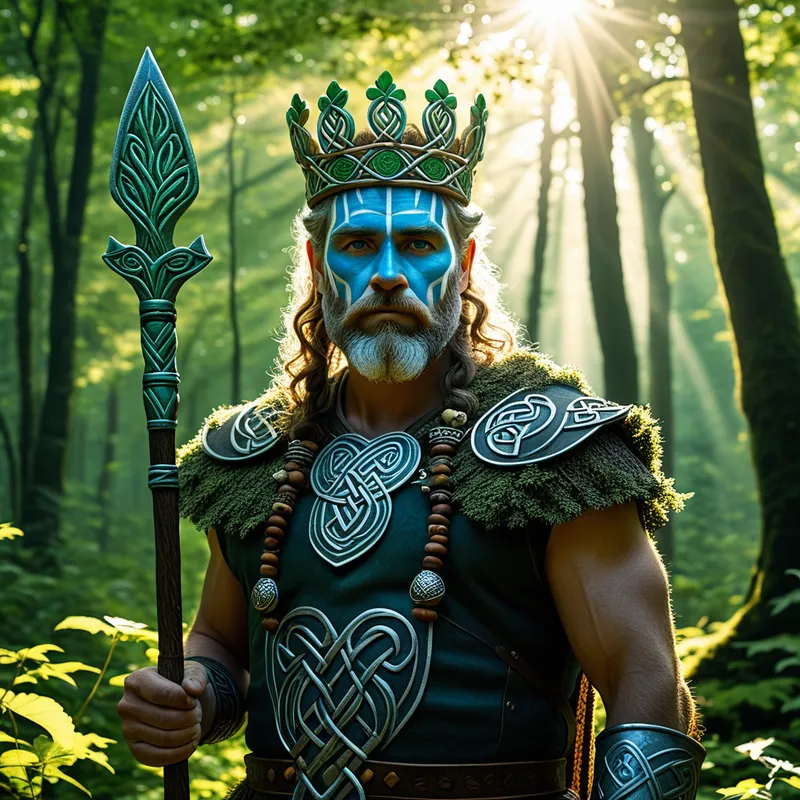
One is the Oak King. He is the breath of the burgeoning sun. His hair is the colour of ripe wheat, his eyes the green of new leaves after rain. His cloak is the forest canopy in high summer, woven with light and the hum of bees. His crown is not of gold, but of living oak—gnarled, strong, and hung with the promise of acorns. He rules the bright half, from the frail hope of the winter solstice to the blazing throne of midsummer. In his time, the sap rises, the seed bursts, and the world swells with a fierce, joyful life.
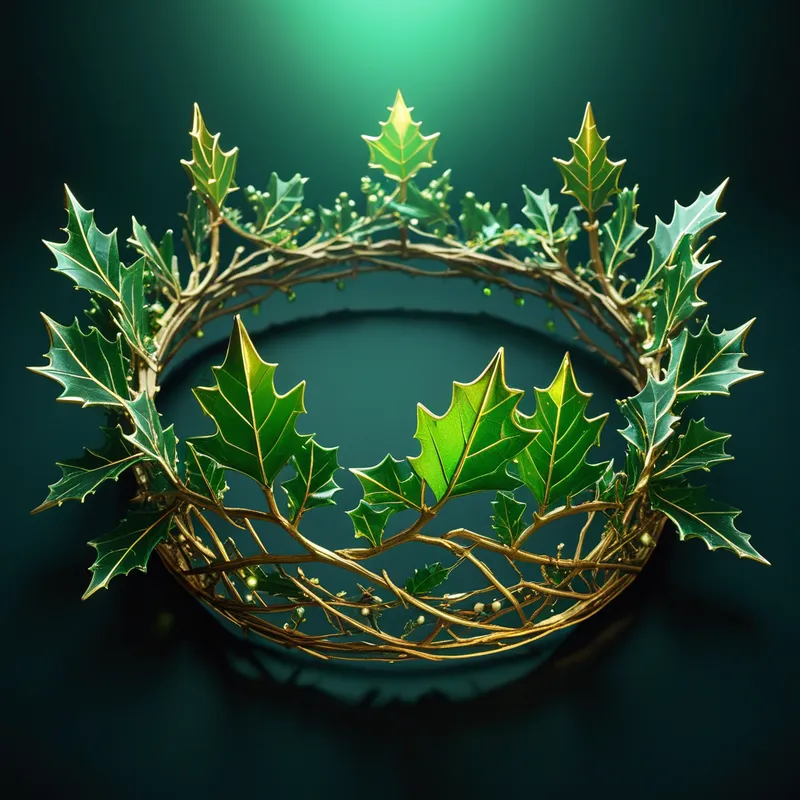
The other is the Holly King. His hair is the dark of yew wood, his eyes the deep red of winter berries. His cloak is the silent, frost-laden forest, patched with the stark green of his own namesake leaves, sharp and enduring. His crown is of holly, gleaming with blood-red fruit and thorns that guard the secrets of decay and rest. He rules the dark half, from the triumphant height of summer’s end to the deep cradle of midwinter. In his time, the grain is cut, the leaf falls, and the world draws inward to dream.
They are brothers. They are rivals. They are two faces of the same sovereign spirit.
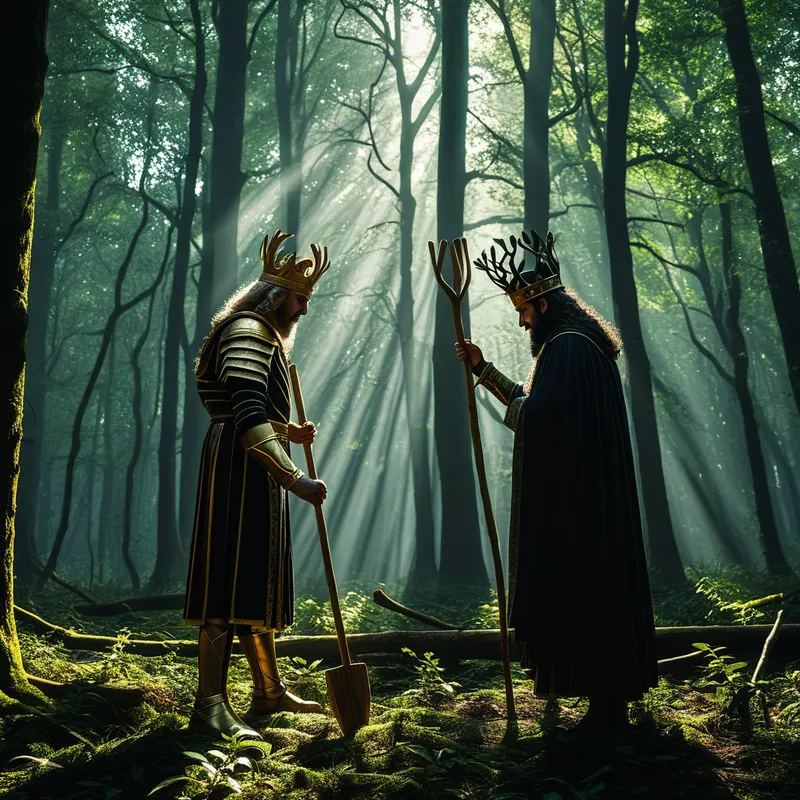
At the turning of the solstices, they must meet. Not in hatred, but in a terrible, necessary love for the world they both serve. When the sun stands still at its peak in June, the air thick with heat and the scent of meadowsweet, they face one another in a sacred grove. The Oak King is at his fullest power, a giant of vitality. The Holly King, who has been sleeping in the shadows, rises, lean and potent with the coming dark.
They fight with staves of their own sacred wood. The clash is not of metal, but of oak against holly, a sound like thunder in the bones of the earth. It is a dance as old as the hills—a pushing, yielding, striving dance. And at the moment the sun begins its long decline, the Holly King’s staff finds its mark. The Oak King does not fall in defeat, but in sacrifice. He yields his sovereignty, his vibrant life-force flowing back into the land he nourished. The Holly King catches him, lowers him gently to the moss, and assumes the crown. The light begins to wane.
And so it goes, until the depth of winter. When the world is still and frosted under the longest night, they meet again. Now the Holly King is full, a lord of introspection and cold beauty. The Oak King, reborn from the acorn hidden in the earth, rises anew, weak with youth but blazing with potential. In the silent, star-shot dark, their staves cross once more. This time, it is the Oak King who triumphs. The Holly King yields, his work of drawing-in complete, and rests as the new light is born.
The wheel turns. The king must die so that the king may live. And in this endless duel, the world is forever renewed.
Cultural Origins & Context
The myth of the dueling kings is not found in a single, canonical text from the ancient Celtic world. The Celts, an intricate tapestry of tribes across Europe, transmitted their wisdom orally, through the revered class of the Druids and bards. Our understanding is a mosaic, pieced together from later Welsh and Irish literature, folk customs, and the indelible seasonal practices that survived Christianization.
The story is fundamentally an agricultural and solar calendar myth. It personifies the annual cycle of growth and decay that was a matter of life and death for these communities. The oak and holly were not arbitrary choices. The Oak was one of the most sacred trees, associated with the supreme god Taranis, strength, and the lightning that splits the sky to bring rain. The holly, evergreen and protective, was a symbol of defense, resilience in the bleak months, and the Otherworldly beauty of winter.
The tale was likely recited or enacted during the great fire festivals, particularly at the solstices. It served a crucial societal function: it explained the natural world’s rhythms in a deeply relational, narrative way. It reinforced the concept of sacred kingship, where the ruler’s vitality was directly tied to the land’s fertility. Most importantly, it taught a profound acceptance of necessary cycles—of sacrifice, rest, and rebirth—as the fundamental law of existence, not a tragedy to be resisted.
Symbolic Architecture
At its heart, this is not a myth of good versus evil, but of complementary opposites engaged in a sacred, eternal dialogue. It is the psyche’s own map of its necessary rhythms.
The Oak King represents the conscious ego in its expansive phase: our ambition, our outward growth, our productivity, and our radiant engagement with the world. He is the force of differentiation, of saying “I am.”
The Holly King represents the unconscious in its necessary, withdrawing phase: our introspection, our shadow work, our rest, and the dissolution of spent forms. He is the force of integration, of returning to the source.
Their battle is the internal conflict we experience at life’s turning points. The summer solstice battle is the painful but necessary surrender of a peak identity—the career we’ve mastered, the role we’ve outgrown—so that a new, unknown phase of introspection (the Holly King’s reign) can begin. The winter solstice battle is the courageous struggle to birth a new potential from the depths of our rest and reflection, even when we feel weak and nascent.
The myth beautifully negates the idea of a final victory. Each king’s “defeat” is actually the fulfillment of his purpose. The Oak King’s sacrifice feeds the roots of the next cycle; the Holly King’s surrender makes space for new life. It is a model of healthy, cyclical psychology, where neither extroversion nor introversion is permanent, but each gives way to the other in a sacred rhythm.
The Dreamer's Resonance
When this myth stirs in the modern dreamer, it often manifests at thresholds. You may dream of a fierce but respectful battle with a shadowy double, or of a crown that changes from leaves to thorns in your hands. You might find yourself in a forest where one half is in full, vibrant summer and the other is in silent, deep winter, with you standing on the border.
Somnatically, this can feel like a profound tension—a pulling between the desire to achieve and expand (the rising sap of the Oak King) and a deep, almost gravitational pull to retreat, slow down, and let go (the drawing-in of the Holly King). This is not pathology; it is the psyche signaling a natural turning point. The dream is the sacred grove where this internal duel is honored. To dream of the Oak King falling may feel like a nightmare of failure, but psychologically, it can indicate the necessary and timely end of an exhausting period of outward striving. To dream of the Holly King yielding may signal that a long period of isolation or introspection is complete, and the dreamer is now called to bring something new into the world, however tender its first growth.
Alchemical Translation
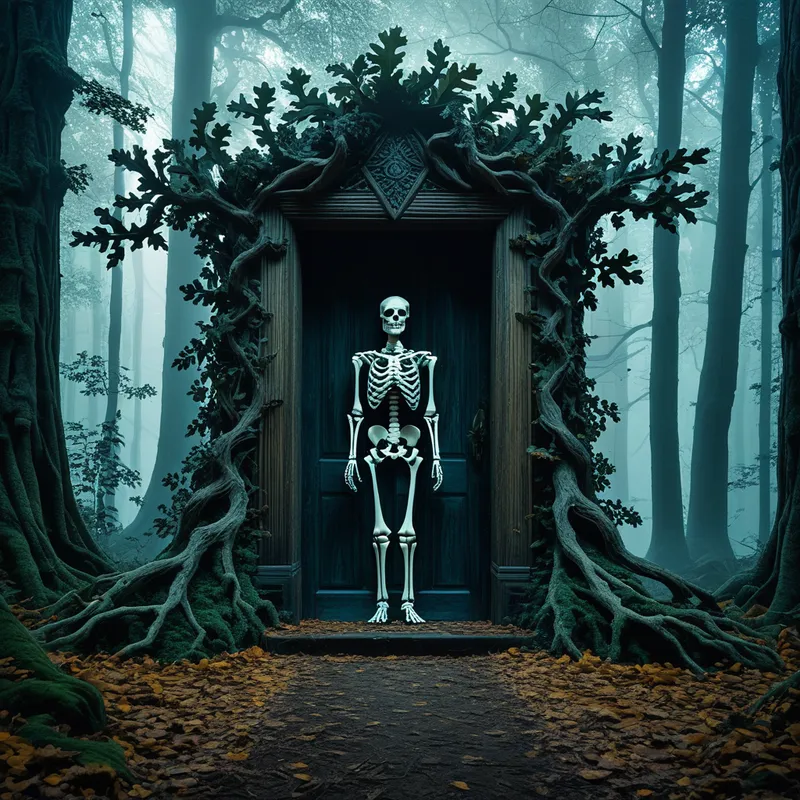
For the modern individual on the path of Individuation, the myth of the kings is a master guide to psychic alchemy. It models the opus contra naturam—the work against our one-sided nature.
We are culturally conditioned to worship the Oak King—endless growth, constant light, perennial productivity. We pathologize the Holly King’s reign as depression, stagnation, or failure. The alchemical work is to recognize both as sovereigns of your inner kingdom and to consciously submit to their alternating rule.
The process begins with identification: Which king are you currently identified with? Are you over-extended in your “Oak” phase, refusing to rest? Or are you stuck in a prolonged “Holly” phase, using introspection as a hiding place from life’s demands?
Next comes the sacrificial battle: This is the conscious engagement with the opposite. For the overworked achiever, it is the deliberate, ritualistic act of “falling”—scheduling rest, embracing silence, allowing projects to end. For the one in retreat, it is the fearful but courageous act of “rising”—voicing an idea, taking a small action, engaging with the world again, even in a fledgling way.
The alchemical gold is not the eternal triumph of one king, but the relationship between them. It is the conscious awareness of the whole cycle. You learn to feel the solstice within yourself—the moment when expansion must yield to contraction, when gestation must give way to birth.
Finally, this leads to transmutation. You no longer experience these shifts as crises or defeats, but as the sacred, rhythmic breathing of your own soul. You become the grove itself—the container in which both kings perform their eternal, life-giving dance. You achieve a sovereignty that is not about rigid control, but about wise submission to the greater law of cycles, finding your unique strength in the graceful art of timely surrender and timely rebirth.
Associated Symbols
Explore related symbols from the CaleaDream lexicon: