The Norns Myth Meaning & Symbolism
Three sisters dwell at the root of the World Tree, weaving the threads of destiny for gods and mortals alike, embodying the inexorable flow of time.
The Tale of The Norns
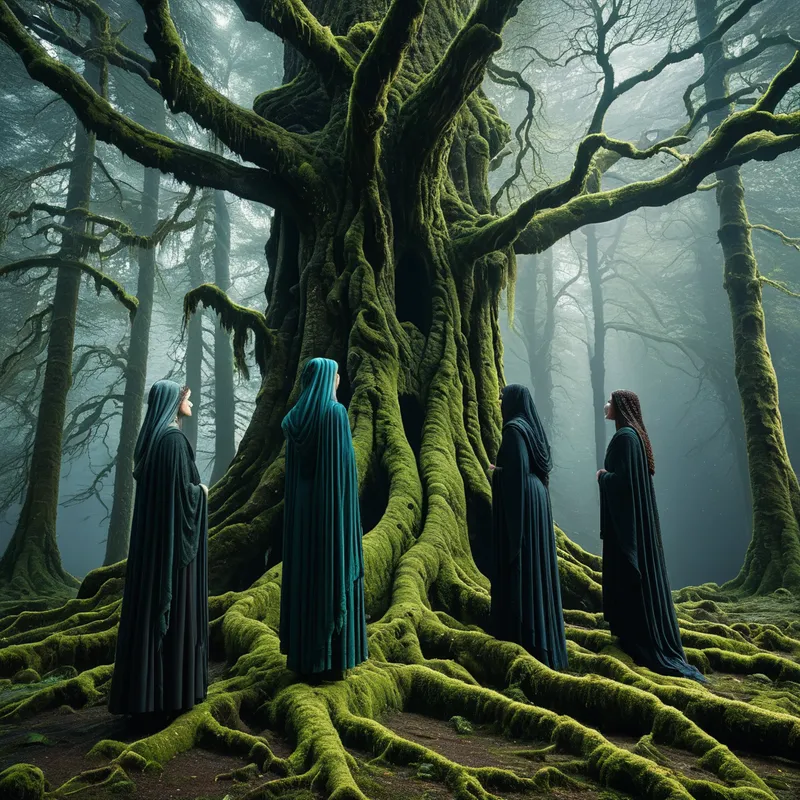
Beneath the groaning weight of the nine worlds, where the mist coils thick and the air tastes of damp earth and ancient memory, there lies a well. It is not a place for the faint of heart, nor for those who seek the sun’s easy warmth. This is Urðarbrunnr, the Well of Fate, and its waters are darker than a moonless night, yet hold the shimmer of every star that ever was or will be.
Here, at the very root of Yggdrasil, where the great serpent Níðhöggr gnaws eternally, three figures are forever at their task. They are the Norns, and they have no palace but the roots, no throne but the stones slick with spring-water. The eldest is Urðr. Her face is a map of time itself, etched with the runes of all that has transpired. Her sister, Verðandi, stands in the full flower of being, her gaze fixed on the unfolding moment, her hands never still. The youngest, Skuld, wears a veil that shifts like mist, and in her eyes flicker possibilities not yet born, debts not yet paid.
Each daybreak, which in this twilight realm is marked only by the faint drip of water from the roots, they begin. From a casket of ash-wood, they draw the threads. These are no ordinary fibers. Some are golden and strong, plucked from the light of Ásgarðr. Others are coarse and grey, spun from the toil of mortals in Miðgarðr. Some are thin and brittle, tinged with sorrow; others are vibrant, humming with joy. Urðr, with hands that know every knot and twist, begins the pattern, her movements slow and irrevocable. Verðandi takes the thread, weaving it into the ever-growing tapestry that hangs, vast and shimmering, in the cavernous space, its images shifting with each pass of her hand. Skuld waits, her shears cold at her side. She measures the thread, her unseen eyes calculating the moment of severance.
The gods themselves, the mighty Odin and the radiant Thor, come here not to command, but to witness. They sit in silence upon the stones, watching the threads of their own glorious, doomed lives being woven into the design. They see the golden thread of Baldr’s life, and they see, too, the pale, treacherous strand of mistletoe that Skuld’s shears will one day seek. Here, even the All-Father’s wisdom meets its limit. He can see the weave, but he cannot unmake it. The only sound is the whisper of thread, the soft splash as the Norns take water from the well to sprinkle upon the root of Yggdrasil, keeping the great tree from rot—a tender act amidst a relentless duty. This is the law of the well: all things that are, have been, or shall be, pass through the hands of the three sisters, from the first breath of creation to the last sigh of Ragnarök.
Cultural Origins & Context
The myth of the Norns emerges from the rich, stark tapestry of pre-Christian Norse and wider Germanic belief, primarily preserved in the 13th-century Icelandic texts, the Poetic Edda and the Prose Edda. Unlike the more centralized myths of Olympus, these stories were the living breath of a people intimately acquainted with harsh climates, unforgiving seas, and the fragile line between survival and doom. The concept of fate, or ørlög, was not a philosophical abstraction but a visceral reality.
The tellers of these tales were skalds—poets and keepers of lore—who performed for chieftains in mead-halls. Their function was not merely entertainment, but the preservation of cosmic order and ancestral wisdom. In speaking of the Norns, they gave form to the pervasive cultural understanding that individual will operated within a vast, predetermined framework. The myth served to explain the inexplicable—why the brave die young, why fortune favors some and abandons others. It provided a somber comfort, situating human struggle within a grand, if fatalistic, narrative overseen by entities more ancient and fundamental than even the gods. The Norns were a reminder that all power, even divine power, had its limits and its source in a deeper, more impersonal law.
Symbolic Architecture
The Norns represent the tripartite structure of time itself—Past (Urðr), Present (Verðandi), and Future (Skuld)—not as a linear sequence, but as a continuous, interwoven process. They are the psychological embodiment of causality, memory, and potential.
The Past is not dead history; it is the settled pattern from which the Present is woven. The Future is not empty possibility; it is the necessary shape implied by the thread’s length and tension.
Their location is paramount: at the root of the World Tree. This signifies that fate is not decreed from on high, but arises from the foundational, often hidden, depths of existence. The Well of Urðr is the unconscious source, the dark waters containing all latent possibilities and solidified outcomes. Weaving is an act of creation that is also an act of binding; every choice, every event, becomes part of an inescapable pattern. Skuld, whose name implies debt and necessity, holds the shears. This is the symbol of inevitable limitation—death, an ending, a crisis that cuts the pattern and defines its final form. Psychologically, they represent the autonomous, objective psyche—the part of our inner world that feels “given,” the temperament, the complexes, the deep memories, and the unconscious telos that shape our lives outside our ego’s control.
The Dreamer’s Resonance
When the pattern of the Norns emerges in modern dreams, it often signals a profound encounter with the dreamer’s sense of destiny and the limits of personal agency. Dreaming of three women, especially of varying ages, engaged in a silent, purposeful craft (weaving, sewing, measuring) points to an unconscious processing of life’s trajectory.
Somatically, this might coincide with feelings of being “bound” or “woven into” a situation—a relationship, a career path, a family dynamic—from which the dreamer feels no easy exit. Alternatively, it may manifest as a sense of inevitability, a calm or anxious premonition about a coming life change. A dream of a thread being cut can relate to the end of a significant life chapter, a loss, or a necessary sacrifice that feels fated. The psychological process at work is the ego’s negotiation with the larger Self. The dreamer is confronting the aspects of their life that feel pre-ordained by family, culture, or deep personality structures, and beginning, perhaps for the first time, to consciously relate to these “threads” rather than merely being subject to them.
Alchemical Translation
The individuation process, the alchemical journey of becoming whole, is not about escaping one’s fate but about consciously relating to it. The Norns model this psychic transmutation perfectly. The first step is the nigredo: the descent to the root, to the well of the unconscious (Urðr’s domain), to acknowledge and accept “that which has become”—our personal history, wounds, and inherited patterns. We must look into those dark waters.
To transform fate into destiny, one must first drink from the well of what is, including all that is broken and bound.
The second is the albedo: the work of Verðandi, the present moment. This is the conscious act of weaving. With the threads we have been given—our talents, our limitations, our circumstances—we engage in the active, creative work of building a life. Here, fate meets free will. We cannot choose our threads, but we have agency in how we weave them, what pattern we emphasize, what beauty we can create from coarse material. The final stage is the rubedo, mirrored in Skuld. This is the conscious acceptance of necessity, of endings, and of the debt we owe to life itself. It is the integration of death—not just physical death, but the death of ego-attachments, outdated identities, and impossible dreams. To take up our own shears, to willingly cut away what must end to fulfill the integrity of our pattern, is the ultimate act of psychological sovereignty. We do not defeat the Norns; we become conscious collaborators at the root of our own World Tree, tending the well of our own becoming.
Associated Symbols
Explore related symbols from the CaleaDream lexicon:
- Page
- Effect
- Hours
- Record
- Opportunity
- Must
- Never
- Instead
- Cashier
- Pattern
- Director
- Outcome
- Latter
- Script
- Fate
- Chart
- Weaving Loom
- Sewing Needle
- Vintage Rug
- Algorithm Patterns
- Folk Costume
- Luxury Watch
- Wool Sweater
- Weaving Threads
- Shuffling Cards
- Glimpsing the Future
- Hurdling Through Time
- Woven Whimsy
- Dreamweaver’s Touch
- Silken Thread
- Woven Dreams
- Intertwined Destinies
- Frayed Edges
- Tangled Threads
- Elderly Woman
- Distant Relative
- Dream Weaver
- Train Station Clock
- Timeless Celestial Clock
- Nettle Patch
- Woven Herbal Patch
- Lacewing Mystery
- Quill of Creation
- Veiled Sorceress
- Time Traveler’s Compass
- Woven Tapestry
- Dreamweaver’s Loom
- Vintage Typewriter
- Skillful Tailor
- Card Deck
- Time Limit
- Bingo Card
- Fortune Teller
- Embroidery Thread
- Journaling Station
- Crochet Hook
- Mayan Calendar
- Quill and Ink
- Silken Fabric Collage
- Celestial Bookmark
- Chronicles of Time
- Woven Stories
- Woven Fable
- Distant Narrator
- Wordsmith’s Workshop
- Handcrafted Scissors
- Antique Singer Sewing Machine
- Pocket Watch
- Forgotten Spool
- Dream Weaver’s Loom
- Grandfather Clock
- Embroidery Frame
- Wooden Kitchen Timer
- Patterned Leggings
- Handknit Mittens
- Vintage Charm Bracelet
- Woven Jewelry
- Wire-Wrapped Jewelry
- Tape Dispenser
- Flipping Calendar Pages
- Timeworn Notepad
- Meeting Agenda
- To-Do List
- Gumball Machine
- Tangled Web Room
- Traffic Light
- Echoes of the Past
- Tangled Yarn
- Unraveling Thread
- Inspired Quill
- Torn Fabric
- Tapestry of Fate
- Existential Clock
- Veil of Time
- Philosophical Hourglass
- Ironick Clock
- Spindle
- Blueprint Outline
- Thread
- Interlaced Braids
- Woven Fabric
- Tapestry of Dreams
- Loom of Time
- Embroidery Stitch
- Bone Needle
- Loom for Weaving
- Weaving Plant Fibers
- Net Weaving
- Loom Weaving
- Loom Weaving Tool
- Tanning Rack
- Fabricated Bone Needle
- Weaved Grass Mat
- Wool Spindle
- Tapestry
- Weaving Shuttle
- Ornamental Stitch
- Textile Fragment
- Macrame Plant Hanger
- Cloud Gathering
- Omikuji Fortune
- Number 24
- Fate’s Loom
- The Algorithm
- Temporal Paradox
- Probability Cloud
- Nonlinear Dynamics
- Adverbial
- Meter
- Texture
- Rng
- Chronological
- Year
- Gene
- Weave
- Foreshadow
- Derivative
- Futures
- Divination
- Shear
- Prognosis
- Shuffle
- Sleepspindle
- Random
- History
- Lived
- Memorable
- Endless Fingerprint
- Vortex of Time
- Vintage Film Reel
- Historical Fiction
- Three Treasures
- Well of Urðr (Fate Well)
- Fate (Urðr / Wyrd)
- Hourglass of Destiny