The Nine Muses Myth Meaning & Symbolism
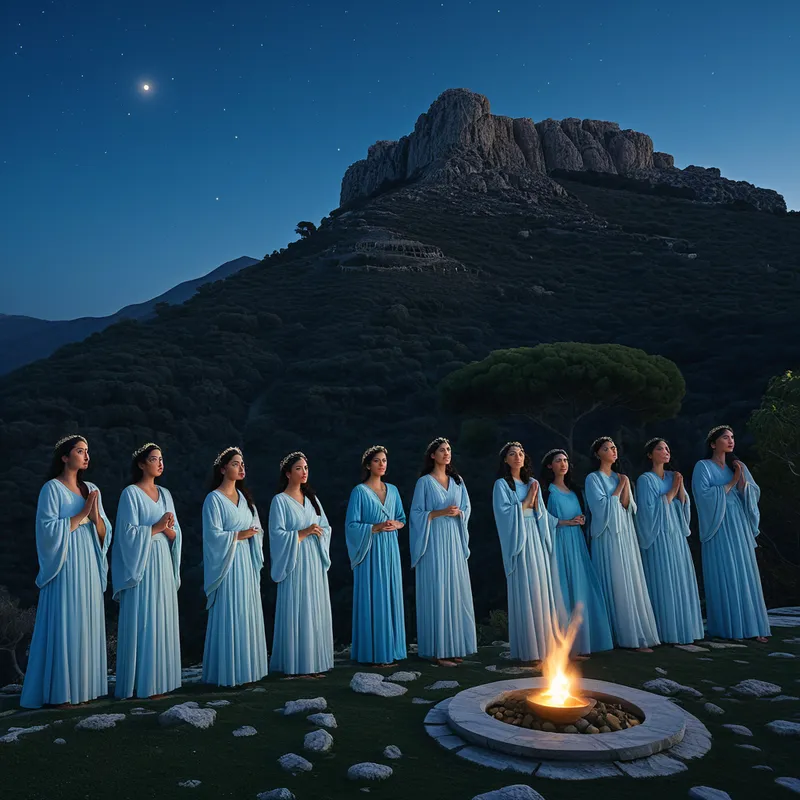
The nine daughters of Zeus and Memory, divine patrons of the arts and sciences, who breathe inspiration into the human soul from their sacred springs.
The Tale of The Nine Muses
Before the world knew its own name, when the mountains were young and the seas still whispered secrets to the shore, there was a silence. It was not an empty silence, but a pregnant one, a vast waiting in the heart of creation. From this silence, a memory was born. Her name was Mnemosyne, and she lay with the sky-father, Zeus, for nine nights under a canopy of stars that had never before shone so brightly.
From that union of cosmic power and deep remembrance, nine daughters were born. They did not arrive with a crash of thunder, but with the soft, persistent sound of a spring bubbling from stone. They were the Muses. The gods gave them a home on the slopes of Mount Helicon or near the clear peak of Mount Parnassus, places where the air was thin with possibility and the water tasted of clarity.
Their realm was one of perpetual twilight, caught between the setting sun and the rising moon. Here, the hoof of the winged horse Pegasus struck the earth, and from the rock burst forth the Hippocrene, a spring of water so pure it was not liquid, but liquid thought. The Muses danced around its silver pool, their feet barely touching the dewy grass. Calliope, with her tablet of wax, would trace the first lines of a heroic fate. Erato plucked the heartstrings of a lyre, and the very trees leaned in to listen. Urania pointed a finger, and a star would blink into sharper focus in the darkening sky.
But their power was not for themselves alone. They waited. They watched the valleys below where mortals struggled, their lives a series of grunts and labors, their stories untold, their songs unsung. Then, a shepherd would wander too high, his mind clouded with the tedium of his flock. Or a poet, like Hesiod, would come seeking lost sheep and find instead a loss of self. The air would grow still. The babble of the spring would become a clear, commanding voice.
The mortal would look up, and there they were. Not as vague ideas, but as terrifyingly present goddesses. Their eyes held the depth of the Hippocrene spring. They would speak, and their voice was not a single sound, but a chorus—the rustle of scrolls, the chord from a lyre, the rhythm of a dance, the logic of a geometric proof, all woven into one compelling command: Tell. Sing. Remember. Know.
They would breathe upon the mortal—a breath that was not air, but pneuma, the very spirit of inspiration. And in that instant, the shepherd’s simple staff would feel like a scepter, the poet’s confused thoughts would align into perfect hexameter. The mortal became a vessel, hollowed out by awe and filled to overflowing with a divine gift. The conflict was the human resistance to this overwhelming grace; the resolution was always surrender. The Muse gave the gift, and the human, trembling, carried it down the mountain to transform the silent, waiting world below.
Cultural Origins & Context
The myth of the Nine Muses is not a single, frozen story but a living, breathing tradition that evolved alongside Greek culture itself. Their earliest mentions are fragmentary, woven into the fabric of the oldest Greek poetry. In Homer’s Iliad, they are invoked as goddesses of song, but their number and individual domains were not yet fixed. It was with Hesiod’s Theogony (c. 700 BCE) that the canonical nine received their names, their parentage, and their fundamental role: to bring forgetfulness of sorrow and a respite from care through the gifts of the arts.
Their worship was central to Greek intellectual and artistic life. No epic poem began without an invocation to the Muse—“Sing, goddess, the anger of Peleus’ son Achilles…”—a ritual act that was both a prayer for skill and a humble acknowledgment that true creation flows from a source beyond the individual ego. They were patrons of the Mouseia, festivals with musical and poetic competitions, and their cult centers, particularly at Thespiae near Helicon and at Delphi, were pilgrimage sites for artists and thinkers.
Societally, the Muses served a crucial function: they sacralized knowledge and creativity. In a pre-literate and then early-literate society, memory (mneme) was the primary vessel of culture. The Muses, as daughters of Memory, literally embodied the process by which history, law, genealogy, and art were preserved and transmitted. They provided a divine framework that elevated the scribe, the poet, the musician, and the astronomer from mere craftsmen to mediators between the human and the divine. To be inspired was to be temporarily theios (god-like), channeling order, beauty, and truth into the chaotic human realm.
Symbolic Architecture
Psychologically, the Nine Muses represent the differentiated facets of the creative unconscious. They are not a monolithic “inspiration” but a pantheon of specific, archetypal energies within the psyche that must be courted, respected, and given individual voice.
The Muses do not invent; they remember. True creativity is the anamnesis—the unforgetting—of patterns that already exist in the soul of the world.
Their mother, Mnemosyne, is the key. She symbolizes the vast, impersonal reservoir of the collective unconscious—all human experience, potential, and ancestral knowledge. Their father, Zeus, represents the organizing, lightning-bolt of conscious will and structure. Thus, each Muse is a child born from the marriage of deep, formless memory with active, shaping consciousness. Clio is not just “history” but the psyche’s need to narrativize its own past. Melpomene is the archetypal pattern of catharsis and meaningful suffering. Polyhymnia is the silent, contemplative vessel for the numinous.
The sacred springs—Castalia and Hippocrene—symbolize the source of this psychic content, the point where the unconscious “wells up” into awareness. The ritual washing or drinking from these springs before poetic composition is a powerful metaphor for the necessary purification of the ego, the clearing of personal preoccupations to become a clear channel for transpersonal content.
The Dreamer’s Resonance
When the pattern of the Muses appears in modern dreams, it often signals a profound somatic and psychological process: the awakening of a specific creative or intellectual faculty that has been dormant or suppressed. This is not merely about “wanting to paint.” It is about a deep, archetypal energy demanding recognition and integration.
One might dream of a specific number—nine women, nine doors, nine instruments. This can point to a need to differentiate one’s creative spirit, to move from a generalized longing to a specific calling. Dreaming of drinking from a strange, clear spring suggests a thirst for authentic inspiration, a desire to connect with a source of wisdom beyond the polluted streams of daily information consumption. A dream of being given a tool (a pen, a lyre, a compass) by a majestic but intimidating female figure often accompanies the somatic feeling of a weight being placed in one’s hands—a responsibility to use a nascent gift.
Conversely, dreams of the Muses turning away, of a dry spring, or of being unable to hear their song reflect a state of psychic barrenness. This is the “creative block” experienced at a soul level, where connection to the nourishing depths of Mnemosyne has been severed by trauma, hyper-rationality, or sheer exhaustion. The body may feel heavy, the mind fogged. The dream is diagnosing a disconnect from the animating, inspirational breath (pneuma) of the unconscious.
Alchemical Translation
The myth of the Muses models the alchemical process of psychic transmutation, or individuation, for the modern individual. It maps the journey from the massa confusa of unconscious potential to the disciplined, golden expression of the Self.
The first stage is the invocation. This is the conscious ego’s admission of insufficiency—the “writer’s block,” the existential crisis, the feeling of being stuck. It is the modern equivalent of Hesiod calling upon the Muses from Helicon. One must actively seek the source, often by withdrawing from collective noise (ascending the mountain).
The second stage is the breath of the goddess—the moment of inspiration. In alchemical terms, this is the informatio, the imposition of a spiritual form upon base material (the human mind). This is often experienced as a sudden download, a synchronicity, or an irrational compulsion to create. It can be destabilizing. The ego must endure a temporary solutio—a dissolution of its ordinary structures to receive this new form.
Individuation is not self-invention. It is the courageous act of becoming a skilled instrument for the music that already exists in the cosmos.
The final, crucial stage is the return to the valley. This is the coagulatio, the hard work of grounding the vision into tangible form—writing the poem, composing the song, building the theory, choreographing the dance. The Muse gives the inspiration, but the mortal must provide the craft, the discipline, the techne. This is where the divine gift is humanized and made communicable. To fail in this duty is to betray the Muse, leaving the inspiration to rot as a private fantasy.
Thus, the full alchemical cycle—invocation, inspiration, and diligent manifestation—mircles the Muses’ own genesis from Chaos (the silent waiting) through the union of Memory and Divine Will, into nine distinct, harmonious expressions. The modern individual, by honoring this internal pantheon, does not become a passive vessel but a conscious co-creator, partnering with the deep memory of the world to bring something new, yet eternally true, into being.
Associated Symbols
Explore related symbols from the CaleaDream lexicon: