The Nereids Myth Meaning & Symbolism
The fifty sea nymphs, daughters of the Old Man of the Sea, embody the fluid, nurturing, and tempestuous depths of the psyche and the natural world.
The Tale of The Nereids
Listen. The story does not begin on the sun-baked earth, but in the sighing, salt-tinged dark. It begins in the embrace of the [Pontus](/myths/pontus “Myth from Greek culture.”/), the abyssal plain, and the luminous Nereid Doris, whose name means “bounty.” From their union came not one hero, not one monster, but a chorus—fifty daughters, the [Nereids](/myths/nereids “Myth from Greek culture.”/).
They were the very soul of [the sea](/myths/the-sea “Myth from Greek culture.”/). Not the terrifying chaos of the deep trenches, but the living, breathing personality of the coastal waters, the sunlit shallows, the places where wave meets land. Their father was Nereus, gentle and wise, and in his underwater halls of shimmering mother-of-[pearl](/myths/pearl “Myth from Chinese culture.”/), they learned the rhythms of the tides and the secrets whispered between currents.
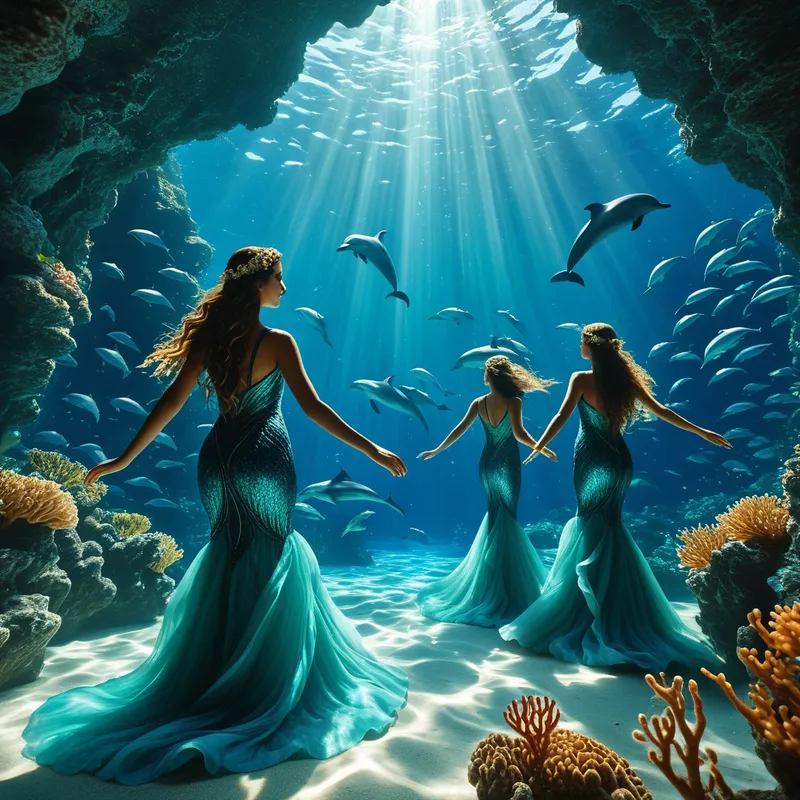
They were not solitary. As a pod of dolphins moves as one mind, so too did the Nereids often appear—a radiant company dancing in the foamy wake of ships, their laughter the sound of waves lapping on a quiet shore, their sorrow the sudden silence before a storm. They rode on dolphins and hippocampi, their gowns woven from sea-foam and sunlight filtered through fathoms of blue.
But from this chorus, individual voices would rise with the swell of fate. [Thetis](/myths/thetis “Myth from Greek culture.”/), most famous of them all, was prophesied to bear a son greater than his father. The gods themselves, Zeus and [Poseidon](/myths/poseidon “Myth from Greek culture.”/), desired her, yet fear of the prophecy made them wed her to a mortal king, Peleus. At that wedding on Mount Pelion, [the golden apple of discord](/myths/the-golden-apple-of-discord “Myth from Greek culture.”/) was cast, setting in motion the war at Troy. And from that union came Achilles, a son of sea and earth, whose destiny was written in [water](/myths/water “Myth from Chinese culture.”/) and blood. [Thetis](/myths/thetis “Myth from Greek culture.”/), in her divine grief, would try to burn away his mortality in fire, then hide him, disguised, to keep him from war—a mother’s love clashing with an unchangeable fate.
Another, Amphitrite, was pursued by Poseidon. She fled to the farthest reaches of the ocean, but a dolphin, emissary of the god, found her and spoke of his majesty. She returned, becoming his queen, the calming, sovereign presence who could sometimes still her husband’s tempestuous rage.
And others acted as saviors. To sailors crying out in a sudden squall, a glimmer of light on the water might be a Nereid, Galene, calming the waves. To the hero [Heracles](/myths/heracles “Myth from Greek culture.”/), lost and seeking [the garden of the Hesperides](/myths/the-garden-of-the-hesperides “Myth from Global/Universal culture.”/), the Nereids rose from the deep to guide him. They were the helpful hand from the unseen world, the unexpected grace in a moment of despair.
They were present at every great maritime event, a silent, shimmering witness. When the ship Argo sailed into unknown waters, the Nereids, led by Thetis, guided it safely through the clashing rocks. They rose from the waves to mourn the fallen at Troy, their dirge the sound of the eternal sea claiming all stories, all heroes, back into its depths.
Cultural Origins & Context
The Nereids were not the abstract personifications of a philosophical age, but the vital, immanent spirits of a culture born from and dependent upon the sea. Their myths were woven by poets like [Homer](/myths/homer “Myth from Greek culture.”/) and Hesiod, and later cataloged in texts like the Homeric Hymns and the vast mythological libraries of later scholars. They were the deities of the fisherman casting his net at dawn, the merchant praying for a safe passage, the sailor who saw faces in the foam.
Their primary societal function was explanatory and relational. The sea was not merely a resource or a barrier; it was a living, capricious entity. The Nereids gave that entity a face—many faces—that could be understood, appealed to, and respected. They localized the divine in the specific: the calm cove, the safe harbor, the treacherous strait. By naming them—Thetis (Establishment), Galene (Calm), Kymothoe (Swift Wave)—the Greeks entered into a relationship with the forces of nature. They were the bridge between human vulnerability and the immense, impersonal power of the ocean.
Symbolic Architecture
Psychologically, the Nereids represent the fluid, dynamic, and nurturing [matrix](/symbols/matrix “Symbol: A dream symbol representing the fundamental structure of reality, consciousness, or the self. It often signifies feelings of being trapped, controlled, or questioning the nature of existence.”/) of the unconscious itself. They are not the terrifying monsters of the [abyss](/symbols/abyss “Symbol: A profound void representing the unconscious, the unknown, or a spiritual threshold between existence and non-existence.”/) (that is the [realm](/symbols/realm “Symbol: The symbol of ‘Realm’ often signifies the boundaries of one’s consciousness, experiences, or emotional states, suggesting aspects of reality that are either explored or ignored.”/) of Ceto or the [Sirens](/myths/sirens “Myth from Greek culture.”/)), but the accessible [depths](/symbols/depths “Symbol: Represents the subconscious, hidden emotions, or foundational aspects of the self, often linked to primal fears or profound truths.”/). They embody the aspects of the unconscious that are creative, supportive, and intimately connected to [life](/symbols/life “Symbol: The symbol of ‘Life’ represents a journey of growth, interconnectedness, and existential meaning, encompassing both the joys and challenges that define human experience.”/) and [emotion](/symbols/emotion “Symbol: Emotion symbolizes our inner feelings and responses to experiences, often guiding our actions and choices.”/).
The sea nymph is the soul’s first teacher of fluidity, showing that identity can be a chorus, not a monolith.
Their [father](/symbols/father “Symbol: The father figure in dreams often symbolizes authority, protection, guidance, and the quest for approval or validation.”/), Nereus, the “Old Man of the Sea,” symbolizes the deep, ancestral wisdom of the unconscious—truthful, prophetic, but often requiring [effort](/symbols/effort “Symbol: Effort signifies the physical, mental, and emotional energy invested toward achieving goals and personal growth.”/) (his shape-shifting) to grasp. The fifty daughters emanating from him signify the multiplicity of potential within the [psyche](/myths/psyche “Myth from Greek culture.”/): the myriad moods, feelings, intuitions, and nurturing impulses that arise from our foundational, emotional [nature](/symbols/nature “Symbol: Nature symbolizes growth, connectivity, and the primal forces of existence.”/).
Thetis’s [story](/symbols/story “Symbol: The symbol of ‘Story’ represents the narrative woven through our lives, embodying experiences, lessons, and emotions that shape our identities.”/) is a profound [archetype](/symbols/archetype “Symbol: A universal, primordial pattern or prototype in the collective unconscious that shapes human experience, behavior, and creative expression.”/) of the [tension](/symbols/tension “Symbol: A state of mental or emotional strain, often manifesting physically as tightness, pressure, or unease, signaling unresolved conflict or anticipation.”/) between the eternal and the temporal. As a divine being forced into a mortal [alliance](/symbols/alliance “Symbol: A formal or informal union between individuals or groups for mutual benefit, support, or protection.”/), she represents a transcendent element (an [insight](/symbols/insight “Symbol: A sudden, deep understanding of a complex situation or truth, often arriving unexpectedly and illuminating hidden connections.”/), a potential, a spiritual [truth](/symbols/truth “Symbol: Truth represents authenticity, honesty, and the quest for knowledge beyond mere appearances.”/)) attempting to incarnate in [human](/symbols/human “Symbol: The symbol of a human represents individuality, complexity of emotions, and social relationships.”/) life. Her attempts to make Achilles immortal—by fire and by disguise—are the psyche’s struggle to protect its most precious, vulnerable creation from the ravages of time, [fate](/symbols/fate “Symbol: Fate represents the belief in predetermined outcomes, suggesting that some aspects of life are beyond human control.”/), and collective demands ([the Trojan War](/myths/the-trojan-war “Myth from Greek culture.”/)). Her ultimate failure is the necessary tragedy of human incarnation: even the children of the gods are subject to [mortality](/symbols/mortality “Symbol: The awareness of life’s finitude, often representing transitions, impermanence, or existential reflection in dreams.”/).
The Dreamer’s Resonance
When the Nereids surface in modern dreams, they rarely appear as a textbook mythological tableau. Instead, one might dream of being in or near a body of water—a pool, a lake, the ocean—and sensing a benevolent, watchful, feminine presence within it. There may be a feeling of being guided, supported, or cleansed by the water. Multiple feminine figures may appear, not as individuals but as a collective atmosphere of compassion.
Such dreams often signal a process of emotional healing or a return to the nourishing depths of [the self](/myths/the-self “Myth from Jungian culture.”/) after a period of arid, overly rational, or “dry” existence. The somatic sensation is often one of release, a softening of rigid boundaries, and a reconnection with fluid intuition. It can indicate a need to listen to the subtle, often ignored voices of one’s inner world—the fifty feelings, [the chorus](/myths/the-chorus “Myth from Theater culture.”/) of needs and creative impulses that have been silenced. Conversely, dreaming of troubled or grieving Nereids (like Thetis mourning Achilles) may point to a profound, perhaps unacknowledged, grief related to a “child” of the psyche—a project, a relationship, or a part of [the self](/myths/the-self “Myth from Jungian culture.”/)—that feels fated for loss or sacrifice.

Alchemical Translation
The alchemical journey modeled by the Nereids is that of solution—the process of dissolving rigid, conscious attitudes back into the primal, nurturing waters of the unconscious to be reformed. It is the antithesis of heroic, solar consciousness that forges ahead through will alone.
Individuation is not only a climbing of the mountain but a willing descent into the nourishing, salt-dark womb of the sea to be remade.
The first step is to acknowledge the chorus within—to move from a singular, ego-driven identity (“I am this”) to a more fluid, pluralistic self-conception (“I contain multitudes”). This is the stage of recognizing the Nereids. The next is to engage with the specific nymph who calls—often the one related to our current struggle. Is it Thetis, calling us to confront the painful but sacred duty of nurturing something destined for a fate beyond our control? Is it Galene, inviting us to find the calm within our own emotional storms?
The ultimate transmutation is to become, in a sense, a vessel for this sea-wisdom. It is not about controlling the depths, as Poseidon might, but about embodying their qualities: fluid adaptability, deep compassion, and the ability to nurture life from the unseen, emotional ground of being. One integrates the “Old Man” Nereus’s truth and the daughters’ nurturing grace, becoming a person whose consciousness is rooted in the deep, salty truth of feeling, and whose actions flow from that place with natural, life-supporting grace. The goal is not to leave the sea for the dry land permanently, but to become an amphibious being, at home in both the depths of the soul and [the world](/myths/the-world “Myth from Tarot culture.”/) of form.
Associated Symbols
Explore related symbols from the CaleaDream lexicon: