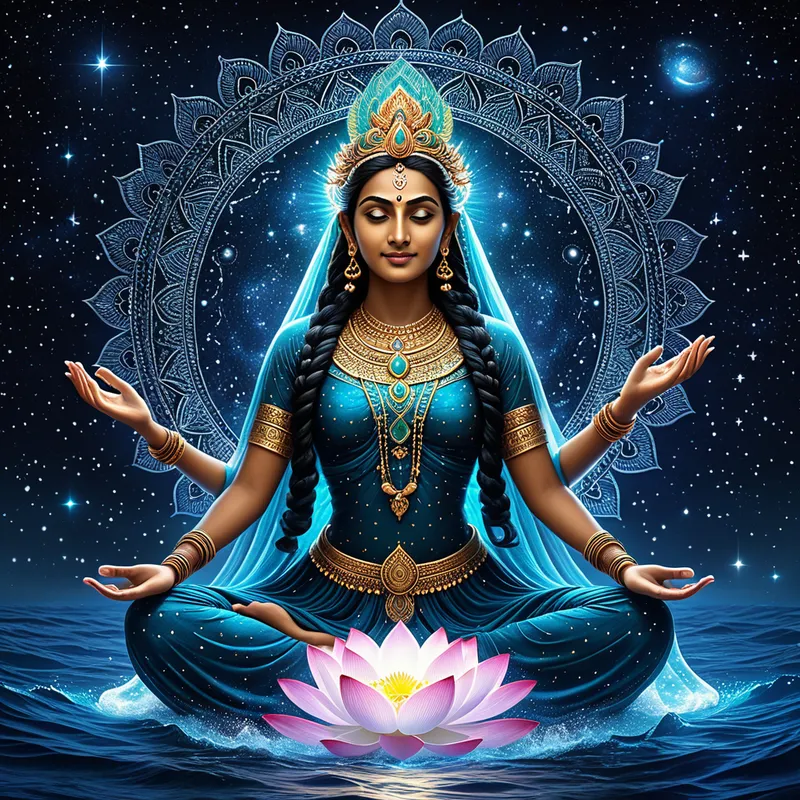
The myth of Maya in Hinduism Myth Meaning & Symbolism
The cosmic principle of illusion and creative power that veils the ultimate truth, inviting the seeker to discern the real from the unreal.
The Tale of The myth of Maya in Hinduism
Listen. Before the first word was spoken, before the first thought took form, there was a silence so complete it was a presence. From this boundless ocean of potential, a vibration arose—a hum that was also a light. This was the first movement, the first differentiation. And with it, the great weaving began.
The weaver is not a single face but a fundamental force, a feminine principle of boundless creativity and unfathomable power. She is Maya. She does not create from nothing, but from the substance of the one reality, Brahman. Her loom is the cosmos. Her threads are the elements: earth, water, fire, air, and space. With rhythms as old as time, she weaves.
She weaves the sapphire dome of the sky and the emerald carpet of the forest. She weaves the roaring lion and the whispering grass. She weaves the mountain, immovable and eternal, and the river, forever fleeing to the sea. She weaves the human form—the delicate lattice of bone, the symphony of breath, the flickering flame of consciousness within. She weaves the sweet agony of love, the sharp sting of loss, the dizzying pursuit of success, and the quiet despair of failure. Every sensation, every object, every story, every "you" and every "me" is a pattern in her grand, shimmering tapestry.
To the beings woven within it, the tapestry is all there is. The gold thread of pleasure seems solid and eternal. The black thread of pain seems an absolute abyss. The silver thread of a beautiful face seems the very meaning of life. The tapestry is so vivid, so compelling, so real in its textures and dramas that they forget it is a weaving. They take the image for the substance, the name for the thing itself. They believe the dancer is the dance.
This is her power, her lila—her divine play. She conceals the weaver in the beauty of the weave. She makes the infinite appear finite, the timeless appear sequential, the one appear as many. The world of names and forms, of separation and striving, rises and falls at her will, a magnificent and convincing dream.
Yet, in the heart of the dream, a strange echo sometimes sounds. A king sits on his throne of solid gold, yet feels a hollow wind blow through him. A lover holds their beloved, yet senses a fathomless distance. A scholar masters all known texts, yet finds only dust on the tongue. This echo is the faint memory of the silence from which the hum was born. It is the call of Brahman, the unchanging canvas upon which Maya paints.
The one who hears this echo clearly, who turns their gaze from the dazzling patterns to seek the source of the light that illuminates them, begins the great return. They see the gold thread not as gold, but as a play of light on fiber. They see the dancer and the dance as one movement. The tapestry remains—no less beautiful, no less intricate—but its power to bind is broken. The seeker realizes they are not the thread, nor the pattern, but the silent witness to the weaving. The veil remains, but it is seen as a veil. And in that seeing, the first and final freedom is found.
Cultural Origins & Context
The concept of Maya is not a single myth with a plot but a foundational philosophical and theological principle that permeates Hinduism, evolving over millennia. Its earliest seeds are found in the hymns of the Rig Veda, which speak of the "golden womb" and the "illusory power" of the gods. It was in the revelatory texts of the Upanishads that Maya crystallized as the power that projects the manifold universe from the singular Brahman.
This teaching was not for the marketplace but for the forest groves and the guru's hut, passed from teacher to disciple in a lineage of direct experience. Its societal function was profound: it provided the ultimate rationale for the spiritual quest (Jnana Yoga) and contextualized all of life's dramas. It explained why the world of sensory experience, though vividly real, could not provide lasting peace (moksha). It was a call to look beyond the apparent (samsara) to the real (Brahman), shaping ethics, art, and the very goal of human life.
Symbolic Architecture
Maya is the ultimate symbol of phenomenal reality itself. She is not "false" in the sense of being nonexistent, but "real" in a provisional, dependent way—like a dream is real to the dreamer. She represents the structuring principle of the psyche and the cosmos, the innate tendency of consciousness to create form, distinction, and narrative.
Maya is the divine magic show where the magician (Brahman) forgets Himself in order to seek Himself through every character in the play.
Psychologically, Maya represents the ego-constructing principle. It is the force that says "I am this body, these thoughts, these achievements, these failures." It creates the sense of a separate, bounded self navigating a world of other separate objects. The "veil" is this very structure of perception. The core symbols within the myth are profound:
- The Weaver/The Tapestry: The unconscious psyche in its creative, world-projecting capacity. The tapestry is the personal and collective reality we inhabit.
- The Veil: The filter of conditioned perception, cultural programming, personal history, and biological instinct that stands between pure awareness and experience.
- The Echo/The Call: The promptings of the Self (Brahman within), often experienced as existential discontent, a sense of "there must be more than this," or moments of awe that shatter ordinary perception.
The Dreamer's Resonance
When the archetype of Maya stirs in the modern dreamscape, it signals a profound psychological process: the beginning of dis-identification. The dreamer is starting to differentiate their eternal witnessing consciousness from the temporary contents of their psyche.
Common dream motifs include: finding that the walls of your home are made of painted canvas; realizing everyone in a crowded room is wearing an intricate but slightly off-putting mask; looking in a mirror and seeing your face shift through ages, genders, and emotions rapidly; or discovering that a treasured possession (a diploma, a wedding ring, a trophy) is hollow or turns to sand when held tightly. The somatic feeling is often one of vertigo, profound disorientation, or a chilling clarity. This is not a nightmare of persecution, but a sacred dismemberment of the constructed self. The psyche is rehearsing the dissolution of its most cherished illusions—the illusion of a fixed identity, permanent security, and external fulfillment.

Alchemical Translation
The journey from being ensnared by Maya to seeing through her weave is the alchemical opus of Individuation. It is the transmutation of leaden, literal identification with our roles and traumas into the golden awareness of the Self as the witness and source.
The first stage is Nigredo, the blackening: This is the "echo," the existential crisis, the feeling that the tapestry of one's life, however colorful, is a meaningless confinement. It is the dark night of the soul where all former meanings dissolve. The second stage is Albedo, the whitening: This is the turning inward, the practice of discernment (viveka). Through introspection, therapy, or meditation, one begins to separate the "I" from its objects. "I am not my job. I am not my anxiety. I am not my past." The threads of the tapestry are seen individually. The final stage is Rubedo, the reddening: This is not an escape from the world, but a return to it with liberated eyes.
The goal is not to destroy the tapestry, but to see the thread of the divine in every knot and color, thereby redeeming the world of form by recognizing it as an expression of the formless.
The modern individual achieves this alchemy not by renouncing the world, but by engaging with it fully while holding the silent, inner knowledge of its illusory nature. One works, loves, creates, and suffers, but no longer as a desperate actor believing the script is ultimate reality. One acts as a conscious participant in Maya's divine play, with compassion born from the understanding that all beings are fellow characters in the same grand, bewildering, and beautiful dream. The veil becomes transparent, and in that transparency, everything is revealed as sacred.
Associated Symbols
Explore related symbols from the CaleaDream lexicon: