
The Muses' Spring Myth Meaning & Symbolism
The sacred spring of the Muses, born from a god's hoof-strike, where poets and seekers drink to receive the gift of inspired memory and divine song.
The Tale of The Muses’ Spring
Hear now, and listen with the ear of the soul, to the tale of the wellspring from which all songs flow.
Before the world knew its own name, the slopes of Mount Helicon were silent. Not a silence of peace, but a stillness of waiting, a land holding its breath. The nine Muses walked there, daughters of mighty Zeus and Mnemosyne. They were the keepers of all that is beautiful and true—epic poetry, history, love songs, hymns, dance, comedy, tragedy, astronomy, and the sacred music of the spheres. Yet, they had no font from which to offer their gifts to mortals. Their wisdom was a locked treasury, their songs a melody heard only by the gods.
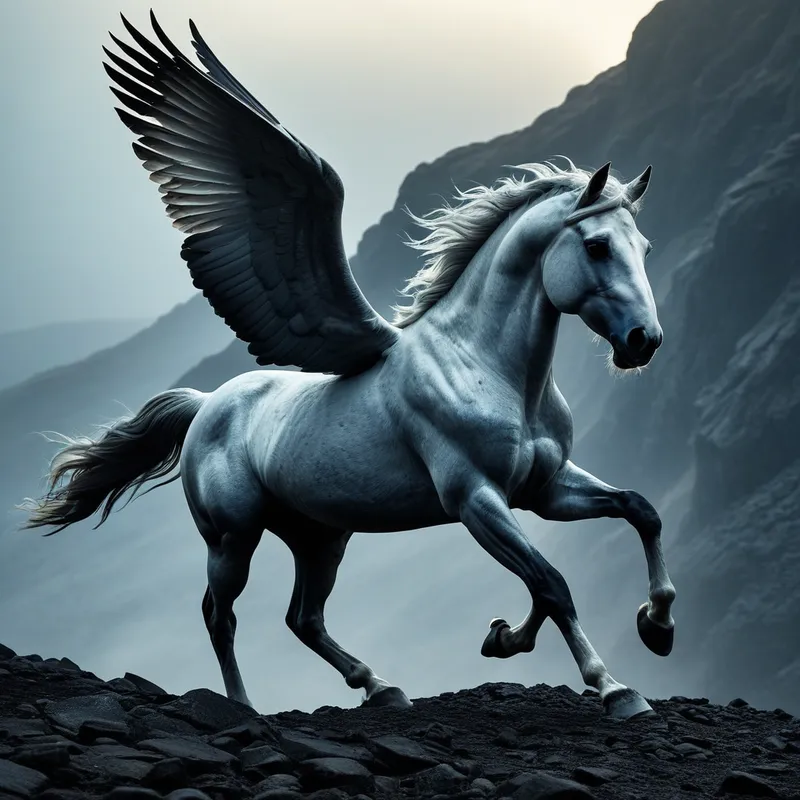
The silence was broken not by a whisper, but by a thunderous strike. From the high, clear air descended Pegasus, his coat the white of sunlit cloud, his wings beating a rhythm older than the wind. He was no ordinary steed, but a creature born of sea-god and gorgon’s blood, a being of pure, untamed poetic power. He galloped across the barren rock of Helicon, his hooves ringing like chisels on marble, seeking a place to quench a thirst not of the body, but of the spirit.
Then, with a force that shook the mountain’s roots, his mighty hoof came down. The rock did not shatter; it yielded. It sighed open. And from the deep, dark heart of the earth, where the memories of the world are stored, a spring burst forth. It was not mere water. It was liquid light, liquid memory. It was Hippocrene—the “Horse’s Spring.”
The waters flowed, cool and clear, singing a note so pure it tuned the very air. The Muses gathered, their eyes wide with recognition. This was the vessel they lacked. They bathed in its waters, and their voices gained new clarity. They drank, and their knowledge became a fountainhead. The spring became their sacred home, the nucleus of their power. From that day, any mortal—poet, musician, seeker—brave enough to climb the holy mountain and humble enough to kneel at its source could drink from Hippocrene. To taste its waters was to have the veil torn away. Forgotten truths surfaced, tangled thoughts unknotted, and the soul found the words, the rhythms, the forms it had always longed to express. The gift was not talent, but remembering—a sudden, shocking recollection of the divine pattern within.
Cultural Origins & Context
The myth of the Muses’ Spring is not a single, codified epic, but a pervasive and deeply rooted tradition within the Greek poetic and religious landscape. Its primary sources are the works of Hesiod, the great contemporary of Homer. In his Theogony and Works and Days, he explicitly invokes the Muses of Helicon, who “bathed their soft skin in the waters of the Permessus or Hippocrene,” marking the spring as the literal and spiritual starting point of inspired speech.
This was more than a pretty story; it was a functional cosmology of creativity for ancient Greek society. Poets (aoidoi) were not merely entertainers but vessels of cultural memory, historians, and theologians. Before a recitation of an epic or a hymn, the poet would issue a formal invocation to the Muses, a ritual gesture that was also a psychological technique. By calling upon the goddesses of Helicon and their spring, the poet was performing a symbolic act: leaving the mundane world and journeying to the source of divine knowledge to “drink” and bring back a report. The spring located inspiration not within personal genius, but in a specific, numinous place accessible through ritual, pilgrimage, and proper reverence. It democratized inspiration in a way—it was there, at the spring—while also gatekeeping it behind the trials of the journey and the necessity of the Muses’ favor.
Symbolic Architecture
The symbolism here is a profound map of the psyche. The myth presents a triune structure: the barren mountain (the seeking ego), the striking hoof (the catalyzing trauma or breakthrough), and the erupting spring (the liberated unconscious).
Mnemosyne, the mother of the Muses, is Memory itself. This is the first key. Inspiration is not the creation of something new from nothing, but the recollection of eternal forms, truths, and patterns that already exist within the deep psyche, the personal and collective unconscious. The spring is the point where this vast, inner ocean of Memory breaks through to the conscious mind.
The spring does not create the water; it is the aperture through which the aquifer of the soul is revealed.
Pegasus is the dynamic, psychopomp force. Born from the severed neck of the monstrous Medusa, he represents a sublime transformation of traumatic, petrifying energy (the Gorgon’s gaze) into soaring, creative power. His hoof-strike is the moment of catalytic impact—a sudden insight, a devastating loss, a passionate love, a crushing failure—that, precisely because of its force, cracks open the defensive shell of the conscious personality and allows what is buried to surge forth. He is the instinctual, animal spirit that connects heaven and earth, the unconscious drive that initiates the process.
The water of Hippocrene is the aqua permanens, the permanent water of the alchemists—the substance of the soul itself, the fluid medium of life, emotion, and psychic truth. To drink it is to integrate this substance, to allow the contents of the unconscious to irrigate and nourish the parched landscape of the conscious self.
The Dreamer’s Resonance
When this myth stirs in the modern dreamer, it often signals a profound psychic pressure building towards an awakening of creative or spiritual potential. The dream imagery is rarely a direct replica of the Greek myth, but a personal translation of its architecture.
One might dream of a forgotten room in their house with a sealed well in the floor. They might dream of a blocked fountain in a city square, its basin filled with trash, yet they feel a compulsive need to clear it. They might dream of a powerful animal—a horse, a bull, a stag—stamping the ground, causing vibrations that ripple through their dream-body. Or they may simply dream of drinking from a strange, cool source and waking with a phrase, a melody, or a solution to a long-standing problem on their lips.
Somatically, this process can feel like a pressure in the chest or throat—the “choked” feeling of something that needs to be expressed. Psychologically, it is the struggle of the ego, which prefers the known, barren landscape of its current identity, resisting the disruptive, fertilizing flood from the depths. The dream is the psyche’s attempt to illustrate the source of the pressure and to present the symbolic tool—the hoof-strike, the act of clearing, the decision to drink—that can release it.

Alchemical Translation
The journey to the Muses’ Spring is a perfect model for the alchemical process of individuation—the psychic transmutation of the base lead of the fragmented self into the gold of wholeness. It is a map for the modern creator, who may not believe in goddesses but knows the torment of the blank page and the ecstasy of the flow state.
The first stage, nigredo, is the barren mountain. It is the feeling of aridity, creative block, existential meaninglessness—the “dark night of the soul.” The seeker feels disconnected from their own inner source.
The hoof-strike of Pegasus is the mortificatio and the initiating spark of albedo. It is the necessary sacrifice, the painful breaking of old structures and identifications. This could be abandoning a safe career to pursue art, the end of a relationship that defined you, or the courageous confrontation with a childhood trauma. The ego is cracked open.
The gift of the spring is not poured into an empty vessel, but released from a vessel that has been struck open.
The eruption of the spring is the citrinitas—the dawning of the inner light, the flood of symbolic material, dreams, ideas, and affective energy. This is not yet the finished work; it is the raw, often chaotic, influx of the unconscious.
Finally, to drink from the spring is the rubedo, the integration. It is the conscious ego daring to take in this potent, divine substance and translate it into form—a poem, a painting, a business idea, a healed relationship, a new way of being. The water of the unconscious becomes the blood of consciousness. The mortal who drinks remembers their connection to the divine pattern, to Mnemosyne. They become, for a time, a conduit for the Muses. Their personal creativity is revealed as a participation in a timeless, archetypal act of remembrance and revelation. The spring is not outside on a distant mountain. It is within, waiting for the Pegasus-force of our deepest, most authentic longing to strike the rock and set the waters free.
Associated Symbols
Explore related symbols from the CaleaDream lexicon: