The Muses Myth Meaning & Symbolism
Nine daughters of Memory, born from the thunder of Zeus. They preside over the arts and sciences, granting divine inspiration to mortals who dare to listen.
The Tale of The Muses
Listen. Before history was written, when the world was young and raw with power, there was a sound. It was not the crash of waves nor the sigh of wind through oak leaves. It was a deeper resonance, a vibration that hummed in the marrow of the mountains and the roots of the world. It was the memory of creation itself, sleeping.
This memory slept in the being of Mnemosyne. For nine nights, the lord of the bright sky, Zeus, who shapes the fate of gods and men, came to her. He came not as a conqueror, but as a seeker, drawn to the profound, silent depths she held. Their union was a convergence of cosmic forces: the active, ordering principle of lightning and law meeting the passive, infinite well of all that has ever been.
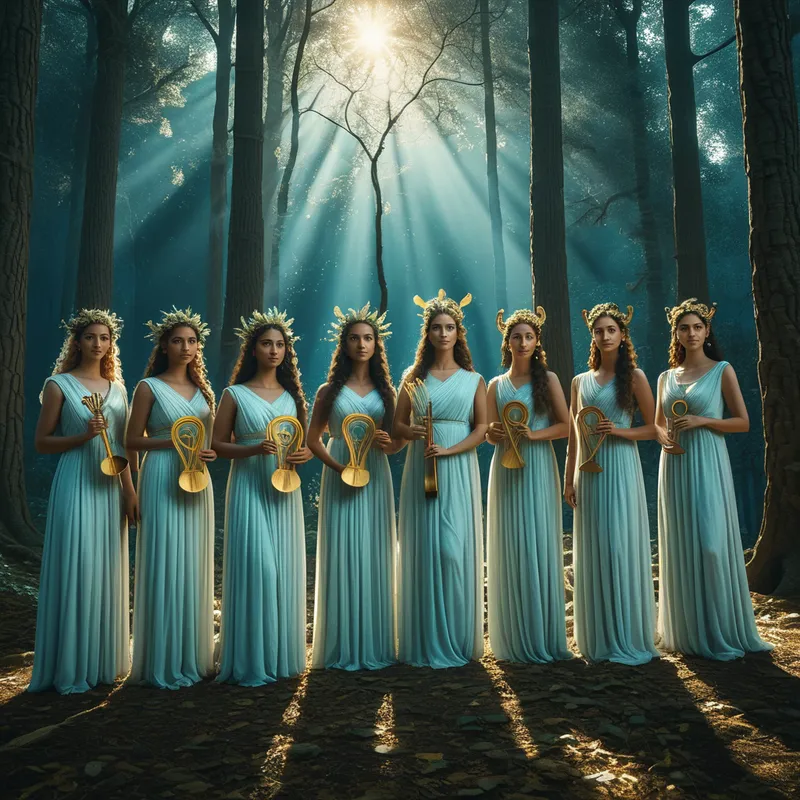
From that sacred congress, in the hidden valleys of Mount Helicon or the clear springs of Mount Parnassus, nine daughters were born. They did not arrive with the wail of infants, but with the harmonious opening of a chorus. They were the Muses. Calliope with her tablet of wax, voice like carved stone. Clio holding the scroll, her eyes holding the weight of ages. Erato with her lyre, whose strings tuned the human heart. Euterpe with her flute, breath sweet as spring. Melpomene bearing the tragic mask, a vessel for sorrow’s purification. Polyhymnia, veiled and contemplative, mistress of silent eloquence. Thalia with the comic mask and shepherd’s staff, laughter’s gentle patron. Urania with her globe and pointer, mapping the music of the spheres. And Terpsichore, whose very movement was a prayer.
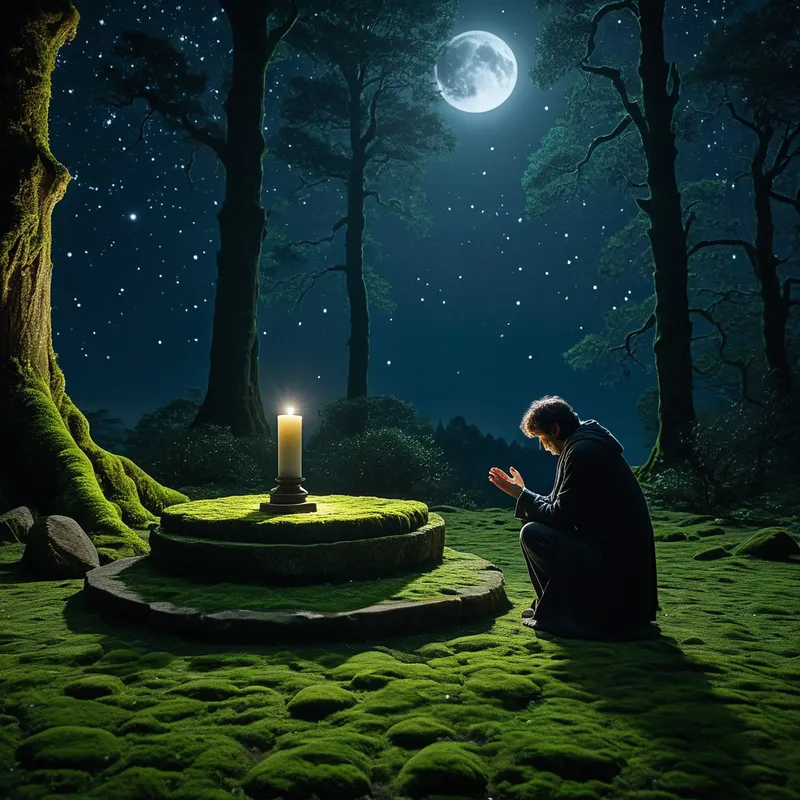
Their conflict was not with monsters, but with silence. Their rising action was the approach of the mortal—the poet with dry throat, the astronomer with clouded vision, the historian grasping at fading echoes. The mortal would come, often lost, to the sacred grove or the bubbling spring. They would offer a libation of water or wine, a token of humility. And then, they would wait in the terrible quiet of their own inadequacy.
The resolution was never a shout. It was a whisper, a sudden scent of ozone and lily, a chill breeze that carried not cold, but clarity. It was the touch of a Muse’s attribute upon the soul—the ghostly strum of a lyre string in the mind, the unrolling of a forgotten scroll within memory. The mortal would be filled, not with their own small voice, but with a Voice. Words would flow, melodies would arrange themselves, steps would find their pattern. The art was born, and in its birth, the chaotic noise of human experience was transformed into a patterned echo of the divine order. The Muses did not sing for themselves; they sang through us, and in doing so, made the world intelligible, beautiful, and bearable.
Cultural Origins & Context
The veneration of the Muses is deeply woven into the fabric of ancient Greek society, predating the Olympian pantheon’s full consolidation. Their origins are chthonic, tied to springs and mountains—Pieria and Helicon—places where the earth’s power was felt most acutely. They were originally a vague collective of inspirational nymphs before their number and domains were formalized, likely by the epic poets who depended on them.
Hesiod’s Theogony provides the canonical account of their birth, and his opening invocation—“Sing, Goddesses…”—was not mere convention but a vital ritual act. Every bard, poet, playwright, and later, historian and philosopher, began their work with an invocation to the Muses. This was a functional technology of the mind. It was an act of psychological preparation, a deliberate humbling of the individual ego (“I am not the source”) and an opening of the psyche to a transpersonal stream. In symposiums, theaters, and schools like Plato’s Academy, the Muses were present as the governing spirits of all structured thought and cultural memory. They provided the bridge between raw human experience and the forms that could make it meaningful to the community.
Symbolic Architecture
The Muses are not merely patrons; they are a profound psychological map. They represent the organized contents of the unconscious mind, made available to consciousness through disciplined invocation. Their mother, Mnemosyne, is the key. She is the undifferentiated pool of all personal and ancestral memory—the collective unconscious itself. Zeus, the archetypal principle of conscious order and light, must unite with this dark, deep memory to produce the specific, articulate forms of inspiration.
The Muses symbolize the moment when the chaos of internal experience is touched by the structuring principle of consciousness, giving birth to meaningful form.
Each Muse governs a specific channel of this transformation. They are not the content (the personal pain, joy, or observation) but the formative patterns through which content becomes communicable: the rhythm of epic, the cause-and-effect of history, the harmonic logic of music, the observational framework of astronomy. To be “inspired” is to have one’s personal material taken up and shaped by these eternal, impersonal patterns. The myth warns that the ego who claims the inspiration as its own sole creation risks madness or sterility—the fate of figures like the bard Thamyris.
The Dreamer’s Resonance
When the pattern of the Muses appears in modern dreams, it seldom manifests as nine classical women. Instead, one dreams of finding a hidden room in a familiar house, filled with specialized tools or instruments one barely knows how to use. One dreams of hearing a transcendent piece of music from a forgotten radio, or of water—from a spring, a faucet, a crack in a wall—that flows not as water, but as light or script.
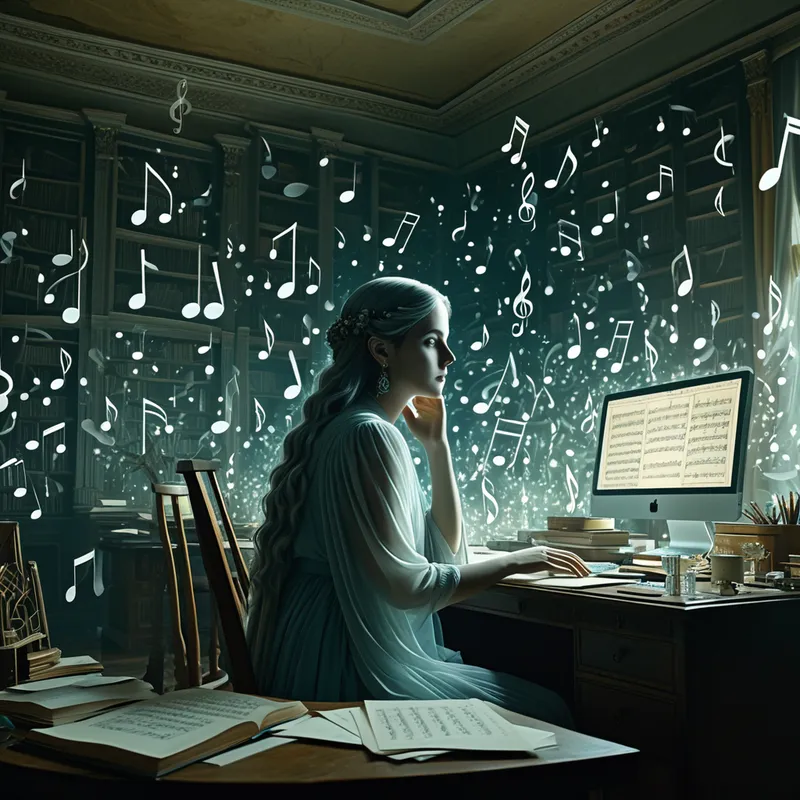
Somatically, this dream complex often accompanies a feeling of pressure or fullness in the head or chest, a creative urge without a clear outlet. Psychologically, it signals that the contents of the personal unconscious (Mnemosyne’s realm) have been fertilized by a moment of insight or intense life experience (Zeus’s lightning) and are now gestating, seeking their proper form. The dream is an invitation from the psyche to engage in a ritual of invocation: to sit at the desk, the instrument, the blank canvas, and consciously invite the pattern to emerge. The anxiety in such dreams is the fear of the formless; the hope is the promise of formulation.
Alchemical Translation
The individuation process, the journey toward psychic wholeness, requires that we move from being passive carriers of unconscious content to conscious co-creators of our own reality. The myth of the Muses provides a precise model for this alchemical work.
The first stage is invocation—the conscious acknowledgment that we are not the sole authors of our lives. This is the humility of the poet at the spring, setting aside the ego’s demand for control. The second is receptivity to Mnemosyne—the active engagement with memory, dream, and fantasy without immediate judgment or interpretation, allowing the raw material to surface. The third and crucial stage is the conjunction, where the conscious mind (Zeus) applies its focused attention and discipline to this material. This is not a forceful imposition, but a sacred marriage.
The creative act, in its deepest sense, is the ritual through which the personal self aligns with transpersonal patterns, transforming leaden experience into golden meaning.
The final stage is the birth of the specific form. This is not necessarily a poem or a painting, but could be the clear formulation of a life decision, the articulation of a long-held feeling, or the structuring of a personal narrative that makes sense of one’s past. Each Muse represents a possible mode of this formulation—through narrative (history), through relationship (love poetry), through understanding of cosmic place (astronomy). The “art” we create is, ultimately, the coherent and beautiful shape of our own lived experience. To live in dialogue with the Muses is to continually engage in this psychic transmutation, ensuring our inner world does not remain a formless chaos, but becomes a cosmos—an ordered, inspired, and meaningful whole.
Associated Symbols
Explore related symbols from the CaleaDream lexicon:
- Choir
- Magazine
- Member
- Classmate
- Sorority
- Groups
- Chorus
- Gallery
- Exhibit
- Echoing Laughter
- Melodic Waterfall
- Melodic Cricket
- Flocking Finches
- Harmony Insect
- Bell of Clarity
- Writer’s Quill
- Recording Studio
- Melodic Autoharp
- Rhythmic Cajón
- Tinkling Glockenspiel
- Cheerleader Uniform
- Fitness Class
- Book Club
- Unwritten Stories
- Phantom Author
- Budding Writers
- Artistic Inspiration
- Distant Narrator
- Secret Literary Society
- Feather Quill
- Typewriter
- Gallery Wall Shelf
- Decorative Wall Shelf
- Notepad
- Printer Paper
- Ink Cartridge
- Stationery
- Chorus Echo
- Art Gallery
- Mural Art
- Uplifting Choir
- Joyful laughter
- Harmonic Convergence
- Philosopher’s Quill
- Honeycomb Pattern
- Chanting Circle
- Geisha Fan
- Number 9
- Soul Calling
- Background Hum
- Hum
- Ambient Drone
- Census
- Syllable
- Vowel
- Synonym
- Agreement
- Adjective
- Transcription
- Secretion
- Genre
- Ensemble
- Narrator
- Humming
- Hive