The murmuration of starlings—a Myth Meaning & Symbolism
A tale of the sky becoming a living mind, where countless individuals surrender to a single, fluid intelligence, weaving a dance of chaos and perfect order.
The Tale of The Murmuration
Listen. Before the names of gods were carved in stone, before the first city cast a shadow, [the sky](/myths/the-sky “Myth from Persian culture.”/) told a story. It was not a story of a single hero, but of the many becoming one. It began not with a word, but with a whisper—a whisper of wings.
In the time when [the world](/myths/the-world “Myth from Tarot culture.”/) was raw and [the wind](/myths/the-wind “Myth from Various culture.”/) spoke secrets, the starlings were merely birds. They were countless, a chattering, scattered multitude, each a speck of dark intent against the vast canvas of the sky. They knew hunger, fear, the frantic search for roost. Their world was a cacophony of individual needs, a chaos of beating hearts.
Then came the Turning.
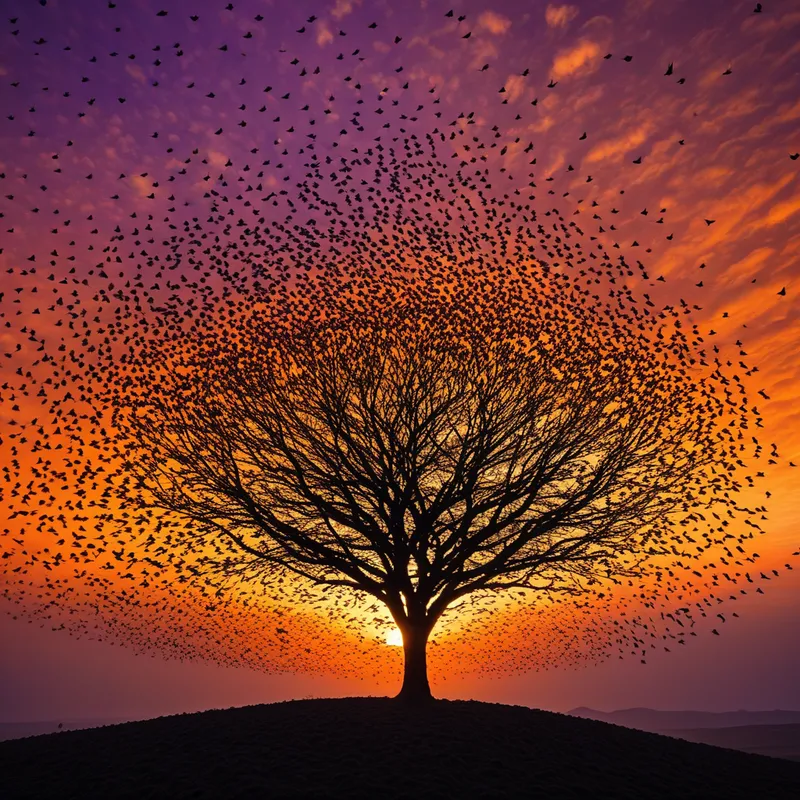
It did not come from a mountain peak or a deep forest pool. It arose from the between-spaces, from the very air that separated one wingtip from another. A restlessness, not of panic, but of a deep, forgotten longing. As the sun began to bleed into [the horizon](/myths/the-horizon “Myth from Various culture.”/), painting the world in the colors of fire and memory, one bird—or perhaps all birds at once—felt a shift. It was not a command, but an invitation. A subtle pull, softer than gravity, more intimate than instinct.
The first bird banked, not away from danger, but toward a neighbor. Then another mirrored the move. And another. A ripple passed through the flock, not as a wave through [water](/myths/water “Myth from Chinese culture.”/), but as a thought through a mind. The chattering ceased. The frantic individual pulses began to sync. What was a cloud of disparate beings began to breathe as a single entity.
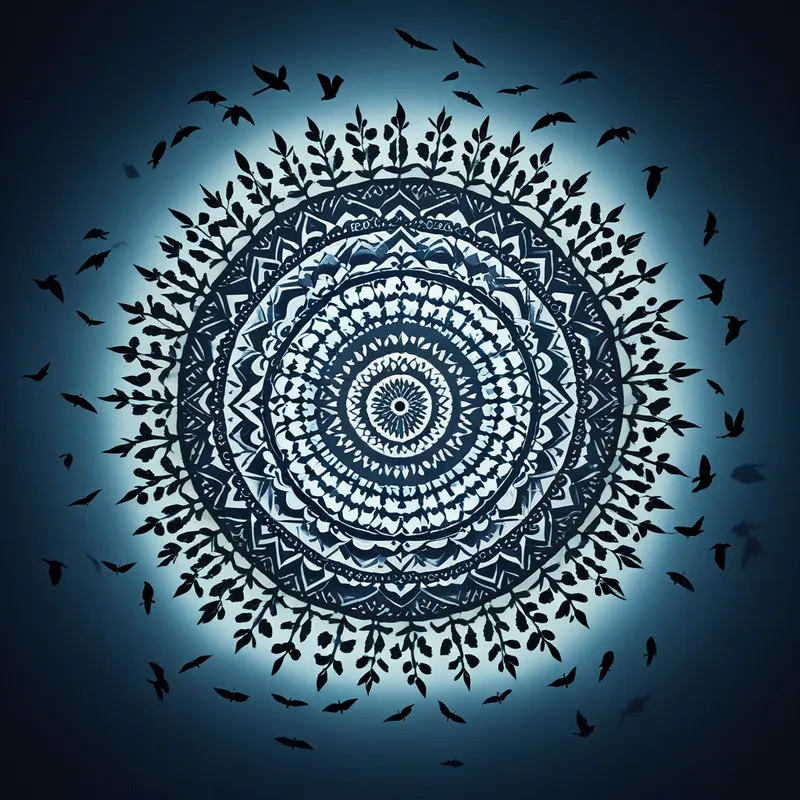
Watch now, as the sky transforms. The murmuration is born. It is a living, shifting sculpture of life. It pours like liquid night over the hills, contracting into a dense, throbbing heart before exploding into a shimmering veil. It folds in upon itself, a cosmic [origami](/myths/origami “Myth from Japanese culture.”/), becoming a great dragon one moment, a spinning [mandala](/myths/mandala “Myth from Buddhist culture.”/) the next. There is no leader, no follower. There is only the Pattern. Each starling is both utterly free—a single point of consciousness—and completely surrendered to the will of the whole. They move with a precision that would make the finest army weep, a grace that would humble the greatest dancer.
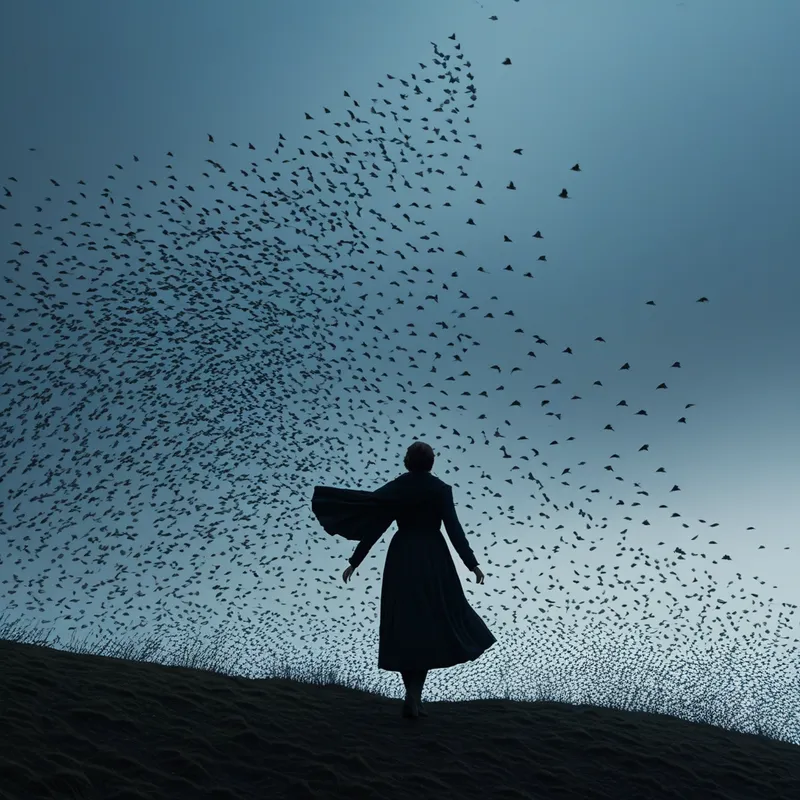
The wind itself holds its breath. The watching creatures on [the earth](/myths/the-earth “Myth from Hindu culture.”/) below—the fox in the field, the human by the fire—feel a sacred hush fall. They are not witnessing a flock of birds. They are witnessing the sky dreaming. They are seeing the visible breath of a collective soul, a demonstration that separation is an illusion, and that true power lies in fluid, willing communion. The dance continues until the last light fades, and as one, with a final, sighing sweep, the great being dissolves back into the thousand-thousand points of individual life, settling into the reeds to sleep, carrying the memory of unity in their small, fierce hearts.
Cultural Origins & Context
This is a myth without a single birthplace, a story written not on [papyrus](/myths/papyrus “Myth from Egyptian culture.”/) or clay, but on the retina of every human who has ever looked up in awe. The murmuration of starlings is a polygenetic myth, emerging independently wherever humans and these gregarious birds have coexisted. From the misty wetlands of prehistoric Europe to the vast skies observed by early thinkers, the phenomenon demanded explanation and reverence.
It was passed down not by professional bards around a king’s fire, but in the casual, stunned pointing of a farmer to his child, in the hushed discussions of shepherds watching the evening sky. Its societal function was multifaceted: as a natural calendar marking the turning seasons, as a symbol of community cohesion for tribal societies, and later, as a profound metaphor for philosophers and mystics. It served as a living parable of how individual action, when harmonized, creates something transcendentally greater—a lesson for hunters, warriors, and eventually, citizens. It was empirical evidence of an invisible order, a demonstration of a intelligence that resided not in one head, but in the space between all heads.
Symbolic Architecture
At its core, the murmuration myth dismantles the [archetype](/symbols/archetype “Symbol: A universal, primordial pattern or prototype in the collective unconscious that shapes human experience, behavior, and creative expression.”/) of the solitary [hero](/symbols/hero “Symbol: A hero embodies strength, courage, and the ability to overcome significant challenges.”/). Its power is an [emergent property](/symbols/emergent-property “Symbol: A complex phenomenon arising from simpler interactions, where the whole becomes greater than the sum of its parts.”/). The symbols are clear: the individual starling represents the [human](/symbols/human “Symbol: The symbol of a human represents individuality, complexity of emotions, and social relationships.”/) ego—distinct, willful, survival-driven. The murmuration represents the [collective unconscious](/symbols/collective-unconscious “Symbol: The Collective Unconscious refers to the part of the unconscious mind shared among beings of the same species, embodying universal experiences and archetypes.”/) or the unified field of being—intelligent, purposeful, and beautifully chaotic.
The self is not found in isolation, but in the resonant space between oneself and another.
The fluid, shape-shifting form of the flock symbolizes the [nature](/symbols/nature “Symbol: Nature symbolizes growth, connectivity, and the primal forces of existence.”/) of [reality](/symbols/reality “Symbol: Reality signifies the state of existence and perception, often reflecting one’s understanding of truth and life experiences.”/) itself—not solid and fixed, but relational, probabilistic, and constantly in [flux](/symbols/flux “Symbol: A state of continuous change, instability, or flow, often representing the impermanent nature of existence and experience.”/). The lack of a central [leader](/symbols/leader “Symbol: A leader signifies authority, responsibility, and guidance; representing aspirations for achievement or fear of following.”/) points to a decentralized intelligence, a model of [democracy](/symbols/democracy “Symbol: A political system where power is held by the people through voting and representation, symbolizing collective voice, freedom, and governance.”/) and swarm [logic](/symbols/logic “Symbol: The principle of reasoning and rational thought, often representing order, structure, and intellectual clarity in dreams.”/) that modern [science](/symbols/science “Symbol: Science symbolizes the pursuit of knowledge and understanding through observation and experimentation, representing logic and rationality.”/) now studies in complexity theory. Psychologically, it represents the [moment](/symbols/moment “Symbol: The symbol of a ‘moment’ embodies the significance of transient experiences that encapsulate emotional depth or pivotal transformations in life.”/) when the individual ego surrenders its illusion of total control and aligns with a deeper, transpersonal [rhythm](/symbols/rhythm “Symbol: A fundamental pattern of movement or sound in time, representing life’s cycles, emotional flow, and universal order.”/)—the rhythm of the group [soul](/symbols/soul “Symbol: The soul represents the essence of a person, encompassing their spirit, identity, and connection to the universe.”/), the [family](/symbols/family “Symbol: The symbol of ‘family’ represents foundational relationships and emotional connections that shape an individual’s identity and personal development.”/) [system](/symbols/system “Symbol: A system represents structure, organization, and interrelated components functioning together, often reflecting personal or social order.”/), or the guiding patterns of the [psyche](/myths/psyche “Myth from Greek culture.”/) itself.
The Dreamer’s Resonance
To dream of a murmuration is to dream of integration. Often appearing during periods of personal fragmentation, social anxiety, or a felt sense of disconnection, the dream murmuration signals a deep psychological process underway. Somaticly, the dreamer may report sensations of lifting, swirling, or a loss of solid boundaries upon waking.
This dream is the psyche’s theater for practicing surrender. The dreaming mind, observing the flawless, terrifyingly beautiful coordination, is working through conflicts between individual desire and group belonging, between personal freedom and relational responsibility. It can manifest as a soothing balm, showing the dreamer they are part of a larger, intelligent pattern, or as a confronting spectacle, highlighting their resistance to joining the dance. The ever-changing shape mirrors the dreamer’s own shifting identity, reassuring them that to change form is not to be lost, but to be alive within the greater movement.
Alchemical Translation
The alchemical journey modeled here is not one of slaying dragons, but of joining the dance. The [prima materia](/myths/prima-materia “Myth from Alchemical culture.”/) (base material) is the scattered, chattering, fearful individual ego. The process begins with the [nigredo](/myths/nigredo “Myth from Alchemical culture.”/)—the darkening, the restlessness, the felt insufficiency of solitary existence.
The turning point, the coniunctio ([sacred marriage](/myths/sacred-marriage “Myth from Alchemy culture.”/)), is the surrender. It is [the ego](/myths/the-ego “Myth from Jungian culture.”/)’s conscious decision to heed the subtle pull, to align its flight path with the seven birds around it. This is not annihilation, but a transmutation of purpose. The individual does not disappear; it becomes a vital cell in a new, greater body.
Individuation is not about becoming more separate, but about becoming a more conscious and willing participant in the pattern that already contains you.
The resulting murmuration is the [lapis philosophorum](/myths/lapis-philosophorum “Myth from Alchemical culture.”/) (philosopher’s stone) of this process: the creation of the Self. It is a state where one is simultaneously fully individuated (a distinct starling) and fully integrated (the flowing pattern). The core [triumph](/myths/triumph “Myth from Roman culture.”/) is the realization that one’s deepest individuality is only expressed and fulfilled through conscious, fluid participation in the whole. For the modern individual, lost in the noise of hyper-individualism, the myth offers a radical path: wholeness is found not in further self-assertion, but in resonant, attentive surrender to the living, intelligent pattern of which we are all a part.
Associated Symbols
Explore related symbols from the CaleaDream lexicon: