The Mummy Bundles of the Inca Myth Meaning & Symbolism
A myth of sacred guardianship where the living carry the preserved ancestors, weaving the threads of time, memory, and cosmic order into a single, living lineage.
The Tale of The Mummy Bundles of the Inca
Listen. The air is thin here, a sharp, cold clarity that cuts to the bone of the world. The sun, Inti, bleeds gold across the peaks, and the stones of Cusco hold the day’s last warmth like a secret. But the true warmth does not come from the sky. It comes from within the walls of the Coricancha, where the ancestors do not sleep.
They sit. They watch.
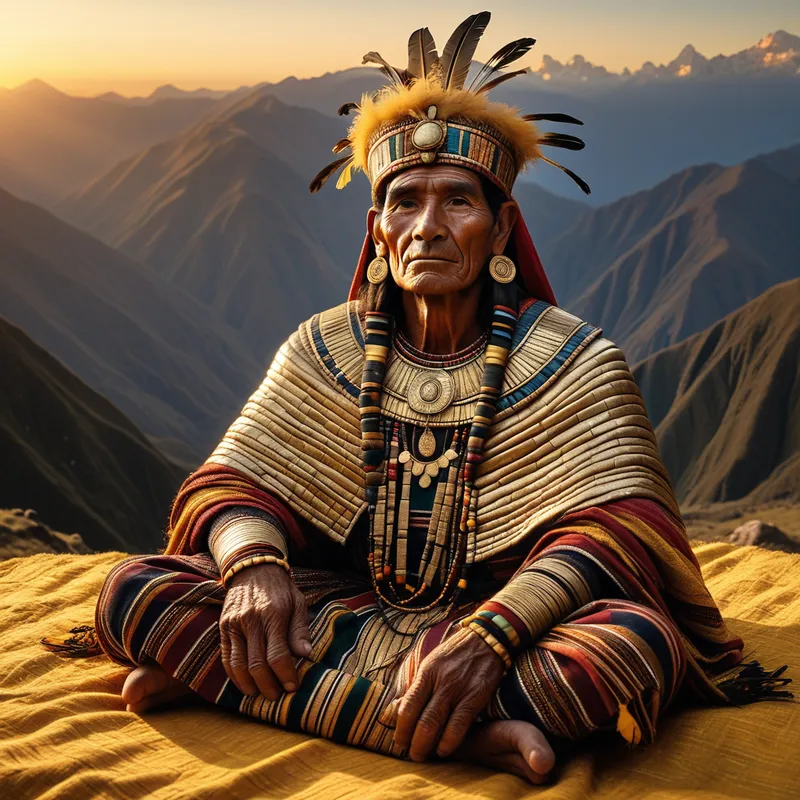
They are the Mummy Bundles, the mallquis. Not corpses, but persons. Wrapped in layer upon layer of the finest cumbi cloth, woven with stories of condors and serpents. Their faces, sometimes visible through masks of gold or shell, are not grimaces of death, but serene countenances of perpetual presence. Fingers, curled and dark, may clutch a golden tumi or a spondylus shell. They are dressed for festival, fed with maize beer and llama fat, consulted on matters of state and harvest.
The story is not of one journey, but of an eternal return. When a Sapa Inca drew his last breath in this world, the true work began. His body was carefully prepared, his organs removed with reverence, his form desiccated by the cold, dry breath of the Andes. Then, the wrapping. Each layer a prayer, a memory, a territory of his reign bound into the fabric. He was seated upon a golden stool, his bundle became a throne.
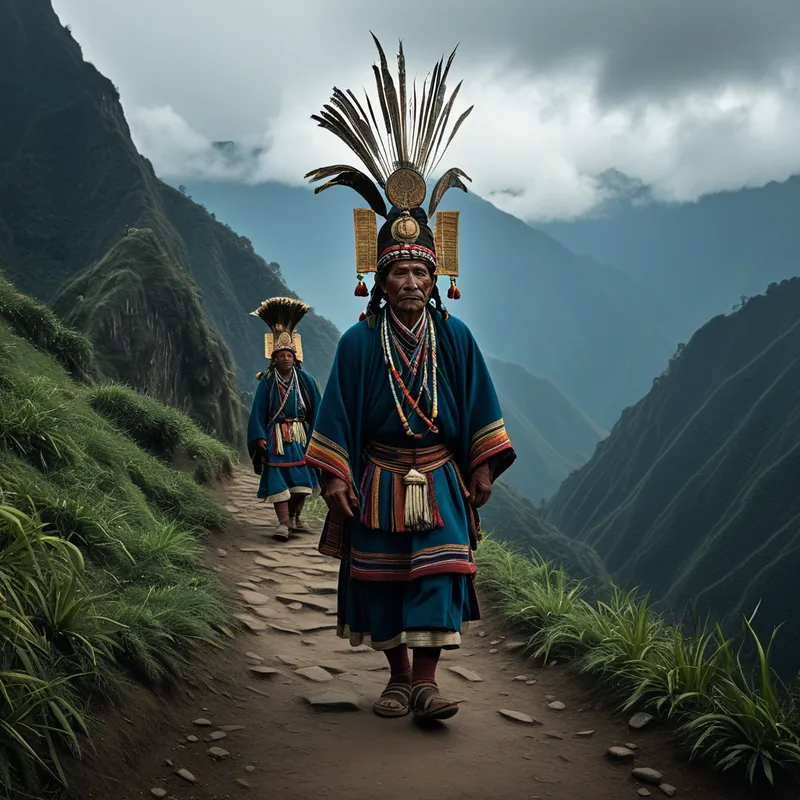
And then, his successor, the new Sapa Inca, would perform the ultimate act of duty. He would lift the heavy, sacred bundle of his father onto his own back. To the beat of deep drums and the wail of panpipes, he would carry his predecessor through the sacred plaza, bearing the literal and spiritual weight of the past. The ancestor was not interred. He was installed. In life, he ruled the living. In death, he ruled time itself. His bundle was brought to councils, paraded during Inti Raymi, and asked for counsel. The lineage was not a line; it was a circle, a living council of kings, a continuum of power and memory that defied the finality of the grave.
The conflict was not of battle, but of neglect. The greatest fear was not the death of a king, but the abandonment of his bundle. For if a bundle was lost, or left to rot, or captured by enemies, the chain of ayni—the sacred reciprocity between the living and the dead, the people and the ancestors—would be shattered. The world would fall into chaos. The resolution was eternal vigilance. The living cared for the dead, and the dead, in turn, ensured the fertility of the land, the order of the seasons, and the continuity of the Tawantinsuyu. In this sacred duty, the breath of the past forever warmed the present.
Cultural Origins & Context
This was not a single, codified myth from a sacred text, but a living, breathing complex of practices and beliefs central to the Incan worldview. The Mummy Bundles were the physical anchors of ancestral veneration, or mallqui worship. This practice had deep roots in Andean cultures long before the Inca, but the empire refined it into a state ideology.
The “story” was told not by bards, but by ritual. It was enacted every time a new emperor ascended, every time a bundle was consulted, every time offerings were made. The tellers were the priests of the Coricancha and the royal panacas (the descendant kin groups of each past Sapa Inca), whose sole duty was the care and cult of their founding ancestor’s bundle. Its societal function was paramount: it legitimized the ruling dynasty by directly linking them to Inti, it provided a stable, unchanging source of authority in the person of the deified ancestor, and it cemented the social order through the tangible, ever-present weight of history. The past was not behind them; it was in the room, sitting in state.
Symbolic Architecture
The Mummy Bundle is a profound [symbol](/symbols/symbol “Symbol: A symbol can represent an idea, concept, or belief, serving as a powerful tool for communication and understanding.”/) of the [paradox](/symbols/paradox “Symbol: A contradictory yet true concept that challenges logic and perception, often representing unresolved tensions or profound truths.”/) of preservation and continuity. It is not a tomb, but a [throne](/symbols/throne “Symbol: A seat of authority, power, and sovereignty, representing leadership, divine right, or social hierarchy.”/); not an ending, but a method of sustained [presence](/symbols/presence “Symbol: Presence in dreams often signifies awareness or acknowledgment of something significant in one’s life.”/).
The bundle is the psyche’s attempt to keep its history alive and in council, not buried and silent. It represents the parts of ourselves—our lineage, our traumas, our triumphs—that we feel we must carry with us, formally preserved, for our identity to remain intact.
The act of carrying the [ancestor](/symbols/ancestor “Symbol: Represents lineage, heritage, and the collective wisdom or unresolved issues passed down through generations.”/) represents the burden and blessing of [legacy](/symbols/legacy “Symbol: What one leaves behind for future generations, encompassing values, achievements, possessions, and memory.”/). The new Sapa Inca does not run from the [weight](/symbols/weight “Symbol: Weight symbolizes burdens, responsibilities, and emotional loads one carries in life.”/) of his [father](/symbols/father “Symbol: The father figure in dreams often symbolizes authority, protection, guidance, and the quest for approval or validation.”/); he lifts it onto his own [spine](/symbols/spine “Symbol: The spine symbolizes strength, support, and the foundational structure of one’s life and identity.”/) and carries it forward. Psychologically, this symbolizes the conscious [integration](/symbols/integration “Symbol: The process of unifying disparate parts of the self or experience into a cohesive whole, often representing psychological wholeness or resolution of internal conflict.”/) of parental and ancestral complexes. We do not slay the [father](/symbols/father “Symbol: The father figure in dreams often symbolizes authority, protection, guidance, and the quest for approval or validation.”/); we learn to carry his wisdom and his flaws as part of our own [constitution](/symbols/constitution “Symbol: A foundational document or set of principles that establishes the structure, rights, and governance of a society, representing collective agreement and order.”/). The bundle is also a perfect symbol of the [persona](/symbols/persona “Symbol: The social mask or outward identity one presents to the world, often concealing the true self.”/) in its most literal sense—the “mask” or outer [presentation](/symbols/presentation “Symbol: A presentation in a dream can symbolize the act of revealing or showcasing one’s ideas, emotions, or status, reflecting the dreamer’s current life circumstances or relationships.”/) (the beautiful textiles, the gold) that contains and shapes the inner essence. In the Incan view, this [persona](/symbols/persona “Symbol: The social mask or outward identity one presents to the world, often concealing the true self.”/) was not false; it was the dignified, public face of an enduring [soul](/symbols/soul “Symbol: The soul represents the essence of a person, encompassing their spirit, identity, and connection to the universe.”/), necessary for its continued social [role](/symbols/role “Symbol: The concept of ‘role’ in dreams often reflects one’s identity or how individuals perceive their place within various social structures.”/).
The Dreamer’s Resonance
When this mythic pattern stirs in the modern dreamscape, it often manifests as dreams of carrying a heavy, sacred, or mysterious object—a locked chest, an ornate vase, a wrapped package. The dreamer may be on a journey, compelled to deliver this object, yet its contents remain unknown. There is a somatic weight, a literal ache in the shoulders or back.
This is the psyche signaling a process of ancestral or personal-historical reckoning. The “bundle” is the compacted memory—genetic, familial, or karmic—that the dreamer is now strong enough to bear consciously. The dream may evoke feelings of solemn duty, resentment at the burden, or awe at its sacredness. To dream of losing the bundle speaks to fears of cultural amnesia, of failing one’s lineage or forgetting one’s roots. To dream of unwrapping it, however carefully, points to a readiness to examine the specific contents of this inheritance—to see the face of the ancestor, with all its serene wisdom and unhealed wounds.
Alchemical Translation
The alchemical process mirrored here is not the nigredo of utter dissolution, but the careful preservation that precedes transmutation. The base material (the mortal body) is not destroyed; it is meticulously dried, purified by the elemental air of the mountains, and wrapped in the finest cloth (symbolizing consciousness and culture).
The individuation journey requires this stage of honoring and carrying our bundles. We cannot integrate what we have discarded or denied. We must first acknowledge the weight, give it a seat at our inner council, and learn its language.
The modern soul’s “Inca Road” is the path of conscious life. Our “bundles” are the inherited scripts, the parental voices, the cultural traumas, and the ancestral gifts we carry. The alchemical translation is the move from carrying the burden to consulting with the ancestor. Initially, the bundle is a heavy obligation. Through the work of introspection (the inner ayni), we learn to unwrap it not to dispose of it, but to dialogue with it. We feed it symbolic offerings—our attention, our understanding. In return, it offers the counsel of time-depth, the stability of continuity, and the authority that comes from acknowledging one’s entire lineage. The ultimate transmutation is when the living self and the ancestral bundle are no longer bearer and burden, but a united council presiding over the realm of the individual soul. The past is preserved, not as a dead weight, but as a seated, sacred source of gravity and wisdom.
Associated Symbols
Explore related symbols from the CaleaDream lexicon:
- Mountain — The enduring, unchanging backdrop of the Andes, representing the eternal nature of the ancestors and the lofty, challenging path of carrying one’s legacy.
- Bundle — The core symbol of wrapped, preserved essence; the containment of history, memory, and identity in a portable, sacred form.
- Ritual — The precise, reverent acts of wrapping, feeding, and parading the bundles, symbolizing the conscious practices needed to honor and integrate the past.
- Ancestor — The deified forebear whose presence remains active and consultable, representing the living influence of lineage and genetic memory within the psyche.
- Duty — The sacred obligation of the living to the dead, and vice versa, modeling the psychological necessity of responsibly engaging with one’s inheritance.
- Gold — The solar, imperishable material of the masks and ornaments, symbolizing the attempt to make the mortal eternal and to attribute divine, lasting value to the ancestor.
- Stone — The enduring substance of the tombs and temples that house the bundles, representing the solid, factual reality of the past and the structures built upon it.
- Journey — The literal procession carrying the bundle and the metaphorical life-path of bearing one’s history, emphasizing movement and purpose in integration.
- Circle — The cyclical nature of time and lineage in the Incan worldview, where the dead remain in the present to guide the future, breaking the linear arrow of time.
- Order — The cosmic and social harmony (Tawantinsuyu) maintained by the correct veneration of the bundles, reflecting the inner order achieved when the past is properly acknowledged.
- Rebirth — The continuous life of the ancestor in bundle-form, representing the psychological rebirth that occurs when we reconstitute our relationship with our history, not as death, but as a new state of being.