The Mountain of the Magnet Myth Meaning & Symbolism
A legendary mountain of magnetic rock that pulls ships to their doom, symbolizing an irresistible cosmic force and the peril of unchecked ambition.
The Tale of The Mountain of the Magnet
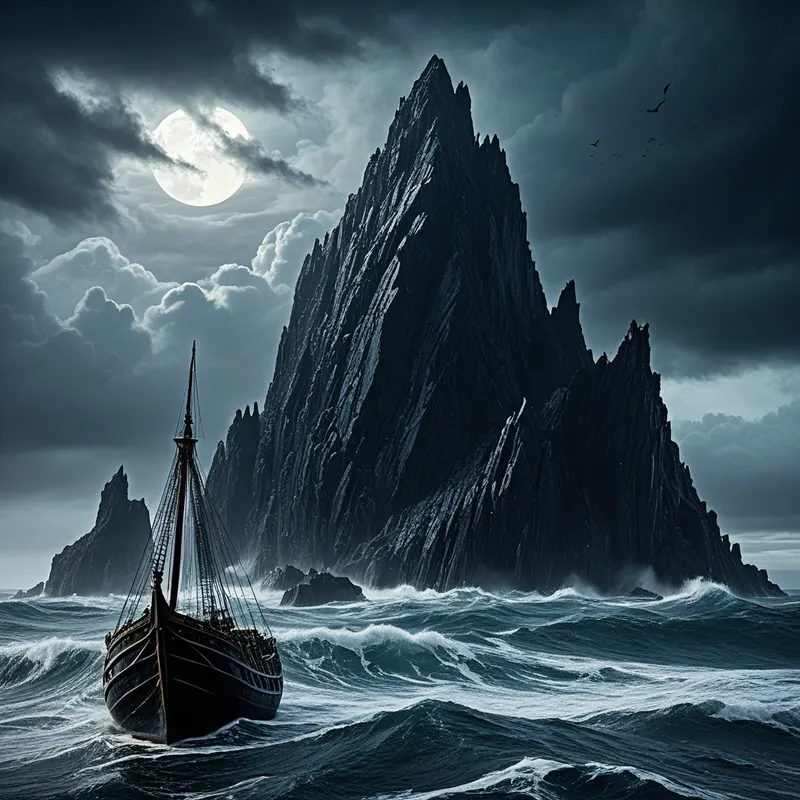
Listen, and hear the tale whispered by the salt-wind and the creaking timbers of lost ships. Beyond the known sea-lanes, where the stars themselves grow strange and the water turns the color of tarnished lead, there stands a mountain that is no mountain. It is a hunger made of stone.
The sailors of old knew it as Jabal al-Maghnaatis. It does not merely sit upon the earth; it is a claw of the world, forged from a single, titanic lodestone. Its slopes are black and glassy, devoid of life, for even the birds know to give its shadow a wide berth. Its true power is silent, invisible, a will that reaches out across the waves.
It calls to the iron in the world. The nails that hold a ship together, the anchor that should grant safety, the very sword at a captain’s hip—all become traitors. As a vessel ventures too near that cursed latitude, a deep groan begins in its bones. The compass needle spins in a mad, frantic dance, then points, unerringly, to the shore of doom. The ship slows, as if sailing through honeyed air. Then, the pull begins.
No sail can fight it, no oar can resist. The current of force is absolute. The ship is drawn, faster and faster, toward those black cliffs. Men weep and pray to Allah, but their prayers seem to fall into the same abyss that pulls their vessel. The air crackles with a metallic taste. The sound is the horror: the shriek of iron nails being drawn from wood, the groan of planks buckling, and finally, the catastrophic thunder of hulls dashed against unyielding stone. The mountain feasts on ambition, consuming ships and souls, adding their splinters to the vast, skeletal midden at its base. It is a god that does not listen, a force that does not care, a truth written in magnetism and wreckage.
Cultural Origins & Context
This myth finds its most famous literary anchor in the One Thousand and One Nights, within the voyages of [Sinbad the Sailor](/myths/sinbad-the-sailor “Myth from Islamic culture.”/). However, its roots dig deeper into the collective psyche of seafaring and trading cultures across the Arabian Peninsula, Persia, and the Indian Ocean. It is a story born from the marriage of empirical observation and profound dread.
Ancient mariners truly did fear regions where magnetic anomalies could disrupt their compasses. The myth poetically crystallizes this very real navigational terror into a tangible, awesome entity. It was a tale told on night watches and in harborside taverns, a cautionary legend that served a vital societal function. It mapped the psychological boundaries of the known world. The Mountain of the Magnet marked the absolute limit—beyond lay not just physical destruction, but annihilation by an impersonal, cosmic power. It taught respect for the sea’s mysteries, warned against the hubris of believing technology (the iron ship) could conquer all, and reinforced the Islamic worldview of Qadar, where even the most skilled sailor’s fate could be sealed by a force beyond his comprehension.
Symbolic Architecture
The [Mountain](/symbols/mountain “Symbol: Mountains often symbolize challenges, aspirations, and the journey toward self-discovery and enlightenment.”/) is the ultimate [symbol](/symbols/symbol “Symbol: A symbol can represent an idea, concept, or belief, serving as a powerful tool for communication and understanding.”/) of an impersonal archetypal force. It is not evil; it simply is. It represents the psyche’s encounter with a [reality](/symbols/reality “Symbol: Reality signifies the state of existence and perception, often reflecting one’s understanding of truth and life experiences.”/) that is utterly indifferent to [human](/symbols/human “Symbol: The symbol of a human represents individuality, complexity of emotions, and social relationships.”/) desire, hope, or morality.
The Mountain of the Magnet is the Shadow of the World Soul—a place where the laws of nature reveal themselves not as supportive, but as annihilating.
Psychologically, it embodies the pull of the unconscious itself—specifically, the gravitational field of a complex so powerful it dismantles the integrity of the conscious [personality](/symbols/personality “Symbol: Personality in dreams often symbolizes the traits and characteristics of the dreamer, reflecting how they perceive themselves and how they believe they are perceived by others.”/) (the ship). The iron nails are our attachments, our ego-structures, our “hard” convictions. The mountain demonstrates how these very structures can become our downfall when we encounter a force that speaks their primordial [language](/symbols/language “Symbol: Language symbolizes communication, understanding, and the complexities of expressing thoughts and emotions.”/). The [hero](/symbols/hero “Symbol: A hero embodies strength, courage, and the ability to overcome significant challenges.”/)’s [journey](/symbols/journey “Symbol: A journey in dreams typically signifies adventure, growth, or a significant life transition.”/), in this context, is not to conquer the mountain, but to learn its laws well enough to navigate its waters without being destroyed. It is the myth of coming to terms with an [aspect](/symbols/aspect “Symbol: A distinct feature, quality, or perspective of something, often representing a partial view of a larger whole.”/) of reality that cannot be bargained with, only acknowledged and circumvented.
The Dreamer’s Resonance
When this myth pattern arises in modern dreams, it seldom appears as a literal mountain. The dreamer may feel an inexorable, helpless pull toward a person, a situation, a memory, or a emotional state. The somatic sensation is one of being dragged, of losing autonomy. The psychological process is one of encountering a magnetic complex—often a deep-seated wound, a compulsive pattern, or a tidal pull of the Anima or Animus.
The dream ship is the dreamer’s current psychic configuration. The pulling apart of its iron fittings signifies the deconstruction of old, rigid ego-defenses in the face of this powerful attraction/repulsion. To dream of this is to be in the grip of a process far larger than one’s conscious will. It is a crisis of direction, where all one’s internal compasses fail. The healing lies not in stopping the pull, but in understanding what within oneself is made of “iron”—what attachments are vulnerable to this specific, fatal magnetism.
Alchemical Translation
The alchemical journey modeled here is the nigredo—the blackening, the confrontation with the massa confusa, the primal, chaotic, and all-consuming aspect of the unconscious. The mountain is the alchemist’s Prima Materia: dense, black, and deadly if approached with arrogance.
The transmutation begins when the sailor (the ego) stops trying to sail away and instead asks, “What is the nature of this pull?”
The individuation process requires building a ship with less iron—forging a consciousness less reliant on rigid, magnetic identifications and more on organic, flexible understanding. It is about replacing iron nails with wooden pegs; swapping literal, binding truths for symbolic, navigable ones. The triumphant figure in this myth is not one who destroys the mountain, but one like Sinbad, who learns of its existence from others’ wreckage, who respects its power, and who devises a creative, non-magnetic strategy (often involving substitution or sacrifice) to pass by. The ultimate alchemical gold is the self that has integrated the knowledge of this magnetic force, carrying its warning as wisdom, not terror, thereby mastering the seas of the inner world.
Associated Symbols
Explore related symbols from the CaleaDream lexicon:
- Mountain — The ultimate symbol of an immutable, daunting challenge and a cosmic force indifferent to human striving, representing the absolute power of the unconscious or fate.
- Ship — The vessel of the conscious personality and its journey, vulnerable to dissolution when its structural integrity (ego) encounters a force that speaks to its foundational materials.
- Journey — The core narrative of encountering, surviving, and learning from overwhelming, archetypal forces that define the boundaries of the known world and the self.
- Fate — The inexorable, magnetic pull toward a destiny that seems pre-ordained, against which individual will and skill appear powerless.
- Iron — Symbolizes the hard, rigid structures of the ego, technology, and human ambition, which become the very agents of destruction when subjected to a greater force.
- Magnet — The pure essence of attraction, an invisible field of force that compels, binds, and destroys, representing the power of complexes and unconscious pulls.
- Shadow — The mountain embodies the collective Shadow, a realm of psychic reality that is dangerous, all-consuming, and utterly real, which must be navigated, not conquered.
- Destiny — The fixed point toward which one is drawn, often tragically, representing the collision between human agency and cosmic design.
- Sea — The vast, unknown medium of the unconscious and life’s journey, across which the magnetic pull of deep archetypes operates.
- Stone — The implacable, unfeeling substance of the mountain itself, representing the cold, factual reality of laws—both physical and psychological—that do not bend for plea or prayer.
- Hero — The archetypal figure who, through cunning and respect for the force, learns to navigate the peril rather than defy it, achieving wisdom through near-annihilation.
- Fear — The primal emotional response to the recognition of an omnipotent, indifferent force, a necessary teacher that instructs respect for limits.