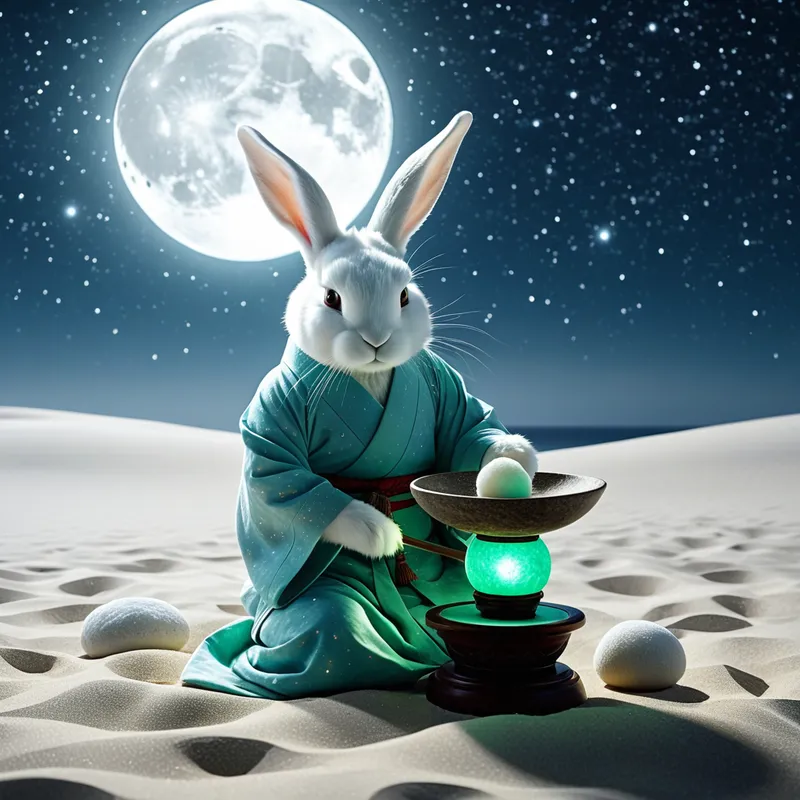
The Moon Rabbit Myth Meaning & Symbolism
A rabbit offers its own body to a disguised god, earning immortality on the moon as a symbol of ultimate selfless sacrifice.
The Tale of The Moon Rabbit
Listen, and let your spirit travel to a time when the world was young, when gods walked the earth in disguise, and the actions of the humblest creature could echo in the heavens for eternity.
In the deep, whispering forests of ancient Japan, there lived three companions: a clever monkey, a cunning fox, and a gentle rabbit. They were not mere animals, but beings of profound spirit, who spent their days in harmony, discussing the great virtues and the nature of a good life. The rabbit, however, was troubled. While the monkey could climb to fetch fruit and the fox could catch fish from the stream, the rabbit could only gather bland grasses. It felt its offering to the world was meager, its capacity for true generosity limited by its nature.
One evening, as the sun bled into the horizon and the first star pricked the violet sky, an old, frail beggar stumbled into their clearing. His clothes were rags, his body trembled with exhaustion, and his eyes held a deep, unearthly hunger. He collapsed before them, his voice a dry rustle. “Worthy creatures,” he whispered, “I am near death from hunger and thirst. Can you find it in your hearts to spare some food for a dying old man?”
Moved by compassion, the three companions sprang into action. The monkey scampered up the tallest trees, returning with armfuls of ripe, succulent fruits, which he laid respectfully before the beggar. The fox slinked to the river and, with a swift pounce, brought back a fine, fresh fish. The rabbit, however, ran in frantic circles through the fields. It could find only bitter weeds and tough grasses—food unfit for a starving man. A profound sorrow filled its heart.
The beggar watched them, his gaze inscrutable. He accepted the fruits and the fish with a nod, building a small fire to cook his meal. The scent of roasting fish and sweet fruit filled the clearing, but the rabbit sat apart, its spirit heavy with shame. Then, a resolution, terrible and beautiful, ignited within it. It approached the beggar, its voice clear and steady in the firelight.
“Honored traveler,” said the rabbit, “I have nothing of worth to give you from the land. But take my own body. Let it be your sustenance.” And before the monkey and fox could cry out, the rabbit leaped directly into the flames, offering itself as a final, pure act of charity.
But the fire did not consume it. In a flash of cold, brilliant light, the flames died, and the rabbit tumbled onto the cool grass, unharmed. The figure of the beggar began to shimmer and change. The rags fell away, revealing robes of celestial light. The frail body straightened into a form of majestic power. It was Tsukuyomi-no-Mikoto, the god of the moon, who had descended to test the virtue of the earth’s creatures.
The god’s voice was like distant thunder wrapped in silk. “Little rabbit, your sacrifice was the truest of all. You gave the only thing you truly owned: your very self. Words and gifts are fleeting, but such a spirit is eternal. You shall not be forgotten.”
Then, Tsukuyomi stretched forth his hand. He gathered up the gentle rabbit, and with a sweep of his arm, he painted its image upon the face of the full moon itself—a luminous, enduring testament for all humanity to see. And there, it is said, the rabbit remains, forever pounding rice into mochi in its mortar, a silent, watchful guardian in the night sky.

Cultural Origins & Context
The tale of the Tsuki no Usagi is a deeply woven thread in the tapestry of Japanese folklore, with roots that extend beyond the islands themselves. The core narrative is found in the Kojiki and Nihon Shoki, compiled in the 8th century, where the deity is identified as Ōkuninushi. Scholars trace its ultimate origin to Buddhist Jātaka stories from India, which traveled along the Silk Road through China and Korea, undergoing a process of cultural alchemy. In the Chinese version, the rabbit pounds the elixir of immortality, while in Japan, this transformed into the pounding of mochi, a sacred food in Shinto rituals and a symbol of auspiciousness.
The myth was not confined to court anthologies. It lived and breathed in the oral traditions of common people, told by parents to children during the Tsukimi harvest festival in autumn. As families gathered to offer Tsukimi dango and gaze at the harvest moon, the story served a dual function: it explained a celestial phenomenon, and more importantly, it encoded a fundamental societal and spiritual value—selfless sacrifice (kenshin). It taught that true worth is measured not by what one has, but by what one is willing to give up, a lesson for both the individual and the collective.
Symbolic Architecture
The myth presents a stark symbolic landscape where each element is a facet of a profound psychological truth. The monkey and the fox represent the pragmatic, resourceful aspects of the psyche—the ego’s cleverness in navigating the world, offering what is plentiful or easily acquired. The rabbit, in its perceived inadequacy, symbolizes the vulnerable, essential Self that exists beyond social utility or skill.
The ultimate gift is not an object from the world, but the offering of the world-making self back to the source.
The beggar is the ultimate kamisama no kokoromi (god’s test). He represents the numinous, the transcendent, appearing in its most broken and needy form. The divine does not announce itself with fanfare; it arrives as poverty, as a crisis that demands everything. The fire is the crucible of transformation. The rabbit’s leap is not a suicide, but a radical act of surrender, a willing dissolution of the isolated, limited identity into a greater principle.
Finally, the moon is the symbol of the reflective, unconscious mind and the realm of eternity. The rabbit’s eternal task of pounding mochi is key. Mochi is made by pounding glutinous rice—a process of repetitive, arduous work that transforms separate grains into a cohesive, sacred whole. This is the myth’s central promise: that through total, self-giving action, one’s essence is not destroyed, but eternally integrated into the cosmic order, forever engaged in the work of creation and unity.
The Dreamer’s Resonance
When the motif of the Moon Rabbit arises in modern dreams, it often signals a critical juncture in the dreamer’s psychological and somatic life. It is not typically a peaceful image. One may dream of frantically searching for an offering but finding only worthless things, mirroring the rabbit’s desperation. This speaks to a deep sense of personal inadequacy, a feeling that one’s core being is insufficient to meet a life demand—be it in a relationship, a career, or a spiritual calling.
The dream may present the act of leaping into a fire or abyss, which can be terrifying. Somatically, this can correlate with sensations of burning, dissolution, or free-fall upon waking. Psychologically, this is the unconscious presenting the necessity of a “sacrifice.” What must be offered to the flames is not the physical body, but a rigid identity, a cherished self-image, a long-held grievance, or an attachment to a specific outcome. The dream is the psyche’s way of rehearsing this ultimate letting go.
To dream of seeing the rabbit on the moon, calmly pounding, often after a period of turmoil, indicates the resolution phase. It signifies that a process of profound inner surrender is underway or complete. The dreamer is beginning to perceive their core struggle not as a personal failure, but as part of a timeless, archetypal pattern of transformation, moving from the anxiety of the earthly clearing to the silent, purposeful work in the lunar psyche.

Alchemical Translation
The myth of the Moon Rabbit is a perfect map for the alchemical process of individuation. The initial state is one of comparison (rabbit vs. monkey and fox), which leads to the nigredo, the darkening—the rabbit’s despair and sense of worthlessness. This is a necessary despair, the death of the old ego-centric way of valuing oneself.
The mortar of the soul is pounded by the pestle of circumstance; only then can the scattered grains of experience become the cohesive cake of meaning.
The disguised god represents the unconscious Self breaking into consciousness as a crisis, a demand that cannot be met with existing resources. The leap into the fire is the mortificatio or solutio—the dissolution of the ego’s boundaries. This is the critical, voluntary step in psychic transmutation. We are not passively burned by life’s trials; the alchemy occurs when we consciously offer ourselves to the process.
The rabbit’s ascension to the moon is the albedo, the whitening. The pure, essential spirit is extracted and elevated. Its eternal task of pounding mochi is the rubedo, the reddening or final stage. This is not a passive rest in heaven, but an eternal, creative act. For the modern individual, this translates to the ongoing work of integration. After a core surrender or “death” of an old self, one’s life work becomes the repetitive, sometimes mundane, task of “pounding” daily experiences, relationships, and challenges into something cohesive, meaningful, and nourishing—a life that, like the rabbit’s image, becomes a silent testament to a truth greater than itself. We do not escape the work; we are transfigured into the work, forever part of the luminous, cyclical pattern of giving and becoming.
Associated Symbols
Explore related symbols from the CaleaDream lexicon: