The Mist of Annwn Myth Meaning & Symbolism
A magical mist from the Celtic underworld, Annwn, that veils and reveals profound truths, challenging heroes and dreamers to navigate the unknown.
The Tale of The Mist of Annwn
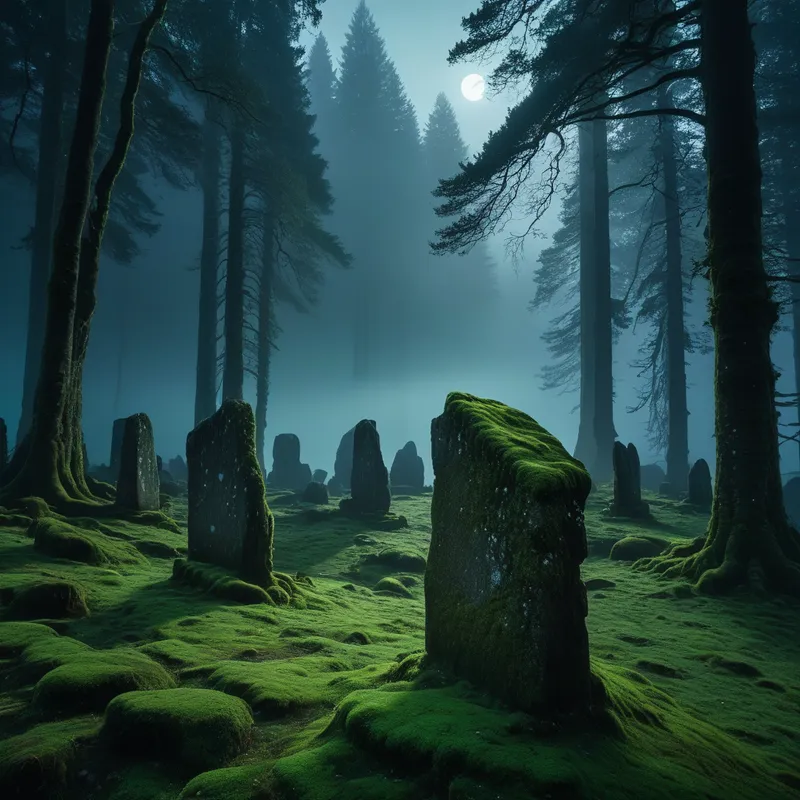
Listen, and let the fire’s glow dim. Let the sounds of the world fall away. We speak now of a time when the veil was not a metaphor, but a living breath upon the land—the Annwn.
It does not begin with a clash of swords, but with a sigh. A sigh from the roots of the oldest oak, from the deepest spring where no light stirs. From the Arawn, Lord of that realm, comes an exhalation that is not of air, but of essence. It pours forth from the hollow hills, seeps from the cracks between worlds, and flows like a silent, silver tide across the borders of the known.
This is the Mist of Annwn. It does not obscure; it transforms. To the cowherd on the hill at dusk, it is a sudden chill, a blurring of the familiar path home, the lowing of his cattle becoming strange, melodic calls. To the warrior at the ford, it is a wall of pearlescent grey where once there was a river, and from within, the sound of a hunting horn—not of this earth—that stirs his blood with a longing he cannot name.
It is the cloak of The Wild Hunt, masking their passage as they ride the edges of reality. It is the threshold itself. To step into it is to consent to being unmade and remade. The path underfoot becomes soft moss, then cold water, then star-dust. Time stretches and compresses; a heartbeat within the mist might be a season in the world left behind.
The greatest of the mortal kind, like Pwyll, Prince of Dyfed, did not fight this mist. He stood still as it enveloped him, letting the familiar shapes of his own lands dissolve. In that surrender, the mist parted not to reveal, but to invite. It led him to a clearing where two stags of impossible size clashed, and to the solemn, antlered figure of Arawn, who was both the land and the law of that place. The mist was the first word of their conversation, the medium of their fateful pact.
The mist is also the final test. It guards the Cauldron of Cerridwen, from which poetic inspiration and regeneration boil. To find it, one must navigate banks of mist that confuse the senses, that show the seeker their own fears and desires reflected back as phantom landscapes. The mist asks: Do you seek the cauldron for glory, or for wisdom? For power, or for healing? Your path through the haze will be shaped by your answer.
And when the journey is done—whether one returns with a gift, a truth, or simply one’s own soul intact—the mist recedes. It does not vanish. It withdraws, like a breath held, back into the hollow hills, leaving the world seemingly ordinary. But the grass is wet with dew that glistens with a strange light, and the air carries the faint, clean scent of a world that is not this one. The mist is always there, just beyond the corner of the eye, waiting for the moment when the veil grows thin once more.

Cultural Origins & Context
The Mist of Annwn is not a single, codified story from a sacred text. It is a pervasive atmospheric motif woven through the surviving fragments of Celtic mythology, primarily from medieval Welsh literature like the Mabinogion and earlier Irish cycles. These texts are Christian transcriptions of much older, oral traditions—the echoes of the Druidic world-view preserved by bardic poets.
In a culture that saw the world as inherently alive and interwoven with the numen of place, the mist was a tangible manifestation of the Otherworld’s proximity. Annwn was not a hellish underworld but a parallel realm of timelessness, abundance, and potent magic, often accessed through specific liminal sites: burial mounds (sídhe), lakes, forests, and shorelines. The mist was the sensory experience of that threshold.
The societal function was multifaceted. For the community, stories of the mist reinforced the sacredness of the landscape and the rules of hospitality and conduct when in strange places. It explained mysterious disappearances, sudden inspirations, or encounters with the divine. For the individual, particularly the warrior or poet, it framed the ultimate adventure: a journey into the source of sovereignty, wisdom, or artistic power, requiring not just brute strength but perceptual acuity, courage, and often, ethical purity.
Symbolic Architecture
Psychologically, the Mist of Annwn represents the autonomous activity of the unconscious. It is not a passive fog but an active, enveloping agent that emerges when the conscious mind’s grip on "reality" relaxes—at dusk, in dreams, during crisis or deep introspection.
The mist does not hide the path; it becomes the path. The journey is a navigation of one's own interiority, where landmarks are feelings and guides are archetypes.
The mist symbolizes the liminal space itself, the critical "in-between" where transformation is possible. It is the blurring of ego boundaries, where repressed contents (shadow), latent potentials (the Self), and ancestral patterns (collective unconscious) can begin to stir and take form. The figures one meets within it—Arawn, the spectral hunt, a guiding animal—are personifications of these unconscious forces, offering challenges or pacts that, if integrated, lead to profound growth.
The constant shifting of the landscape within the mist mirrors the psyche's fluid, symbolic nature. What seems solid (a long-held belief, a self-concept) may dissolve; what was hidden (a talent, a trauma) may suddenly loom large. The mist demands a different kind of seeing, not with the eyes but with what the Celts might have called the "second sight."
The Dreamer's Resonance
When this mythic pattern stirs in modern dreams, it rarely appears as a literal Celtic narrative. Instead, one dreams of being lost in a familiar city now shrouded in an impenetrable, beautiful fog. Of wandering through the rooms of one's childhood home, only to open a door onto a misty, endless moor. Of driving on a road where a sudden bank of silver haze swallows the world ahead, filled with indistinct, meaningful shapes.
Somatically, this can correlate with a feeling of dissolution, groundlessness, or a loss of direction in waking life. Psychologically, it signals a powerful encounter with the liminal. The dream-ego is in a state of transition. An old identity, job, relationship, or worldview is dissolving (the receding familiar world), but the new structure has not yet coalesced (the obscured path forward).
The dream-mist is the psyche's medium for this alchemical process. The anxiety of being lost is the ego's protest. The task for the dreamer is not to "escape" the mist, but to heed its peculiar logic: to stop, to listen for the distant horn (intuition), to notice what forms begin to emerge from the grey (insights), and to have the courage to take the next step without full certainty. This is the process of navigating by soul, not by map.

Alchemical Translation
The myth of the mist models the core of Jungian individuation: the necessary descent into the unconscious for the purpose of wholeness. The conscious personality (the hero in their known kingdom) must willingly enter the mist—the realm of the unknown and repressed—to engage with the Lord of the Underworld (the Shadow or the Self).
The pact with Arawn is the central alchemical act. It is the ego's agreement to acknowledge and rule rightfully over the disowned parts of the self, in exchange for wisdom and sovereignty.
The mist represents the nigredo, the darkening, the confusing dissolution of old certainties. This is not pathology, but the prerequisite for renewal. Wandering in the mist is the painful, essential work of shadow integration, where we confront what we have denied in ourselves.
Finding the Cauldron within the mist symbolizes achieving the albedo—a purification and inspiration. The cauldron is the vessel of the psyche that can now contain opposites: death and rebirth, agony and poetry. The one who drinks from it gains not mere facts, but imbas, inspired wisdom—the insight that comes from having been reconstituted by the journey.
To return, as Pwyll did, is to achieve a kind of rubedo. The mist recedes, but one is fundamentally changed. The ordinary world is reinhabited, but now it is seen as contiguous with the numinous. The explorer who has negotiated the Mist of Annwn no longer lives merely in the world, but with the world, aware of the shimmering, transformative veil that forever lies just beneath the surface of the real.
Associated Symbols
Explore related symbols from the CaleaDream lexicon: