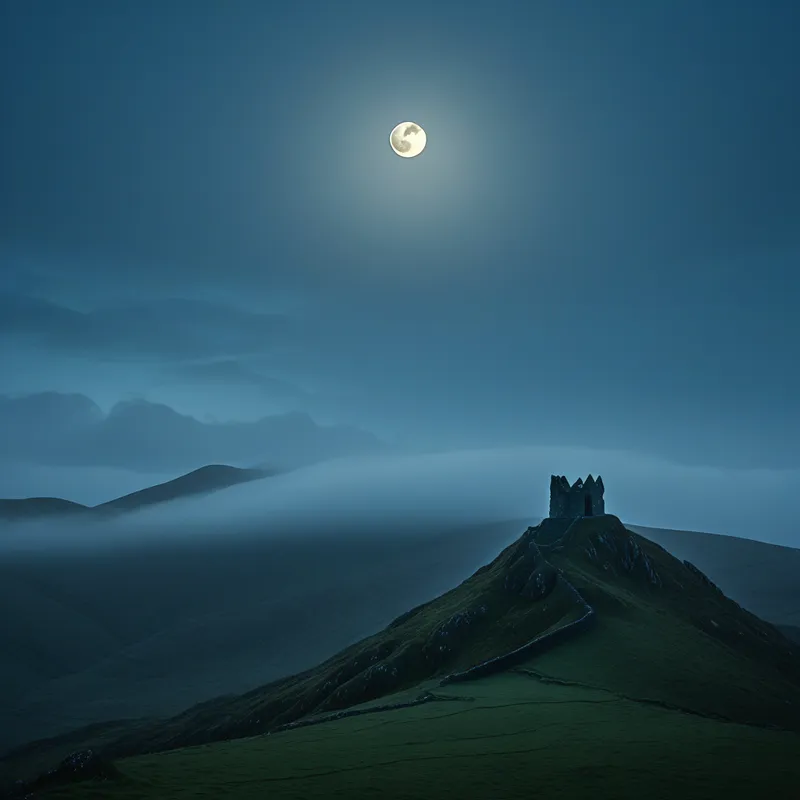
The Mist Myth Meaning & Symbolism
A tale of a hero who must navigate a sentient, shape-shifting mist to reclaim a stolen soul, confronting the liminal space between worlds and selves.
The Tale of The Mist
Listen now, and let the fire’s crackle fade. Hear [the wind](/myths/the-wind “Myth from Various culture.”/) in the [nemeton](/myths/nemeton “Myth from Celtic culture.”/), whispering of a time when [the world](/myths/the-world “Myth from Tarot culture.”/) was thinner, and [the Otherworld](/myths/the-otherworld “Myth from Celtic culture.”/) breathed close against our own. This is the tale of Conn, son of Cian, and his journey into the Ceó Draíochta.
It began not with a battle cry, but with a silence. A silence that fell over the rath of Conn’s clan on a night when the air was still and heavy. His sister, Fín, the clan’s seer, had walked the perimeter, her hands tracing the protective wards. At dawn, she was gone. Not a footprint led away, not a broken branch marked a struggle. Only a patch of dewless grass and a chill that clung to the skin spoke of her passing. The elders nodded grimly. The Ceó Draíochta had taken her. Not a weather, but a will. A living veil that sometimes slipped from the [Sídhe](/myths/sdhe “Myth from Celtic / Irish culture.”/) mounds when the gates between worlds grew slack.
Conn took his spear of ash, its point bound in iron, and a cloak woven by Fín herself. He walked to the edge of the known world, where the forest grew ancient and the paths forgot their way. And there it waited. Not a wall, but a presence. A mist that glowed with a faint, internal light, the colour of moonlight on milk. It did not drift; it breathed. It pooled in the hollows and climbed the trunks of oaks, and within its depths, Conn saw shapes—a flash of Fín’s smile, the curve of a deer’s neck, the menacing glint of warrior’s eyes. It showed him what he loved and what he feared, and it offered no path through.
For three days and three nights, Conn stood at its border. The mist whispered in voices half-remembered, promising rest, promising Fín’s return if he would but lay down his iron and sleep. On the fourth dawn, he did not step forward. He sang. His voice, rough and human, cut the spectral silence. He sang of the solid earth beneath his feet, of the taste of spring [water](/myths/water “Myth from Chinese culture.”/), of the weight of his father’s hand on his shoulder—songs of the mortal world. The mist recoiled from the notes as if burned.
He walked then, not fighting the tendrils that curled around his ankles, but anchoring himself with each step in the memory of physical sensation. The mist thickened, becoming a [labyrinth](/myths/labyrinth “Myth from Various culture.”/) of shifting phantoms. He saw battles he had fought, friends he had lost, and his own reflection, twisted by doubt. The iron of his spear grew cold, a tiny core of certainty in the formless world. He did not swing it at the illusions, but used its cold touch to ground himself, to remember what was real.
Deep in the heart of the Ceó Draíochta, he found not a prison, but a garden of pale, ghostly flowers. And there sat Fín, not bound, but entranced, her eyes reflecting the endless, swirling grey. The mist had not stolen her body, but had unmoored her anam. Conn did not grasp her hand. He knelt, placed the iron spear on the ground between them, and told her a story. A simple, foolish story of the two of them as children, stealing [honeycomb](/myths/honeycomb “Myth from Natural culture.”/) and being chased by bees. He spoke of the sting, the sweetness, the sound of their own laughter.
At the memory of that laughter, Fín’s eyes focused. She blinked, and a tear traced a path through the spectral dust on her cheek. Where it fell, a single, real blade of green grass pushed through the grey soil. Conn took her hand—warm, solid, alive—and together, they began the long walk back, singing their mortal songs, their joined voices a thread leading them home. The Ceó Draíochta did not attack. It parted, thinning with each step, until they emerged under a sky brilliant with familiar stars, the ordinary night air a shocking, beautiful gift.

Cultural Origins & Context
The motif of the sentient, perilous mist is not a single, standardized myth but a pervasive archetype woven through the tapestry of Celtic oral tradition, particularly in Irish and Welsh cycles. These stories were the province of the filí and bards, who preserved history, law, and cosmology in verse. The mist, or ceó, functioned as a primary narrative device for the sídhe.
In a culture that perceived the landscape as inherently alive and sacred, weather was never merely meteorological. Fog, especially the dense, sudden sea-haar or mountain mist, was a literal and figurative veil. It represented [the thin places](/myths/the-thin-places “Myth from Celtic culture.”/), the moments where the Middle Kingdom and the [Otherworld](/myths/otherworld “Myth from Celtic culture.”/) intersected. Stories of the Ceó Draíochta served a crucial societal function: they codified the danger and protocol of these liminal zones. They taught that navigation required not brute force, but right memory, right song, and a steadfast connection to one’s own truth and lineage. To enter the mist unprepared was to risk dissolution of [the self](/myths/the-self “Myth from Jungian culture.”/)—a fate worse than death.
Symbolic Architecture
The Mist is the ultimate [symbol](/symbols/symbol “Symbol: A symbol can represent an idea, concept, or belief, serving as a powerful tool for communication and understanding.”/) of the liminal. It is not the Otherworld itself, but [the threshold](/myths/the-threshold “Myth from Folklore culture.”/) state of [consciousness](/symbols/consciousness “Symbol: Consciousness represents the state of awareness and perception, encompassing thoughts, feelings, and experiences.”/) one must traverse to reach it. Psychologically, it represents the unstructured, chaotic potential of the unconscious mind when we first dare to confront it.
The Mist does not attack; it assimilates. Its danger is not destruction, but the eternal, seductive offer to forget who you are.
The [hero](/symbols/hero “Symbol: A hero embodies strength, courage, and the ability to overcome significant challenges.”/), Conn, embodies the conscious ego setting out on a necessary [quest](/symbols/quest “Symbol: A quest symbolizes a journey or search for purpose, fulfillment, or knowledge, often representing life’s challenges and adventures.”/)—to reclaim a lost part of the [psyche](/myths/psyche “Myth from Greek culture.”/) (Fín, the intuitive, visionary function). His weapons are telling: the iron [spear](/symbols/spear “Symbol: The spear often symbolizes power, aggression, and the drive to protect or conquer.”/), symbol of focused will and the discriminating power of consciousness, and the [cloak](/symbols/cloak “Symbol: A garment that conceals identity, protects from elements, or signifies authority and transformation in dreams.”/) woven by the very [soul](/symbols/soul “Symbol: The soul represents the essence of a person, encompassing their spirit, identity, and connection to the universe.”/) he seeks, representing his enduring [connection](/symbols/connection “Symbol: Connection symbolizes relationships, communication, and bonds among individuals.”/) to that which is lost. His victory is not conquest, but remembering. He defeats the formless by asserting form; he counters spectral whispers with the solid, sensory [truth](/symbols/truth “Symbol: Truth represents authenticity, honesty, and the quest for knowledge beyond mere appearances.”/) of his own lived experience. The mist’s retreat before song signifies that the chaotic unconscious responds not to force, but to the authentic [vibration](/symbols/vibration “Symbol: A rhythmic oscillation or resonance, often representing energy, connection, or unseen forces. In dreams, it can signal awakening, disturbance, or spiritual communication.”/) of the individual’s unique [spirit](/symbols/spirit “Symbol: Spirit symbolizes the essence of life, vitality, and the spiritual journey of the individual.”/).
The Dreamer’s Resonance
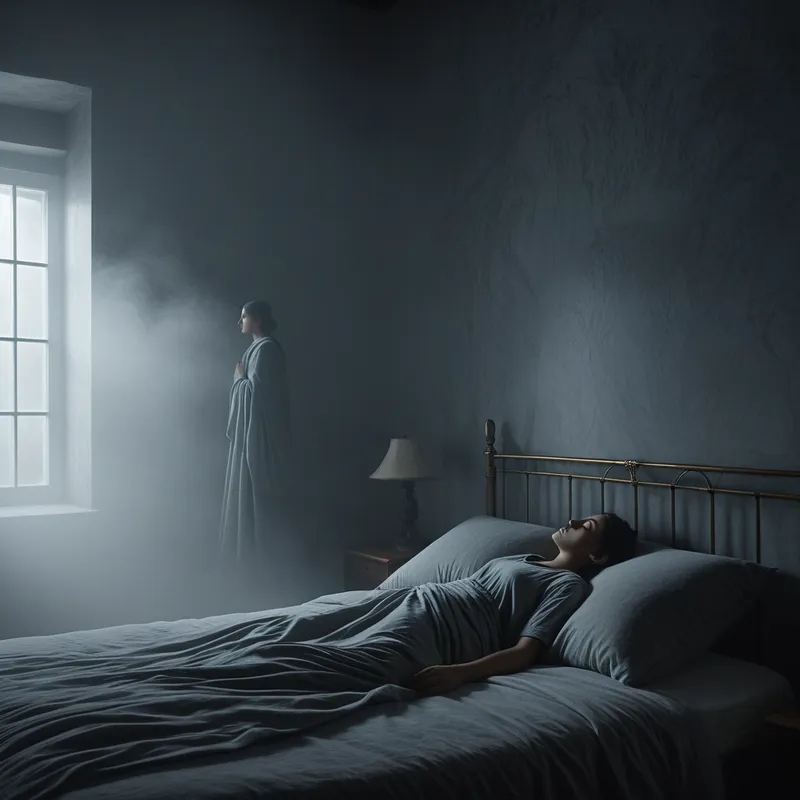
When this myth stirs in the modern dreamer, it often manifests as dreams of being lost in fog, wandering featureless landscapes, or being pursued by shapeless presences. The somatic experience is one of profound disorientation, weightlessness, and muffled sensation—a direct correlate to the psychological state of facing the unknown contents of one’s own shadow or confronting a life transition without a clear map.
This dream-mist signifies [the ego](/myths/the-ego “Myth from Jungian culture.”/)’s temporary dissolution as it engages with material too complex or primal for its ordinary structures. The dreamer is in the Mist. The psychological process is one of containment: can the dream-ego, like Conn, find a core of selfhood to cling to? The appearance of a specific, lost person or object within the dream-fog is the psyche’s signal of what specific quality or potential (the “Fín”) needs reintegration. The terror of the dream is the fear of psychic dissolution; its purpose is to initiate the dreamer into navigating by inner truth, not external landmarks.
Alchemical Translation
The journey through the Ceó Draíochta is a perfect allegory for the alchemical [nigredo](/myths/nigredo “Myth from Alchemical culture.”/) and the Jungian process of individuation. [The first stage](/myths/the-first-stage “Myth from Alchemical culture.”/) of [the Great Work](/myths/the-great-work “Myth from Alchemical culture.”/) is dissolution, the breaking down of the old, rigid personality into [prima materia](/myths/prima-materia “Myth from Alchemical culture.”/)—the formless mist.
The hero’s journey into the mist is the ego’s voluntary descent into the unconscious, not as a ruler, but as a petitioner seeking its own lost sovereignty.
Conn’s initial standstill at the border is the resistance of the conscious mind. His decision to sing, rather than fight, is the crucial shift from a heroic conquering complex to a relational engagement with the unconscious. This is the alchemical “solution.” The iron spear, laid down, represents the temporary suspension of judgment and will, allowing for a new, reconciling symbol (the shared memory, the tear, the blade of grass) to emerge from the unconscious partnership.
The triumphant return is not to the old self, but to a renewed one. Fín, the soul-image, is not dragged back but willingly returns, now conscious and integrated. The pair emerge under a sky of “familiar stars,” but the dreamer is changed. The process models that psychic wholeness is achieved not by banishing the mysterious and formless aspects of our being, but by learning to walk through them, anchored by the humble, singing truth of our own lived story. The Mist, therefore, is not an enemy to be slain, but the necessary medium in which the gold of the Self is finally revealed.
Associated Symbols
Explore related symbols from the CaleaDream lexicon: