The Mirror of the Soul Myth Meaning & Symbolism
A mystical tale of a soul's journey to a celestial mirror, where gazing upon its own reflection reveals the ultimate truth of its divine origin.
The Tale of The Mirror of the Soul
In the time before time was counted, when the desert wind carried whispers of the unseen, there existed a realm known only to the heart. It was said that in the furthest, most silent corner of creation, where the dome of the sky kisses the endless sand, there stood a palace not made of stone or jewel, but of longing itself. This was the Sanctuary of the Beloved.
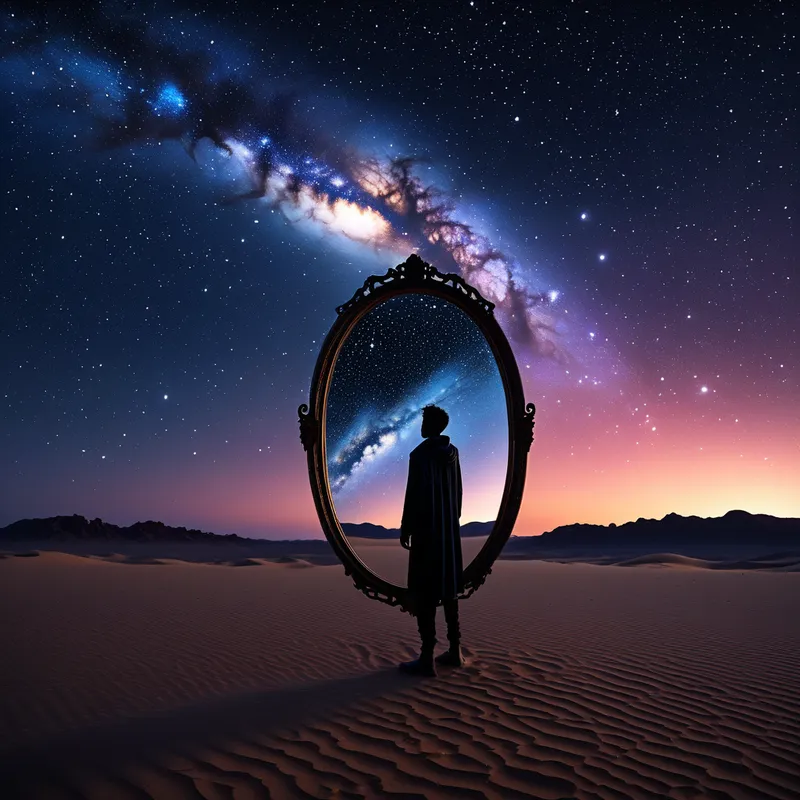
Within its innermost chamber, veiled from all eyes, hung the Mirror of the Soul. It was not a mirror of glass and silver, but a pool of liquid light, a surface of stilled breath. Its frame was the circle of eternity, and to gaze into it was not to see one’s own face, but to behold the Face behind all faces.
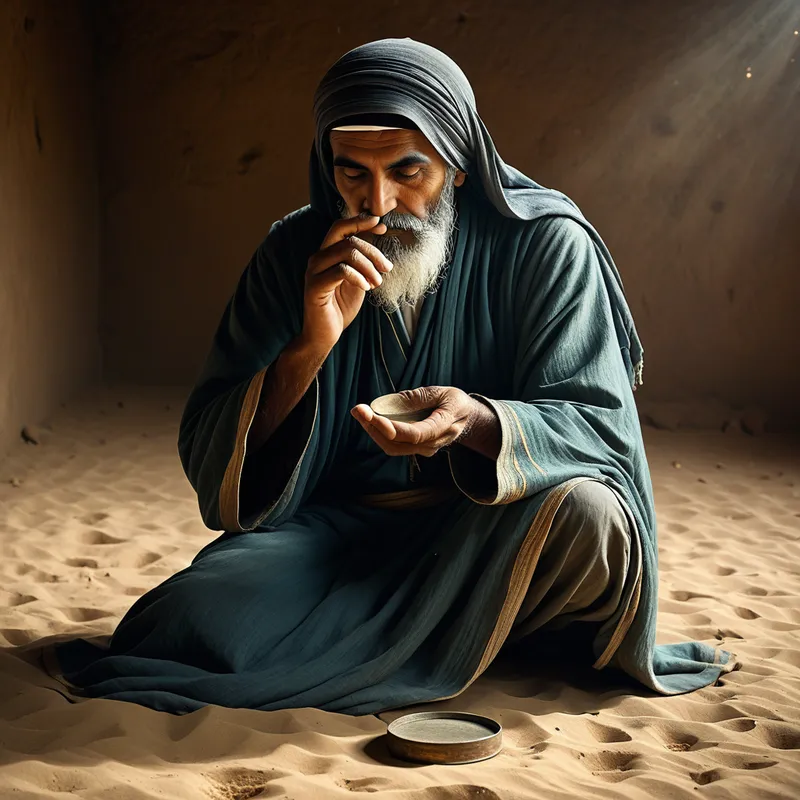
The guardian of this mirror was a figure of profound solitude, the Murshid of the Threshold. His eyes had witnessed eons of seekers arrive, their hearts pounding with a question they could not name. They came as princes and paupers, scholars and fools, each drawn by a homesickness for a home they had never seen. The Murshid would meet them at the palace gates, which were not doors but a sudden stillness in the wind.
“You seek the Mirror,” he would say, his voice like dry leaves. “But the Mirror seeks you. To approach it, you must leave everything you carry. Not your robes or your sandals, but the weight you call ‘I’.”
Most turned away, clutching their identities like precious stones. But one, always one in a generation, would feel the truth of the words like a hook in the chest. This seeker would begin the great unraveling. They would sit in the dust before the gates for days, then months, then years. They shed tears that washed away pride, breathed sighs that dissolved memory, until all that remained was a pure, burning ache—a single note of longing.
Only then would the Murshid rise and, without a word, lead the hollowed-out soul through the gates. The palace corridors were mirrors themselves, reflecting not form but intention, magnifying every hidden motive until the seeker walked in a hall of their own amplified flaws. This was the journey of the Tariqa, the path of annihilation.
Finally, they would stand before the veil of the innermost chamber. The air hummed. The Murshid would step aside. “The Mirror is bare. It shows only what is real. Are you?”
The seeker would draw back the veil.
And there, in the radiant pool of light, they would see… themselves. But not the self they knew. Not the face marked by time and trouble, but the original face, the face from before the world was made. It was their own essence, shining with a beauty so devastating it was indistinguishable from the beauty of the Beloved. In that moment of recognition, the seeker would understand. The mirror and the image, [the lover and the Beloved](/myths/the-lover-and-the-beloved “Myth from Sufi culture.”/), the soul and its source, were not two. They had never been two.
A cry would escape them—not of joy or sorrow, but of homecoming. And as the cry faded, the reflection would soften, merge with the light, and the mirror would become simply a window, and the window an eye, and the eye a tear of gratitude upon the cheek of existence. The seeker was gone. Only the seeing remained.
Cultural Origins & Context
This myth, in its myriad forms, is woven into the very fabric of Sufism. It is not a single, codified story from a specific text, but a living, breathing teaching tale that has been passed down for centuries through the oral tradition of the Tariqas. It was told in the Khanqah by masters to disciples, not as a historical account, but as a map of the interior journey.
Its primary function was pedagogical and transformative. The story served as a symbolic container for the central Sufi doctrine of Tawhid—the absolute oneness of God. It illustrated the process of Fana (annihilation) and Baqa (subsistence). The mirror was a potent metaphor for the heart (Qalb), which must be polished clean of the rust of worldly attachment (Nafs) to perfectly reflect the divine reality. Poets like Rumi and Hafez alluded to this mirror in their verses, speaking of the heart as a mirror that must be cleansed to see the beauty of the Friend.
Symbolic Architecture
The myth’s power lies in its layered [symbolism](/symbols/symbolism “Symbol: The use of symbols to represent ideas or qualities, often conveying deeper meanings beyond literal interpretation. In dreams, it’s the language of the unconscious.”/), each element a guidepost for the psyche.
The Mirror is the core [symbol](/symbols/symbol “Symbol: A symbol can represent an idea, concept, or belief, serving as a powerful tool for communication and understanding.”/). It represents the purified [consciousness](/symbols/consciousness “Symbol: Consciousness represents the state of awareness and perception, encompassing thoughts, feelings, and experiences.”/), the [human](/symbols/human “Symbol: The symbol of a human represents individuality, complexity of emotions, and social relationships.”/) [heart](/symbols/heart “Symbol: The heart symbolizes love, emotion, and the core of one’s existence, representing deep connections with others and self.”/) that has become a flawless [receptor](/symbols/receptor “Symbol: A biological or psychological structure that receives signals, representing openness, sensitivity, and the capacity to connect with external or internal stimuli.”/) of divine [truth](/symbols/truth “Symbol: Truth represents authenticity, honesty, and the quest for knowledge beyond mere appearances.”/). It does not create an [image](/symbols/image “Symbol: An image represents perception, memories, and the visual narratives we create in our minds.”/); it reveals what is already there, obscured by the [dust](/symbols/dust “Symbol: Dust often symbolizes neglect, forgotten memories, or the passage of time and life’s impermanence.”/) of [identity](/symbols/identity “Symbol: Identity represents the sense of self, encompassing personal beliefs, cultural background, and social roles.”/).
The mirror does not show you what you are, but what you have forgotten you have always been.
The [Journey](/symbols/journey “Symbol: A journey in dreams typically signifies adventure, growth, or a significant life transition.”/) to the [Palace](/symbols/palace “Symbol: A palace symbolizes grandeur, authority, and the pursuit of one’s ambitions or dreams, often embodying a desire for stability and wealth.”/) symbolizes the spiritual [path](/symbols/path “Symbol: The ‘path’ symbolizes a journey, choices, and the direction one’s life is taking, often representing individual growth and exploration.”/) itself—arduous, requiring the surrender of the ego. The Gates of [Stillness](/symbols/stillness “Symbol: A profound absence of motion or sound, often representing inner peace, creative potential, or existential pause in artistic contexts.”/) represent the [moment](/symbols/moment “Symbol: The symbol of a ‘moment’ embodies the significance of transient experiences that encapsulate emotional depth or pivotal transformations in life.”/) of sincere [intention](/symbols/intention “Symbol: Intention represents the clarity of purpose and direction in one’s life and can symbolize motivation and commitment within a dream context.”/) and the [death](/symbols/death “Symbol: Symbolizes transformation, endings, and new beginnings; often associated with fear of the unknown.”/) of worldly desire. The Murshid is the embodiment of the guiding Self, the inner [archetype](/symbols/archetype “Symbol: A universal, primordial pattern or prototype in the collective unconscious that shapes human experience, behavior, and creative expression.”/) of wisdom that appears when the ego is ready to relinquish control.
The climactic Gaze into the Mirror is the moment of Kashf, the unveiling. It is not an acquisition of something new, but a shocking recognition of one’s original, divine [nature](/symbols/nature “Symbol: Nature symbolizes growth, connectivity, and the primal forces of existence.”/). The [dissolution](/symbols/dissolution “Symbol: The process of breaking down, dispersing, or losing form, often representing transformation, release, or the end of a state of being.”/) of the [seeker](/symbols/seeker “Symbol: A person actively searching for meaning, truth, or a higher purpose, often representing the dreamer’s own quest for identity or fulfillment.”/) into the [reflection](/symbols/reflection “Symbol: Reflection signifies self-examination, awareness, and the search for truth within oneself.”/) models the ultimate psychological truth: the separate, egoic self is an illusion. The true Self is transpersonal, identical with the ground of all being.
The Dreamer’s Resonance
When this myth stirs in the modern dreamer, it often signals a profound crisis or calling of identity. To dream of searching for a mirror, or of a mirror that shows a strange, luminous, or terrifying reflection, is to encounter the psyche’s imperative for self-reconciliation.
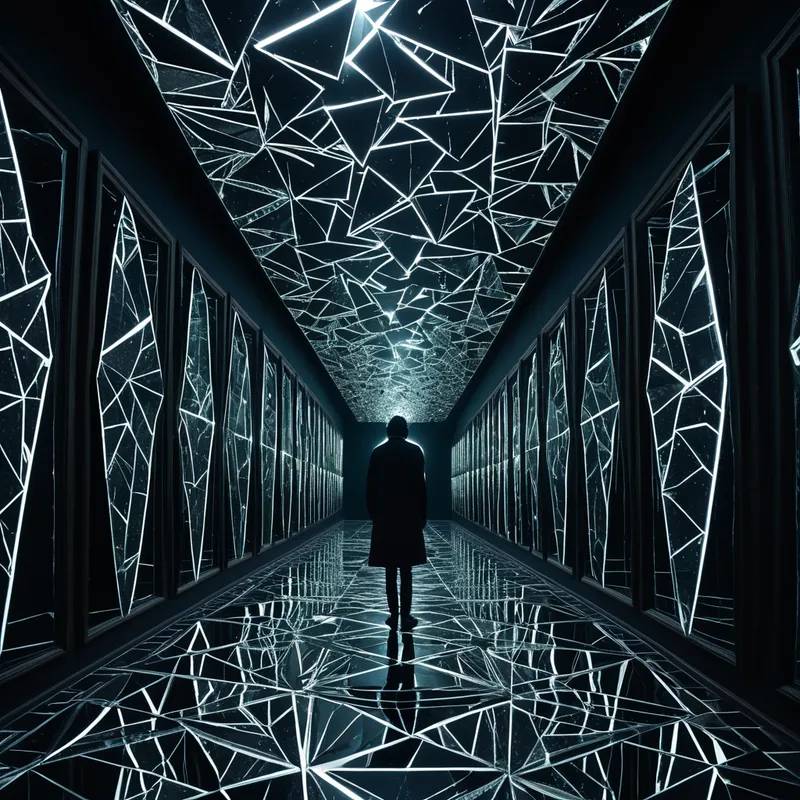
The somatic experience might be one of awe, vertigo, or profound relief. Dreaming of a fragmented mirror suggests a fractured self-image, where parts of the personality (the Shadow) are disowned and projected. Dreaming of polishing a dirty mirror reflects the active, often painful, work of introspection and shadow-work—scrubbing away the grime of past wounds, societal conditioning, and personal guilt. The moment of seeing the true reflection in the dream is a moment of psychic integration, where the conscious ego glimpses its larger, archetypal foundation. It is the soul calling the personality home.
Alchemical Translation
For the individual, this myth is a blueprint for individuation. The “base metal” of the leaden, confused ego must be transmuted into the “gold” of the authentic Self.
The first alchemical stage, Nigredo (the blackening), is the seeker’s despair before the gates—the confrontation with the shadow, the dissolution of old identities. The Albedo (whitening) is the purification, the long polishing of the mirror-heart through honest self-observation and the containment of opposites. The Rubedo (reddening) is the fiery gaze into the mirror, the ecstatic and terrifying recognition of one’s own divine spark, the Atman that is one with Brahman.
The alchemy occurs not in changing what you see in the mirror, but in realizing you are the mirror, the gaze, and the light being reflected.
The modern application is not about becoming a mystic in a cave, but about undertaking the inner journey with the same seriousness as the mythic seeker. It means having the courage to sit before the gates of your own defenses, to engage in the “unraveling” through therapy, meditation, or creative expression, and to eventually face the reflection in your own inner mirror—not the curated self of social media, but the raw, eternal essence beneath the persona. The triumph is the end of the seeking, the realization that what you longed for was the seeker itself, returned to its source.
Associated Symbols
Explore related symbols from the CaleaDream lexicon:
- Mirror — The central artifact representing the heart or consciousness, which must be cleansed to reflect the ultimate truth of one’s divine origin and unity with the Beloved.
- Soul — The eternal essence of the seeker, which undertakes the journey of annihilation to recognize its true nature in the mirror’s reflection.
- Journey — The arduous spiritual path (Tariqa) the soul must travel, shedding the ego’s attachments to reach the mirror’s sanctuary.
- Light — The divine reality and purity reflected in the mirror, symbolizing enlightenment, truth, and the unveiled essence of the Beloved and the self.
- Door — The gates of the palace, representing the threshold of surrender and stillness one must pass through, leaving the ego behind to begin the true inner journey.
- Shadow — The disowned parts of the self and the ego (Nafs) that must be confronted and integrated during the purification process before the mirror.
- Heart — The symbolic seat of the mirror in Sufi thought, the Qalb that is polished through love and remembrance to become a clear reflector of divine beauty.
- Love — The driving force of the entire myth, the longing (Ishq) that draws the soul to the Beloved and is ultimately revealed as the substance connecting the seeker and the sought.
- Vision — The moment of Kashf or unveiling, the transcendent sight granted when gazing into the mirror, which reveals not an external image but an internal, eternal reality.
- Rebirth — The outcome of the mirror gaze; the death of the limited ego-self and the birth into a sustained consciousness of unity and subsistence (Baqa) in the divine.
- Key — The purified intention and surrendered state of the seeker, which unlocks the gates of stillness and allows access to the inner chamber of revelation.