The Millennium of Revelation Myth Meaning & Symbolism
A thousand-year reign of peace after the final battle, where the primordial serpent is bound, and humanity is tested one last time before the final renewal.
The Tale of The Millennium of Revelation
Listen, and hear the tale of the thousand years, the great parenthesis in the scroll of time, the breath held between the roar of ending and the whisper of a new beginning.
The final trumpet has sounded. The rider on the white horse, whose eyes are like flames and whose name is Faithful and True, has judged and made war. The beast and the false prophet are cast into the lake of fire that burns with sulfur. And now, a silence falls—a silence deeper than any that has been since the foundations of the world were laid.
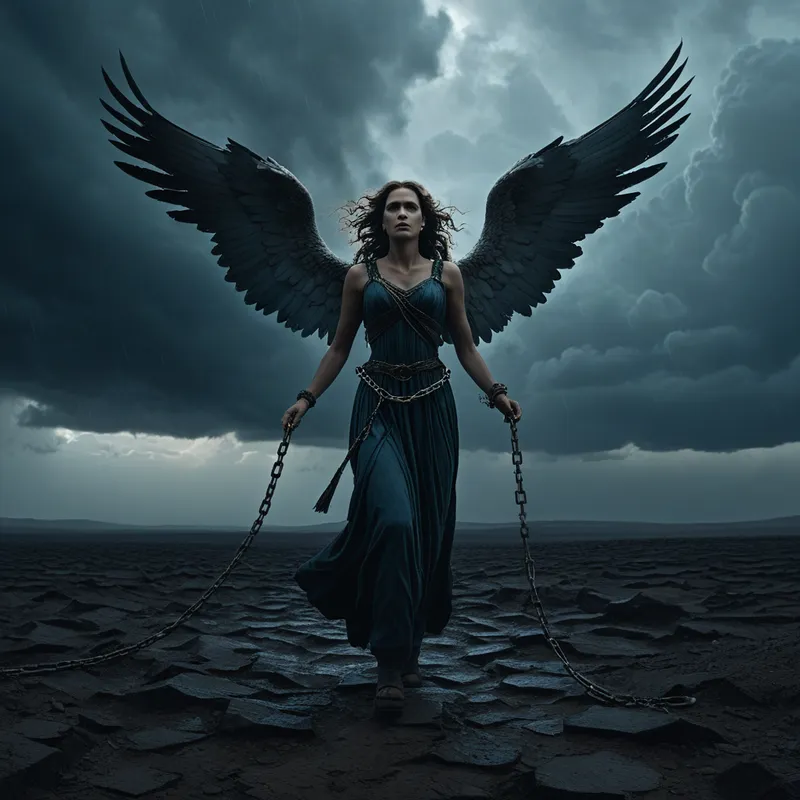
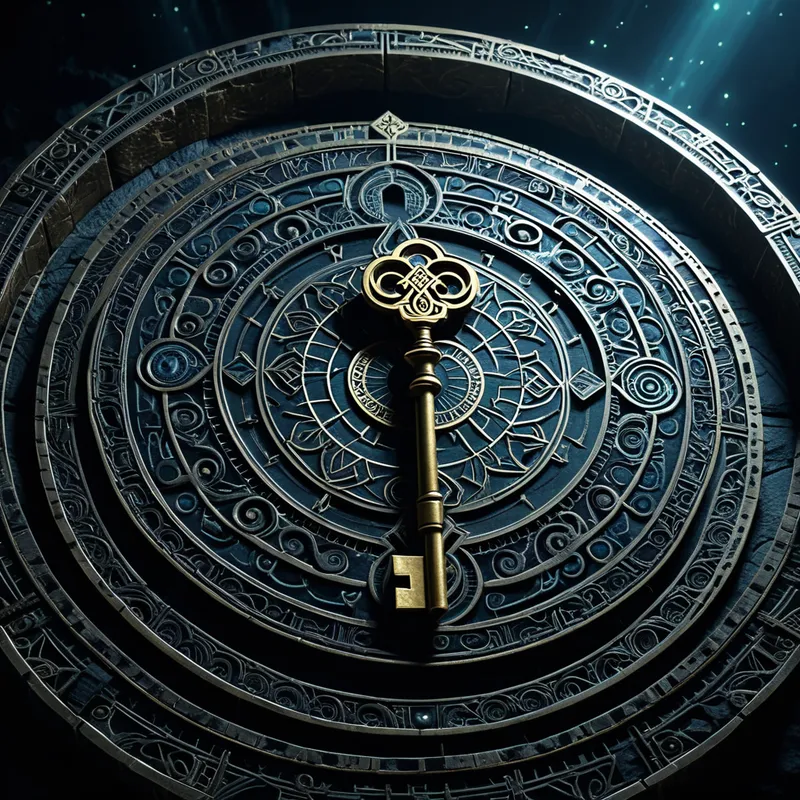
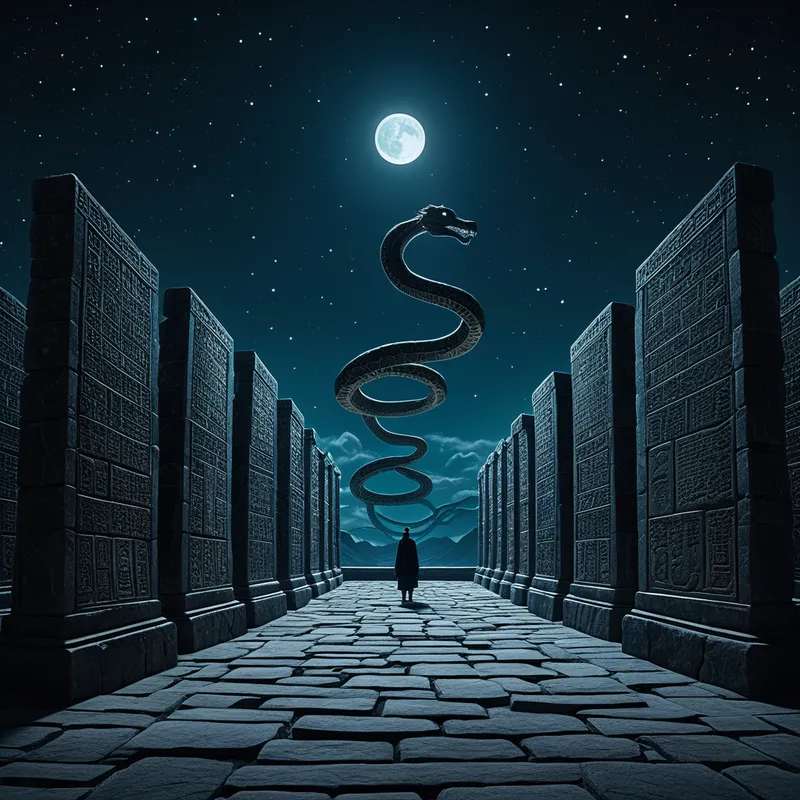
Then, an angel descends from the heavens, holding a great chain and a key. The key is heavy, forged for a single lock. The chain is unbreakable, woven from divine decree. He goes to the edge of the abyss, to the place where the primordial chaos yet stirs. There, in the form of the ancient serpent, the dragon of old, who is called Satan and the deceiver of the whole world, lies the root of all rebellion. The angel seizes him. The struggle is not of flesh, but of essence against essence, order against chaos. The chain is fastened. The key turns in the lock of the bottomless pit. The dragon is thrown in, and the pit is shut and sealed over him, that he should deceive the nations no more, until the thousand years were ended.
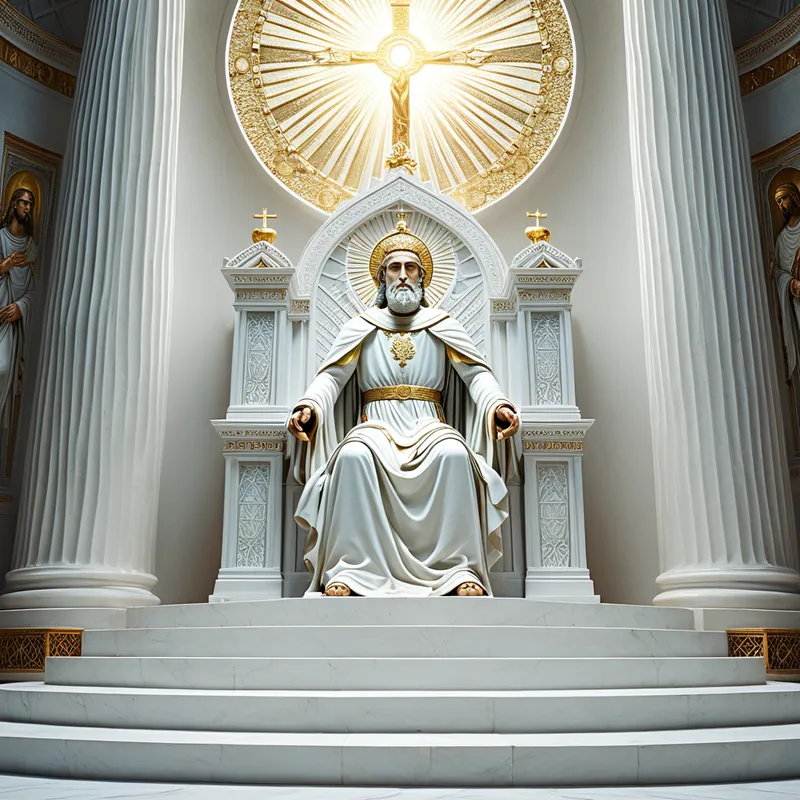
And a throne is established on the earth, white and terrible in its purity. Upon it sits the one who was slain, yet lives. The martyrs, those who had been beheaded for their witness, now stir. They awake, their bodies whole, their spirits ablaze with a light not of the sun. This is the first resurrection. They come to life and reign with Christ for a thousand years. The rest of the dead do not come to life until the thousand years are completed.
This is the Millennium. The earth, scarred but healing, breathes. The lion does not yet lie with the lamb, but the deceiver’s voice is absent from the wind. Nations exist, but they are not deceived. Peace, a profound and unearthly peace, settles like a mantle. It is a kingdom of priests, a reign of those who have already passed through the fire. For a thousand years, the long sigh of history is held in check.
But time, even sacred time, must flow. The thousand years reach their fulfillment. The seal on the pit is not eternal. For a little while, the chain must be tested. The serpent is released from his prison. And he goes out, once more, to deceive the nations at the four corners of the earth, Gog and Magog, to gather them for battle. Their number is like the sand of the sea. They march across the broad plain of the earth and surround the camp of the saints, the beloved city.
But the test is swift, the conclusion foregone. Fire descends from heaven and consumes them. And the deceiver, whose final gambit has revealed the unyielding hearts of those who, even after a thousand years of peace, choose the shadow, is thrown into the lake of fire and sulfur where the beast and the false prophet are, and they will be tormented day and night forever and ever.
Then, and only then, does the final scroll unroll. A great white throne appears, and earth and sky flee from its presence. The sea gives up its dead. Death and Hades give up the dead in them. All stand before the throne. Books are opened. Another book is opened, which is the book of life. The dead are judged according to what they had done. Then Death and Hades themselves are thrown into the lake of fire. This is the second death.
And then, a voice, louder than the passing of universes, cries out: “Behold, I am making all things new.”
Cultural Origins & Context
The myth of the Millennium finds its primary articulation in the final book of the Christian New Testament, the Book of Revelation, specifically chapter 20. This text, composed in a highly symbolic and apocalyptic genre, emerged from a context of intense persecution and political oppression under the Roman Empire. Its author, a figure named John, wrote to seven churches in Asia Minor, offering not a literal timeline but a theological vision of divine justice and ultimate hope.
The societal function of this myth was multifaceted. For persecuted communities, it was a theodicy—a vindication of God’s justice. It promised that the martyrs’ blood was not forgotten but would be honored in a tangible, reigning kingdom. It framed their present suffering as a prelude to a glorious inversion of power. The myth also served as a narrative container for the tension between the “already” of Christ’s victory and the “not yet” of its full manifestation on earth. It was passed down through homilies, art, and eschatological speculation, becoming a cornerstone of Christian apocalyptic thought, particularly within Millenarianism and Dispensationalism.
Symbolic Architecture
The Millennium is not merely a future event but a profound symbolic structure within the human psyche. It represents the necessary binding of chaos so that consciousness can be established and matured.
The thousand years is the sacred space where the ego, having confronted the shadow (the beast), must learn to reign without the constant, deceptive whispers of the undifferentiated unconscious.
The dragon symbolizes the raw, archaic, and potentially devouring forces of the unconscious—the untamed psychic energy that scatters and deceives the nascent conscious standpoint (the nations). Its binding is the heroic act of the Self (the angel) creating a temenos, a protected space within the psyche. The martyrs who reign represent those psychic contents—ideals, values, sufferings—that have been fully integrated through conscious sacrifice; they are now the governing principles of the personality.
The subsequent release of Satan signifies a critical psychological truth: integration is never a one-time event. The bound complex must be revisited, its energy encountered anew, to see if the conscious attitude has truly changed or if it was merely maintained by force of repression (the chain). The final battle of Gog and Magog is the ultimate assimilation of this residue, its final and complete dissolution into the transformative fire of the Self, making way for the novum, the entirely new.
The Dreamer's Resonance
When this mythic pattern stirs in the modern dreamer, it often signals a profound phase of consolidation after a period of intense inner conflict or crisis. The dreamer may experience dreams of profound peace after a storm, of finding a sealed room or vault in a familiar house, or of being part of a council or governing body in a quiet, ordered place.
Somatically, this can feel like a deep, sustained exhale. Psychologically, it is the process where insights won through great struggle are being “lived into.” The binding of the dragon in the dream reflects the temporary neutralization of a powerful, disruptive complex—perhaps a deep-seated fear, a compulsive behavior, or a toxic internal narrative. The dream-ego is now in a position of stewardship (“reigning”) over reclaimed psychic territory. However, dreams that hint at a sealed door beginning to crack, or a trusted figure showing a deceptive face, point to the inevitable next phase: the “little while” of release. This is not a failure, but the psyche’s demand for a deeper, more authentic integration that can withstand the return of the repressed in a new form.
Alchemical Translation
The alchemical journey mirrored in the Millennium is that of fixatio followed by solutio—the making solid, then the final dissolving. The individual’s journey begins in the nigredo, the chaotic battle with the personal shadow (the beast and false prophet). Victory here leads not to completion, but to the albedo, the whitening: the Millennium.
This thousand-year reign is the psychic equivalent of the albedo—a state of illuminated clarity and order where the refined substance of the personality is stabilized upon the throne of consciousness.
Here, the individual lives from a place of hard-won principle and values (the martyrs who reign). But this white stone must be tested by the return of the prima materia in its most ancient form. The release of Satan is the solutio, the return to the waters of the unconscious, not for drowning, but for a final purification. The attack of Gog and Magog is the last resistance of the base, unregenerate elements of the psyche, which are then subjected to the calcinatio—the heavenly fire that reduces them to their essential, unusable ash.
This final combustion clears the way for the rubedo, the reddening, the stage of the “new heaven and new earth.” Psychologically, this is the full realization of the Self, where the ego is not merely reigning in a peaceful kingdom, but has been fundamentally transcended and reborn within a wholly new psychic structure. The old cosmos of neurosis, compulsive patterns, and fragmented identity flees away. What remains is the individual, no longer in conflict with the depths, but as a unique manifestation of the timeless, creative ground of being—truly, all things made new.
Associated Symbols
Explore related symbols from the CaleaDream lexicon: