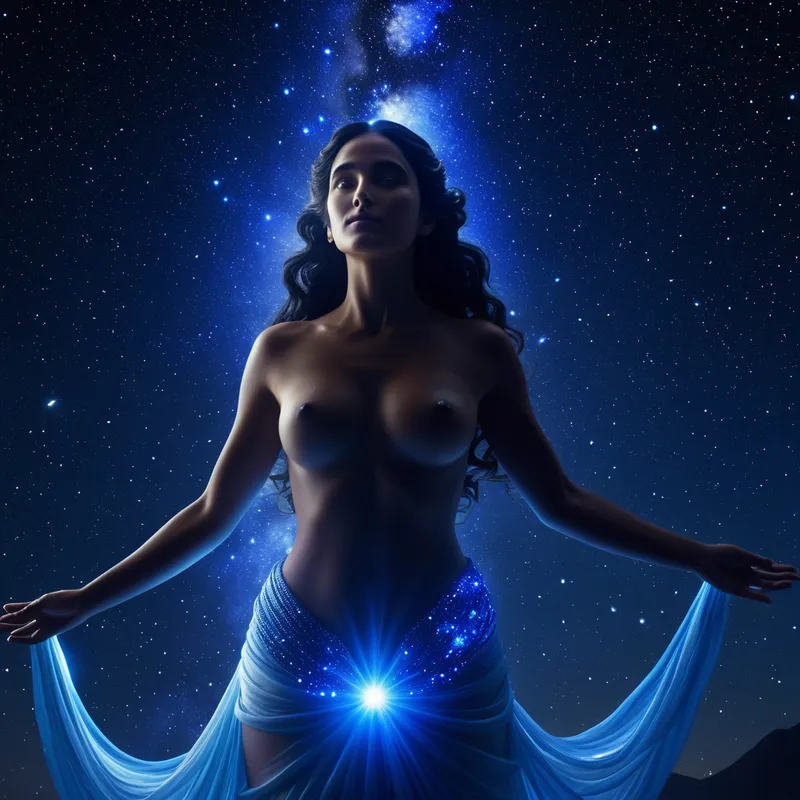
The Milky Way Myth Meaning & Symbolism
The infant Heracles, destined for godhood, is placed at Hera's breast. Her startled rejection spills divine milk across the heavens, forging the starry river.
The Tale of The Milky Way
Listen, and let the night sky tell its oldest story. It begins not in peace, but in a theft in the deep dark, a desperate gamble played upon the sleeping form of a queen.
The great goddess Hera lay in her chamber, the deep, untroubled sleep of the divine upon her. Into that sacred silence stole Hermes, his steps lighter than a sigh. In his arms he carried a burden of fate: the infant Heracles, newborn son of Zeus and the mortal woman Alcmene. The child squirmed, his tiny fists clenched, already pulsing with a strength not of this world. His destiny was godhood, but to achieve it, he needed the one thing his birth denied him: the nourishment of a goddess.
Hermes, his heart a drum against his ribs, placed the hungry child at Hera’s bare breast. The infant latched on, and the first draught of immortal milk, thick and blazing with the essence of eternity, began to flow. In that instant, the cosmos held its breath. The divine energy surged into the mortal babe, searing his mortal flesh with the fire of Olympus, beginning the alchemy that would forge him into a hero.
But Hera stirred. A divine dream fractured. Her eyelids flew open, and in the moonlit gloom, she saw not her own child, but the son of her husband’s betrayal. A shock, cold and violent, lanced through her—a spasm of betrayal, rage, and visceral rejection. She jerked away from the suckling infant.
And as she pulled back, the stream of her milk—that liquid light of divinity—did not stop. It arced into the air, a glorious, spontaneous fountain of radiance. It did not fall to the earth. It kept going, up and out, through the vault of her chamber, through the very fabric of the night. It sprayed across the black dome of the heavens, a river of luminous drops freezing into a billion points of cold, gentle fire. Where it splashed and pooled, it left a great, swirling smear of soft light, a path of spilled potential stretching from one horizon to the other. The infant Heracles, his lips still wet with that first, fateful taste, was cast aside, his cry echoing. But above him, his first and most lasting monument was already etched in stars: the Galaxias Kyklos, the Milky Circle. A road of shattered nourishment, a scar of maternal wrath, and a celestial pathway born from a single, reflexive act of denial.

Cultural Origins & Context
This evocative tale is preserved for us by the Roman scholar Gaius Julius Hyginus in his Poeticon Astronomicon, a compilation of star myths. While a Roman source, it transmits a deeply Greek understanding of the cosmos. The myth is not part of the grand epic cycles of Homer or Hesiod but belongs to the rich stratum of aetiological myths—stories that explain the origin of natural phenomena. For the ancient Greeks gazing up at the hazy band arching across the sky, the question was inevitable: "What is that? How did it get there?" Their answer was not astrophysics, but biography. They wove it into the biography of their greatest hero, Heracles, and their most complex goddess, Hera.
The myth served multiple societal functions. It explained the cosmos in human, relational terms. It also reinforced the fraught dynamics of the Olympian family, where Hera’s justified wrath is a constant, shaping force. Furthermore, it provided a divine origin for Heracles’ superhuman nature—his strength was literally divine, sourced from the queen of gods herself, albeit stolen. The story would have been told not in formal temples, but in informal settings, perhaps by mothers to children, or by travelers pointing at the night sky, connecting the mundane to the majestic through narrative.
Symbolic Architecture
At its core, this is a myth of failed nourishment and unintended creation. The Milky Way is not a planned monument; it is a cosmic accident, a byproduct of rupture. Hera’s breast symbolizes the ultimate source of life, legitimacy, and power. To drink from it is to be adopted into the divine order, to be granted a place. Heracles’ attempt is an act of profound existential hunger—the orphan’s craving for belonging and the power that comes with it.
The cosmos itself can be born from a wound, and the most glorious path in the night sky is paved with what was refused.
Hera’s rejection is multifaceted. It is the rage of the betrayed spouse, but on a symbolic level, it represents the necessary no of the unconscious. Not all nourishment is meant for us; not all power is ours to claim directly. The milk that sprays into the void represents potential energy released but not integrated. It becomes something else: a beautiful, distant, untouchable ideal—the galaxy we see but cannot walk upon. Heracles is left in a liminal state: touched by divinity but not fully embraced by it, setting him on his lifelong labored path to earn his place, a path far harder than simple suckling.
The Dreamer's Resonance
When this myth stirs in the modern psyche, it often manifests in dreams of failed nurturance and stolen potential. One might dream of reaching for a nourishing source—a person, a job, an ideal—only to have it violently withdrawn, leaving one with a sense of radiant loss. The dream image of a spilled, glowing substance that transforms into something beautiful yet inaccessible is key.
Somatically, this can feel like a sudden hollowing in the chest, a gasp, or a jerk awake—mirroring Hera’s shock. Psychologically, the dreamer is likely grappling with a core wound of rejection, particularly in relation to claiming one’s own power or legitimacy. It asks: "Where did I seek nourishment from a source that was not truly mine? What glorious, unintended path did that rejection create in my life?" The dream points to the pain of the orphan archetype—the one who must forge their own identity outside the expected lineage—and the first, shocking moment of that realization.

Alchemical Translation
The alchemical journey modeled here is the transmutation of rejected nourishment into a guiding path. The prima materia is the raw, divine potential (Hera’s milk). The initial attempt at integration (Heracles’ suckling) fails catastrophically, resulting in separatio—a violent splitting. The rejected substance does not disappear; it undergoes sublimatio, rising to the highest, most spiritual plane to become the Milky Way—a map written in stars.
For the individual, this myth illustrates that our deepest wounds and rejections are not merely losses. They are often the catalysts that spray our latent potential across the psyche, where it crystallizes into a new, overarching structure—a personal mythology, a life’s calling, a "starry path" we are meant to follow. Heracles cannot walk the Milky Way, but he can see it. It is his reminder of both his alienation and his divine spark.
Individuation requires the shattering of the naive hope for easy nourishment. Our wholeness is not given; it is built from the luminous debris of our refusals.
The modern task is not to lament the lost milk, but to learn to navigate by the light of the galaxy it formed. We must become astronomers of our own inner sky, tracing the contours of that spilled destiny, understanding that our path, though born of rupture, is uniquely and brilliantly our own. The orphan, through his labor, becomes the hero not by reclaiming the breast, but by following the celestial road his initial hunger painted across the heavens.
Associated Symbols
Explore related symbols from the CaleaDream lexicon: