
The Menehune
Tiny, elusive forest spirits of Hawaiian lore, the Menehune are master builders who work only at night, creating remarkable structures with magical precision.
The Tale of The Menehune
In the deep, velvet dark between sunset and dawn, when the land of Hawaiʻi breathes with the rhythm of the sleeping forest, they stir. They are the [Menehune](/myths/menehune “Myth from Polynesian culture.”/), a people no taller than a man’s knee, dwelling in the hidden valleys and shadowed ravines where the sun’s full gaze seldom falls. Their skin is the rich, dark brown of wet earth, their forms sturdy and strong despite their stature, and they move with a silence that is part of the night itself.
They are a people apart, living in their own secret society, governed by their own kings and laws. But their true nature is revealed not in their politics, but in their hands. They are the supreme artisans, the master builders whose craft borders on magic. A single night is all they need. If a chief or a community requires a fishpond to feed the people, an aqueduct to carry [water](/myths/water “Myth from Chinese culture.”/), or a temple platform to honor the gods, they need only make a proper offering—often a great quantity of their favorite food, the ʻawa root or shrimp—and state their wish clearly.
As the last light fades, the Menehune emerge. Not as individuals, but as a single, flowing organism of labor. They form chains that stretch for miles, passing stones hand to hand from quarry to site with impossible speed and precision. Their work is a silent symphony: the soft scrape of basalt against basalt, the faint rustle of countless small feet through fern and loam. No command is shouted; the work is known, the pattern held in a collective mind. By first light, the task is complete: a perfect, seamless fishpond wall curves against the shore; a watercourse of fitted stone emerges from the mountainside; a heiau platform stands where only earth lay before. And with the first pink rays of dawn, they are gone, vanished back into the forest’s green heart, leaving behind only the testament of their skill and the lingering mystery of their passage.
Yet this gift has one sacred, inviolable condition: the work must be finished in a single night. To witness them, to interrupt their flow, is to break the spell. Legends tell of projects left forever unfinished—a single stone missing from an aqueduct, a gap in a wall—because a curious human peered from the shadows, or a rooster crowed too early, scattering the invisible workforce back into the realm of myth. They exist in the liminal hours, and their power is bound to that darkness.
Cultural Origins & Context
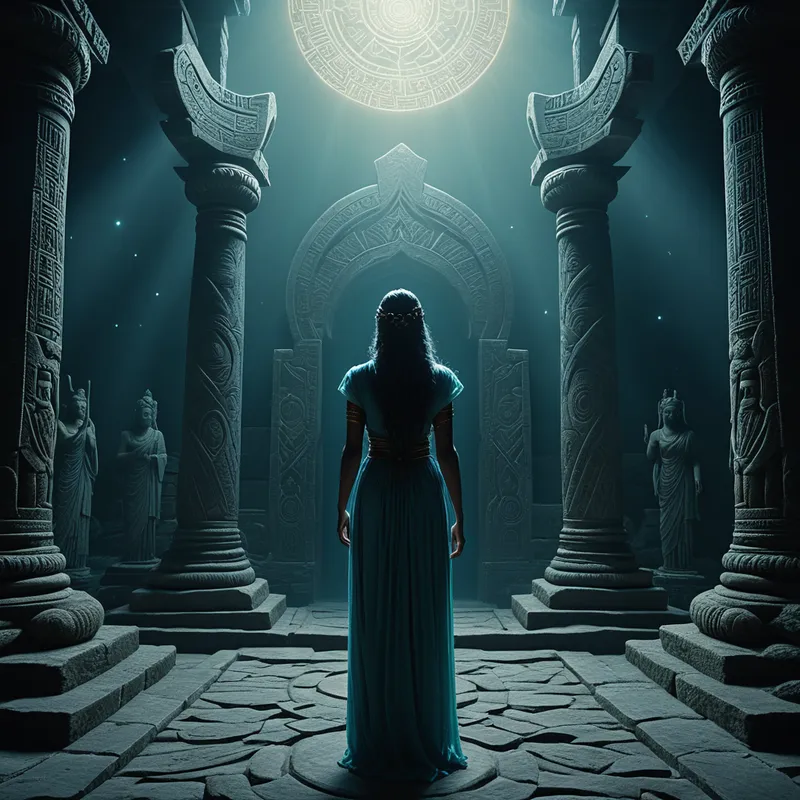
The Menehune occupy a complex and poignant space in Hawaiian historiography and memory. Ethnologists and folklorists, such as Katharine Luomala, have noted that they are not merely “[fairies](/myths/fairies “Myth from Celtic culture.”/)” in a European sense, but are often described in oral histories as an actual, earlier people. Some traditions hold them to be the first inhabitants of the islands, small in stature but immense in capability, who were eventually displaced by the later, larger Polynesian migrations. In this reading, the Menehune are a mythic memory of a conquered or assimilated indigenous population, their extraordinary building prowess a folk explanation for the ancient, sophisticated stonework found across the archipelago—structures whose origins were forgotten by later generations.
They are thus beings of the before time, a bridge between the primordial creation of the islands by the gods and the historical era of the aliʻi (chiefs). Their elusive, nocturnal nature reinforces their status as belonging to a different order of reality, one that is receding yet never fully gone. They are the “hidden folk” in both a literal and a cultural sense: hidden in the forests, and hidden in the deep past. Their persistent presence in folklore speaks to a Hawaiian worldview that perceives the landscape as animate and inhabited, where every rock formation and forest grove might hold the trace of an older consciousness.
Symbolic Architecture
The structures the Menehune build are not random. They are foundational to [human](/symbols/human “Symbol: The symbol of a human represents individuality, complexity of emotions, and social relationships.”/) [community](/symbols/community “Symbol: Community in dreams symbolizes connection, support, and the need for belonging.”/): sources of nourishment (fishponds), [life](/symbols/life “Symbol: The symbol of ‘Life’ represents a journey of growth, interconnectedness, and existential meaning, encompassing both the joys and challenges that define human experience.”/) (aqueducts), and spiritual [connection](/symbols/connection “Symbol: Connection symbolizes relationships, communication, and bonds among individuals.”/) (temples). Their work is always in service to the whole, never for personal glory or gain. This positions them as archetypal servants of the [collective unconscious](/symbols/collective-unconscious “Symbol: The Collective Unconscious refers to the part of the unconscious mind shared among beings of the same species, embodying universal experiences and archetypes.”/), the hidden, instinctual parts of the [psyche](/myths/psyche “Myth from Greek culture.”/) that, when properly petitioned and respected, can construct the inner infrastructure necessary for a thriving conscious [life](/symbols/life “Symbol: The symbol of ‘Life’ represents a journey of growth, interconnectedness, and existential meaning, encompassing both the joys and challenges that define human experience.”/).
Their craftsmanship is a perfect metaphor for the psyche’s nocturnal labor. While the ego sleeps, the myriad, unseen aspects of the self—the “little people” of our complexes, memories, and innate potentials—work with silent, coordinated precision to mend, build, and integrate. They repair the walls of our identity, channel the waters of emotion, and lay the foundations for new stages of spiritual understanding.
The absolute requirement of secrecy and the single-[night](/symbols/night “Symbol: Night often symbolizes the unconscious, mystery, and the unknown, representing the realm of dreams and intuition.”/) [deadline](/symbols/deadline “Symbol: A deadline symbolizes pressure, urgency, and the constraints of time in achieving goals or fulfilling obligations.”/) is profoundly psychological. It represents the fragile, non-[linear](/symbols/linear “Symbol: Represents order, predictability, and a direct, step-by-step progression. It symbolizes a clear path from cause to effect.”/) [nature](/symbols/nature “Symbol: Nature symbolizes growth, connectivity, and the primal forces of existence.”/) of [insight](/symbols/insight “Symbol: A sudden, deep understanding of a complex situation or truth, often arriving unexpectedly and illuminating hidden connections.”/) and [integration](/symbols/integration “Symbol: The process of unifying disparate parts of the self or experience into a cohesive whole, often representing psychological wholeness or resolution of internal conflict.”/). This inner work happens in its own time and on its own terms, in the dark. To shine the harsh, analytical light of conscious scrutiny upon it too soon—to “look at the workers”—is to disrupt the process, leaving the project incomplete. True transformation often occurs in unseen bursts of nocturnal genius, and can only be witnessed in its finished form by the light of a new day.
The Dreamer’s Resonance
To dream of the Menehune is to encounter the profound, efficient, and often overlooked builders within one’s own psyche. It suggests a period of foundational work happening beneath the surface of awareness. The dreamer may feel they are “in the dark” about some process in their life, yet this dream affirms that essential construction is underway. The feeling is not of [chaos](/myths/chaos “Myth from Greek culture.”/), but of ordered, purposeful activity just out of sight.
If the Menehune are seen at work, it honors the patient, piece-by-piece assembly of a new capability or perspective. If they are fleeing, scattering at the dreamer’s approach, it may warn against excessive self-consciousness or impatience with one’s own growth. It cautions that some processes require trust and non-interference. To see a completed Menehune structure—a perfect wall, a flowing fountain—upon waking is to receive a gift from the unconscious: a symbol of newly integrated wholeness, a functional piece of inner architecture now ready for use in waking life.
Alchemical Translation
In the alchemy of the soul, the Menehune represent the opus in its [nigredo](/myths/nigredo “Myth from Alchemical culture.”/) phase—the work in the blackness, the dissolution and hidden coagulation. They are the labor that happens in the sealed vessel of the night, away from the observing eye. Their raw material is the unshaped stone of primal experience and inherited pattern; their product is the lapis, the sacred stone of the completed structure, which is both a functional part of [the world](/myths/the-world “Myth from Tarot culture.”/) and a philosophical achievement.
They embody the principle that the most sacred acts of creation are often anonymous, collective, and executed in humility. Their magic is not flashy sorcery, but the sublime magic of perfect right action—each stone finding its neighbor, each hand knowing its task. This is the alchemy of service, where the many small, correct actions of the unconscious self coalesce into a monument of conscious being.
They teach that wholeness (heiau) is built, that nourishment (loko iʻa, fishpond) is engineered through wise boundaries, and that the waters of life (ʻauwai, aqueduct) can be directed but never owned. Their final, and perhaps greatest, lesson is one of graceful disappearance. They do not cling to their creations. Having manifested form from the formless, they return to it, their identity absorbed back into the generative mystery of the forest, leaving the gift behind for others to use and wonder at.
Associated Symbols
Explore related symbols from the CaleaDream lexicon:
- Forest — The deep, untamed, and hidden realm of the unconscious mind, a place of mystery, growth, and the dwelling of instinctual beings.
- Night — The time of hidden work, introspection, and the rule of the unseen; the necessary darkness in which seeds germinate and psychic repairs are made.
- Stone — The primal, enduring substance of [the earth](/myths/the-earth “Myth from Hindu culture.”/), shaped by patience and skill into forms that channel meaning and function; the raw material of [the self](/myths/the-self “Myth from Jungian culture.”/).
- Craft — The sacred application of skill, patience, and knowledge to transform raw materials into objects of utility and beauty, an act of devotion in itself.
- Bridge — A structure that connects separated realms, allowing for the flow of vital resources (water, insight) from the unconscious to the conscious world.
- Cyclic Nature — The eternal rhythm of withdrawal and return, of work done in darkness and revealed in light, mirroring the natural cycles of day and season.
- Ephemeral Nature — The quality of being present only for a fleeting, liminal moment, emphasizing the preciousness and transient opportunity of creative inspiration.
- Community — The power of many small, coordinated parts working in silent unison toward a single, monumental goal beyond any individual’s capacity.
- Shadow — The hidden, often overlooked or dismissed aspects of the self or history that nonetheless possess potent creative and formative power.
- Dream — The native realm of the Menehune, where the laws of time and space are suspended and impossible constructions become manifest.
- Temple — The sacred space constructed through devotion and skill, a meeting point between the human and the divine, built from the offerings of the hidden self.