The Master Swordsmith Myth Meaning & Symbolism
A swordsmith's quest to forge a perfect blade becomes a sacred ordeal, demanding the ultimate sacrifice to birth a weapon of divine spirit.
The Tale of The Master Swordsmith
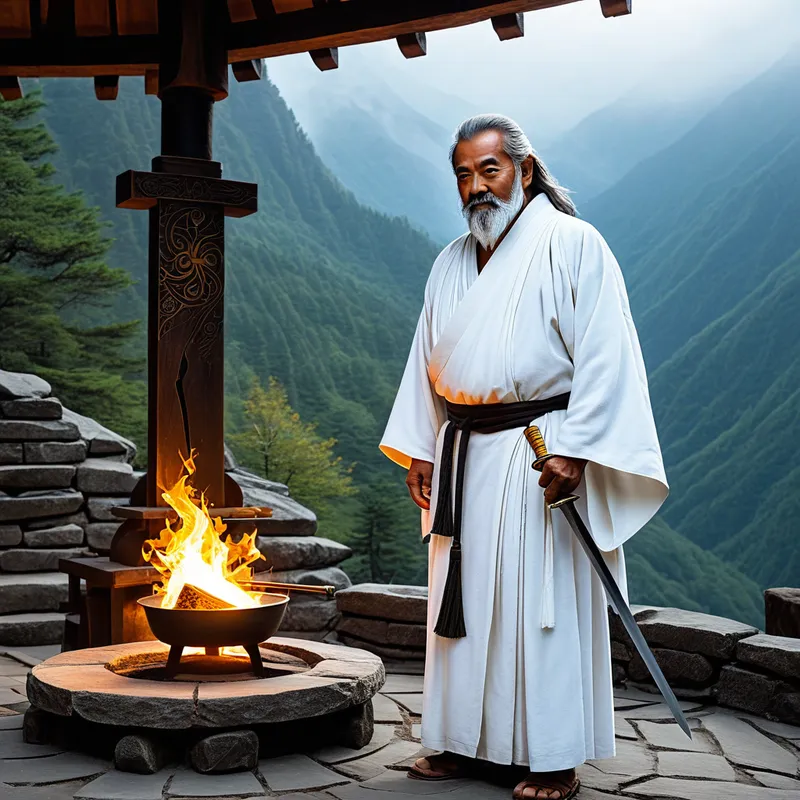
Listen, and hear the tale not of a man, but of a vessel. In a time when [the world](/myths/the-world “Myth from Tarot culture.”/) was woven tight with spirits, there lived a smith whose name was whispered with [the wind](/myths/the-wind “Myth from Various culture.”/) through the pines: Amakuni. His forge was not of this earth alone; it was built upon a sacred mountainside, where the breath of the Yama-no-Kami cooled the steel and the fire was fed by more than charcoal.
The emperor’s warriors returned from battle, and Amakuni’s heart cracked like flawed tamahagane. Their swords were broken, snapped like twigs against the enemy’s armor. He saw not failure of arm, but failure of soul. The spirit had left the blade. For seven days and seven nights, he and his son prayed and purified themselves, donning the white robes of the priest. They entered the forge as men and did not leave it as such.
The fire was a living dragon. The iron sand, drawn from the mountain’s womb, wept in the heat. With each strike of the hammer—clang… clang…—a prayer was folded into the metal. Ten thousand folds, a [labyrinth](/myths/labyrinth “Myth from Various culture.”/) of strength. The rhythm was a heartbeat, syncopated with the chanting of the Kannushi from a distant shrine. But as the blade took form, a cold dread settled in the smith’s belly. The steel was perfect, yes, but silent. It was a body without a Kami.
On the final night, under a moon like a sliver of cold steel, the truth descended upon him. The forge demanded not just skill, but life. The final quenching—the moment the red-hot blade is plunged into [water](/myths/water “Myth from Chinese culture.”/)—would require a sacrifice to invite a spirit to dwell within. His son, his loyal apprentice, stepped forward, his eyes holding the resolve of the ancients. But Amakuni’s wife, who had watched the firelight dance in her husband’s hollow eyes for weeks, moved with a grace that stilled them both. She understood the deeper law: the spirit of devotion, of love willingly given, would make the blade not just deadly, but sacred. A protector’s soul.
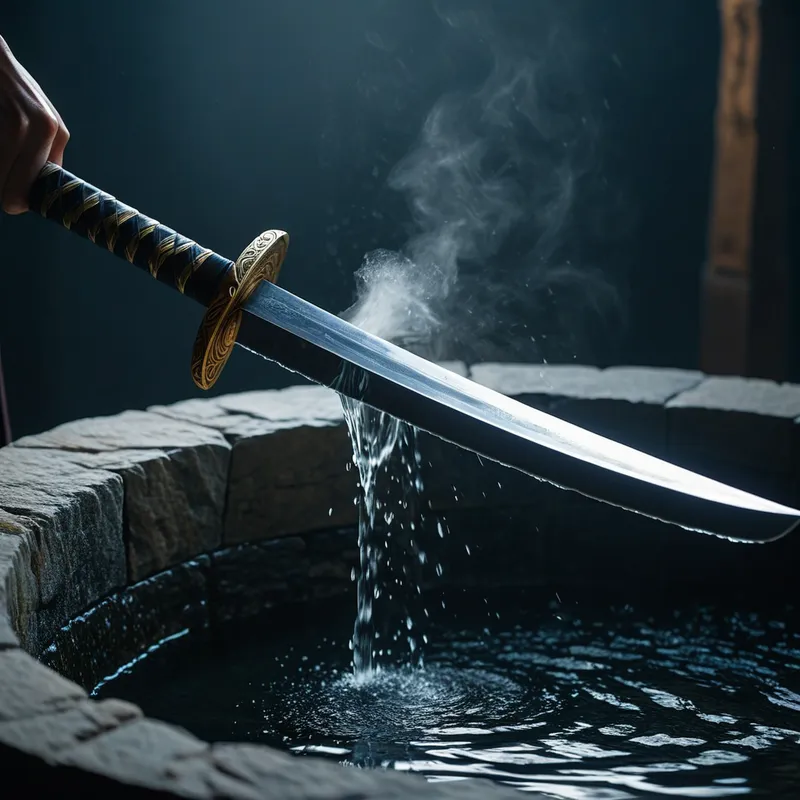
Without a word, she approached the trough of quenching water. She drew a small knife, and with a final look of boundless love at her husband and his life’s work, she let her life essence fall into the water. The liquid turned dark, not with blood, but with potential. In that moment of ultimate horror and awe, Amakuni seized the glowing blade, its light painting his face in agony and ecstasy, and plunged it into the sacred trough.
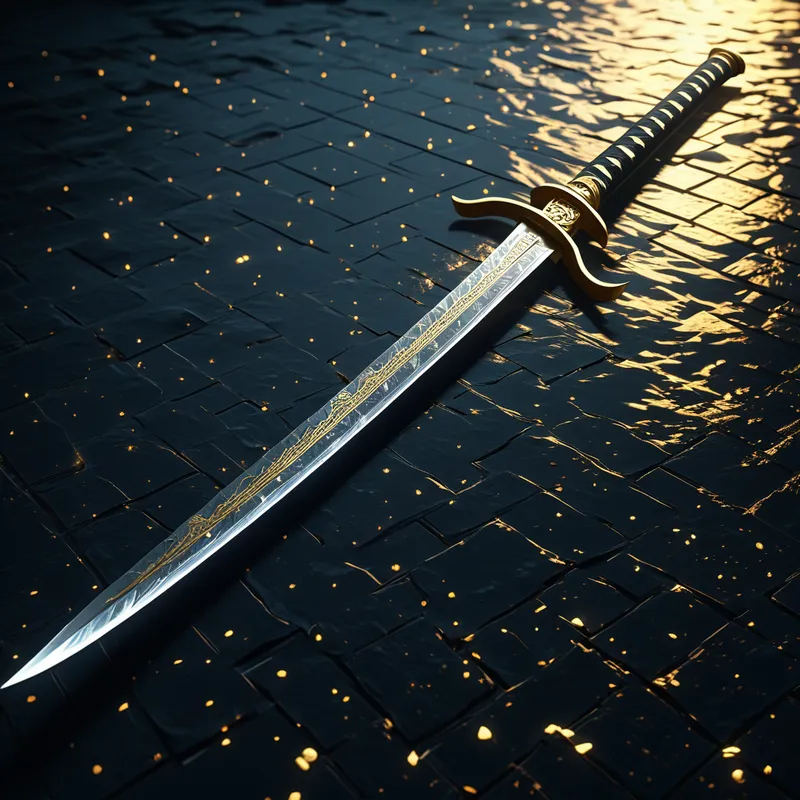
A scream tore from the steel itself—a sound of birth and death. Steam erupted, filling the forge with a ghostly shroud. When it cleared, the blade lay in the water, cool and serene. Along its edge, a pattern had appeared: the Hamon, a misty, undulating line like a frozen moment of that final, transformative scream. It was the blade’s soul, its name: Kogarasu. It was unbreakable. It sang when drawn. It held within it the silent, fierce love that had called its spirit forth.
Cultural Origins & Context
This archetypal narrative, of which the Amakuni legend is a prime example, is rooted in the Shinto worldview and the arrival of advanced metallurgy from the Asian mainland. Swords were not mere tools of war; they were Shintai, vessels for divine spirits, and among the Imperial Regalia. The myth served a crucial societal function: it sacralized the craft, elevating the smith from artisan to a kind of priestly mediator between the human and spirit worlds.
These stories were passed down within smithing lineages (Ryuha) as secret oral traditions and in chronicles like the Heike Monogatari, which immortalized famous blades and their often-tragic histories. The myth enforced ritual purity, demanding fasting, abstinence, and elaborate ceremonies before forging. It explained the inexplicable perfection of a masterwork—such a blade must contain a spirit, for how could mere human effort achieve such a [thing](/myths/thing “Myth from Norse culture.”/)? It was a narrative that bound technology to the sacred, ensuring that the power of the sword was always tempered by spiritual responsibility.
Symbolic Architecture
At its core, this myth is not about forging a [weapon](/symbols/weapon “Symbol: A weapon in dreams often symbolizes power, aggression, and the need for protection or defense.”/), but about forging a Self. The swordsmith represents the conscious ego undertaking the monumental [task](/symbols/task “Symbol: A task represents responsibilities, duties, or challenges one faces.”/) of psychic [integration](/symbols/integration “Symbol: The process of unifying disparate parts of the self or experience into a cohesive whole, often representing psychological wholeness or resolution of internal conflict.”/). The forge is the [vas Hermeticum](/myths/vas-hermeticum “Myth from Alchemical culture.”/), the sealed container of the [individuation process](/symbols/individuation-process “Symbol: The psychological journey toward self-realization and wholeness, integrating conscious and unconscious aspects of personality.”/). The raw iron [sand](/symbols/sand “Symbol: Sand in dreams often symbolizes time, transience, or the foundation of life and the fluidity of existence.”/) is the crude, unrefined [material](/symbols/material “Symbol: Material signifies the tangible aspects of life, often representing physical resources, desires, and the physical world’s influence on our existence.”/) of our innate [nature](/symbols/nature “Symbol: Nature symbolizes growth, connectivity, and the primal forces of existence.”/), full of impurities and potential.
The true masterpiece is not the object created, but the consciousness that undergoes the fire to create it.
The folding of the [steel](/symbols/steel “Symbol: Steel symbolizes strength, resilience, and endurance, suggesting a solid foundation or a formidable presence in one’s life.”/) is the endless, repetitive work of self-[reflection](/symbols/reflection “Symbol: Reflection signifies self-examination, awareness, and the search for truth within oneself.”/), layering experience upon experience, [strength](/symbols/strength “Symbol: ‘Strength’ symbolizes resilience, courage, and the ability to overcome challenges.”/) upon flexibility. The [moment](/symbols/moment “Symbol: The symbol of a ‘moment’ embodies the significance of transient experiences that encapsulate emotional depth or pivotal transformations in life.”/) of [crisis](/symbols/crisis “Symbol: A crisis symbolizes turmoil, urgent challenges, and the need for immediate resolution or change.”/)—the silent, soulless [blade](/symbols/blade “Symbol: A sharp-edged tool or weapon symbolizing cutting action, separation, precision, or violence. It represents both creative power and destructive force.”/)—is the pivotal realization in any creative or transformative act: technical perfection is dead without the infusion of [soul](/symbols/soul “Symbol: The soul represents the essence of a person, encompassing their spirit, identity, and connection to the universe.”/), of meaning. This is the confrontation with the [Shadow](/symbols/shadow “Symbol: The ‘shadow’ embodies the unconscious, repressed aspects of the self and often represents fears or hidden emotions.”/). The sacrifice, the ultimate price, represents the necessity of surrendering something precious, a cherished part of the old self—a naive [innocence](/symbols/innocence “Symbol: A state of purity, naivety, and freedom from guilt or corruption, often associated with childhood and moral simplicity.”/), a comfortable [identity](/symbols/identity “Symbol: Identity represents the sense of self, encompassing personal beliefs, cultural background, and social roles.”/), a deep attachment—to the transformative process. The quenching is the shocking integration of this sacrifice into the core of one’s being, a [baptism](/symbols/baptism “Symbol: A ritual of spiritual cleansing, initiation, and rebirth, symbolizing profound transformation and commitment to a new path.”/) that fixes the new [structure](/symbols/structure “Symbol: Structure in dreams often symbolizes stability, organization, and the framework of one’s life, reflecting how one perceives their environment and personal life.”/).
The Dreamer’s Resonance
When this myth stirs in the modern unconscious, it often manifests in dreams of intense, focused creation or ordeal. You may dream of laboring in a workshop on an object of immense importance, feeling a rising panic as a deadline nears and the work remains “lifeless.” You may dream of a pivotal test—a trial by fire or water—where you must choose to let go of something or someone to achieve a breakthrough.
Somatically, this can feel like a pressure in the chest (the forge), tension in the arms and shoulders (the hammering), or a sudden, chilling clarity (the quenching). Psychologically, you are in the “sacred ordeal” phase of a life transition. The dream signals that you are engaged in forging a new aspect of your identity—a career, a relationship with your own artistry, a more resilient [psyche](/myths/psyche “Myth from Greek culture.”/). The conflict is between the part that wants to control the process (the technician) and the part that knows a deeper, more costly offering is required (the priest). The dream asks: What must you truly sacrifice—what attachment, what old story—to give soul to your endeavor?
Alchemical Translation
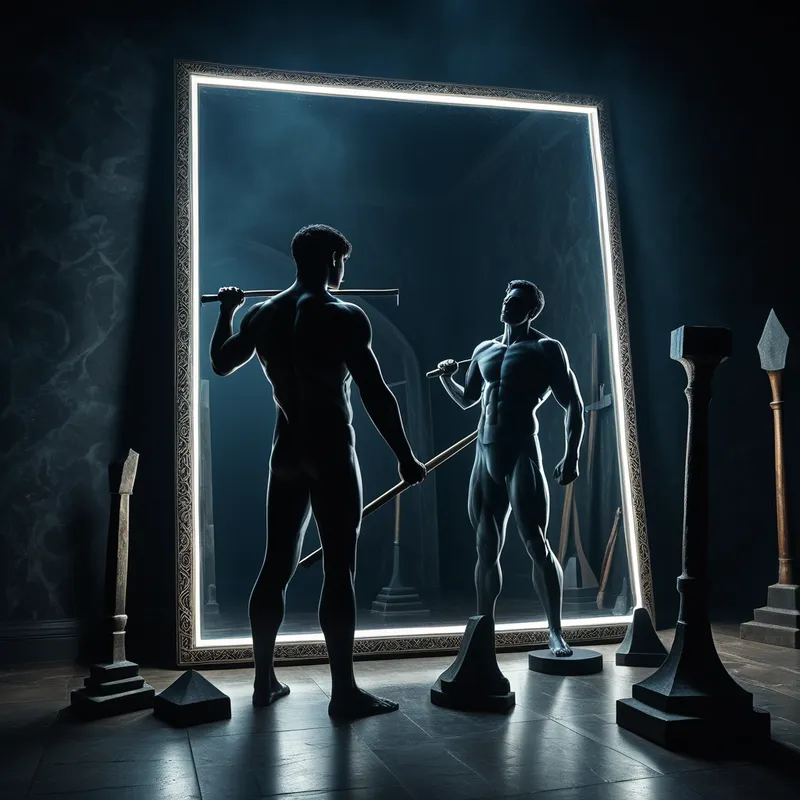
The alchemical journey of the Master Swordsmith is a perfect map for Individuation. It begins with [Nigredo](/myths/nigredo “Myth from Alchemical culture.”/): the blackening, the smith’s despair at the broken swords, the recognition of the flawed, base material of one’s life. The purification rituals and the folding of the steel are the Albedo: the whitening, the endless, mindful work of refinement and conscious effort.
The crisis at the moonlit moment is the Citrinitas: the yellowing, the dawning, solar realization that conscious effort alone leads to a spiritual dead end. Here, the will of [the ego](/myths/the-ego “Myth from Jungian culture.”/) must break.
The spirit does not answer the call of the will, but the surrender of it.
Then comes the ultimate operation: the [Rubedo](/myths/rubedo “Myth from Alchemical culture.”/), the reddening. This is not the red of the hot steel, but the red of the vital, living spirit entering. The sacrifice is the ego’s final surrender, the offering of its most valued possession (often symbolized by the Anima, the inner feminine principle of relatedness and soul) to the process. The quenching is the sudden, often traumatic integration. The born blade, with its living Hamon, is the [Lapis Philosophorum](/myths/lapis-philosophorum “Myth from Alchemical culture.”/)—the Philosopher’s Stone of the psyche. It is the newly forged, resilient, and authentic Self, a consciousness that has integrated its shadow and its soul, now capable of cutting through illusion with precision and bearing the beautiful, unique pattern (Hamon) of its own traumatic, glorious creation. You are no longer the smith hammering the metal. You have become the sacred blade, tempered by life itself.
Associated Symbols
Explore related symbols from the CaleaDream lexicon: