
The Mapinguari Ancient Sloth Myth Meaning & Symbolism
A myth of a colossal, guardian sloth spirit, born from a shaman's curse, that protects the deep forest and embodies the untamed, ancient memory of the land.
The Tale of The Mapinguari Ancient Sloth
Listen. The air is thick, a warm broth of decay and life. Beneath the emerald cathedral of the Amazon, where light falls in shattered coins, there walks a memory. It is not a memory of men, but of the land itself—a slow, tectonic remembering.
Long ago, when the world was younger and the trees whispered secrets in a language now forgotten, there lived a great shaman. His power was as deep as the river’s source, his wisdom older than the stones. But his heart grew heavy with the greed of men who came from beyond the great water, men with fire-sticks and hunger for things that cannot be owned. In a final, desperate act to protect the sacred groves, the shaman called upon the oldest spirits of the forest. He did not ask for a warrior, but for a guardian. He offered his own form, his own breath, in a curse of eternal vigilance.
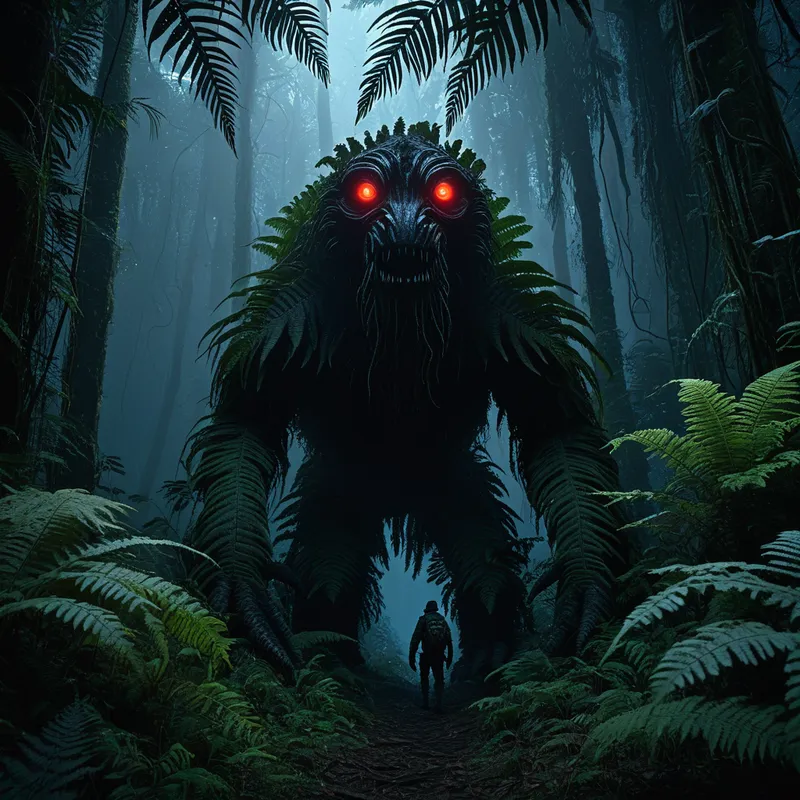
The earth trembled. The shaman’s bones groaned and stretched, his skin hardening like bark, his hair becoming a forest of moss and vine. His form swelled, becoming immense, a mountain that breathed. One eye saw the world of men—their fleeting lives and sharp fears. The other, he plucked out, so that he might see only the world of the forest—its timeless, patient soul. His mouth twisted into a terrible vertical gash, and from it poured not words, but the stench of a bog, a warning of decay. His hands became great claws, not for killing, but for embracing the very trunk of the world, for holding fast. He became Mapinguari, the One Who Guards the Meat of the Earth.
Now he walks. You do not find him; he finds you. He moves with a slowness that is not weakness, but the pace of geology. You hear him first—a deep, rhythmic huff… huff… like a bellows stoking the furnace of the world. Then the smell finds you: the sweet rot of fallen Victoria blossoms, the iron tang of wet earth, the breath of a cave unopened for millennia. If you are foolish, if you hunt where you should not, if you take more than the forest gives, his shadow will fall upon you. It is not a chase. It is an arrival. The ferns part, and he is there—a wall of living antiquity. His single eye holds you, and in it, you see not a monster, but the profound sadness of a protector who must forever frighten away the very children he is sworn to shelter. He may roar, a sound that shakes the fruit from the trees. He may simply stand, a monument to what was, until you flee, your soul scoured clean by pure, primordial awe. Then he turns, and with infinite patience, melts back into the green, a dream of the earth returning to its sleep.
Cultural Origins & Context
The myth of the Mapinguari originates from the oral traditions of numerous Indigenous peoples across the Amazon Basin, including the Tupi-Guarani and other cultural-linguistic groups. It is not a single, fixed story but a living narrative ecosystem, with variations in each community that holds it. Traditionally, it is recounted by elders and shamans, often around the fire at night, serving as a powerful pedagogical tool. Its primary societal function is profound and practical: it is a myth of ecological ethics and territorial protection. By instilling a respectful fear of the deep forest, it establishes behavioral boundaries, deterring over-hunting, the desecration of sacred sites, and unsustainable exploitation. The Mapinguari is the embodiment of the forest’s retributive justice, a constant reminder that the human world is a guest in a much older, sentient domain.
Symbolic Architecture
Psychologically, the Mapinguari represents the [Shadow](/symbols/shadow “Symbol: The ‘shadow’ embodies the unconscious, repressed aspects of the self and often represents fears or hidden emotions.”/) of the land itself, and by extension, the [shadow](/symbols/shadow “Symbol: The ‘shadow’ embodies the unconscious, repressed aspects of the self and often represents fears or hidden emotions.”/) of our own ancient, instinctual [nature](/symbols/nature “Symbol: Nature symbolizes growth, connectivity, and the primal forces of existence.”/). It is not evil, but untamed and unassimilated. Its colossal size speaks to the overwhelming [magnitude](/symbols/magnitude “Symbol: A measure of scale, intensity, or importance, often reflecting one’s perception of significance, impact, or overwhelming force in life.”/) of what we have forgotten—the deep time of biological and psychic evolution. Its single eye symbolizes a bifurcated [consciousness](/symbols/consciousness “Symbol: Consciousness represents the state of awareness and perception, encompassing thoughts, feelings, and experiences.”/): one [aspect](/symbols/aspect “Symbol: A distinct feature, quality, or perspective of something, often representing a partial view of a larger whole.”/) fixed on the tangible present, the other sacrificed to perceive a wholly different, non-[human](/symbols/human “Symbol: The symbol of a human represents individuality, complexity of emotions, and social relationships.”/) [reality](/symbols/reality “Symbol: Reality signifies the state of existence and perception, often reflecting one’s understanding of truth and life experiences.”/).
The guardian is often that which we must first perceive as a monster. Its roar is the sound of a forgotten part of the soul demanding recognition.
Its defining characteristic—its devastating odor—is key. Smell is the most ancient and visceral of senses, directly linked to [memory](/symbols/memory “Symbol: Memory symbolizes the past, lessons learned, and the narratives we construct about our identities.”/) and the limbic [brain](/symbols/brain “Symbol: Symbolizes intellect, thoughts, and cognitive processing in dreams.”/). The Mapinguari does not argue with [logic](/symbols/logic “Symbol: The principle of reasoning and rational thought, often representing order, structure, and intellectual clarity in dreams.”/); it communicates through the [body](/symbols/body “Symbol: The body in dreams often symbolizes the dreamer’s self-identity, personal health, and the relationship they have with their physical existence.”/), triggering a primal somatic [response](/symbols/response “Symbol: Response in dreams symbolizes how one reacts to situations, often reflecting the subconscious mind’s processing of events.”/). It is the stink of [truth](/symbols/truth “Symbol: Truth represents authenticity, honesty, and the quest for knowledge beyond mere appearances.”/), the inescapable aroma of processes (decay, fermentation, [gestation](/symbols/gestation “Symbol: A period of development and preparation before a significant birth or emergence, symbolizing potential, transformation, and the journey toward manifestation.”/)) that modern consciousness often tries to sanitize and deny. Its sloth-like nature symbolizes a [tempo](/symbols/tempo “Symbol: The pace, rhythm, or timing of events in life, often reflecting internal or external pressures.”/) of being that stands in absolute [opposition](/symbols/opposition “Symbol: A pattern of conflict, duality, or resistance, often representing internal or external struggles between opposing forces, ideas, or desires.”/) to the [frenzy](/symbols/frenzy “Symbol: A state of uncontrolled excitement, agitation, or wild activity, often indicating overwhelming emotions or loss of rational control.”/) of consumption and progress—the wisdom of profound slowness, of moving at the speed of growth and healing.
The Dreamer’s Resonance
When the pattern of the Mapinguari emerges in modern dreams, it often signals a confrontation with what depth psychology calls the collective unconscious, specifically its chthonic, earthly layers. The dreamer may be stalked by a large, slow, inescapable presence or find themselves in a suffocating, overly fertile landscape that feels both alive and decaying.
Somatically, this can relate to feelings of being weighed down, of carrying an ancient burden, or of a deep, rhythmic pulsation within the body that feels alien yet intrinsic. Psychologically, it marks a process of encountering the “undigested past”—this could be personal ancestral trauma, cultural history, or even the biological memory of the body. The Mapinguari-dream is an invitation, however frightening, to stop running, to turn and face the slow, patient truth that has been following you all along. It asks: What part of your own nature have you had to make monstrous in order to survive in the modern world? What ancient, protective instinct have you cursed into the form of a persecutor?
Alchemical Translation
The alchemical journey modeled by the Mapinguari myth is that of integration, specifically the integration of the ancient self into the modern psyche. The initial state is one of division: the conscious ego lives in a world of speed and extraction, while the ancient, instinctual self is cursed, monstrous, and exiled to the deepest recess of the inner forest (Forest).
The shaman’s transformation is the archetypal transformation. It is the ultimate sacrifice of a familiar human identity for a greater, transpersonal purpose. For the modern individual, this translates to the difficult, often ugly process of allowing a part of oneself to be radically changed—to let go of a comfortable ego-stance to become a guardian of one’s own depth.
The work is not to slay the monster, but to withstand its gaze until you recognize the protector within its form. The curse becomes a covenant.
The final stage is not the defeat of the Mapinguari, but the establishment of a new relationship with it. One learns to recognize its “scent” as a warning signal against soul-eroding behaviors. One learns to move at times with its deliberate slowness, to embrace the fertile decay necessary for new growth. The integrated Mapinguari no longer stalks as an external terror, but stands as an internal sentinel, a grounding presence that connects the individual to the timeless, slow-moving currents of life and instinct beneath the surface chaos. The psychic transmutation is complete when what was perceived as a threat to one’s modern life is revealed as the very foundation that makes a whole life possible.
Associated Symbols
Explore related symbols from the CaleaDream lexicon:
- Forest — The deep, unconscious realm where the Mapinguari dwells, representing the unknown, fertile, and untamed aspects of the psyche and the physical world.
- Shadow — The Mapinguari is a perfect embodiment of the psychological Shadow: the feared, rejected, yet powerful protector of the wilderness within and without.
- Earth — The myth is profoundly chthonic; the Mapinguari is an emanation of the living Earth itself, a guardian of its physical and spiritual substance.
- Transformation — The shaman’s curse is a radical alchemical transformation, modeling the painful yet necessary change of identity required for profound guardianship.
- Memory — The creature is a walking archive, a living memory of a prehistoric past and of forgotten covenants between humanity and nature.
- Guardian — Its primary function is not predation but protection, a fierce caretaker of ecological and psychic balance.
- Decay — Its signature stench symbolizes the essential, alchemical processes of breakdown and decomposition that feed new life, a truth modern consciousness often rejects.
- Sloth — Represents the profound wisdom of slowness, patience, and a mode of being in harmony with natural cycles, in stark contrast to frantic consumption.
- Cave — The Mapinguari is often associated with caverns, symbolizing a return to the womb of the Earth, the place of deepest introspection and primal memory.
- Fear — The myth expertly uses fear as a teacher and a boundary-setter, initiating a respectful relationship with powers greater than the individual ego.
- Ancient — The essence of the myth is contact with the ancient, not as a historical fact, but as a living, breathing presence that informs the present.
- Ritual — The shaman’s act of becoming the Mapinguari is the ultimate ritual of sacrifice and transfiguration, establishing a sacred pattern for interacting with the wild.