The Majapahit Creation Myth Meaning & Symbolism
The myth of the god Batara Guru descending to the primordial sea, encountering the cosmic serpent, and initiating the creation of the world through sacrifice.
The Tale of The Majapahit Creation
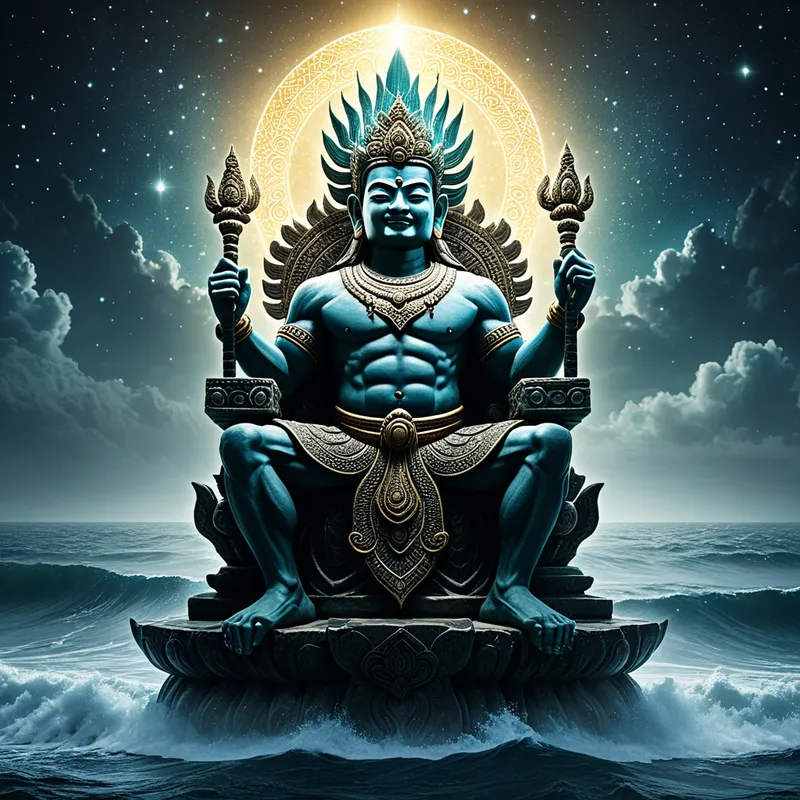
In the time before time, there was only the Antaboga, the endless, silent sea. No wind stirred its surface, no light pierced its depths. It was a vast, dreaming potential, a womb of dark water holding the memory of all things yet to be. From the highest realm of the gods, Batara Guru looked upon this stillness. A profound longing stirred within him—not a loneliness, but the creative urge of the universe itself, the desire to see its own reflection.
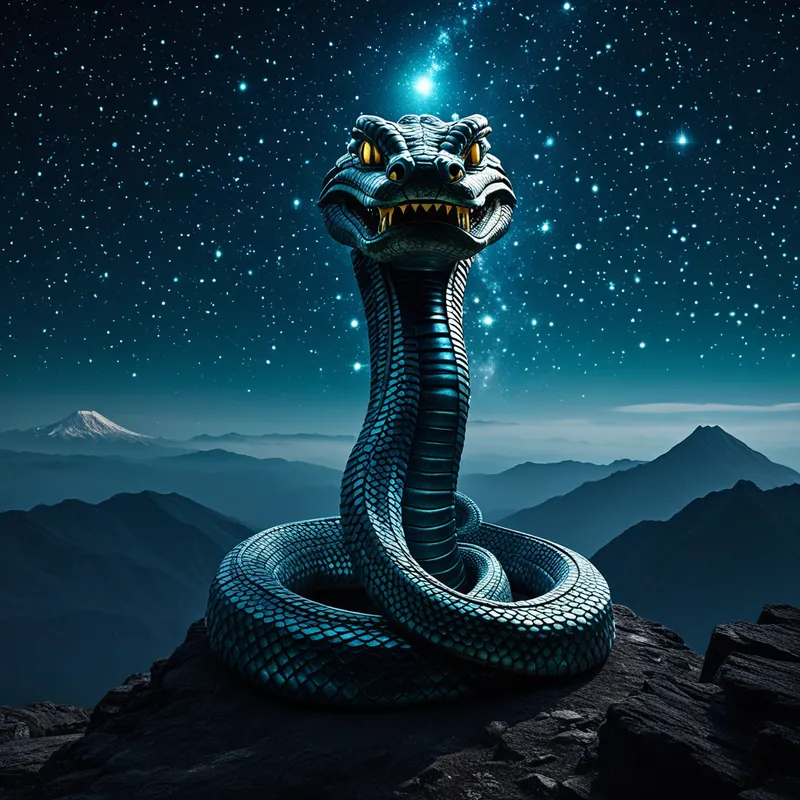
He determined to descend. Not with thunder or fury, but with the quiet purpose of a seed falling to earth. He took his divine throne and began his journey down through the layers of being, leaving the perfect harmony of the celestial for the formless murmur of the waters. As he descended, the first disturbance rippled across the face of the Antaboga. The sea, which had known only its own solitude, sensed a presence. From its profound depths, a consciousness awoke. This was Naga Antaboga, the serpent who was the sea, the ancient guardian of the unformed.
The god and the serpent beheld one another. Batara Guru, embodiment of order and will. Naga Antaboga, embodiment of primal chaos and latent power. There was no war, but a tremendous, silent tension—the tension of possibility itself. The serpent, vast as a mountain range coiled upon itself, recognized the intent in the god’s gaze. To create a world, a stable ground, a place for life, would require a foundation. It would require a sacrifice from the very substance of the primordial.
And so, from its own immense body, Naga Antaboga offered a part of itself. Some tales say it was a scale, others a fragment of its spirit, or the clay from its own form. This offering was placed upon the waters. Then, with a breath that held the first law of existence, Batara Guru infused the substance with his divine will. The offering expanded, hardening, rising. It became the first land, the world-mountain, the stable axis in the center of the swirling, supportive sea. Upon this foundation, the cosmos could now be arranged; the heavens above, the earth below, and the intricate dance of life between them could begin. Creation was not an act of conquest, but a sacred dialogue between consciousness and the deep.
Cultural Origins & Context
This creation narrative is woven from the rich tapestry of Hindu-Javanese mythology that flourished during the Majapahit Empire. It is not a single, canonical text, but a living tradition preserved in kakawin literature, such as the Tantu Panggelaran, and in the oral repertoires of dalang. The myth served a profound societal function: it established a cosmic model for the relationship between authority (the god-king, or raja) and the foundational, often chthonic, powers of the land (the naga). It legitimized the ruler’s power as deriving from a sacred pact with the primordial forces of the territory itself, a necessary balance of alus and kasar. The story was told in court ceremonies and shadow plays, reminding all of the sacred, sacrificial origin of their world and the delicate equilibrium upon which civilization rests.
Symbolic Architecture
At its [heart](/symbols/heart “Symbol: The heart symbolizes love, emotion, and the core of one’s existence, representing deep connections with others and self.”/), this myth maps the primordial [drama](/symbols/drama “Symbol: Drama signifies narratives, emotional expression, and the exploration of human experiences.”/) of [consciousness](/symbols/consciousness “Symbol: Consciousness represents the state of awareness and perception, encompassing thoughts, feelings, and experiences.”/) emerging from the unconscious. The endless sea, Antaboga, is the Self in its undifferentiated, potential state. Naga Antaboga is the instinctual, archetypal [guardian](/symbols/guardian “Symbol: A protector figure representing safety, authority, and guidance, often embodying parental, societal, or spiritual oversight.”/) of this [depth](/symbols/depth “Symbol: Represents profound layers of consciousness, hidden truths, or the unknown aspects of existence, often symbolizing introspection and existential exploration.”/)—the psyche’s own foundational intelligence, often feared as chaotic.
Creation is not an act imposed upon chaos, but a request made of it, answered by a sacrifice from its own body.
Batara [Guru](/symbols/guru “Symbol: A Guru represents a teacher or guide, often embodying wisdom, knowledge, and spiritual insight.”/) represents the differentiating principle of the ego, the “I” that chooses to engage, to descend from abstract unity into the messy process of formation. His descent is the [journey](/symbols/journey “Symbol: A journey in dreams typically signifies adventure, growth, or a significant life transition.”/) of [awareness](/symbols/awareness “Symbol: Conscious perception of self, surroundings, or internal states. Often signifies awakening, insight, or heightened sensitivity.”/) into the inner world. The pivotal [moment](/symbols/moment “Symbol: The symbol of a ‘moment’ embodies the significance of transient experiences that encapsulate emotional depth or pivotal transformations in life.”/) is not battle, but negotiation. The [serpent](/symbols/serpent “Symbol: A powerful symbol of transformation, wisdom, and primal energy, often representing hidden knowledge, healing, or temptation.”/)’s voluntary sacrifice signifies that the raw [material](/symbols/material “Symbol: Material signifies the tangible aspects of life, often representing physical resources, desires, and the physical world’s influence on our existence.”/) for our conscious [life](/symbols/life “Symbol: The symbol of ‘Life’ represents a journey of growth, interconnectedness, and existential meaning, encompassing both the joys and challenges that define human experience.”/)—our [stability](/symbols/stability “Symbol: A state of firmness, balance, and resistance to change, often represented by solid objects, foundations, or steady tools.”/), our [identity](/symbols/identity “Symbol: Identity represents the sense of self, encompassing personal beliefs, cultural background, and social roles.”/), our “ground”—must be granted by the deep unconscious. We cannot build a stable psyche by repressing or defeating our inner [chaos](/symbols/chaos “Symbol: In Arts & Music, chaos represents raw creative potential, uncontrolled expression, and the breakdown of order to forge new artistic forms.”/); we must respectfully engage it and receive its gift. The resulting world-[mountain](/symbols/mountain “Symbol: Mountains often symbolize challenges, aspirations, and the journey toward self-discovery and enlightenment.”/) is the nascent ego-complex, the first stable point of consciousness around which the inner [cosmos](/symbols/cosmos “Symbol: The entire universe as an ordered, harmonious system, often representing the totality of existence, spiritual connection, and the unknown.”/) organizes itself.
The Dreamer’s Resonance
When this mythic pattern stirs in the modern dreamer, it often manifests as a profound somatic sense of being adrift on a vast, dark ocean, or of encountering a majestic, terrifying serpent or aquatic being. The dreamer may feel a call to “descend”—into a cave, a basement, or deep water—representing a necessary engagement with the foundational layers of the psyche. The serpent in such dreams is rarely purely antagonistic; it holds a watchful, ancient energy. The psychological process underway is one of foundation-building. The dreamer is at a threshold where old, provisional structures of identity are dissolving back into the formless sea (a period of depression, loss, or confusion), and a new, more authentic foundation is being requested from the depths. The anxiety felt is the tension of the dialogue itself—the ego’s fear of the unconscious, and the unconscious’s wary assessment of the ego’s intent.

Alchemical Translation
The alchemical journey of individuation mirrors this myth precisely. The prima materia, the worthless starting substance, is the Antaboga—the confused, chaotic, or depressed state of the psyche. The first operation is not forceful change, but descent: the nigredo or darkening, where one consciously enters the inner void.
The serpent’s sacrifice is the unconscious’s consent to participate in the individuation process, offering up its archetypal energy to be transformed.
Batara Guru’s role is performed by the conscious attitude of the individual—the will to engage with depth, to sit with the tension without fleeing. The sacrifice of the naga is the critical moment of transmutatio. An instinct (rage, grief, primal fear) or a complex (the inner child, the shadow) is not eliminated, but voluntarily offered up and transformed into a structural element of the personality. This becomes the stable “land”—a core of resilience, a newfound value, or a healed perspective. The ongoing relationship between the god and the serpent symbolizes the enduring dialogue between consciousness and the unconscious that characterizes a mature, grounded individual, one who is built upon a sacred pact with their own deepest nature.
Associated Symbols
Explore related symbols from the CaleaDream lexicon:
- Ocean — The primordial, undifferentiated unconscious, the source of all potential and the medium from which the stable self must emerge.
- Serpent — The instinctual wisdom and foundational power of the unconscious, the guardian of the depths who must be engaged, not conquered.
- Mountain — The stable ego-complex and conscious identity formed from the sacrificed material of the unconscious, serving as the central axis of the psyche.
- God — The principle of conscious will, order, and differentiation that initiates the creative dialogue with the formless depths.
- Sacrifice — The essential act where a part of the primal, chaotic whole is voluntarily offered to become the foundation for a new, ordered structure.
- Earth — The achieved stability, the grounded reality of the conscious personality and lived experience, born from the alchemy of sea and spirit.
- Order — The cosmic and psychological structure that arises from the sacred pact, representing the integration of chaos into a functioning whole.
- Chaos — Not merely destructive disorder, but the fertile, potent, and necessary raw material of the unconscious from which all creation springs.
- Descent — The critical movement of consciousness away from lofty abstraction into the tangible, often dark, waters of the embodied and instinctual psyche.
- Stone — The enduring, foundational truth or core complex that forms from the solidified sacrifice, the bedrock of the new self.