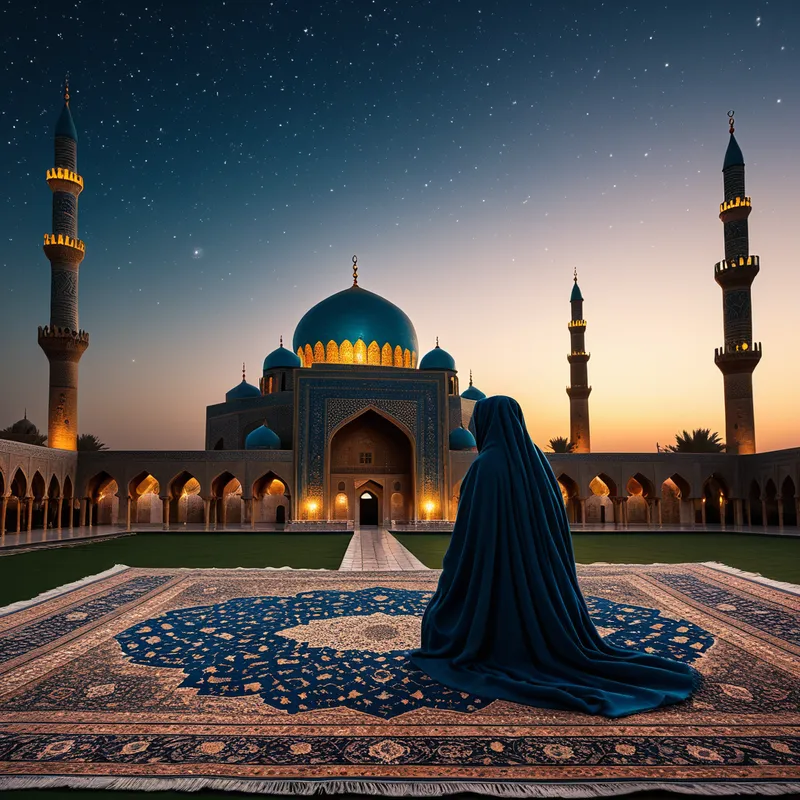
The Magic Carpet in One Thousand and One Nights Myth Meaning & Symbolism
A flying carpet from ancient tales, carrying heroes beyond physical limits, symbolizing the soul's journey, liberation of the will, and the power of imagination.
The Tale of The Magic Carpet in One Thousand and One Nights
Listen, and let the night wind carry you to a time when the world was woven with wonder. In the city of Baghdad, there lived an aging Sultan with three sons, each beloved, each a jewel in his crown. As his days grew short, a shadow of uncertainty fell upon the kingdom. Who was worthy to inherit the throne? The Sultan, wise in his twilight, devised a test not of strength, but of soul.
He summoned his sons—Prince Husain, Prince Ali, and Prince Ahmed. To each he gave a purse of gold. "Go forth," he commanded, his voice like dry parchment. "Travel to the farthest markets. Return in one year with the rarest, most singular curiosity you can find. He who brings the most marvelous item shall be my successor."
The brothers kissed their father's hand and departed, each taking a separate road into the vast, whispering world. Prince Husain, the eldest, journeyed to the bustling Bisnagar. For months he searched through silks and spices, gems and strange beasts, finding nothing that stirred his spirit. Then, in a cramped stall at the market's dusty edge, an old vendor with eyes like cracked river stones showed him a carpet. It was not large, its colors muted by time. "O Prince," the vendor whispered, "this is no ordinary rug. Command it to carry you, and in the blink of an eye, you will be wherever you wish to be."
Skeptical, yet desperate, Husain paid the gold. He spread the carpet on the ground, sat upon its worn threads, and with a heart full of doubt, said, "Take me to my father's palace." The world did not spin; it folded. The raucous sounds of Bisnagar vanished, replaced by the familiar scent of his father's rose garden. He had traveled months of desert in a single breath. The carpet settled softly on the palace floor, its magic humming a silent song against the marble.
Cultural Origins & Context
The tale of the magic carpet is woven into the grand tapestry of One Thousand and One Nights. This story, specifically from "The Story of Prince Ahmed and the Fairy Peri Banou," is part of a corpus that evolved over centuries, from ancient Persian, Indian, and Mesopotamian roots, crystallizing in the Arab-Islamic world of the Abbasid era. It was not a fixed text but a living, oral tradition, told by qussas in coffee houses and market squares, and later refined by scribes.
Its societal function was multifaceted. On one level, it was pure entertainment, a "wonder-tale" that offered escape and ignited the imagination of listeners from all walks of life. On a deeper level, it served as a narrative vessel for cultural values: the importance of wisdom over brute force, the virtue of a quest for the extraordinary, and the belief in a world where divine grace or hidden knowledge (ilm ladunni) could manifest in mundane objects. The carpet itself reflects the pinnacle of Islamic artisanal and spiritual culture—where geometry, pattern, and infinite detail were seen as reflections of a divine order. To imagine such an object possessing motion was to imagine the ultimate liberation of human creativity and will.
Symbolic Architecture
The magic carpet is far more than a fantastical vehicle. It is a profound symbol of the liberated psyche.
The carpet does not fly; it renders the weight of the world irrelevant. It is the soul's capacity to transcend the literal for the realm of meaning.
Psychologically, it represents the activated imagination. It is the faculty that allows consciousness to travel beyond the confines of immediate perception, trauma, or social conditioning. Prince Husain’s initial skepticism mirrors our own resistance to this inner power. The carpet is often described as humble-looking, its power concealed—a perfect metaphor for the latent potential within the unconscious, waiting for the conscious ego (the Prince) to acknowledge and "sit upon" it.
The journey it facilitates is not a random adventure but a directed return. Husain’s first command is to go home. This is critical. The ultimate purpose of this psychic power is not mere escapism but reintegration. It provides the means to navigate vast internal and external landscapes to return to the core Self (the Sultan/palace) with newfound wisdom. In the context of the brothers' contest, the carpet symbolizes a victory of transcendent insight over more tangible, yet ultimately lesser, magical items (like an apple that cures all ills or a spy-glass that sees all).
The Dreamer's Resonance
When the magic carpet appears in modern dreams, it signals a profound somatic and psychological process: the urgent need for psychic mobility. The dreamer may be feeling trapped—in a job, a relationship, a repetitive mental pattern, or a physical location. The body's sensation might be one of heaviness, constriction, or paralysis upon waking.
The dream carpet’s condition is diagnostic. Is it vibrant and responsive, or faded and uncooperative? To dream of successfully commanding it suggests the dreamer is accessing a newfound inner resource, an ability to gain perspective and move above their problems. To dream of it failing to lift off, or of falling from it, points to a conflict: a conscious desire for liberation clashing with a deep, perhaps fearful, attachment to the known world. The flight itself is the somatic experience of released tension, the "aha" moment of insight made visceral. It is the dream-ego practicing sovereignty over its own narrative, learning that the boundaries it perceives are, in part, woven by its own mind.
Alchemical Translation
The myth models the alchemical process of individuation, specifically the stage of sublimation—the transmutation of a base condition into a higher, more mobile state.
The "base material" is the ordinary, earth-bound human condition, burdened by gravity, time, and space (the dusty market, the long journey). The Sultan’s test is the nigredo, the darkening, the crisis that forces a search for the philosophical gold. Prince Husain’s act of purchasing the carpet with all his gold represents a total investment of libido (psychic energy) into the unconscious. He trades literal currency for symbolic power.
The alchemical secret is that the transformative agent is not made; it is recognized. The carpet was always magical. The work is in seeing it.
Sitting on the carpet is the act of relating to the symbol, engaging the transcendent function. The conscious mind (the Prince) must trust and direct the autonomous, transpersonal power of the unconscious (the carpet). The instantaneous flight is the rubedo, the glorious result: the birth of a psychic capacity that unites opposites. It reconciles the desire for rootedness (the carpet is a home, a place to sit) with the need for freedom (it flies). It marries intention (the command) with surrender (the mode of travel is beyond control).
For the modern individual, the myth instructs us to seek not external solutions first, but to examine the "worn carpets" of our own psyche—our habits, dreams, and intuitions. The magic is in the directed application of attention and will onto these inner patterns. The throne to be won is not an external kingdom, but the sovereignty of a Self that can navigate the vast interior world and return, at will, to its own center, transformed and whole.
Associated Symbols
Explore related symbols from the CaleaDream lexicon: