
The Liver Omen Divination
Babylonian priests examined animal livers to interpret divine omens, guiding kings and revealing cosmic secrets through this ancient ritual practice.
The Tale of The Liver Omen Divination
The king’s breath hung in the cool dawn air of the bīt mummi, the “house of the washing.” The fate of the campaign, the stability of the realm, the very favor of the gods, rested on the trembling flanks of a perfect, unblemished lamb. The world was not silent, but thick with portent. The priest, the bārû, moved with a gravity that stilled the court. His hands were not those of a butcher, but of a reader, a translator of celestial script. The ritual incantations rose, a low drone weaving with the scent of cedar and myrrh, binding the earthly to the divine. The plea was uttered: “Shamash, lord of judgment, Adad, lord of the storm, be present! Show the truth, pronounce the verdict!”
With a swift, consecrated blade, the offering was made. The life passed not into nothingness, but into a channel of communication. As the animal’s warmth faded, a new luminescence was sought. The organ was extracted with reverent care—not the heart of passion, nor the brain of thought, but the liver, the seat of life, the dark mirror of the cosmos. Placed upon the sacred reeds, it was a landscape revealed: a clay tablet written by the gods in the moment of divine attention.
The bārû bent close, his eyes tracing the ridges and valleys of the martu, the gallbladder, the “bitter thing.” He measured the lobes, the padānu or “path,” with his fingers. He noted the color, the texture, the presence of any marks—a fissure like a lightning bolt, a spot like a star, a lobe swollen like a storm cloud. Each feature was a word; their configuration, a sentence from Marduk or Ishtar. A “palace gate” shape on the Processus caudatus might speak of divine protection for the king’s own gates. A cleft on the “station of the path” could warn of ambush on the royal road. The liver was not random viscera; it was a microcosm, a map of the heavens pressed into clay of flesh, reflecting the intentions of the gods as clearly as the night sky reflected their eternal forms. The priest deciphered, his voice low and sure, delivering the omen—a promise of victory, a warning of drought, a command to delay, a blessing to proceed. The king listened, and an empire turned on the reading of a single, sacred organ.
Cultural Origins & Context
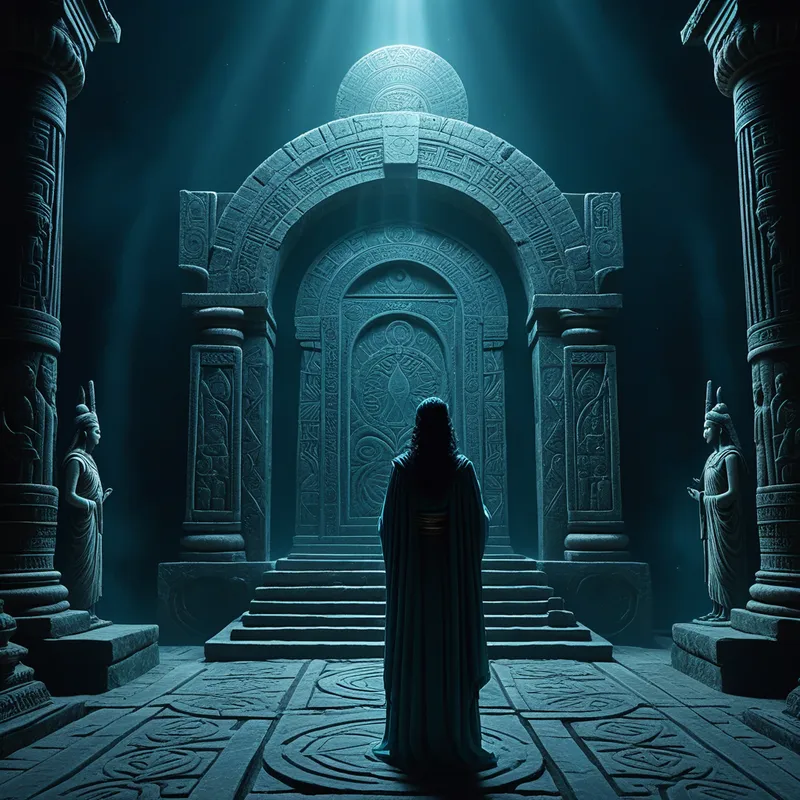
The practice of hepatoscopy, or liver omen divination, was not mere superstition in Mesopotamia; it was the supreme science of discerning divine will, a cornerstone of statecraft and cosmic order. Its roots stretch deep into the Sumerian world, evolving into a highly systematized discipline in Old Babylonian times (c. 1900-1600 BCE) and preserved in vast compendia like the 70-plus tablet series known as Bārûtu. This was a culture that perceived the universe as an encoded text, with the gods as active authors. No significant decision—military, political, agricultural, or personal—was made without consulting this divine script.
The liver was chosen as the primary medium for this communication because it was considered the source of blood, and thus of life itself (napištu). It was the body’s densest organ, a nexus of vitality where emotions and the soul were thought to reside. To examine the liver was to examine the very life-force offered to the deity, now returned inscribed with their answer. The bārû was a scholar-scientist, trained for years in the elaborate omen literature, which cataloged thousands of possible configurations and their interpretations. This practice institutionalized the belief that the cosmos was interconnected and legible, that the microcosm (the liver) faithfully mirrored the macrocosm (the state, the world, the heavens). It was a ritual technology for navigating a universe alive with will and meaning.
Symbolic Architecture
At its core, hepatoscopy is an act of profound symbolic correspondence. It rests on the ancient hermetic principle “as above, so below,” but rendered in visceral, bureaucratic detail. The liver is the imago mundi—the image of the world. Its lobes become regions, its vessels roads and canals, its markings celestial events. The divination ritual itself is a dramatic hieros gamos, a sacred marriage of the human and divine realms. The killing of the animal is not a violence but a necessary dissolution of the boundary, an offering of life to solicit wisdom about life.
The liver is the clay tablet of the body, inscribed by the gods at the moment of their attention. The priest is not a butcher, but a scribe of the interior, reading the autobiography of the cosmos written in the language of flesh.
The practice also symbolizes the human confrontation with fate and uncertainty. The future is not random; it is authored. But the text is cryptic, requiring an expert interpreter. The bārû thus becomes a mediator of me, translating divine decree into human action. The ritual formalizes anxiety into ceremony, transforming the chaos of the unknown into the structured grammar of the omen, where even a negative reading provides a path—propitiation, delay, or alternative action. It is a technology for making the will of the gods administrable.
The Dreamer's Resonance
To the modern psyche, the liver omen speaks to the deep, often unconscious, desire to find pattern and meaning in the raw, visceral stuff of existence. We no longer read sheep livers, but we endlessly scrutinize the “entrails” of our lives—dream images, random events, slips of the tongue, the patterns of our relationships—for signs and portents. The bārû’s practice externalizes this inner process. The liver represents the shadowy, instinctual, embodied knowledge that logic cannot reach. It is the “gut feeling” made literal, the wisdom of the body elevated to cosmic significance.
Psychologically, the ritual enacts a crucial dialogue between the ego (the king, the conscious mind seeking direction) and the Self (the gods, the totality of the psyche). The ego must surrender its illusion of sole control, offering up its vitality (the sacrifice) to be reshaped and reinterpreted by a greater wisdom. The returned omen, even when challenging, integrates unconscious content into conscious planning. It is a ritualized form of active imagination, where the contents of the collective unconscious (the archetypal gods) are made visible and actionable through a concrete, symbolic object. We perform our own hepatoscopy when we ponder a persistent dream image or a somatic symptom, asking, “What is the deeper life trying to tell me through this manifestation?”
Alchemical Translation
In the alchemical opus, the prima materia—the base, chaotic substance—must be dissolved and examined to reveal the hidden signatura rerum, the signatures of the divine. The Babylonian ritual is a precise precursor. The living animal (the unconscious, undifferentiated state) is dissolved in the ritual act. The liver, the prima materia extracted, is subjected to the solutio of scrutiny—washed, anointed, laid bare. The bārû’s gaze performs the separatio and inspectio, distinguishing significant marks from insignificant flesh.
The alchemical vessel is the ritual space; the fire is the focused attention of the priest. The lapis philosophorum sought is not physical gold, but the golden knowledge of right action, the alignment of human endeavor with cosmic law.
The process transforms the massa confusa of potential futures into the structured liber mundi, the book of the world. The “lead” of anxiety and doubt is transmuted into the “gold” of clarified purpose. This is not magic in a supernatural sense, but the magic of profound attention: the belief, and the experience, that concentrated, ritualized observation of a symbolic fragment of reality can reveal truths about the whole. It is the alchemy of meaning-making, where the base metal of random event is turned into the gold of destined path.
Associated Symbols
Explore related symbols from the CaleaDream lexicon:
- Liver — The primordial clay tablet of the body, where the cosmos inscribes its immediate will in the language of lobes, vessels, and markings.
- Omen — A fragment of the future made present, a divine sign demanding interpretation to bridge the chasm between human intention and cosmic law.
- Divination — The sacred art of reading the world as a symbolic text, a ritual dialogue with the hidden architecture of fate and meaning.
- Ritual — The structured performance that creates a vessel for the meeting of mortal and divine, transforming chaos into order and anxiety into actionable knowledge.
- Altar — The elevated boundary where the exchange of life for wisdom occurs, the fixed point where heaven and earth are forced into conversation.
- Sacrifice — The voluntary surrender of a valued vitality, not as loss, but as the essential currency for purchasing clarity from the realm of the gods.
- Shadow — The unseen, visceral interiority of life represented by the liver, the repository of instinctual knowledge and the dark mirror of cosmic truth.
- Mirror — The liver as a speculum that reflects not the face, but the state of the world and the will of the gods, a microcosm holding the image of the macrocosm.
- Door — The ritual act itself, which opens a threshold between the mundane and the numinous, allowing messages to pass from the divine realm into the council of kings.
- Fate — The woven tapestry of divine decree, whose threads become partially visible in the intricate patterns revealed upon the sacred organ.