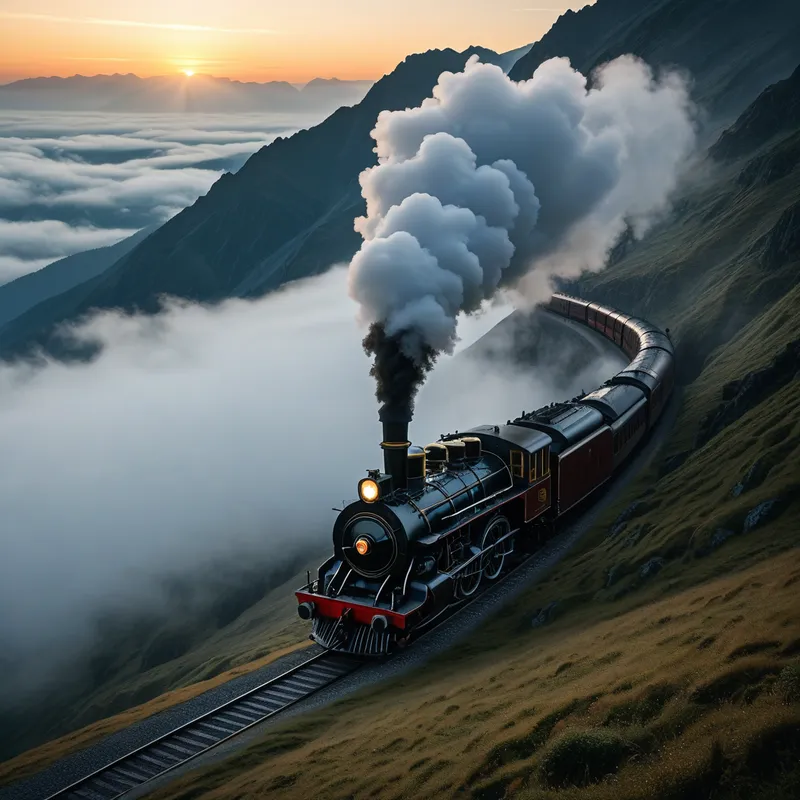
The Little Engine That Could Myth Meaning & Symbolism
A small, overlooked engine must pull a stranded train over a mountain by sheer force of optimistic will, embodying the triumph of self-belief.
The Tale of The Little Engine That Could
Beyond the bustling cities and the wide, sleeping plains, there stood a mountain. It was not the tallest, nor the most treacherous, but to those who lived in the valley on the other side, it was a wall between them and [the world](/myths/the-world “Myth from Tarot culture.”/)’s delights. And on this day, a great train was stranded at its foot.
The train was a splendid sight, a long chain of cars painted like rainbows, filled with the most wonderful things: toys and games, fresh fruit and picture books, and all the good things for the children of the valley. But its engine, a great, shiny, and proud Shiny New Engine, had broken down. It sat on the tracks, silent and cold, a giant of failed promise.
The toys and dolls whispered in fear. The clockwork clown’s smile seemed strained. They needed an engine, and quickly.
First, they asked a Big Passenger Engine, sleek and haughty, puffing down the main line. “I pull the likes of you?” it huffed. “I am an Engine of Importance. I carry fine ladies and gentlemen. I cannot be bothered.” And it steamed away, leaving only the scent of coal and contempt.
Desperation grew. Then came a Big Freight Engine, powerful and worn, its sides scarred from long labor. It looked at the mountain, then at its own weary wheels. “I have hauled too much for too long,” it groaned. “That mountain is too steep for me now. I cannot. I cannot.” And it, too, retreated, its sigh a cloud of exhaustion.
Hope was a dying ember. Then, from a forgotten spur track, a small sound was heard. Chug-chug… chug-chug… It was the Little Blue Engine, a humble switcher who had only ever moved cars around the yard. It was not big. It was not important. It was not strong in [the way](/myths/the-way “Myth from Taoist culture.”/) the others were.
The dolls called out to it, their voices tiny against the vast mountain. “Please, Little Engine! Won’t you try? The children are waiting!”
The Little Blue Engine looked at the towering mountain. It looked at the long, heavy train. It felt its own small boiler, its modest wheels. A tremor, not of fear, but of profound uncertainty, passed through its frame. Then, it looked into the hopeful faces in the cars. It backed down, chuffed softly, and coupled to the great load.
As it began to pull, the weight was immense. The wheels strained. The mountain loomed. And from deep within its firebox, a mantra was born, a spell of will made steam. “I-think-I-can,” it puffed. “I-think-I-can. I-think-I-can.” With every chug, the words grew stronger, beating in time with its pistons. The slope grew steeper, the track seemed to vanish into [the sky](/myths/the-sky “Myth from Persian culture.”/). The world narrowed to the next tie, the next breath of effort. “I-think-I-can… I-think-I-can…”
And then, the crest. For a terrifying moment, the engine hung between effort and [triumph](/myths/triumph “Myth from Roman culture.”/). And as its front wheels passed the peak, the mantra transmuted, born anew from the proven deed. “I-thought-I-could!” it sang. “I-thought-I-could! I-thought-I-could!” It rolled, now freely, joyously, down the slope toward the waiting valley, its whistle a clear, triumphant cry against the morning sun. The mountain had been crossed. Not by might, but by mind.

Cultural Origins & Context
The myth of The Little Engine That Could is a quintessential piece of 20th-century American folklore, its origins humble and its dissemination viral. First published in 1906 in a Sunday school publication, its most famous iteration was crafted by Watty Piper (a pseudonym for publisher Arnold Munk) in 1930. It did not emerge from ancient oral tradition but from the printing press, designed explicitly as a teaching story for the burgeoning culture of American individualism and optimism.
Its societal function was clear and potent: to inculcate the values of perseverance, positive thinking, and self-reliance in children. It was a secular sermon for the age of industry and ambition. Passed down not by village elders but by parents at bedtime, teachers in classrooms, and later through animated films, it became a foundational narrative. It answered a core American anxiety: what do you do when you are small, new, or overlooked in a land of giants and established power? The myth provided the algorithm: Believe, verbalize, persist. It served as a psychological technology for a meritocratic ideal, teaching that attitude could compensate for a lack of innate stature or resource.
Symbolic Architecture
At its [heart](/symbols/heart “Symbol: The heart symbolizes love, emotion, and the core of one’s existence, representing deep connections with others and self.”/), this is a myth about the [alchemy](/symbols/alchemy “Symbol: A transformative process of purification and creation, often symbolizing personal or spiritual evolution through difficult stages.”/) of [consciousness](/symbols/consciousness “Symbol: Consciousness represents the state of awareness and perception, encompassing thoughts, feelings, and experiences.”/) confronting the inertia of matter. The [mountain](/symbols/mountain “Symbol: Mountains often symbolize challenges, aspirations, and the journey toward self-discovery and enlightenment.”/) is the [Obstacle](/symbols/obstacle “Symbol: Obstacles in dreams often represent challenges or hindrances in waking life that intercept personal progress and growth. They can symbolize fears, doubts, or external pressures.”/), the objective [reality](/symbols/reality “Symbol: Reality signifies the state of existence and perception, often reflecting one’s understanding of truth and life experiences.”/) of limitation. The stranded train represents the Vital Cargo—our unlived [life](/symbols/life “Symbol: The symbol of ‘Life’ represents a journey of growth, interconnectedness, and existential meaning, encompassing both the joys and challenges that define human experience.”/), our talents, our joys—that cannot move without an agent of will.
The first two engines are archetypes of a failed [psyche](/myths/psyche “Myth from Greek culture.”/). The Shiny New Engine is the Inflated Ego, all [appearance](/symbols/appearance “Symbol: Appearance in dreams relates to self-image, perception, and how you present yourself to the world.”/) and no [depth](/symbols/depth “Symbol: Represents profound layers of consciousness, hidden truths, or the unknown aspects of existence, often symbolizing introspection and existential exploration.”/), shattered by the first real challenge. The Big [Passenger](/symbols/passenger “Symbol: A passenger often represents dependence or a feeling of being guided by others in life’s journey.”/) Engine is the Complex of Superiority, while the Big Freight Engine is the Complex of Resignation. They represent psychic structures that say, “I am too good for this,” or “I am too broken for this,” both of which are refusals of the [soul](/symbols/soul “Symbol: The soul represents the essence of a person, encompassing their spirit, identity, and connection to the universe.”/)’s calling.
The Little Blue Engine is the emergence of the conscious Self, small but undivided. Its power is not horsepower, but word-power.
The [mantra](/symbols/mantra “Symbol: A sacred utterance, sound, or phrase repeated in meditation to focus the mind and connect with spiritual energy.”/) “I-think-I-can” is the critical symbolic engine of the myth. It is not a [statement](/symbols/statement “Symbol: A statement in a dream can symbolize the need to express one’s thoughts or beliefs, reflecting a desire for honesty or clarity.”/) of fact (“I-can”), which would be delusion on the lower slopes. Nor is it a question (“Can-I?”), which is pure doubt. It is a psychic hypothesis stated as an [affirmation](/symbols/affirmation “Symbol: A positive statement or declaration that reinforces self-worth, truth, or belief, often used in artistic and musical expression to create emotional resonance.”/). It is [the ego](/myths/the-ego “Myth from Jungian culture.”/)’s willing submission to a possibility greater than its current [evidence](/symbols/evidence “Symbol: Proof or material that establishes truth, often related to justice, guilt, or validation of beliefs.”/). It performs the magical function of building a bridge of cognition from the shore of “I cannot” to the shore of “I did.”
The Dreamer’s Resonance
When this myth patterns a modern dream, the dreamer is at a precipice of will. The somatic feeling is often one of immense weight, of being tasked with moving something crucial (the train) that feels impossibly heavy. The mountain may appear as a literal hill, a daunting work project, a stack of bills, or a physiological symptom.
To dream of being the Little Engine is to experience the psyche mobilizing the Hero archetype in its most humble form. The dream-ego feels small, inadequate, but strangely committed. The refusal of the other engines in the dream might manifest as memories of naysayers, internalized critical voices, or the sheer fatigue of the dreamer’s own history. The chanting of “I-think-I-can” in a dream is a direct manifestation of the psyche attempting to generate the psychic torque needed to overcome a somatic inertia—often linked to depression, anxiety, or creative blockage. It is the unconscious participating in its own cure, rehearsing the neural pathways of agency.
Alchemical Translation
The process modeled here is a perfect map for Individuation in the face of a specific life challenge. The [prima materia](/myths/prima-materia “Myth from Alchemical culture.”/) (base material) is the stranded cargo of [the Self](/myths/the-self “Myth from Jungian culture.”/)—the unexpressed talent, the unhealed wound, the unlived relationship. The [nigredo](/myths/nigredo “Myth from Alchemical culture.”/) (blackening) is the breakdown of the old, shiny identity (the broken engine) and the refusal of the known coping strategies (the haughty and weary engines).
The Little Blue Engine represents the humble, often ignored voice of the true Self, willing to engage with the work. The mantra is the Rotatio, the repeated, cyclical effort that heats and transforms the substance of the psyche.
The mountain is the indispensable Oppositor. Without its steep grade, the engine would never discover its transformative mantra, its true will. The obstacle is the catalyst.
The climax—the shift from “I-think-I-can” to “I-thought-I-could”—is the [Rubedo](/myths/rubedo “Myth from Alchemical culture.”/), the reddening, the achievement of the goal. This is not just success, but a fundamental transmutation of identity. The engine is no longer the “little” engine that might; it is now the engine that did. Its self-concept is forever altered. The cargo delivered to the “children” is the integrated aspect of the Self now available to the inner community of the psyche. The myth teaches that individuation is not a single, glorious battle, but a slow, chugging, mantra-repeating ascent, where the very act of conscious, persistent effort becomes the transformation.
Associated Symbols
Explore related symbols from the CaleaDream lexicon: