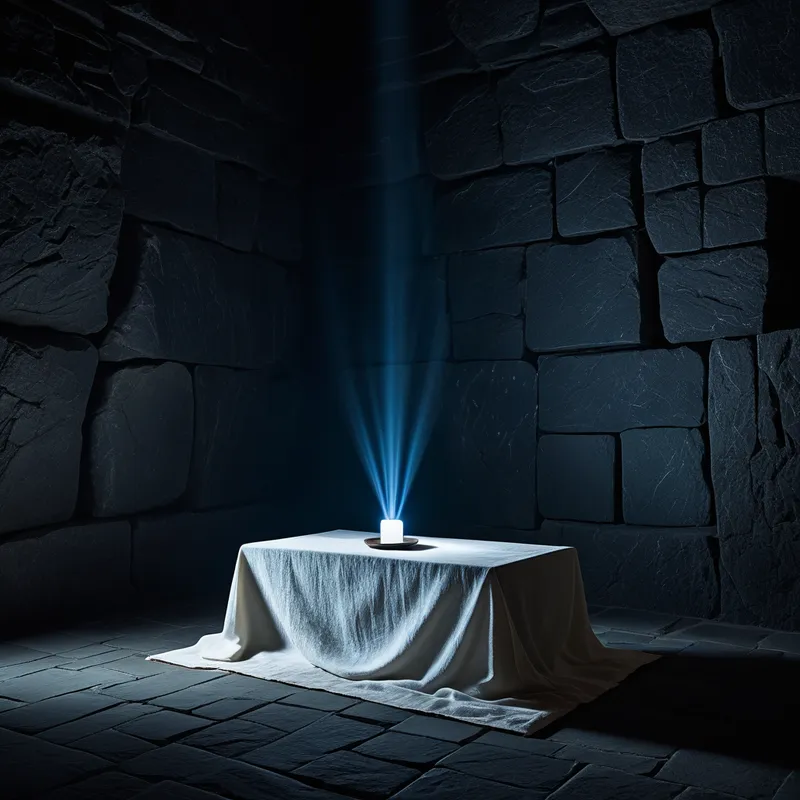
The linen cloths used to wrap Myth Meaning & Symbolism
A universal myth of sacred cloths that hold the formless between death and rebirth, containing the mystery of transformation in silent, expectant folds.
The Tale of The linen cloths used to wrap
Listen. There is a silence that is not empty, but full. A silence that comes after the last breath has been drawn, after the final cry has echoed into stone, after the great struggle is done. It is into this pregnant, waiting silence that the Keepers of the Threshold come.
They are not gods of thunder or love, but deities of the in-between. Their names are whispered: The Preparer, The One Who Folds, and She Who Waits by the Stone. Their realm is the hushed space between the setting and the rising sun, between the known life and the unknown journey.
The great hero, or the sacred king, or the wise one who has tasted the fruit of both heaven and earth, lies still. The battle is over, the lesson is learned, the sacrifice is made. But the story is not. For the form that remains is a vessel of potent mystery, a seed soaked in the waters of experience. It cannot be left exposed to the raw winds of change.
So the Keepers approach. From a chest of pale cedar, they draw the cloths. Not rich purple, nor warrior’s red, but pure, undyed linen, woven by hands that understood the language of stalks and rain. The cloth is cool. It carries the scent of earth and sunlight held in its fibers.
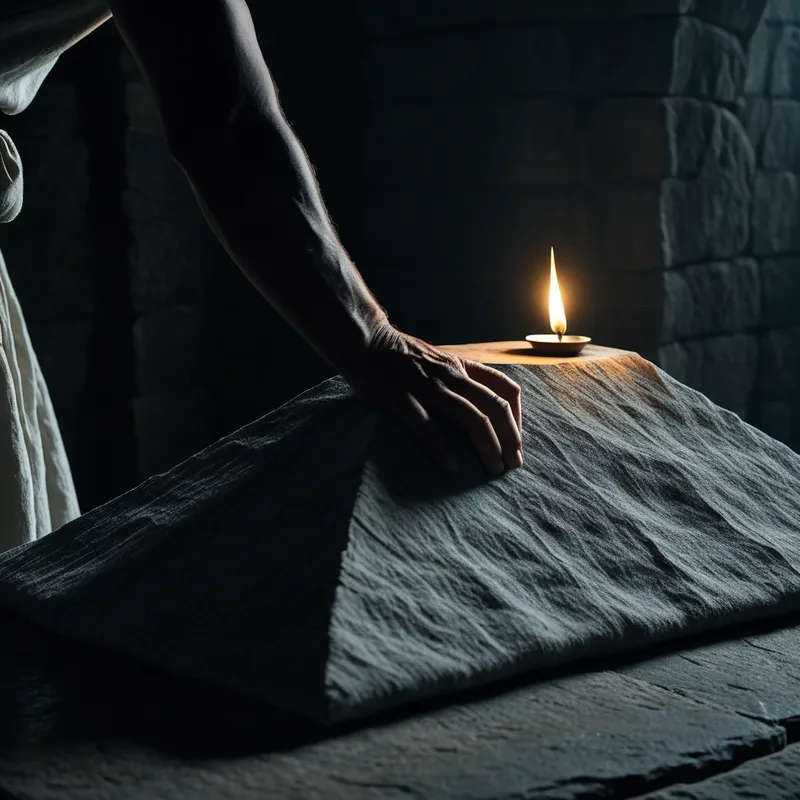
With movements that are a liturgy in themselves, they begin. The first cloth is for the foundation, laid beneath with a murmured blessing for the road. The next is drawn over, a shroud of dignity, a veil between the eyes that have seen too much and the world that must now be seen anew. Limb by limb, the form is gathered in. The folds are precise, not as binding, but as embrace. Each tuck is a word in a silent prayer, each layer a sentence in a story of waiting.
This is the heart of the tale: the long, quiet night of the wrapped one. In that linen cocoon, under the watch of the starless vault of the tomb, the great alchemy occurs. Not with fire or sound, but with a profound, patient holding. The identity that was, the face known to the world, is gently dissolved within this sacred container. The pains, the triumphs, the memories—all are held in suspension, like dust in a sunbeam, allowed to settle into a new pattern.
The conflict is not against a monster, but against chaos. The action is not a journey, but a profound stillness. The resolution comes with the first, faint glow at the seam of the cloth—not a breaking, but an unfolding. When the time is full, the wrappings will be found, empty, lying in the order of their purpose, a testament not to what was taken, but to what was perfectly, patiently held.
Cultural Origins & Context
The motif of the sacred linen wrappings is a true mytheme of the human psyche, appearing not as a single story from one culture, but as a profound ritual pattern recognized globally. We find its echo in the meticulous mummification rites of ancient Egypt, where linen was the “skin of the god” Ra, protecting the Ka for eternity. We hear it in the Gospel narratives of the sindōn, left in the tomb as a silent witness. We see it in the clean, white cerements of countless burial traditions across continents.
Its origin is not in a book, but in the human hand performing a final, loving duty. It was passed down not by bards, but by the tenders of the dead and the wise women who presided over life’s thresholds. Its societal function was dual: practical and cosmic. Practically, it managed the sacred pollution of death with dignity. Cosmically, it enacted a universal truth—that all transformation requires a period of containment, a gestational darkness where the old form is dissolved before the new can emerge. It was a collective ritual affirming that an ending is also a preparation.
Symbolic Architecture
The linen cloths are far more than a funeral custom; they are a master symbol of the psyche’s own processes. They represent the necessary container.
The soul, in its moments of greatest death and rebirth, requires a sheath. Without the linen, the mystery spills out, formless and lost.
The Linen itself symbolizes purity, but not sterile purity. It is organic, woven from life, representing a natural, ordered process. It is a boundary that defines and protects a sacred space. The Act of Wrapping is the ritual of creating that container—a deliberate, loving application of structure to chaos, of form to the formless. The Wrapped Form is the latent content, the unformed potential, the self in a state of psychic dissolution. It is the hero in the belly of the whale, the seed in the earth.
Psychologically, the myth addresses the phase in individuation where conscious identity must be surrendered. It is not annihilation, but envelopment. The ego is not destroyed; it is respectfully, ritualistically wrapped and set aside, so that the deeper, transformative work of the Self can proceed unseen and unharmed.

The Dreamer’s Resonance
When this myth stirs in the modern dreamer, it rarely appears as an ancient burial. Instead, one might dream of being tightly swaddled in bandages after an unseen wound, or of wrapping a precious, fragile object in layers of white paper for safekeeping. One may dream of a room being meticulously prepared, emptied, and covered in drop cloths before a renovation.
These dreams signal a somatic and psychological process of contained dissolution. The psyche is announcing a major transition—the end of a relationship, a career, a long-held identity, or a traumatic chapter. The conscious self may feel helpless, “dead,” or in stasis. The dream imagery of wrapping is the unconscious asserting its ancient wisdom: “You are being held. This inactivity is not void; it is a sacred process. You are in the linen.” The feeling upon waking is often not of fear, but of a strange, solemn peace. The struggle is over, for now. The work happening is subtle, cellular, and must not be interrupted.
Alchemical Translation
The alchemical journey mirrors this myth precisely. After the initial stage of nigredo—the chaos and suffering of an ending—comes a crucial, often overlooked phase: the sealing of the vas. This is the wrapping in linen.
The alchemist does not rush from death to rebirth. He learns the art of the vigil, tending the sealed vessel with constant, gentle heat.
For the modern individual, the “alchemical translation” is the conscious practice of creating and honoring a container for your transformation. This means allowing for a period of ritual withdrawal. It could be a literal retreat, a digital sabbath, or simply a committed space in one’s own mind. It is the practice of wrapping the old identity in respect and gratitude—journaling about the ended phase, performing a small personal ritual to mark its closure—before setting it down.
It means trusting the process happening in the darkness of that container. The new consciousness, the albedo, does not emerge from frantic searching, but from the fertile, patient darkness of the wrapped tomb. The triumph of the myth is not in a spectacular resurrection, but in the perfect, silent integrity of the wrappings themselves—proof that the transformation was allowed to complete its course. Our task is not to avoid the tomb, but to learn the sacred craft of weaving our own linen, and to lie patiently within it, knowing we are held in the folds of a universal, caring intelligence.
Associated Symbols
Explore related symbols from the CaleaDream lexicon: