
The Lernaean Hydra Myth Meaning & Symbolism
Hercules battles a monstrous, regenerating serpent in a poisoned swamp, a primal myth of confronting the self-perpetuating nature of our deepest fears.
The Tale of The Lernaean Hydra
Hear now of the second labor, a task born not of glory, but of atonement. The oracle’s voice still echoed in the halls of Eurystheus, a cruel sentence for a crime of madness: go to Lerna. Find the beast in the swamp.
Beyond the bright cities and tilled fields lay the marsh of Lerna, a place where the air grew thick and the light died young. Here, beneath the twisted roots of ancient cypress trees, the waters of the spring Amymone bubbled up, not with life, but with a miasmic breath. This was the lair of the Hydra, child of monstrous Gaia and the serpent-god Typhon. It was a creature of the primordial ooze, a perversion of the serpent’s form.
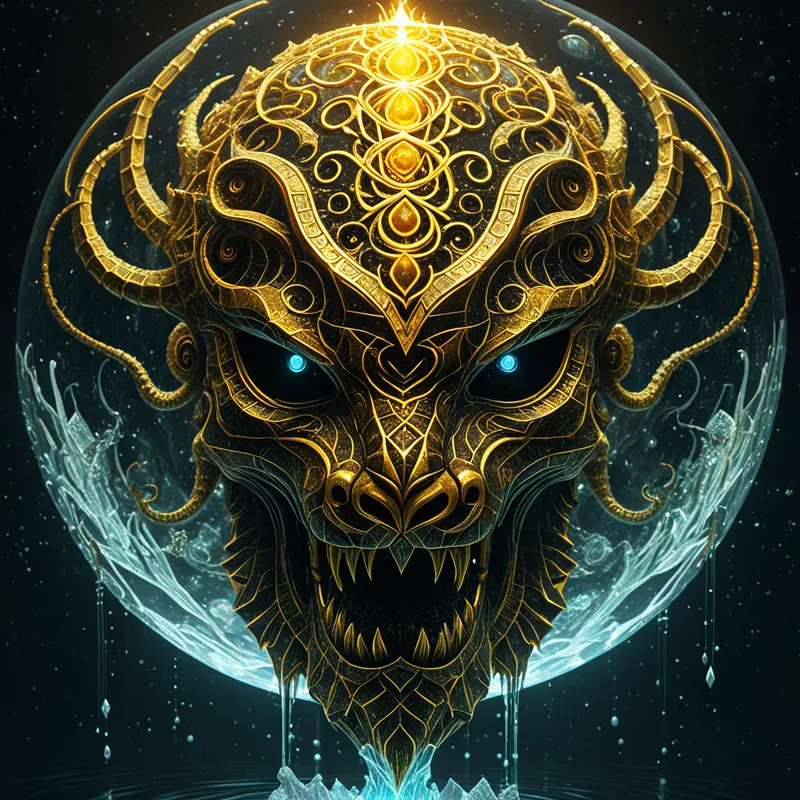
Heracles, son of Zeus, approached with his nephew Iolaus. The stench of rot and stagnant water filled their nostrils. Then, the water stirred. Not with a ripple, but with a violent, coiling eruption. The Hydra rose, its body a scaled mountain of putrid green, its necks a forest of serpents. Eight heads thrashed and screamed with voices like tearing metal, but a ninth, central head held itself aloof, its eyes burning with a cold, knowing light—this one was immortal.
The hero roared and charged. His club, carved from a wild olive tree, fell like thunder. A head burst, a fountain of black blood. But before the victory cry could leave his lips, a horror unfolded. From the bleeding stump, two new heads sprouted, wet and shrieking, their fangs already bared. He struck again, and again. Two became four, four became eight. The monster grew stronger with every blow, its multiplied fury pressing him back into the sucking mud. To make the despair complete, a giant crab, sent by the vengeful goddess Hera, scuttled from the reeds to bite his foot, a perfect symbol of a problem that pinches and distracts from all sides.
Trapped, overwhelmed, his strength bleeding into the futile task, Heracles saw the truth: direct force was not merely failing; it was feeding the beast. In that moment of supreme crisis, a flash of cunning—a god-given spark—ignited. He called to Iolaus. “Bring fire! Bring me a burning brand!” As Heracles seized a head and severed it with his golden sword, Iolaus was there, thrusting a torch into the raw wound. The flesh sizzled and sealed, blackening under the sacred fire. No new growth could spring from that cauterized ruin. Head by terrible head, they worked in terrible harmony: the severing and the sealing. Until only the immortal head remained, twisting and hissing, invulnerable to blade and flame. With a final, titanic effort, Heracles buried it deep beneath a colossal rock, a weight to hold eternity at bay. He dipped his arrows in the Hydra’s venomous blood, a final, toxic trophy from the swamp. The labor was complete, but the air in Lerna would never again be clean.

Cultural Origins & Context
This myth was not a fireside fancy but a foundational strand in the cultural DNA of the Hellenic world. It was codified most famously in the epic compilation known as the Hesiodic Catalogue, and later elaborated by authors like Apollodorus. As one of the canonical Twelve Labors of Heracles, it was a story told to define the very concept of the hero. It functioned on multiple levels: as an etiological myth explaining the feared, miasma-ridden landscape of Lerna; as a charter for the necessity of cunning (metis) over brute force; and as a societal narrative about confronting the chaotic, untamed wilds that perpetually threatened the order of the polis. The hero’s victory was a collective sigh of relief, a symbolic taming of the multiplying chaos at the world’s edge.
Symbolic Architecture
The Hydra is the archetypal image of the problem that grows when attacked directly. It is the perfect symbol for neurosis, addiction, cyclical anxiety, or any pattern of thought or behavior that seems to strengthen through opposition.
The swamp is the unconscious itself—the murky, emotional substrate where our unresolved complexes fester and breed. To enter it is to engage with the shadow.
Each head represents a specific manifestation of the core issue: a worry, a compulsion, a defensive rage. The central, immortal head is the core complex itself, the psychic wound or foundational belief that cannot be destroyed, only contained and managed. The crab from Hera symbolizes the cruel, distracting “pinches” of fate or self-sabotage that arise when we are most vulnerably engaged in our struggle. Heracles’s initial, futile strategy is the ego’s default position: to beat the problem into submission through willpower alone. Iolaus, the companion, represents the necessary auxiliary function—the supportive insight, the therapeutic technique, or the humble tool (the fire) that allows for true transformation. The solution is not in a single heroic stroke, but in a sustained, twofold process: the courageous act of facing and naming the issue (severing the head), immediately followed by the integrating act of healing the wound so it cannot regenerate (cauterization).
The Dreamer’s Resonance
When the Hydra slithers into modern dreams, it signals a confrontation with a self-perpetuating psychological pattern. The dreamer may find themselves in a murky, confusing landscape—a basement filling with water, a tangled forest, or an endless bureaucratic hallway. The monster itself may not be a literal serpent; it could be a multiplying pile of paperwork, a crowd of identical, accusing faces, or a weed that sprouts two more when pulled.
The somatic experience is one of exhausting, escalating frustration. Each effort to solve the problem drains energy and makes the situation worse. The dreamer wakes with a feeling of futility and entrapment. This is the psyche’s brilliant, if distressing, way of illustrating that the conscious approach to a deep-seated issue is inadequate. The dream is an invitation to stop the direct assault and to seek the “Iolaus” function—the new perspective, the healing modality, or the supportive relationship that provides the “fire” of transformative insight.
Alchemical Translation
The alchemical journey is one of solve et coagula—dissolve and coagulate. The Hydra myth is a perfect map for this psychic operation. The hero’s descent into the swamp is the nigredo, the descent into the blackness of the unconscious, where the prima materia (the raw, problematic stuff of the soul) is found in its most terrifying form.
The labor is not to annihilate the shadow, but to transmute its endless, chaotic growth into a focused, usable force. The immortal head is not killed; it is integrated as a source of potent, if dangerous, power.
Heracles’s initial, failed attacks represent the ego’s futile attempts to solve (dissolve) the problem through negation. The true alchemy begins with the acceptance of help (Iolaus) and the application of the ignis (fire). This fire is the heat of conscious attention, the light of understanding, the passion of a committed will to heal. The cauterization is the coagula—the sealing of the wound, the creation of a psychic scar tissue that contains the pattern’s energy without allowing it to proliferate chaotically. The final act, dipping the arrows in the Hydra’s blood, is the ultimate alchemical triumph: the poison of the complex is not discarded but distilled into a tool. The very thing that sought to destroy the hero becomes the source of his future potency. The individual learns that their greatest weakness, when confronted with wisdom and enduring effort, can become the source of their unique strength.
Associated Symbols
Explore related symbols from the CaleaDream lexicon: