
The Legend of Naupaka Myth Meaning & Symbolism
A story of two lovers, a goddess's curse, and a flower forever split in two, symbolizing a love that is whole yet eternally separate.
The Tale of The Legend of Naupaka
Listen, and let the wind carry you to a time when the islands were younger, and the gods walked closer to the earth. There was a princess, Naupaka, whose beauty was not merely of form but of spirit, as radiant and clear as the high mountain pools. She lived among the misty peaks of Pele’s domain, where the air was thin and the world felt vast. And there was a commoner, a fisherman named Kaui, whose heart was as deep and steadfast as the ocean he knew. His world was the warm, sun-drenched shore, the rhythm of the waves, the salt on his skin.
Their worlds were not meant to meet. Yet, in the verdant valley between mountain and sea, their paths crossed. It was a meeting not of chance, but of mana. In his eyes, she saw the endless blue horizon; in hers, he saw the serene heights above the clouds. Their love was immediate, a force as natural and undeniable as the tide. They walked together, a union of mountain and sea, their laughter blending with the calls of forest birds and the crash of surf.
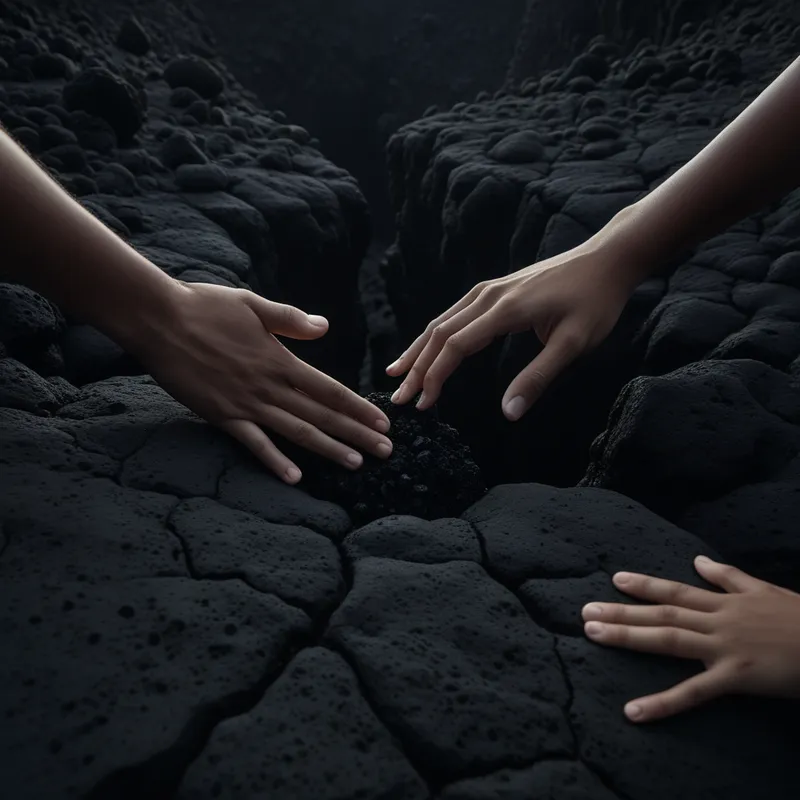
But the order of the world, upheld by the akua, was strict. A princess of such high lineage could not marry a common fisherman. Desperate and heartbroken, they sought counsel from a kahuna at a temple. The priest, bound by the sacred laws, could offer no blessing. In their anguish, Naupaka and Kaui turned their prayers to the gods themselves. Naupaka, taking a beautiful white flower from her hair, tore it in half. She gave one piece to Kaui. “Take this,” she whispered, her voice trembling like a leaf. “As we are now, so shall this flower be. We are of one heart, but we cannot be whole in this world.”
With a grief that shook the very foundations of the land, she ascended to her misty peaks. He, with a sorrow as heavy as a stone anchor, returned to his endless shore. The gods, witnessing this profound and pure love, were moved. But the law was the law. In a gesture of both compassion and eternal decree, they transformed the lovers. Naupaka became the mountain Naupaka plant, her flowers blooming only as delicate half-blooms. Kaui became the beach Naupaka, his flowers mirroring hers perfectly on the warm sand. Forever separated by the realm they called home, they forever yearn across the distance, two halves of a single, perfect bloom.
Cultural Origins & Context
This poignant narrative is rooted in the Kumulipo, the understanding that all life is interconnected. It is an moʻolelo passed down through generations, not merely as a tragic romance, but as an etiological myth that explains the unique morphology of the Naupaka plant (Scaevola), which appears to bloom only half a flower. Storytellers, or kūpuna, would recount this tale to impart lessons about social structure, the kapu (sacred law) system, and the consequences of transgressing societal boundaries for love. It served as a poetic reminder of the natural order (pono) and the deep, sometimes painful, connections between all parts of the ecosystem—the uplands and the shore, the noble and the common, the human and the botanical.
Symbolic Architecture
At its [heart](/symbols/heart “Symbol: The heart symbolizes love, emotion, and the core of one’s existence, representing deep connections with others and self.”/), the myth is a profound [meditation](/symbols/meditation “Symbol: Meditation represents introspection, mental clarity, and the pursuit of inner peace, often providing a pathway for deeper self-awareness and spiritual growth.”/) on the [archetype](/symbols/archetype “Symbol: A universal, primordial pattern or prototype in the collective unconscious that shapes human experience, behavior, and creative expression.”/) of the split whole. The Naupaka flower is not two different flowers; it is one flower manifesting in two separate, complementary forms. This speaks to a fundamental psychological and cosmic [truth](/symbols/truth “Symbol: Truth represents authenticity, honesty, and the quest for knowledge beyond mere appearances.”/).
Separation is not the absence of connection, but its most poignant and definitive shape.
The [mountain](/symbols/mountain “Symbol: Mountains often symbolize challenges, aspirations, and the journey toward self-discovery and enlightenment.”/) represents the [spirit](/symbols/spirit “Symbol: Spirit symbolizes the essence of life, vitality, and the spiritual journey of the individual.”/), the lofty ideals, the [realm](/symbols/realm “Symbol: The symbol of ‘Realm’ often signifies the boundaries of one’s consciousness, experiences, or emotional states, suggesting aspects of reality that are either explored or ignored.”/) of tradition and [lineage](/symbols/lineage “Symbol: Represents ancestral heritage, family connections, and the transmission of traits, values, and responsibilities across generations.”/) (Naupaka). The shore represents the [body](/symbols/body “Symbol: The body in dreams often symbolizes the dreamer’s self-identity, personal health, and the relationship they have with their physical existence.”/), the practical, the [realm](/symbols/realm “Symbol: The symbol of ‘Realm’ often signifies the boundaries of one’s consciousness, experiences, or emotional states, suggesting aspects of reality that are either explored or ignored.”/) of sustenance and immediacy (Kaui). Their love is the yearning of these two aspects of the self to unite. The gods’ “[curse](/symbols/curse “Symbol: A supernatural invocation of harm or misfortune, often representing deep-seated fears, guilt, or perceived external malevolence.”/)” is, symbolically, the [reality](/symbols/reality “Symbol: Reality signifies the state of existence and perception, often reflecting one’s understanding of truth and life experiences.”/) of incarnation—the [soul](/symbols/soul “Symbol: The soul represents the essence of a person, encompassing their spirit, identity, and connection to the universe.”/) (mountain) is forever separated from its pure essence by its embodiment in the [material](/symbols/material “Symbol: Material signifies the tangible aspects of life, often representing physical resources, desires, and the physical world’s influence on our existence.”/) world (shore), yet they remain aspects of the same being. The torn flower is the [symbol](/symbols/symbol “Symbol: A symbol can represent an idea, concept, or belief, serving as a powerful tool for communication and understanding.”/) of this primordial wound of existence, a wound that is also the [source](/symbols/source “Symbol: The origin point of something, often representing beginnings, nourishment, or the fundamental cause behind phenomena.”/) of all longing, creativity, and the search for meaning.
The Dreamer’s Resonance
When this myth surfaces in modern dreams, it rarely appears as a literal retelling. Instead, the dreamer may experience powerful somatic and emotional states of irreconcilable longing. One might dream of a beloved person standing across an uncrossable divide—a canyon, a raging river, a pane of unbreakable glass. There is profound recognition and love, but an immutable law (social, psychological, or metaphysical) prevents union.
This dream pattern often emerges during life transitions where two core identities or life paths are in conflict: career vs. family, duty vs. desire, the person you are expected to be vs. the person you feel you are. The dream is the psyche’s way of holding the tension of the opposites. It does not offer a solution, but it makes the conflict sacred and beautiful, transforming it from a mere problem into a mythic dilemma. The somatic feeling is one of a deep, aching pull in the chest—the heart, like the flower, feeling split.

Alchemical Translation
The individuation process, the journey toward psychological wholeness, is not about erasing the split but about consciously relating to it. The Legend of Naupaka models this alchemical work. The first step is the recognition of the split—the painful, tearful acknowledgment that parts of us feel eternally separate (mountain and shore). The second is the sacred offering—Naupaka tearing the flower. This is the conscious act of sacrificing the fantasy of easy wholeness, accepting the reality of our internal divisions.
The transmutation occurs not in union, but in the steadfast, conscious maintenance of the connection across the divide.
The final, transcendent stage is the mythic transformation. The lovers do not die; they become enduring symbols. Psychologically, this means the conflicting parts are not eliminated or forced together. Instead, they are elevated into permanent, complementary archetypal forces within the personality. The mountain-self and the shore-self cease to war; they learn to communicate across the internal landscape. One tends to the heights of spirit and aspiration, the other to the grounded realities of daily life. The individual who integrates this myth learns to hold their own contradictions, to see the half-flower not as broken, but as a complete expression of a beautiful, necessary duality. Wholeness, in this alchemy, is the relationship between the halves, not their merger.
Associated Symbols
Explore related symbols from the CaleaDream lexicon:
- Flower — The Naupaka blossom itself, representing perfect beauty forever split, the physical manifestation of a love and a self that is whole in essence but divided in form.
- Mountain — The realm of Naupaka, symbolizing tradition, lineage, the lofty spirit, ascension, and the cool, misty heights of ideals and societal structure.
- Ocean — The realm of Kaui, representing the emotional depths, the unconscious, the practical world of sustenance, fluidity, and the warm immediacy of embodied life.
- Separation — The core wound and central dynamic of the myth, representing the inevitable divides imposed by law, nature, society, and the very condition of individual consciousness.
- Love — Not as a unifying force, but as the enduring connection that persists across an unbridgeable gap, the ache that proves the existence of the whole.
- Sacrifice — The conscious tearing of the flower, representing the necessary surrender of the ego’s demand for perfect, unobstructed union in favor of a higher, more painful truth.
- Heart — The organ of feeling that is metaphorically split, representing the central conflict between deep emotional longing and the immutable realities that constrain it.
- Goddess — Referencing Pele and the divine feminine authority that upholds the natural and social order, whose laws, though harsh, frame the sacred tragedy.
- Shadow — The unrecognized or rejected aspect; the mountain princess contains her shadow of common, earthly love, while the fisherman holds the shadow of noble aspiration.
- Dream — The state where the longing of the separated halves is most keenly felt, and where the mythic truth of their connection is revealed beyond waking logic.