
The Legend of Arang Myth Meaning & Symbolism
The ghost of a murdered maiden haunts a magistrate until a virtuous official uncovers her truth, transforming rage into justice and restless spirit into peace.
The Tale of The Legend of Arang
Listen, and hear the wind that whispers through the bamboo groves of Miryang. It carries not just the scent of pine and night dew, but a story—a story of silk torn, innocence betrayed, and a silence that grew teeth.
In the time of the Joseon Dynasty, there lived a magistrate, a man entrusted with the order of the land. He had a daughter, Arang, whose beauty was said to rival the moon on still water. But her true beauty was her spirit, kind and bright. A servant in their household, a man whose heart was a nest of shadows, coveted her. When she refused his advances, his desire curdled into a venomous rage. In the deep of night, within the very walls meant to protect her, he dragged her to a secluded bamboo forest. There, beneath a cold and indifferent sky, he murdered her and fled, leaving her pale form among the rustling leaves.
But a soul severed so violently does not simply depart. Arang’s spirit remained, bound to the site of her betrayal. Her pure white hanbok became her shroud, her long black hair a veil over a face now etched with eternal sorrow and a fury as cold as the grave. She became a Gwishin, a restless ghost. And she turned her haunting not upon the world, but upon the very office that failed her: the magistracy. One by one, newly appointed magistrates of Miryang would meet her. On the road to their post, a spectral figure would appear. “Look upon my face,” her voice would echo, a sound like frozen silk. Those who looked would die of terror on the spot, their hearts stilled by the injustice they witnessed.
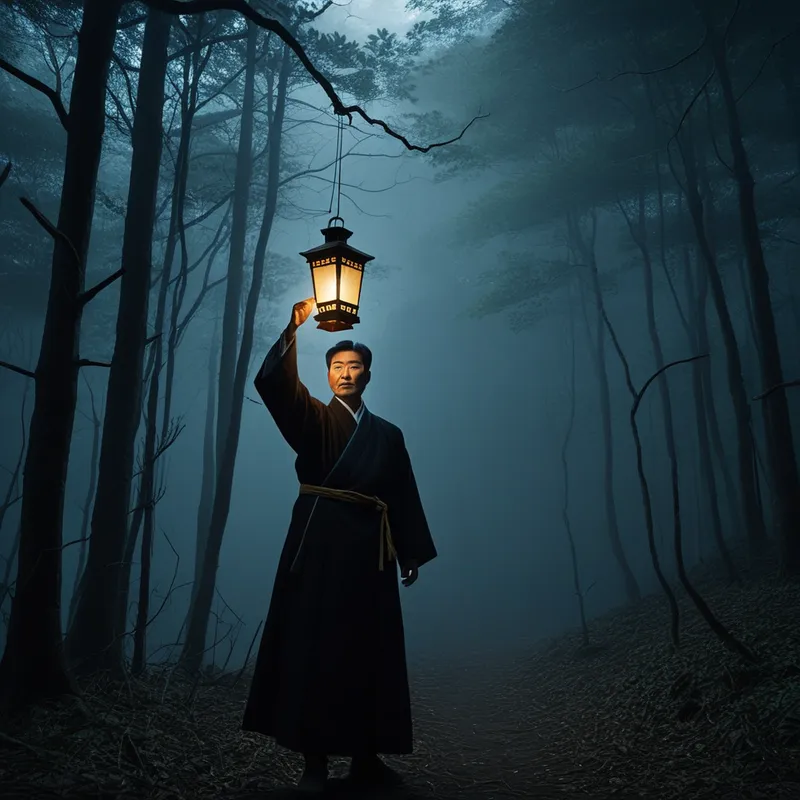
For years, the post of Miryang magistrate became a death sentence, a cursed office shrouded in fear. The community lived under a pall, the unavenged crime poisoning the very air. Until a man named Kim arrived. He was a magistrate of renowned integrity and courage. Hearing the legend, he did not flee. He walked deliberately toward his duty. On that fateful path, she appeared—the luminous, terrifying form of Arang. “Look upon my face,” she intoned.
But Kim, steadying his own trembling spirit, replied with profound respect, “Honorable spirit, I cannot look upon your face without reason. But if you have a grievance, tell me. I am the magistrate. It is my duty to listen.”
In that moment, the cycle of blind terror broke. The ghost’s posture shifted from menace to profound grief. She told him her story—her name, her father’s position, the servant’s crime, the location of her forsaken body. “Bring my murderer to justice,” she pleaded, “and I will trouble this world no more.” With a clue—a token left by the killer—Kim began his investigation. He pursued the truth with the diligence of a scholar and the resolve of a warrior, following the thread of evidence until the guilty servant was uncovered and faced the law.
As justice was served, a profound change swept over Miryang. The oppressive chill lifted. Where Arang’s body was finally given proper rites, it is said a pure, white magnolia tree bloomed overnight, a symbol of restored innocence and peace. The haunting ceased. Magistrate Kim had not conquered a monster; he had listened to a wound, and in doing so, healed a rupture in the world.
Cultural Origins & Context
The Legend of Arang is rooted in the Joseon Dynasty’s complex social fabric, where Confucian ideals of order, filial piety, and bureaucratic justice were paramount. It belongs to a rich genre of Korean ghost stories, or yojeon, often told orally, especially by women, in the intimate spaces of the home or the communal space of the village. These stories were not mere entertainment; they were a vital social and psychological safety valve.
In a rigid, patriarchal hierarchy, the story of Arang gave voice to the silenced. Young women, whose fates were often decided by men, found in Arang a powerful, if tragic, avatar of resistance. The tale functioned as a stark warning to those in power—magistrates, fathers, masters—about the catastrophic consequences of failing in their duty of protection. Furthermore, it served as a folk mechanism for enforcing social justice. When the official system was perceived as corrupt or inaccessible, folklore created a supernatural arbiter: a ghost who would literally kill incompetent officials until a righteous one appeared. The myth thus reinforced the Confucian ideal of the virtuous scholar-official while critiquing its all-too-frequent failures.
Symbolic Architecture
At its core, Arang’s legend is a profound map of psychological [trauma](/symbols/trauma “Symbol: A deeply distressing or disturbing experience that overwhelms the psyche, often manifesting in dreams as unresolved emotional wounds or psychological injury.”/) and its necessary [resolution](/symbols/resolution “Symbol: In arts and music, resolution refers to the movement from dissonance to consonance, creating a sense of completion, release, or finality in a composition.”/). Arang is not merely a ghost; she is the [Shadow](/symbols/shadow “Symbol: The ‘shadow’ embodies the unconscious, repressed aspects of the self and often represents fears or hidden emotions.”/) of the [community](/symbols/community “Symbol: Community in dreams symbolizes connection, support, and the need for belonging.”/) itself—the murdered [innocence](/symbols/innocence “Symbol: A state of purity, naivety, and freedom from guilt or corruption, often associated with childhood and moral simplicity.”/), the buried secret, the rage that cannot be spoken. Her repeated demand, “Look upon my face,” is the [trauma](/symbols/trauma “Symbol: A deeply distressing or disturbing experience that overwhelms the psyche, often manifesting in dreams as unresolved emotional wounds or psychological injury.”/)’s cry for witness.
The unseen wound does not fade; it festers and haunts. Justice is not merely punishment, but the act of seeing the wound fully and calling it by its true name.
The murder in the [Forest](/symbols/forest “Symbol: The forest symbolizes a complex domain of the unconscious mind, representing both mystery and potential for personal growth.”/) represents the violent thrusting of a personal tragedy into the [realm](/symbols/realm “Symbol: The symbol of ‘Realm’ often signifies the boundaries of one’s consciousness, experiences, or emotional states, suggesting aspects of reality that are either explored or ignored.”/) of the wild, unconscious, and untamed. The successive magistrates who die represent the ego’s initial, failed attempts to confront raw trauma with unprepared [consciousness](/symbols/consciousness “Symbol: Consciousness represents the state of awareness and perception, encompassing thoughts, feelings, and experiences.”/)—they “look” and are annihilated by its [horror](/symbols/horror “Symbol: Horror in dreams often symbolizes deep-seated fears, anxieties, and unresolved conflicts that the dreamer faces in waking life.”/). Magistrate Kim embodies a new kind of consciousness. He does not look blindly (identify with the trauma), nor does he look away (repress it). He listens. He engages with respect and the intent to restore order. His investigation is the conscious mind diligently reconstructing the narrative of the shattered self. The final resting place, marked by the magnolia, symbolizes the [transmutation](/symbols/transmutation “Symbol: A profound, alchemical process of fundamental change where one substance or state transforms into another, often representing spiritual evolution or personal metamorphosis.”/) of pain into something beautiful and enduring: [memory](/symbols/memory “Symbol: Memory symbolizes the past, lessons learned, and the narratives we construct about our identities.”/) integrated, not forgotten.
The Dreamer’s Resonance
When this myth pattern stirs in the modern Dream, it often signals a profound encounter with a personal or ancestral Wound that demands acknowledgment. To dream of a relentless, sorrowful female figure may point to repressed grief, betrayed trust, or a sense of injustice that has been “buried” in the psyche’s bamboo forest.
The somatic experience can be one of a chilling presence, a weight on the chest, or a feeling of being pursued by an unspeakable sadness. The dreamer may find themselves in the role of the fleeing magistrates, terrified of confronting the source. The turning point comes when the dream ego, like Kim, finds the courage to stop and ask, “What do you need to tell me?” This marks the beginning of moving from being haunted by a memory to holding it. The ghost in the dream is not an external entity but the dreamer’s own split-off affect—the rage, shame, and sorrow of a past self—seeking reintegration.

Alchemical Translation
The alchemical journey of the Arang myth is a perfect model for individuation in the face of deep trauma. The process begins with the nigredo, the blackening: the murder itself, the brutal dissolution of innocence and trust, leaving behind the “black” rage of the ghost.
The spirit does not seek vengeance, but validation. Its peace is not found in another’s suffering, but in the restoration of its story to the ledger of truth.
Magistrate Kim’s investigation represents the albedo, the whitening. This is the careful, conscious work of analysis, therapy, or sincere introspection—gathering the fragments of the story, following the clues of triggers and patterns (the servant’s token), and bringing the facts into the light of awareness. Confronting the perpetrator (the shadow aspect of the self that committed the inner betrayal, or the external source of harm) is the necessary separatio, dividing the poison from the psyche.
The final stage, the rubedo or reddening, is not a return to the original state, but a transcendent synthesis. It is the blooming of the magnolia from the grave. The traumatic energy is not erased; it is transmuted. The rage becomes the fuel for boundaries, the sorrow becomes depth of compassion, and the silenced voice becomes a testament to resilience. The individual is no longer a haunted house, but a sacred grove where a beautiful tree grows from remembered pain. They become their own virtuous magistrate, capable of holding justice for their own inner world.
Associated Symbols
Explore related symbols from the CaleaDream lexicon:
- Forest — The dark, unconscious realm where trauma is buried and hidden, a place of both danger and the potential for profound discovery.
- Ghost — The unresolved past, a memory or emotion that remains energetically present and demands acknowledgment to find peace.
- Justice — The deep psychic need for balance and moral order, the restoration of truth that allows fragmented parts of the self to integrate.
- Wound — The core injury to innocence or trust that, if left unseen, becomes a source of chronic haunting and dysfunction.
- Mirror — The moment of confrontation where one is asked to “look upon” the reflected truth of one’s pain or injustice, a test of consciousness.
- Door — The threshold to the haunted space of memory; crossing it with respect, as Magistrate Kim did, is the first step in healing.
- Ritual — The act of proper burial and remembrance, symbolizing the conscious, respectful practices that help transmute trauma into integrated memory.
- Healing — The ultimate goal of the mythic journey, represented by the blooming magnolia—a peace that incorporates, rather than erases, the past.
- Shadow — The murderer within the household, representing the repressed, violent, or selfish potentials that can betray the innocent self.
- Grief — The primary substance of the ghost, the frozen emotion that must be thawed by witness and given its rightful expression.
- Truth — The hidden narrative that, when uncovered and spoken, holds the power to break curses and restore psychic order.
- Journey — The magistrate’s path, both physical and investigative, representing the dedicated, often frightening inner work required to resolve deep trauma.